Druk Path Trek, Bhutan: From Nepal to Paro and Thimphu

11 Days

The Druk Path is Bhutan's classic high-altitude trek. In 5 days on foot you cross the ridges between the Paro and Thimphu valleys, camp beside yak pastures and high lakes (up to 4,110 m), and walk past ruined fortresses and Phajoding Monastery. Our 11-day trip adds the Tiger's Nest hike to help you acclimatise, and sightseeing in Paro, Thimphu and Punakha. The price is USD 5,120 per person and includes flights from Kathmandu, the Bhutan visa, the Sustainable Development Fee, all meals, camping, ponies and a guide.

Key facts

ItemDetails
Duration11 days (5 trek days, 4 nights in tents)
PriceUSD 5,120 per person
GroupPrivate and tailor-made. Up to 12 guests.
RouteParo to Thimphu, via Jele Dzong, Jangchulakha, Jimilangtso, Simkotra Tsho and Phajoding
Trek distanceAbout 50 to 55 km
Walking per dayAbout 4 to 7 hours
Highest camp / highest pointSimkotra Tsho, about 4,110 m / Phume La, about 4,210 m
DifficultyModerate. Altitude is the challenge.
AccommodationHotels in Paro, Thimphu and Punakha (twin-sharing). Tents on the trek.
Best seasonMarch to May and September to November
Starts / endsFly Kathmandu to Paro (Day 1). Fly Paro to Kathmandu (Day 11).
IncludedFlights, Bhutan visa, SDF, all meals, camping, ponies, guide, transfers, entrance fees, taxes
Payment20% deposit, balance in cash in Kathmandu or by bank transfer 4 weeks before

The Druk Path Trek at a glance

The Druk Path follows an old route that monks and traders used between Paro and Thimphu. It is a good first Himalayan trek in Bhutan: the days are short compared with other treks, there is no technical climbing, and the scenery changes every day, from forest to ridge, high lakes and pastures. The trek is also remote, with no villages on the way, so you camp, and your ponies carry everything but your daypack.

Druk path trek brief itinerary

Day 1: Fly Kathmandu to Paro, sightseeing (2,200 m)
Day 2: Tiger's Nest hike, 5 to 6 h (3,120 m)
Day 3: Trek to Jele Dzong, about 4 h (3,500 m)
Day 4: Trek to Jangchulakha, 4 to 5 h (3,770 m)
Day 5: Trek to Jimilangtso lake, 4 to 6 h (3,870 m)
Day 6: Trek to Simkotra Tsho, about 4 h (4,110 m)
Day 7: Phume La (4,210 m), Phajoding, down to Thimphu, 6 to 7 h
Day 8: Thimphu sightseeing
Day 9: Drive over Dochula Pass to Punakha
Day 10: Drive to Paro
Day 11: Fly Paro to Kathmandu
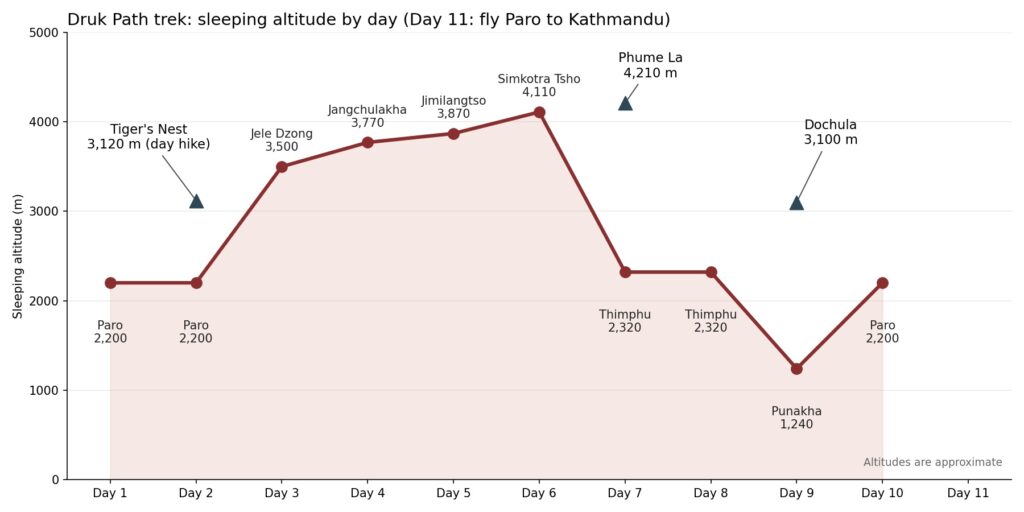
[caption id="attachment_30131" align="alignnone" width="910"]Altitude profile of the 11-day Druk Path trek in Bhutan from Paro to Thimphu, with camps up to 4,110 m Day-by-day sleeping altitude and the highest points. Altitudes are approximate.[/caption]

Highlights

  • Tiger's Nest (Taktsang) Monastery, on a cliff about 900 m above Paro valley
  • Jele Dzong, a ruined hilltop fortress with views over Paro
  • High lakes and yak pastures at Jimilangtso and Simkotra Tsho
  • Mount Chomolhari (7,326 m) and other peaks, on clear days
  • Phajoding Monastery, a hermitage above Thimphu
  • Dochula Pass and Punakha Dzong, with 108 chortens and one of Bhutan's most beautiful fortresses
  • A fully supported trip: your bags are carried, and meals, hotels, flights and visa are all arranged

Who is this trek for?

  • Good for: walkers who are reasonably fit and want a first Himalayan trek, couples and small groups, and travellers who want culture (dzongs, monasteries) as well as mountains
  • Think again if: you have heart or lung problems, you have had serious altitude sickness before (ask your doctor first), or you cannot walk 4 to 7 hours a day with a daypack
  • Not for: travellers who want hotels every night, because 4 nights are in tents at 3,500 to 4,110 m

Why book with Mosaic Adventure?

  • We are a Nepal-registered company based in Kathmandu, and the trip runs with licensed Bhutanese guides and operator
  • One price covers flights from Kathmandu, visa, SDF, hotels, camping, ponies, meals and entrance fees
  • Private, tailor-made trips on the dates you choose, in season
  • A WhatsApp number you can message before you book: +977 982 381 6556
Included

  • Flights: Kathmandu to Paro and Paro to Kathmandu
  • Bhutan visa fee
  • Bhutan Sustainable Development Fee (SDF), about USD 1,000 for the 10 nights
  • All meals
  • Hotels in Paro, Thimphu and Punakha, twin sharing
  • Tents on the trek
  • Ponies to carry bags and camping gear
  • All transfers and sightseeing transport
  • Government royalty and taxes
  • Entrance fees
  • English-speaking Bhutanese guide

Non Included

  • Travel insurance (required)
  • Tips for guide, driver and crew
  • Soft drinks, bottled water and other drinks
  • Personal expenses and shopping
  • Personal trekking gear
  • Extra services you ask for
  • Costs from events outside our control, such as flight changes caused by weather or strikes

Druk Path Trek Itinerary: Day by Day

  • Day
    01

    Fly from Kathmandu to Paro

    You fly from Kathmandu to Paro, a flight of about 1 hour. On a clear day you may see Everest and Kanchenjunga from the plane. Paro airport is in a deep valley at about 2,200 m, so the landing is a highlight in itself. Your Bhutanese guide meets you, and in the afternoon you visit Drukgyal Dzong (a ruined fortress) and Kichu Lhakhang, one of Bhutan's oldest temples.

    • Flight: Kathmandu to Paro, about 1 hour
    • Sleep: hotel in Paro, about 2,200 m

  • Day
    02

    Paro valley and the Tiger's Nest hike

    This is your acclimatization day. You hike up to Taktsang Monastery (Tiger's Nest), which clings to a cliff about 900 m above the valley floor at about 3,120 m. The round trip takes 5 to 6 hours, and the climb is a good test of your fitness before the trek. In the afternoon, if you have energy, you visit the National Museum in Ta Dzong and Rinpung Dzong.

    • Walking: 5 to 6 hours round trip
    • Sleep: hotel in Paro, about 2,200 m

  • Day
    03

    Trek to Jele Dzong

    After breakfast you drive for a short time to the trailhead above Ta Dzong, and then you climb through forest to Jele La (about 3,400 m) and on to Jele Dzong, a ruined hilltop fortress at about 3,500 m. The ponies carry your bags, and you carry only a daypack. This is the biggest climb of the trek (about 950 m), so walk slowly and drink plenty of water.

    • Walking: about 4 hours, 7 to 10 km, about 950 m up
    • Sleep: tent, Jele Dzong, about 3,500 m

  • Day
    04

    Jele Dzong to Jangchulakha

    You follow a ridge path through alpine forest of rhododendron, juniper and fir to the camp at Jangchulakha. On a clear day you see Mount Chomolhari (7,326 m) and other Himalayan peaks. You may see yaks grazing near the camp.

    • Walking: about 4 to 5 hours, about 10 km
    • Sleep: tent, Jangchulakha, about 3,770 m

  • Day
    05

    Jangchulakha to Jimilangtso

    The trail runs along a ridge with open views, then drops to Jimilangtso, a lake by the camp. The area is yak pasture, and you may meet the herders who live there in the warm months.

    • Walking: about 4 to 6 hours, about 11 km
    • Sleep: tent, Jimilangtso lake, about 3,870 m

  • Day
    06

    Jimilangtso to Simkotra Tsho

    You walk past yak herders' camps and a series of high lakes to Simkotra Tsho, the highest camp of the trek. The air is thin and the nights are cold. The camp is a good place to watch the sunset and, on a clear night, the stars.

    • Walking: about 4 hours, about 11 km
    • Sleep: tent, Simkotra Tsho, about 4,110 m (highest camp)

  • Day
    07

    Over Phume La, Phajoding Monastery and down to Thimphu

    This is the longest day. You climb to Phume La (about 4,210 m), the highest point of the trek, and then descend to Phajoding Monastery (about 3,750 m), where monks and hermits have meditated for centuries. From here a steep descent of more than 1,000 m takes you to Motithang above Thimphu, where you may visit the takin preserve (takin is the national animal of Bhutan). A vehicle takes you to your hotel. A hot shower and a bed at the end of the day feel very good.

    • Walking: about 6 to 7 hours, about 15 km, about 1,100 m or more down
    • Sleep: hotel in Thimphu, about 2,320 m

  • Day
    08

    Thimphu sightseeing

    A rest day in Bhutan's capital. You visit the National Memorial Chorten, Dupthob Lhakhang and Tashichho Dzong, and you can walk through the weekend market (on Saturday and Sunday) and the craft shops.

    • Sleep: hotel in Thimphu, about 2,320 m

  • Day
    09

    Drive over Dochula Pass to Punakha

    You drive east over Dochula Pass (about 3,100 m), where 108 chortens stand on the ridge and, on a clear day, you see the Himalayan range. You then descend to the warm Punakha valley (about 1,240 m), and visit Punakha Dzong, at the meeting of two rivers, and Chime Lhakhang, the fertility temple.

    • Drive: about 3 hours
    • Sleep: hotel in Punakha, about 1,240 m

  • Day
    10

    Drive from Punakha to Paro

    You drive back over Dochula Pass through Thimphu to Paro. The afternoon is free for shopping or a last walk in the valley.

    • Drive: about 5 hours
    • Sleep: hotel in Paro, about 2,200 m

  • Day
    11

    Fly from Paro to Kathmandu

    A transfer takes you to Paro airport for your flight to Kathmandu, and our team is there to meet you.

    • Flight: Paro to Kathmandu, about 1 hour

Druk Path Trek: Frequently Asked Questions

Price and booking

How much is the Druk Path trek in Bhutan?

USD 5,120 per person for 11 days. The price includes flights between Kathmandu and Paro, the Bhutan visa fee, the Sustainable Development Fee (SDF), all meals, hotels in the cities, tents on the trek, ponies for your bags, transfers, government taxes, entrance fees and an English-speaking guide.

Is the Bhutan Sustainable Development Fee (SDF) included?

Yes. The SDF is a government fee, currently USD 100 per adult per night for most visitors. We include it in the price, so you pay no separate fee in Bhutan. The Royal Government of Bhutan sets the fee, so check bhutan.travel for the latest rate if you plan to extend your stay.

How do I pay?

You pay a 20% deposit (USD 1,024) to book. You pay the balance of USD 4,096 in cash (US dollars) in Kathmandu before the trip, or by bank transfer at least 4 weeks before the trip.

Can I book for one person, a couple or a group?

Yes. The trek is private and tailor-made, and it can take up to 12 guests. Tell us your dates and group size when you contact us.

Do I need a visa for Bhutan?

Yes. Visitors from most countries need a Bhutan visa (USD 40), which we apply for and include in the price. We need your passport details and a copy of the passport page in advance, and the visa has to be approved before you fly. Citizens of India, Bangladesh and the Maldives follow different rules, so ask us.

The trek

How hard is the Druk Path trek?

It is moderate. You walk 4 to 7 hours a day for 5 days, with a steep first climb of about 950 m on Day 3 and a long descent on Day 7. The challenge is the altitude, not technical ground. You camp as high as 4,110 m and cross a pass of about 4,210 m, so good fitness and a slow pace matter.

How long is the Druk Path trek?

The trek is 5 days on the trail, about 50 to 55 km in total, from Paro to Thimphu. The whole trip is 11 days with the sightseeing in Paro, Thimphu and Punakha.

What is the highest altitude on the Druk Path trek?

The highest camp is Simkotra Tsho at about 4,110 m, and the highest point is Phume La at about 4,210 m on Day 7. Sources differ by up to 100 m for some camps.

Where do we sleep on the trek?

You sleep in tents on the 4 trek nights (at Jele Dzong, Jangchulakha, Jimilangtso and Simkotra Tsho), and in hotels in Paro, Thimphu and Punakha for the other nights. Ponies carry your bags and the camping gear, and you carry only a daypack.

When is the best time for the Druk Path trek?

March to May and September to November. Spring has rhododendron flowers, and autumn has the clearest mountain views. The monsoon (June to August) is best avoided because of rain, mud and cloud, but we can arrange a trip if you want. Winter (December to February) is cold and can have snow at the high camps, so it is harder but possible with proper preparation.

Health, safety and planning

Is there a risk of altitude sickness on the Druk Path trek?

Yes. You sleep at 3,500 to 4,110 m. The Tiger's Nest hike on Day 2 helps you acclimatise, and your guide watches you every day. Tell your guide at once if you have a headache, nausea, dizziness or trouble sleeping, and do not climb higher with symptoms. If symptoms get worse, you must go down. Talk to your doctor before the trip if you have heart or lung problems or have had altitude sickness before. This page is not medical advice.

Do I need travel insurance?

Yes. Insurance is not included. Your policy must cover trekking to at least 4,500 m and medical care, with emergency evacuation. The route is remote, so a rescue from the trail can take many hours.

How do I get to Bhutan from Nepal?

You fly from Kathmandu to Paro, a flight of about 1 hour, and we include the return flights in the price. Paro is Bhutan's only international airport.

What should I bring?

Warm layers, a waterproof jacket and trousers, trekking boots that are already broken in, a warm sleeping bag, a warm hat and gloves, sunscreen, a headtorch, trekking poles and your personal medicines. See the full list in the trip information.

Druk Path Trek Route Map

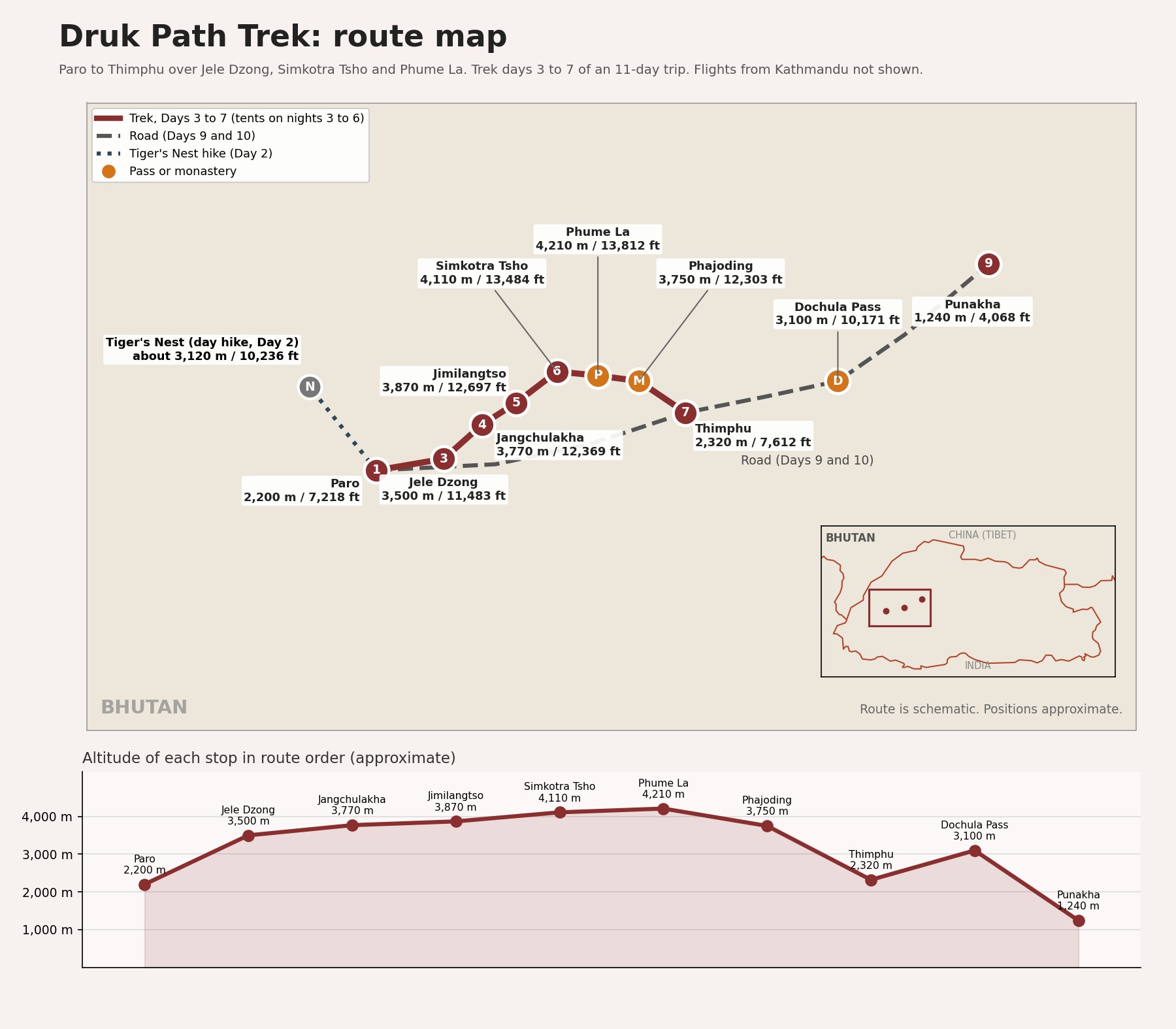
Route map of the Druk Path trek in Bhutan from Paro over Jele Dzong, Simkotra Tsho and Phume La to Thimphu, with Punakha and an altitude strip

Before You Go: Season, Altitude, Visa and Gear

Best time to trek

MonthsConditionsNotes
March to MayRhododendrons flower. Days are mild, nights are cold, and there can be some snow at high camps.Good season
September to NovemberClear views, dry days. Cold nights at the high camps (near 0°C).Good season. October and November have the best mountain views.
June to AugustMonsoon: rain, mud, leeches and cloud.Best avoided. We can arrange it if you want.
December to FebruaryCold, with snow at high camps.Harder, but possible with proper preparation (warm sleeping bag, good gear).

Altitude and health

You sleep between 3,500 and 4,110 m, and Day 3 has a climb of about 950 m from the Paro valley. The Tiger's Nest hike on Day 2 helps your body adapt, and your guide checks how you feel every day.

  • Walk slowly, drink plenty of water and eat well.
  • Tell your guide at once about a headache, nausea, dizziness, or poor sleep. Do not go higher with symptoms. If they get worse, you must go down.
  • Ask your doctor about altitude medicine and your own health before you book, especially with heart, lung or blood pressure conditions, or if you are pregnant. This page is not medical advice.
  • The route is remote, so a rescue from the trail can take many hours. Travel insurance that covers trekking to at least 4,500 m and emergency evacuation is required.

Visa, entry and the SDF

  • Visa: most visitors need a Bhutan visa (USD 40). We apply for it and include the fee. Send us your passport details and a passport copy well before the trip. Passports should be valid for at least 6 months.
  • SDF: the Sustainable Development Fee is a government fee, currently USD 100 per adult per night for most visitors (children aged 6 to 11 pay half, and children under 6 pay nothing). It is included in the price. The Royal Government of Bhutan sets the rate, so check bhutan.travel for the latest.
  • Other nationalities: Indian, Bangladeshi and Maldivian citizens follow different rules and fees. Ask us.
  • Guide: visitors travel with a licensed Bhutanese guide. Our trip runs with licensed Bhutanese guides and operator.

What to bring

  • Trekking boots that you have already worn, and warm socks
  • Layers: base layer, fleece, down jacket, waterproof jacket and trousers
  • Warm hat, gloves, sun hat, sunglasses and sunscreen
  • A warm sleeping bag (comfort rating about -5°C), and a sleeping bag liner
  • Headtorch, trekking poles, a daypack of 25 to 30 litres and a water bottle
  • Personal medicines, blister kit and wet wipes
  • A small amount of cash for tips and drinks

Getting there

You fly from Kathmandu to Paro on Day 1 and back on Day 11. The flights are included, and the flight takes about 1 hour. Paro is Bhutan's only international airport.

Last updated: November 2026. Fees and rules are set by the Royal Government of Bhutan and can change.