Gokyo Lakes Trek

15 Days
Join Mosaic Adventure for an incredible journey on the Gokyo Lakes Trek in the Himalayas! Witness breathtaking mountains and the massive Ngozumpa Glacier. Enjoy views of famous Himalayan peaks such as Everest and Cho Oyu from Gokyo Ri. Immerse yourself in Sherpa culture, prayer flags and peaceful lakes. Book now for an unforgettable experience!

Gokyo Lakes Trek: Key Facts

Duration15 days, including 10 days on the trail
Trip typePrivate teahouse trek. No group joining.
Group sizeMinimum 2 people. Larger groups of your own are welcome.
Start dateAny date you choose
RouteKathmandu, Lukla, Phakding, Namche Bazaar, Phortse Thanga, Machherma, Gokyo, Dole, Namche Bazaar, Lukla, Kathmandu
Highest pointGokyo Ri, 5,360 m / 17,585 ft (Day 9)
Highest overnightGokyo, 4,790 m / 15,715 ft
DifficultyModerate to difficult. 3.5 to 8 hours of walking a day. Good fitness and a steady pace are needed.
Mountain viewsEverest, Lhotse, Makalu, Cho Oyu and Gyachung Kang from Gokyo Ri
Does it reach Everest Base Camp?No. This trek goes up the Gokyo Valley instead and does not visit Base Camp.
Accommodation3-star hotel in Kathmandu. Teahouses on the trek.
MealsBreakfast, lunch and dinner on the trek. Breakfast only in Kathmandu.
FlightsKathmandu to Lukla and back. Depending on airport traffic, the flight leaves from Kathmandu or from Ramechhap.
Guide and portersEnglish-speaking guide and porters, with wages and insurance included
PermitsTrekking area permits included
Gear includedSleeping bag, down jacket and duffel bag on request
Best seasonMarch to mid-June and September to early December
PriceFrom USD 1,410 per person

Overview

Gokyo Lakes Trek rewards you with beautiful views of the mountain peaks and the Ngozumpa Glacier- one of the largest in the world.

Gokyo Lakes Trek also guarantees the most remarkable views of some of the infamous “eight-thousanders” including Everest, Cho Oyu, Makalu, Lhotse, which are clearly visible from Gokyo Ri (5360 meters / 17585 feet).

An unforgettable moment on this Gokyo Lakes Trek route is the view of the spectacular ice point between Cho Oyu (8201m) and Gyachung Kang (7952m) in the Khumbu region.

Hiding high up in the mighty Himalayas, there is a system of fresh water lakes known as the Gokyo lakes, they are immensely sacred and hold important significance in the Hindu and Buddhist religions.

This trek starts with a breath taking flight between the mountains to Tenzing/Hillary airport at Lukla and then follows the Everest Base Camp Trek route for some time before leaving the other trekkers behind and heading out to the Gokyo Valley.

There are many challenging aspects to this route as we walk through Sherpa land where the Buddhist religion dominates, Buddhist prayer flags adorn huge suspension bridges and we will pass mani stone walls and chortens, Buddhist memorial sites, as we go.

We aspire to reach Gokyo Ri and the world’s highest fresh water lake system, an amazing route in a beautiful region where the hustle and bustle of modern society is nowhere to be seen.

Gokyo Lakes Trek Itinerary

Day 1: Arrive in Kathmandu (1,345 m / 4,412 ft) and transfer to your hotel.
Day 2: Pre-trek meeting and Kathmandu Valley sightseeing.
Day 3: Fly to Lukla (2,840 m / 9,320 ft), trek to Phakding (2,610 m / 8,563 ft).
Day 4: Trek to Namche Bazaar (3,440 m / 11,286 ft).
Day 5: Mountain View Hotel (3,962 m / 12,998 ft) and Khumjung (3,790 m / 12,434 ft), then back to Namche.
Day 6: Trek to Phortse Thanga (3,680 m / 12,073 ft).
Day 7: Trek to Machherma (4,470 m / 14,665 ft).
Day 8: Trek to Gokyo (4,790 m / 15,715 ft).
Day 9: Climb Gokyo Ri (5,360 m / 17,585 ft) and return to Gokyo.
Day 10: Trek to Dole (4,110 m / 13,484 ft).
Day 11: Trek back to Namche Bazaar (3,440 m / 11,286 ft).
Day 12: Trek back to Lukla (2,840 m / 9,320 ft).
Day 13: Fly to Kathmandu (1,345 m / 4,412 ft).
Day 14: Rest day in Kathmandu.
Day 15: Departure; transfer to the airport as per your flight time.
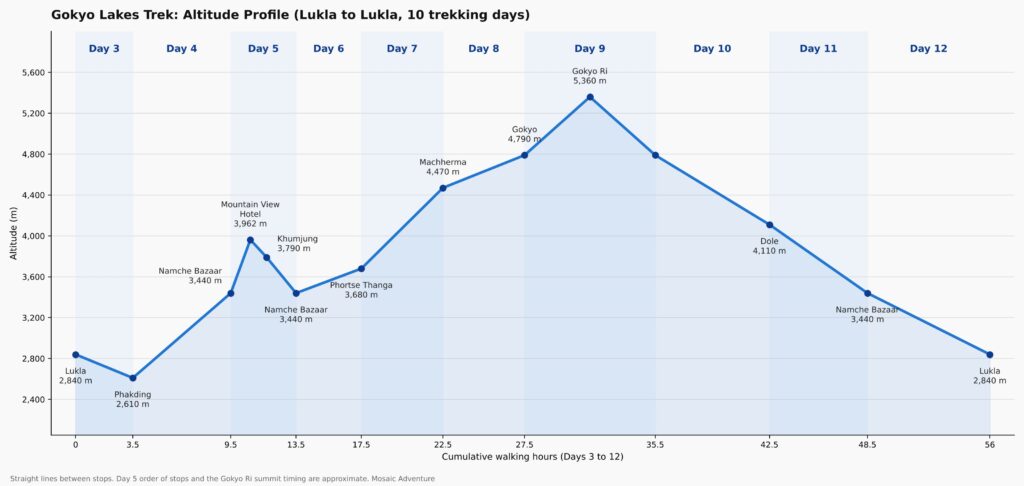
[caption id="attachment_29745" align="alignnone" width="910"]Altitude profile of the 15-day Gokyo Lakes Trek from Lukla (2,840 m) through Namche Bazaar, Machherma and Gokyo to Gokyo Ri (5,360 m) and back Gokyo Lakes Trek altitude profile: you sleep at Gokyo (4,790 m) and climb Gokyo Ri (5,360 m) on Day 9, then descend to Lukla.[/caption]

Important information about re-routing of Lukla flight

Civil Aviation authority of Nepal issued a notice instructing all airlines to divert Lukla flights to Manthali airport which is situated in Ramechap. Manthali Airport is situated in Ramechap District, about 145kms/4hrs drive from Kathmandu. The airport started operation since 2019 spring season when our airport was closed temporarily. Because of the successful operation from Manthali airport and to reduced traffic of Kathmandu airport, Civil Aviation authority has diverted all Lukla flights to Manthali airport. Until further notice, there will be 4 hours drive each way while traveling to/from Lukla; this means you will drive (starting at 230am-300am) about 4 hours to catch flight to Lukla and 4 hours on return to Kathmandu after flight from Lukla. This may change in future as per airport conditions. We are sorry for the inconvenience caused.

Cost Includes

  • Airport arrival and departure transfers
  • Hotel in Kathmandu with breakfast (Days 1, 2, 13 and 14)
  • Guided Kathmandu heritage tour
  • Breakfast, lunch and dinner during the trek
  • Teahouse accommodation during the trek
  • English-speaking guide
  • Porters, with wages and insurance
  • Kathmandu to Lukla and Lukla to Kathmandu flights, with airport transfers
  • Trekking area permits
  • Sleeping bag, down jacket and duffel bag (on request)
  • Government taxes and official expenses

Cost Excludes

  • Lunch and dinner in Kathmandu
  • Personal expenses such as laundry, phone calls and snacks
  • Drinks such as tea, coffee, water, juice and soft drinks
  • Travel insurance (essential for this trek)
  • Personal trekking gear, other than the items listed above
  • Tips for the guide and porters (about USD 200 to 250 per trekker)
  • Extra costs caused by events outside our control

Gokyo Lakes Trek Detailed Itinerary

  • Day
    1

    Welcome to Nepal! Arrive in Kathmandu

    Namaste! Someone from Mosaic Adventure will meet you at Tribhuvan International Airport and take you to your hotel. The rest of the day is yours to rest. If you have the energy, take a short wander around the nearby streets.

    Elevation: Kathmandu, 1,345 m / 4,412 ft

    Overnight: 3-star hotel in Kathmandu

  • Day
    2

    Pre-trek meeting and Kathmandu Valley sightseeing

    After breakfast you take a guided tour of the Kathmandu Valley's heritage sites. Later, your trekking guide goes through the plan with you, checks your gear and answers questions. Ask for the sleeping bag, down jacket or duffel bag now if you need them.

    Meals: Breakfast included

    Overnight: 3-star hotel in Kathmandu

  • Day
    3

    Fly to Lukla and trek to Phakding

    You fly to Lukla in about 45 minutes, past some of the most dramatic mountain scenery you'll ever see from a plane window. Depending on airport traffic, the flight leaves from Kathmandu or from Ramechhap, which means a very early drive. From Lukla you walk gently down the Dudh Koshi valley to Phakding.

    Walking: About 3.5 hours

    Difficulty: Easy

    Elevation: Lukla, 2,840 m / 9,320 ft. Phakding, 2,610 m / 8,563 ft

    Meals: Breakfast, lunch and dinner

    Overnight: Teahouse in Phakding

  • Day
    4

    Trek to Namche Bazaar

    You follow the river, cross suspension bridges strung with prayer flags, and then take the long, steep climb up to Namche Bazaar. This Sherpa town sits in a horseshoe-shaped bowl of mountains, and it's your gateway to the high Himalaya.

    Walking: About 6 hours

    Difficulty: Moderate

    Elevation: Namche Bazaar, 3,440 m / 11,286 ft

    Meals: Breakfast, lunch and dinner

    Overnight: Teahouse in Namche Bazaar

  • Day
    5

    The Mountain View Hotel, Khumjung and back to Namche

    This is your acclimatization day, and the walk is a short one. You climb to the Mountain View Hotel, often called the world's highest hotel, for views of Everest, Lhotse, Taboche and Ama Dablam. Then you visit Khumjung, with its school and Sherpa museum, before coming back down to sleep in Namche.

    Walking: About 4 hours

    Difficulty: Easy to moderate

    Elevation: Mountain View Hotel, 3,962 m / 12,998 ft. Khumjung, 3,790 m / 12,434 ft. Back to Namche Bazaar, 3,440 m / 11,286 ft

    Meals: Breakfast, lunch and dinner

    Overnight: Teahouse in Namche Bazaar

  • Day
    6

    Trek to Phortse Thanga

    Today you leave the main Everest trail. The path climbs through forest, with the river far below, then drops to the quiet settlement of Phortse Thanga. From here the trail turns up the Gokyo Valley, and you'll start to feel the crowds thin out.

    Walking: About 4 hours

    Difficulty: Moderate

    Elevation: Phortse Thanga, 3,680 m / 12,073 ft

    Meals: Breakfast, lunch and dinner

    Overnight: Teahouse in Phortse Thanga

  • Day
    7

    Trek to Machherma

    This is a big day of climbing. You gain nearly 800 m, passing through Dole and Luza, with the valley opening up as the trees give way to scrubby hillsides. Walk slowly and drink lots of water.

    Walking: About 5 hours

    Difficulty: Moderate

    Elevation: Machherma, 4,470 m / 14,665 ft

    Meals: Breakfast, lunch and dinner

    Overnight: Teahouse in Machherma

  • Day
    8

    Trek to Gokyo

    You walk alongside the Ngozumpa Glacier, one of the longest in the Himalaya, and the first of the Gokyo lakes appears, glowing turquoise against the rock and ice. You arrive at Gokyo beside the third lake, with the afternoon free to rest and wander.

    Walking: About 5 hours

    Difficulty: Moderate to difficult

    Elevation: Gokyo, 4,790 m / 15,715 ft (highest overnight stop)

    Meals: Breakfast, lunch and dinner

    Overnight: Teahouse in Gokyo

  • Day
    9

    Gokyo Ri and back to Gokyo

    This is the day the whole trek is built around. You set out early for Gokyo Ri, climbing steadily in the cold to reach the summit for sunrise. From the top you can see Everest, Lhotse, Makalu, Cho Oyu and Gyachung Kang, with the Ngozumpa Glacier and the lakes spread out below. After a long time at the top, you head back down to Gokyo.

    Walking: About 8 hours in total

    Difficulty: Difficult

    Elevation: Gokyo Ri, 5,360 m / 17,585 ft. Back to Gokyo, 4,790 m / 15,715 ft

    Views: Everest, Lhotse, Makalu, Cho Oyu and Gyachung Kang

    Meals: Breakfast, lunch and dinner

    Overnight: Teahouse in Gokyo

  • Day
    10

    Trek to Dole

    You turn around and head back down the valley, retracing your steps, with the lakes and the glacier now behind you. The thicker air at Dole will feel noticeably friendlier after the nights at Gokyo.

    Walking: About 7 hours

    Difficulty: Moderate to difficult

    Elevation: Dole, 4,110 m / 13,484 ft

    Meals: Breakfast, lunch and dinner

    Overnight: Teahouse in Dole

  • Day
    11

    Trek to Namche Bazaar

    A long descent takes you back to Namche, where you'll be pleased to see bakeries and hot drinks again. It's a good place for souvenirs, with time to explore in the afternoon.

    Walking: About 6 hours

    Difficulty: Easy to moderate

    Elevation: Namche Bazaar, 3,440 m / 11,286 ft

    Meals: Breakfast, lunch and dinner

    Overnight: Teahouse in Namche Bazaar

  • Day
    12

    Trek to Lukla

    The final day on the trail is a long one, so start early. You walk the Dudh Koshi valley to Lukla, crossing the same suspension bridges, with the climbs now much easier. Celebrate with your guide and porters tonight.

    Walking: About 7 to 8 hours

    Difficulty: Moderate

    Elevation: Lukla, 2,840 m / 9,320 ft

    Meals: Breakfast, lunch and dinner

    Overnight: Teahouse in Lukla

  • Day
    13

    Fly back to Kathmandu

    You fly back to Kathmandu in the morning and transfer to your hotel. If you left from Ramechhap on the way up, you'll land there and drive back to Kathmandu, about 4 hours. The rest of the day is free.

    Elevation: Kathmandu, 1,345 m / 4,412 ft

    Meals: Breakfast included

    Overnight: 3-star hotel in Kathmandu

  • Day
    14

    Rest day in Kathmandu

    A free day. Shop, get a massage, try some good food or catch up on sleep. It's also our spare day in case a Lukla flight is delayed.

    Meals: Breakfast included

    Overnight: 3-star hotel in Kathmandu

  • Day
    15

    Departure

    Time to say goodbye to Nepal. After breakfast we take you to the airport in time for your flight home. If you'd like to extend your stay, tell us and we'll help you plan it.

    Meals: Breakfast included

Gokyo Lakes Trek FAQs

About this trek

What is the Gokyo Lakes Trek?

It's a 15-day teahouse trek in the Everest region. You fly to Lukla, walk up to Namche Bazaar, then branch off up the Gokyo Valley to a string of glacial lakes. The high point is Gokyo Ri at 5,360 m, with a wide view of Everest, Lhotse, Makalu and Cho Oyu.

How is Gokyo different from the Everest Base Camp trek?

The two share the first few days to Namche Bazaar, then split. Gokyo heads up a side valley with turquoise lakes and a glacier, and many people find it quieter. It doesn't go to Everest Base Camp, but Gokyo Ri gives you a wider view of the whole range than Base Camp does.

Does the Gokyo Lakes Trek go to Everest Base Camp?

No. It stays in the Gokyo Valley. If Base Camp is your goal, take a look at our Everest Base Camp trek instead.

Which mountains will I see from Gokyo Ri?

Everest, Lhotse, Makalu, Cho Oyu and Gyachung Kang, with the Ngozumpa Glacier spread out below. You'll also see Everest, Lhotse, Taboche and Ama Dablam from the Mountain View Hotel on Day 5. Views depend on the weather.

Is Gokyo less crowded than Base Camp?

Generally, yes. Several guests have told us the Gokyo Valley felt quieter than the main Everest trail. It's still the Everest region, so the busy autumn weeks get some company in the teahouses.

Booking, dates and price

Is this a private trek or a group trek?

It's private. Choose any date and the trek runs for a minimum of 2 people, with nobody else joining. If you'd like to bring your own bigger group, that's welcome as well.

Can I choose my own start date?

Yes. Pick any date in the booking form and book online. You don't need to contact us first.

How much does the Gokyo Lakes Trek cost?

From USD 1,410 per person. That covers Kathmandu hotels with breakfast, all trek meals, teahouses, a guide and porters, flights to and from Lukla, permits, and a sleeping bag, down jacket and duffel bag on request.

Can I change the itinerary?

Yes, within reason. Extra days for acclimatization, more time in Kathmandu or a different finish can be arranged. Message us before you book and we'll adjust the plan and the price.

Can I combine Gokyo with another route?

Often you can. Tell us what you have in mind and how much time you have, and we'll say whether it works safely.

Difficulty and altitude

How hard is the Gokyo Lakes Trek?

It's moderate to difficult. You walk between 3.5 and 8 hours a day for 10 days, and the climb to Gokyo Ri is the toughest day. You don't need technical skills, but you do need good fitness and a steady pace.

How high does the trek go?

Gokyo Ri is the highest point, at 5,360 m (17,585 ft). Your highest night is at Gokyo, 4,790 m (15,715 ft).

How hard is the Gokyo Ri day?

It's the hardest day of the trek, about 8 hours in total. You start in the dark to catch the sunrise, climb steadily to 5,360 m and come back down to Gokyo for the night. Your guide sets the pace, and it's fine to stop and rest.

Is there time to acclimatize?

Day 5 is built for it. You walk up to the Mountain View Hotel and Khumjung, then come back down to sleep in Namche. Day 7, from Phortse Thanga to Machherma, is a big climb, so go slowly. If you want extra safety, ask us about adding a day.

What about altitude sickness?

Headaches, nausea and poor sleep are common signs. Drink plenty of water, walk slowly and tell your guide how you feel. Your guide checks on you every day, and if symptoms get worse, you go down. Don't keep climbing with symptoms.

How many hours do I walk each day?

Day 3 is about 3.5 hours, Day 4 about 6, Day 5 about 4, Day 6 about 4, Day 7 about 5, Day 8 about 5, Day 9 about 8, Day 10 about 7, Day 11 about 6 and Day 12 about 7 to 8 hours.

Do I need trekking experience?

Not necessarily. Plenty of our guests are on their first big Himalayan trek. Do regular hikes with a day pack in the months before you go, and build up your stamina.

Accommodation and meals

Where do we sleep on the trek?

In basic teahouses along the trail. Expect simple rooms with beds, shared bathrooms and a communal dining room. Nights in Kathmandu are in a 3-star hotel.

Which meals are included?

Breakfast, lunch and dinner on every trek day. In Kathmandu you get breakfast only. Lunch and dinner there are up to you.

Do I need my own sleeping bag?

We can provide a sleeping bag, down jacket and duffel bag on request, so you don't need to buy them. Ask when you book. You may prefer to bring your own if you're particular about comfort.

Are charging, hot showers and Wi-Fi included?

These aren't included. Most teahouses charge a small fee for charging devices, hot showers and Wi-Fi, usually in cash, and the fees rise with altitude.

Flights and Kathmandu

Where does the Lukla flight leave from?

It depends on airport traffic. When it can, the flight leaves from Kathmandu. When Kathmandu is too busy, we use Ramechhap (Manthali), about 4 hours' drive away, which means a very early start. We'll tell you before the day which one it will be.

What if my flight to or from Lukla is delayed?

Mountain weather can delay flights. Day 14 is a spare day in Kathmandu, so a delay on the way back doesn't cost you your international flight. Still, keep a day or two of buffer after Day 15.

What is the baggage limit?

Airlines usually allow about 15 kg per person on the Lukla flight, with 10 kg checked and 5 kg as hand luggage. Leave anything extra at your Kathmandu hotel.

Costs, gear and best time

How much should I tip the guide and porters?

One trekker should budget about USD 200 to 250 in tips for the guide and porters together. Tips aren't included in the price.

Do I need travel insurance?

Yes. Insurance isn't included, and for this trek it's essential. Check that it covers trekking to 5,500 m and helicopter evacuation.

What should I bring?

Warm layers, a good pair of broken-in boots, a sun hat, sunglasses, a head torch, a water bottle and a day pack. Your sleeping bag, down jacket and duffel bag can come from us.

When is the best time to trek to Gokyo?

March to mid-June and September to early December. Skies are clearest in autumn, and spring brings rhododendrons in the lower forests. Winter is very cold at Gokyo, and the lakes freeze. We don't recommend the monsoon.

Do I need a visa for Nepal?

Most visitors do, and it's easy to get on arrival at Kathmandu airport. Fees are about USD 30 for 15 days, USD 50 for 30 days and USD 125 for 90 days.

Gokyo Lakes Trek: Before You Go

The practical details, answered the way trekkers usually ask them.

Is the Gokyo Lakes Trek right for you?

It suits you if you want big mountain views and a quieter valley, and you are happy to walk for 10 days at altitude. You don’t need climbing skills, but you do need good fitness. The climb to Gokyo Ri at 5,360 m is a long, cold day. If that sounds like too much, our shorter Everest Panorama Trek stays lower, and the Everest Base Camp trek follows the main trail.

How does each day feel?

DayWalkingSleep atFeel
3About 3.5 hoursPhakding, 2,610 mEasy, mostly downhill from Lukla
4About 6 hoursNamche Bazaar, 3,440 mA steady climb, with a steep last hour
5About 4 hoursNamche Bazaar, 3,440 mShort acclimatization walk, sleeping at the same height
6About 4 hoursPhortse Thanga, 3,680 mModerate, with ups and downs
7About 5 hoursMachherma, 4,470 mA big climb. Go slowly.
8About 5 hoursGokyo, 4,790 mModerate to difficult, along the glacier
9About 8 hoursGokyo, 4,790 mThe toughest day. Early start to Gokyo Ri, 5,360 m.
10About 7 hoursDole, 4,110 mA long descent
11About 6 hoursNamche Bazaar, 3,440 mEasier going, in thicker air
12About 7 to 8 hoursLukla, 2,840 mA long day on tired legs

How do you handle the altitude?

You gain height gradually, with one acclimatization day around Namche on Day 5. Day 7 is the biggest single climb, so you walk at a very slow pace. Drink plenty of water, tell your guide how you feel and don’t hide headaches or nausea. If symptoms get worse, you go down. That rule is not negotiable. If you’d like an extra rest day at Machherma or Gokyo, ask us and we’ll work it into the plan.

How does the Lukla flight work?

The flight takes about 45 minutes. When it can, it leaves from Kathmandu. When Kathmandu is too busy, we use Ramechhap (Manthali), about 4 hours’ drive away, so you leave around 2:30 to 3:00 AM. We’ll tell you which one before the day. Airlines usually allow about 15 kg per person. Day 14 is a spare day in Kathmandu in case a flight is delayed.

Where do we stay?

NightsPlaceStay
1 and 2Kathmandu3-star hotel
3PhakdingTeahouse
4 and 5Namche BazaarTeahouse
6Phortse ThangaTeahouse
7MachhermaTeahouse
8 and 9GokyoTeahouse
10DoleTeahouse
11Namche BazaarTeahouse
12LuklaTeahouse
13 and 14Kathmandu3-star hotel

Teahouses are basic: simple beds, a shared bathroom and a communal dining room. Higher up, rooms are unheated and nights are cold, so a good sleeping bag matters. We can provide one, with a down jacket and duffel bag, on request.

What will we eat?

Breakfast, lunch and dinner are included on every trek day. Menus are simple and filling, with dal bhat, noodles, soup, eggs and rice dishes. In Kathmandu only breakfast is included. Tell us about dietary needs before you travel.

When is the best time to go?

MonthsWhat to expect
March to mid-JuneWarmer days and rhododendrons in the lower forests. Views can get hazy as the season warms up.
Mid-June to AugustMonsoon. Clouds and rain hide the mountains, and flights can be disrupted. We don’t recommend it.
September to early DecemberClear skies and the best mountain views. The busiest months on the trail.
Mid-December to FebruaryVery cold at Gokyo, with frozen lakes and snow on the trails. Only for well-prepared trekkers.

What should I pack?

  • Warm layers: thermal base layers, fleece and a windproof shell
  • Boots: broken-in, waterproof walking boots, plus sandals for the teahouse
  • Sun protection: sunglasses, a hat and sunscreen
  • Extras: a head torch, a water bottle, a day pack and trekking poles
  • From us on request: a sleeping bag, down jacket and duffel bag

What about money and extras?

Bring cash in Nepali rupees and don’t count on ATMs on the trail. You pay for drinks, snacks, laundry, charging, hot showers and Wi-Fi yourself, and prices go up with altitude. Tips for the guide and porters are not included. One trekker should budget about USD 200 to 250 for the guide and porters together.

What do we need for Nepal entry?

Most visitors need a tourist visa, and your passport should be valid for at least six months. Fees are about USD 30 for 15 days, USD 50 for 30 days and USD 125 for 90 days. Nepal is rolling out an e-visa system from August 2026, so check the official immigration site before you fly. Travel insurance is not included and is essential. It should cover trekking to 5,500 m and helicopter evacuation.

Group size, dates and permits

The trek is private. Choose any date in the booking form. The minimum is 2 people, and a larger group of your own is welcome. Trekking area permits are included in the price.