10
Days
The Annapurna Circuit Trek is a true classic. In 10 days you walk from the forests of the Marsyangdi valley to the high desert of Manang, cross Thorong La Pass at 5,416 m and descend to the pilgrimage site of Muktinath, with Himalayan views on almost every day.
Quick answer: The Mosaic Adventure Annapurna Circuit Trek takes 10 days from Kathmandu to Pokhara. You drive to Dharapani, walk about 78 km over 7 days (including one acclimatization day in Manang), cross Thorong La Pass (5,416 m) and fly from Jomsom to Pokhara. The price is USD 970 per person, with a licensed guide, porters, tea house accommodation, meals on the trek and permits included.
Autumn 2026 update: heavy rain and snow in late September 2026 disrupted parts of the Marsyangdi road and the upper Manang trails. The road to Dharapani has since been repaired and vehicles are running again. Our guides check road, trail and Thorong La conditions before every departure. Last updated: October 2026.
Key Facts: 10-Day Annapurna Circuit Trek via Thorong La Pass
Cost
USD 970 per person
Deposit
20% to secure your spot, balance on arrival in Kathmandu
Duration
10 days (7 days on the trail, including 1 acclimatization day)
Maximum altitude
5,416 m / 17,769 ft at Thorong La Pass
Highest overnight stay
4,450 m / 14,600 ft at Thorong Phedi
Trekking distance
About 78 km (48 miles) on foot
Group size
Maximum 12 trekkers; minimum 2 to book online, solo travelers please contact us
Daily walking
About 4 to 6 hours a day on most days; the Thorong La day takes 8 to 10 hours and starts around 3 to 4 am
Best season
Spring (March to early June) and Autumn (September to early December)
Highly recommended time
Mid-November to early December for clear skies and stable weather
Tour availability
All year round (pass crossing depends on conditions)
Meeting point
Tribhuvan International Airport, Kathmandu
Transport
Private vehicle from Kathmandu to Dharapani (about 10 hours), private vehicle from Muktinath to Jomsom (about 1 hour), and a morning flight from Jomsom to Pokhara (about 25 minutes). If the flight is cancelled, we drive from Jomsom to Pokhara (about 6 to 7 hours).
Accommodation
3-star hotel in Kathmandu (Day 1) and tea houses during the trek; Pokhara hotel not included
Meals
All trek meals included; breakfast in Kathmandu; lunch and dinner on Day 1 not included
Fitness level
Good fitness required; you should be comfortable walking 6 to 8 hours a day at altitude
Permits & fees
Annapurna Conservation Area Permit (ACAP) and all required entry fees included
Travel insurance
Required; must cover trekking up to 5,500 m and emergency helicopter evacuation
Connectivity
Paid Wi-Fi and charging at most tea houses; signal is weaker at higher altitudes
Equipment
Gear list provided; free rental of a sleeping bag, down jacket and duffel bag (on request)
Safety
Strong safety standards with clear emergency and evacuation protocols. Guides check oxygen levels regularly at altitude, and we follow the rule of climb high, sleep low.
i
Use the tabs on this page to find all key information about the Annapurna Circuit Trek, including itinerary, departure dates, cost, inclusions, FAQs and more.
Overview
The Annapurna region was opened to foreign trekkers in 1977, and the circuit has been among the world’s favorite trekking routes ever since. In a typical recent year, more than 100,000 trekkers visit the Annapurna Conservation Area.
The full circuit, depending on where you start and finish, covers roughly 160 to 230 km and traditionally takes two to three weeks. Our 10-day route is a shorter version of it. We drive from Kathmandu to Dharapani, skipping the lowest section of the valley, and we fly from Jomsom to Pokhara at the end, so the time on the trail is spent in the most spectacular part of the circuit.
The trek explores the trans-Himalayan region between the Annapurna and Dhaulagiri ranges. The landscape changes every day, from green forests and waterfalls to a dry, high-altitude desert, glacial lakes and stone-walled villages. You will walk with views of Annapurna II, Annapurna IV, Gangapurna, Tilicho Peak and many more snow-covered peaks.
The route takes you through the districts of Manang and Mustang, home to Gurung, Ghale, Thakali and Tibetan-influenced communities. You follow the Marsyangdi River for the first part of the trek, crossing it several times on suspension bridges, and pass monasteries, mani walls and prayer flags.
The challenge and the highlight is Thorong La Pass. The crossing is a long, cold day that starts before dawn, but the sunrise and the panorama from the top are what most trekkers remember most.
This is a standard itinerary that we can customize. A minimum of two participants is needed to book online. If you are a solo trekker, please contact us to make arrangements.
Annapurna Circuit Trek 10 Days Outline Itinerary
Day 01: Arrival in Kathmandu (1345 meters), meet at the airport, and transfer to the hotel.
Day 02: Drive to Dharapani (1910 meters) - 10 hours.
Day 03: Trek to Chame (2710 meters) - 5 to 6 hours.
Day 04: Trek to Pisang (3300 meters) - 5 hours.
Day 05: Trek to Manang (3540 meters) - 6 hours.
Day 06: Acclimatization day at Manang (3,540 meters).
Day 07: Trek to Letdar (4,230 meters) - 4 hours.
Day 08: Trek to Thorang Phedi (4,450 m / 14,600 ft) - 4 hours.
Day 09: Trek to Muktinath (3800 meters) via Thorang La Pass (5,416 meters) - 8 hours. Further Drive to Jomsom for an hour.
Day 10: Fly to Pokhara (822 m / 2,697 ft) - transfer to your hotel; further on your own.
[caption id="attachment_29404" align="alignnone" width="910"] Annapurna Circuit Trek altitude profile: you sleep at Manang (3,540 m / 11,614 ft) for two nights, then cross Thorong La Pass (5,416 m / 17,769 ft) from Thorong Phedi (4,450 m / 14,600 ft).[/caption]
Highlights of the Annapurna Circuit Trek
Thorong La Pass (5,416 m): one of the highest trekking passes in the world and the high point of the trek, reached on a sunrise climb.
Landscape variety: forests, waterfalls, trans-Himalayan desert, glacial lakes and wide views of Annapurna and Dhaulagiri in one trek.
Cultural variety: Gurung, Ghale, Thakali and Tibetan-influenced communities, with monasteries, mani walls and prayer flags.
Manang village: a centuries-old village with a proper rest day, views of Annapurna III and Gangapurna and a short walk to Gangapurna Lake.
Braga Monastery: a centuries-old monastery on the way to Manang.
Muktinath: a pilgrimage site sacred to both Hindus and Buddhists.
The Kali Gandaki valley: often described as one of the deepest gorges in the world, seen on the way to Jomsom.
How the Thorong La crossing works
Thorong La day is the longest of the trek, so here is what to expect. You sleep at Thorong Phedi (4,450 m) and start around 3 to 4 am with headlamps, because the wind usually picks up after midday. The trail climbs steeply to Thorong High Camp (4,860 m), then continues more gradually to the pass at 5,416 m, about 4 to 5 hours from the start. Prayer flags and a tea stop mark the top. The long descent of about 1,600 m takes 3 to 5 hours and ends at Muktinath and the whole day takes 8 to 10 hours. It is cold, dry and windy, so you wear all your layers. Your guide decides when to go, when to wait and when to turn back, based on the weather and on how every trekker is feeling.
What is included
Arrival transfer in Kathmandu
Hotel in Kathmandu with breakfast (Day 1)
Kathmandu to Dharapani drive in a private vehicle
All standard meals (breakfast, lunch and dinner) during the trek
Tea house accommodation during the trek
English-speaking, licensed guide and porters (1 porter for 2 trekkers), including their food, accommodation, salary, insurance, equipment and medicine
Annapurna Conservation Area Permit and other required entry fees
Muktinath to Jomsom transfer in a private vehicle
Jomsom to Pokhara flight ticket and transfer from Pokhara airport to Lakeside
Free use of a sleeping bag, down jacket and duffel bag during the trek (on request)
Government-imposed taxes
What is not included
Lunch and dinner in Kathmandu on Day 1
Hotel and meals in Pokhara, and onward travel from Pokhara
Personal expenses such as laundry, phone calls, sweets and snacks
All drinks (tea, coffee, bottled or hot water, soft drinks and bar bills)
Travel insurance (mandatory)
Personal trekking equipment other than the items listed above
Tips for the guide and porters (expected)
Nepal visa
Any loss caused by unforeseen circumstances beyond Mosaic Adventure’s control
Annapurna Circuit Trek Detailed Itinerary and Altitude Profile
Day 1
Arrive in Kathmandu (1,345 m / 4,413 ft)
A Mosaic Adventure representative meets you at Tribhuvan International Airport and takes you to your hotel. Rest or explore the city, and in the evening we brief you about the trek. Overnight at a hotel in Kathmandu.
Day 2
Drive to Dharapani (1,910 m / 6,266 ft)
Driving time: about 10 hours
After breakfast we drive west through Besisahar and then up the Marsyangdi valley through villages including Jagat, Chamje and Tal to Dharapani. This is a long day on mountain roads, so bring snacks and something to keep you busy. Overnight in a tea house.
Breakfast + Lunch + Dinner
Day 3
Trek to Chame (2,710 m / 8,891 ft)
Walking time: 5 to 6 hours
Distance: about 15 km
The trail follows the Marsyangdi through forest ridges and apple orchards, with views of Lamjung Himal, Annapurna II and Annapurna IV. You will pass a natural hot spring before reaching Chame, the headquarters of Manang district, where you can buy last-minute supplies. Overnight in Chame.
Breakfast + Lunch + Dinner
Day 4
Trek to Pisang (3,300 m / 10,827 ft)
Walking time: 5 to 6 hours
Distance: about 14 km
The landscape changes dramatically today. You start in dense forest beside the river, and after crossing the 3,000 m mark the forest thins into a dry trans-Himalayan landscape with a few alpine shrubs. At Pisang you can take either the Upper Pisang trail, which is steeper but has better views, or the easier Lower Pisang trail. Overnight in Pisang.
Breakfast + Lunch + Dinner
Day 5
Trek to Manang (3,540 m / 11,614 ft)
Walking time: 6 to 7 hours
Distance: about 17 km
You can walk from either Upper or Lower Pisang through the old village of Ngawal to Manang. Annapurna, Gangapurna and Tilicho Peak are visible for much of the day. You pass Braga, a village known for its centuries-old monastery, before arriving at Manang. Overnight in Manang.
Breakfast + Lunch + Dinner
Day 6
Acclimatization day in Manang (3,540 m / 11,614 ft)
Manang is one of the best places on the circuit to let your body adjust.
Choose from a short walk to Gangapurna Lake, a visit to Braga Monastery, the steep climb to the Chongkor viewpoint above Manang, or a longer hike to Ice Lake. In the afternoon, you can attend the free altitude sickness talk at the Himalayan Rescue Association aid post in Manang, usually held daily during the trekking seasons. Walk high, sleep low, drink plenty of water, and do not sleep during the day, because that does not help acclimatization. Please confirm with your guides that the talk is still held.
Overnight in Manang.
Breakfast + Lunch + Dinner
Day 7
Trek to Letdar (4,230 m / 13,878 ft)
Walking time: about 4 hours
Distance: about 10 km
The trail climbs steadily through rocky country with juniper shrubs and small pastures, crossing wooden and suspension bridges over the Jharsang Khola and passing the villages of Tengi, Gunsang and Yak Kharka. Overnight in Letdar.
Breakfast + Lunch + Dinner
Day 8
Trek to Thorong Phedi (4,450 m / 14,600 ft)
Walking time: about 4 hours
Distance: about 5 km
A steady climb through huge rock formations and dry, colorful slopes brings you to Thorong Phedi. Some stretches are prone to landslides, so walk carefully and follow your guide. From here you have views of Gundang, Syagang, Thorong Peak and Khatungkang. Rest early, because tomorrow starts before dawn. Overnight at Thorong Phedi.
Breakfast + Lunch + Dinner
Day 9
Cross Thorong La Pass (5,416 m / 17,769 ft) to Muktinath (3,800 m / 12,467 ft), then drive to Jomsom (2,720 m / 8,924 ft)
Walking time: 8 to 10 hours
Distance: about 17 km
Driving time: about 1 hour
This is the most exciting and demanding day of the trek.
Everyone leaves Thorong Phedi around 3 to 4 am, so you walk with headlamps in a long line of trekkers, which many people find reassuring. The first hour climbs steeply to Thorong High Camp (4,860 m). Beyond it the trail eases, and there is a small tea shop on the way to the pass. This is the coldest part of the day, before the sun reaches the trail, so wear all your layers and keep moving. If there is snow or ice, your guide will advise you to wear microspikes. At the top (5,416 m), prayer flags mark the pass. The descent of about 1,600 m to Muktinath takes 3 to 5 hours on snow and then rocky trail, so poles and good boots matter. The whole day takes 8 to 10 hours, and slower trekkers may need up to 12.
A private vehicle then takes you to Jomsom for a comfortable night in a lodge. Overnight in Jomsom.
Note:
Chemical hand and foot warmers need oxygen and often do not activate at this altitude, so rely on insulated mittens, liner gloves and spare socks. Keep drinking water from freezing by using an insulated bottle or carrying it inside your jacket, bring a thermos of hot drink, and pack spare headlamp batteries because the cold drains them.
Breakfast + Lunch + Dinner
Day 10
Fly to Pokhara (822 m / 2,697 ft)
Flight time: about 25 minutes
We take an early-morning flight from Jomsom to Pokhara, then transfer you to Lakeside. Mountain flights depend on the weather, so if the flight is cancelled we drive from Jomsom to Pokhara instead (about 6 to 7 hours). Our service ends in Pokhara, where you can paraglide, boat on Phewa Lake or relax in Lakeside. Your hotel and meals in Pokhara are not included, and return to Kathmandu can be arranged on request.
Breakfast
Frequently Asked Questions (FAQs)
Route and trip basics
What is the Annapurna Circuit Trek?
The Annapurna Circuit is a classic trek through the Annapurna region of Nepal that crosses Thorong La Pass (5,416 m). Our 10-day version drives from Kathmandu to Dharapani, follows the Marsyangdi River up through Chame, Pisang and Manang, crosses the pass to Muktinath and ends with a flight from Jomsom to Pokhara.
How long is the Annapurna Circuit, and how far do you walk on this trek?
The full circuit covers roughly 160 to 230 km depending on where you start and finish, and it traditionally takes two to three weeks. On our 10-day trek you walk about 78 km over 7 days, including one acclimatization day.
Why does the trek start at Dharapani and not Besisahar?
Because roads now run along parts of the lower valley. We drive from Kathmandu to Dharapani so your walking days are spent on the more scenic upper sections of the trail.
Is the Annapurna Circuit still worth doing now that roads reach parts of it?
Yes. Roads have changed some lower and middle sections of the original route, but the high mountain scenery, the Manang valley and the crossing of Thorong La Pass are still walked on foot. A shorter itinerary like ours skips the most road-affected stretch.
What are the main highlights?
The highlights are the sunrise crossing of Thorong La Pass, views of Annapurna, Gangapurna and Dhaulagiri, the acclimatization day in Manang with its monasteries and lakes, and the pilgrimage site of Muktinath.
Cost, permits and booking
How much does the Annapurna Circuit Trek cost and what is included?
The 10-day trek costs USD 970 per person. It includes airport transfers, one night in a Kathmandu hotel, the drive to Dharapani, a licensed guide, porters (one per two trekkers), tea house accommodation, all meals during the trek, permits, the Muktinath to Jomsom transfer and the Jomsom to Pokhara flight. For a full explanation of what to budget on top, read our Annapurna Circuit Trek Cost: A Detailed Breakdown and Budget Guide.
What permits do I need, and are they included?
You need the Annapurna Conservation Area Permit (ACAP), which costs NPR 3,000 (about USD 23 to 25) and is included in your price. A TIMS card is not required at present, although rules can change and we will let you know if they do.
Can I trek the Annapurna Circuit without a guide, and why take one?
According to a government announcement in 2023, trekkers on the Annapurna Circuit are required to be accompanied by a licensed guide. As of October 2026, we are not aware of any checkpoints on the route that check whether trekkers have a guide, and some independent trekkers still walk the circuit because the trail is well used and lodges are available in every village. Regulations can change and checks may be introduced, so we confirm the latest requirements when you book.
Our trek includes a licensed guide and porters, and we recommend a guide for your safety as well as for compliance. Your guide watches for altitude symptoms and checks your oxygen levels, leads the pre-dawn climb to Thorong La, arranges rooms in busy seasons, handles the long drive from Kathmandu and coordinates a helicopter evacuation if needed.
Is travel insurance required?
Yes, travel insurance is mandatory. It must cover trekking up to 5,500 m, medical expenses and emergency helicopter evacuation. Please send us your policy details before departure.
Can I trek solo?
Yes. A minimum of two participants is needed to book online. If you are travelling alone, contact us and we will help you join a group or arrange your trek. You can also read our guide to solo trekking in Nepal.
What is your deposit and cancellation policy?
A 20% deposit secures your spot and the balance is paid on arrival in Kathmandu. Read our Terms and Conditions for detailed information.
Do I need a visa for Nepal?
Yes. Most nationalities can buy a tourist visa on arrival at Tribhuvan International Airport. The usual fees are USD 30 for 15 days and USD 50 for 30 days, but please check the Department of Immigration for the current rates. Visa fees are not included in the trek price.
Best time, weather and trail conditions
What is the best time for the Annapurna Circuit Trek?
The best seasons are autumn (September to November) and spring (March to early June). Skies are clearest and temperatures are comfortable, with chilly but not freezing nights. Mid-November to early December is our recommended window for clear skies and stable weather. Autumn is also the busiest time, so tea houses fill up fast, and we book your rooms in advance.
Can I do the trek in winter or during the monsoon?
The trek is possible outside the main seasons, but conditions are harder. In winter (December to February) it is very cold and heavy snow can close Thorong La Pass. In the monsoon (June to August) the upper Manang valley is drier than the rest of Nepal, but rain can cause landslides on the roads and lower trails. If you plan to travel during these months, please contact us for more information about the season before booking.
Was the trek affected by the 2026 storms and floods?
Heavy rain and snow in late September 2026 disrupted parts of the Marsyangdi road and some upper Manang trails. The road to Dharapani has since been repaired and vehicles are running again. Our guides check road, trail and Thorong La conditions before every departure and will adjust the plan if needed.
What happens if bad weather closes Thorong La Pass?
Your guide makes the final decision on whether to continue, wait or change the plan. If the pass is closed, we first wait at a safe lodge for up to one day if conditions are expected to improve. If it does not, we return to Manang and continue by road. Any extra costs from weather changes are the traveler's responsibility and are normally covered by travel insurance. We recommend keeping one or two spare days before your international flight.
What if the Jomsom to Pokhara flight is cancelled?
Mountain flights depend on the weather. If the flight is cancelled, we drive from Jomsom to Pokhara by road, which takes about 6 to 7 hours.
Difficulty, fitness and altitude
How difficult is the Annapurna Circuit Trek?
The trek is moderate to challenging. Most days are 4 to 6 hours of walking, but the Thorong La day is long and cold, taking 8 to 10 hours at altitude. If you are reasonably fit and comfortable walking 6 to 8 hours a day at altitude, you can complete it with the help of our guides.
How fit do I need to be, and how should I train?
You need good general fitness. We recommend 2 to 3 months of regular cardio training (hill walking, jogging, cycling or stair climbing) and weekly hikes of 3 to 6 hours with a loaded daypack, including some long downhill sections. Anyone with a medical condition should consult a doctor before joining.
What altitudes will I reach?
The trek runs from Dharapani (1,910 m) to Thorong La Pass (5,416 m). The highest point you sleep at is Thorong Phedi (4,450 m).
What are the chances of altitude sickness, and how do you reduce the risk?
Altitude sickness is a real possibility above 3,000 m, and it can affect anyone, including fit and young trekkers. Our itinerary includes a full acclimatization day in Manang and follows the rule of climb high, sleep low. Walk slowly, drink 3 to 4 liters of water a day, avoid alcohol, and tell your guide at once about any symptom, even a mild headache. If you wish to carry Diamox as a precaution, please consult your doctor first.
What if I get sick while on trek?
Our guides are experienced in recognizing altitude sickness and regularly check your oxygen levels at higher altitudes, in addition to daily health checks. If symptoms are mild, we descend immediately to a lower altitude with the help of the porter. If you are seriously ill, we contact your insurance company to arrange an emergency helicopter evacuation. Our guides carry basic medicine and first aid equipment, including painkillers, altitude sickness tablets, bandages, balm for muscle ache and medication for diarrhea and vomiting.
What is the Thorong La crossing day like?
It starts around 3 to 4 am from Thorong Phedi, climbs to Thorong High Camp (4,860 m) and reaches the pass at 5,416 m after about 4 to 5 hours. The descent to Muktinath takes another 3 to 4 hours, so the whole day takes 8 to 10 hours. Expect cold, dry and often windy conditions, so wear all your layers.
Accommodation, food and facilities
What is the accommodation like on the Annapurna Circuit?
You stay in tea houses, which offer basic twin-sharing rooms and a communal dining hall. Some lodges on this trek also have Wi-Fi, hot showers and attached bathrooms. Rooms are simple and clean, and the facilities become more basic as you go higher.
What kind of food is available?
The Annapurna Circuit is a well-developed trail, so tea houses offer a good variety, including dal bhat (rice and lentil soup), noodles, pasta and pizza. You can also buy snacks such as chocolate bars, biscuits and nuts along the way. All trek meals are included in your price.
Is there Wi-Fi, mobile signal and electricity on the trek?
Most tea houses offer paid Wi-Fi and phone charging, but signals weaken at higher altitudes and can be unreliable. Charging usually costs a few dollars per hour. Consider a local SIM card for basic connectivity.
Since you'll be traveling through rural areas, if something goes wrong, it may take a day or longer to get it fixed. So, keep your expectations low and be prepared for occasional inconveniences.
Can I take a shower?
Yes, at most tea houses you can pay for a hot shower, although facilities are shared and the higher you go the colder it gets. Many trekkers wait until Jomsom for a proper shower.
Is enough drinking water available?
Yes, there is water available along the trail, but we ask all trekkers to bring a bottle and water purification tablets. Mosaic supports responsible tourism, so we do not encourage buying bottled water, because there is no proper disposal system for plastic bottles in the mountains. Most tablets take about 30 minutes.
Packing and gear
What should I pack for the Annapurna Circuit Trek?
Essential items include layered clothing (thermals, fleece, waterproof jacket), a warm hat and gloves, sturdy broken-in trekking boots, a daypack, a sleeping bag liner, a water bottle with purification tablets, sunscreen, sunglasses and a headlamp. A detailed packing list is shared when you book.
Do you provide equipment?
Yes. We provide a sleeping bag, down jacket and duffel bag free of charge during the trek, on request.
Do I need trekking poles?
Poles are not essential, but they take strain off your legs on steep sections and are very helpful on the long descent of about 1,600 m after Thorong La. You can buy them in Kathmandu or Pokhara.
What do I carry myself?
A daypack for your water, camera, snacks, sunscreen, hat, fleece and gloves. Porters carry your main bag, with a limit of 20 kg per porter (10 kg per trekker).
Comparing treks
How does the Annapurna Circuit compare with the Annapurna Base Camp Trek?
The Circuit crosses a high pass (5,416 m) and passes through several landscapes and cultures over 10 days. The Annapurna Base Camp Trek stays in the Annapurna Sanctuary, reaches 4,130 m and is generally less demanding. See our 11-day Annapurna Base Camp Trek if you prefer a lower altitude.
Can I combine the Annapurna Circuit with Nar Phu Valley?
Yes. Our 18-day Nar Phu Valley Trek crosses Kang La Pass into the Nar and Phu valleys and then joins the Annapurna Circuit to cross Thorong La. It is longer, more remote and more demanding than this trek.
Annapurna Circuit Trek Route Map
Annapurna Circuit Trek: Notes Before You Commit
The full Annapurna Circuit used to take two to three weeks and 160 to 230 km, starting down at Besisahar. Roads have crept up the Marsyangdi valley since then, and much of the lower trail is now a dirt road with jeeps on it. Our 10-day version is built around that. It keeps the part of the circuit that people actually travel here for, which is the high, dry country around Manang and the crossing of Thorong La at 5,416 m / 17,769 ft, and it uses vehicles for the parts that are no longer much of a walk.
What this version leaves out
You do not walk the lower Marsyangdi, because you drive to Dharapani (1,910 m / 6,266 ft) on Day 2. You do not walk down the Kali Gandaki after Muktinath, because a vehicle takes you to Jomsom and you fly to Pokhara on Day 10. What is left is about 78 km on foot over 7 days, one of them a rest day. If you want the long, slow version with every village, this is not it, and we can talk about a longer plan.
The road to Dharapani
Day 2 is a drive of about 10 hours: Kathmandu, Besisahar, then up the valley through Jagat, Chamje and Tal. It is a long day on mountain roads and nobody enjoys all of it. Leave early, keep snacks in the daypack, and do not plan anything for the evening except dinner. Heavy rain and snow in late September 2026 damaged parts of the Marsyangdi road and some upper trails. As of October 2026 the road to Dharapani has been repaired and vehicles are running, and your guide checks the road, the trail and Thorong La before every departure.
Stop by stop
Night
Altitude
What to know
Dharapani (Day 2)
1,910 m / 6,266 ft
Where the walking starts. Arrive tired from the drive, sleep early.
Chame (Day 3)
2,710 m / 8,891 ft
District headquarters for Manang, with a hot spring on the way in and the last chance to buy supplies.
Pisang (Day 4)
3,300 m / 10,827 ft
The trail forks here into an upper and a lower route (see below). The forest ends and the dry country begins.
Manang (Days 5 and 6)
3,540 m / 11,614 ft
Two nights. The village has a rescue aid post, a monastery at nearby Braga, and views of Annapurna and Gangapurna.
Letdar (Day 7)
4,230 m / 13,878 ft
A small cluster of lodges on a rocky, juniper-dotted slope. Short day, early dinner.
Thorong Phedi (Day 8)
4,450 m / 14,600 ft
The foot of the pass. Lodges are basic, the night is short, and you start before dawn.
Muktinath (Day 9, no night)
3,800 m / 12,467 ft
A pilgrimage site sacred to Hindus and Buddhists, reached after the descent from the pass.
Jomsom (Day 9)
2,720 m / 8,924 ft
Lodge night after a 1-hour drive from Muktinath. Windy, and the departure point for the flight.
Upper Pisang or lower Pisang
On Day 5 you choose between two trails to Manang. The upper trail is steeper and climbs through Ghyaru and Ngawal, with the better mountain views for most of the day. The lower trail stays in the valley and is easier going. If you feel fine, take the upper one. If you slept badly or have a headache, take the lower one, and tell your guide before you decide, not halfway up the slope.
Manang is the day that matters
The rest day at 3,540 m is not a day off. It is the reason the rest of the trek works. The rule is to climb high and sleep low: walk up a few hundred metres in the morning, then come back down to sleep. Good choices are the short walk to Gangapurna Lake, the visit to Braga Monastery, or the steep climb to the Chongkor viewpoint. The long hike to Ice Lake, at about 4,600 m, is a hard day and only for trekkers who feel strong, and your guide decides whether it is wise. Drink more water than feels sensible, do not sleep in the daytime, and do not skip the day. The Himalayan Rescue Association aid post in Manang usually gives a free altitude talk in the trekking season. Ask your guide whether it is running when you arrive.
The altitude numbers
Doctors and mountain guides usually advise sleeping no more than 300 to 500 m higher each night once you are above 3,000 m. This is how the itinerary compares.
Night
Sleeping altitude
Higher than the night before
Dharapani
1,910 m
+565 m from Kathmandu
Chame
2,710 m
+800 m (below 3,000 m)
Pisang
3,300 m
+590 m
Manang
3,540 m
+240 m, then a rest night
Letdar
4,230 m
+690 m
Thorong Phedi
4,450 m
+220 m
Jomsom
2,720 m
1,730 m lower
Pisang (+590 m) and Letdar (+690 m) are a little over the usual guideline. The rest day in Manang and the short days afterwards are what make up for it, and that is why we do not shorten the trek further. The pass itself is a different kind of risk: you climb about 970 m from Thorong Phedi to the pass and drop about 1,600 m to Muktinath in a single day. Headache that gets worse, vomiting, breathlessness at rest, confusion or loss of balance mean you go down, whatever the schedule says. Your guide checks oxygen levels on the way up. If you use acetazolamide (Diamox), ask your doctor before you travel. This is general information and not medical advice.
Thorong La, hour by hour
The crossing is the long, cold day people remember. This is how it usually runs, and the times stretch for slower walkers.
About
What happens
3 to 4 am
Wake, tea, and leave Thorong Phedi with headlamps. This is the coldest part of the day.
About 1 hour later
A steep climb to Thorong High Camp (4,860 m / 15,945 ft), then a gentler slope above it. There is a small tea shop on the way.
4 to 5 hours after leaving
The pass, 5,416 m / 17,769 ft. Prayer flags, photographs, and no long stay, because it is cold and the wind is rising.
Then 3 to 5 hours down
About 1,600 m of descent to Muktinath, snow first and then loose rocky trail. Poles and good boots matter more than on the way up.
Afternoon
Muktinath, then a 1-hour drive to Jomsom. The whole day is 8 to 10 hours of walking, and up to 12 for a slow group.
We start before dawn because the wind usually builds after midday, and it is much harder to cross in a gale than in still cold. Your guide decides whether to go, wait or turn back, based on the weather and on how each person looks and feels that morning. That call is final.
What the cold does to your kit
Chemical hand and foot warmers often stop working at this altitude, so rely on insulated mittens with liner gloves and spare socks. Water freezes in the bottle, so use an insulated bottle or keep it inside your jacket, and carry a flask of something hot. Cold drains headlamp batteries quickly, so bring spares. If the trail has snow or ice, your guide may advise microspikes. A sleeping bag, down jacket and duffel bag are available to rent for free on request, so ask us when you book rather than buying them.
If the pass is shut, or the plane does not fly
Thorong La can close after snow or in high wind, and the guide may keep you at Thorong Phedi for a day or send you back. The flight from Jomsom to Pokhara takes about 25 minutes and leaves in the morning, because the wind in the Kali Gandaki gorge gets stronger later. If it is cancelled, the fallback is a drive of about 6 to 7 hours. Do not book a tight onward connection for the evening of Day 10. Leave a spare day.
Which months
Spring (March to early June) and autumn (September to early December) are the seasons, and we recommend mid-November to early December for clear skies and steady weather. The trek runs all year, but the pass depends on conditions. In winter it is cold and the pass can be snowed under. In the monsoon the high, dry country around Manang gets far less rain than Pokhara, but the road and the lower trail turn messy and the views disappear into cloud.
Money, power and signal
Carry all the Nepali rupees you will need from Kathmandu or Pokhara, and do not count on a cash machine on the trail. Most lodges charge for Wi-Fi and for charging a phone, and mobile signal gets weaker as you go up. A power bank is worth having, and the cold drains it too.
Booking and insurance
The price is USD 970 per person. A 20% deposit secures your place and the balance is paid on arrival in Kathmandu. Group size is up to 12, and two people can book online. Solo trekkers should contact us. If the fixed departures do not suit you, we run private trips and custom itineraries on your dates. Cancellation follows our terms and conditions at https://mosaicadventure.com/terms-and-conditions/. Your insurance must cover trekking up to 5,500 m and emergency helicopter evacuation, and travel insurance is required. Helicopters cannot fly in cloud or high wind, so evacuation is never instant.
Adding Tilicho Lake or Nar Phu
Some guests add the side trip to Tilicho Lake, and others join the circuit to the Nar Phu valley. Both mean more days and different permits, so tell us when you enquire and we will plan it properly instead of squeezing it into the 10 days.
Who should choose something else
This is a bad first trek if you have never walked for several days in a row, if you have had altitude illness before, or if an 8 to 10 hour day at altitude is more than you can do. In that case look at the Annapurna Base Camp trek or the Mardi Himal trek, or ask us to add days to this one. Speak to your doctor first if you have a heart or lung condition, high blood pressure or diabetes, or you are pregnant.
What past trekkers wrote
The trek has a 5.0 average from 14 reviews on this page. One trekker called it harder than expected and 100% worth it, and advised at least a couple of months of preparation. Another remembered the Manang rest day as a highlight and the Thorong La day as tough. See the Reviews tab for the full text.


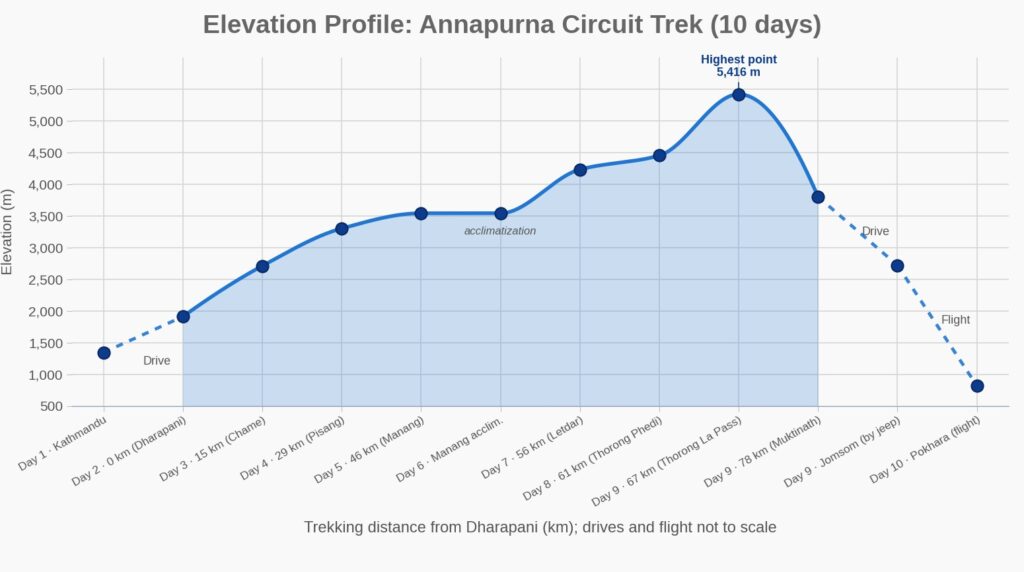 Annapurna Circuit Trek altitude profile: you sleep at Manang (3,540 m / 11,614 ft) for two nights, then cross Thorong La Pass (5,416 m / 17,769 ft) from Thorong Phedi (4,450 m / 14,600 ft).[/caption]
