Everest Base Camp Trek Without Lukla Flight (14 Days by Road)

14 Days

The Everest Base Camp Trek Without Lukla Flight is a 14-day guided trek that replaces the flight with a road journey into the Solu region. You drive from Kathmandu to Salleri on Day 1, continue toward Surke on Day 2 and trek to Phakding, where you join the classic Everest trail. It is an Everest Base Camp trek by road, with no domestic flight at any point.

From Phakding, the route follows the standard Everest Base Camp trail through Namche Bazaar, Tengboche and Dingboche. It includes acclimatization days in Namche and Dingboche, a visit to Everest Base Camp (5,364 m) and a sunrise hike to Kala Patthar (5,545 m). You return via Chaurikharka and Surke and drive back to Kathmandu.

This land-based approach suits trekkers who prefer to avoid domestic mountain flights while still completing the full Everest Base Camp itinerary. Price is USD 1,345 per person, with guide, porter, permits and tea houses included.

Key Facts: 14-Day Everest Base Camp Trek Without Lukla Flight
Cost
USD 1,345 per person
Deposit
20% to secure your spot, balance on arrival in Kathmandu
Duration
14 days (drive in, drive out), with 2 acclimatization days
Route type
Overland approach via Salleri and Surke, joining the main Everest trail at Phakding; return via Chauri Kharka
Difficulty
Moderate to challenging
Guided by
Certified, experienced local guide
Maximum altitude
5,545 m / 18,192 ft at Kala Patthar
Highest overnight stay
5,170 m / 16,961 ft at Gorak Shep
Everest Base Camp
5,364 m / 17,598 ft
Group size
Maximum 12 people
Daily walking
About 3 to 8 hours a day on the trail; two long driving days at the start and end (Kathmandu to Salleri and back)
Why go without a flight
No Lukla flight means no flight delays or cancellations, no pre-dawn departures from Ramechhap, and a gentler first day on the trail
Best season
Spring (March to mid-June) and Autumn (September to early December)
Highly recommended time
Mid-November to early December for clear skies and stable weather
Tour availability
All year round
Meeting point
Pickup from your hotel in Kathmandu
Transport
Private vehicle from Kathmandu to Salleri on Day 1 and from Salleri toward Surke on Day 2. On Day 13 you drive from Surke to Salleri, and on Day 14 from Salleri back to Kathmandu. The Salleri to Surke section is an partly paved mountain road, so landslides or rain can cause delays.
Accommodation
Tea houses and local lodges throughout (Kathmandu hotel not included)
Meals
Breakfast, lunch and dinner during the trek; lunch and dinner on Day 1; breakfast and lunch on Day 14
Fitness level
Moderate to good fitness required
Permits & fees
All required permits and entry fees included
Travel insurance
Required; must cover trekking up to 6,000 m and helicopter evacuation
Connectivity
Paid Wi-Fi and charging at most lodges; signal can be limited at higher altitudes
Equipment
Gear list provided; sleeping bag, down jacket, and duffel bag available for free rental
Safety
Strong safety standards with clear emergency and evacuation protocols. Guides check oxygen levels regularly at altitude, and we follow the rule of climb high, sleep low.

Use the tabs on this page to find all key information about the Everest Base Camp Trek Without Lukla Flight (14 days), including itinerary, departure dates, cost, inclusions, FAQs and more.

Overview

This 14-day Everest Base Camp trek begins with road access into the Solu region rather than a flight to Lukla. The journey starts with a full-day drive from Kathmandu to Salleri before continuing toward the trailhead and joining the main Everest route near Phakding.

From Namche Bazaar onward, the itinerary follows the established Everest Base Camp trail through Tyangboche, Dingboche, Lobuche and Gorak Shep. Acclimatization days are scheduled in Namche and Dingboche before proceeding to Everest Base Camp and Kala Patthar.

Beginning at a lower elevation spreads the initial altitude gain over more days compared to flying directly into Lukla. The overall trekking difficulty remains comparable to the standard Everest Base Camp route.

Accommodation is in locally operated teahouses throughout the trek.

Brief Itinerary

Day 1: Drive from Kathmandu (1,345 m / 4,413 ft) to Salleri (2,370 m / 7,775 ft)
Day 2: Drive toward Surke (2,290 m / 7,513 ft) and trek to Phakding (2,610 m / 8,563 ft)
Day 3: Trek to Namche Bazaar (3,440 m / 11,286 ft)
Day 4: Acclimatization in Namche Bazaar (3,440 m / 11,286 ft)
Day 5: Trek to Tyangboche (3,860 m / 12,664 ft)
Day 6: Trek to Dingboche (4,360 m / 14,304 ft)
Day 7: Acclimatization in Dingboche (4,360 m / 14,304 ft)
Day 8: Trek to Lobuche (4,940 m / 16,207 ft)
Day 9: Trek to Everest Base Camp (5,364 m / 17,598 ft) and return to Gorak Shep (5,170 m / 16,961 ft)
Day 10: Hike to Kala Patthar (5,545 m / 18,192 ft) and descend to Pheriche (4,270 m / 14,009 ft)
Day 11: Trek to Namche Bazaar (3,440 m / 11,286 ft)
Day 12: Trek to Chaurikharka (2,640 m / 8,661 ft)
Day 13: Trek to Surke (2,290 m / 7,513 ft), drive to Salleri (2,362 m / 7,749 ft)
Day 14: Drive back to Kathmandu (1,345 m / 4,413 ft)
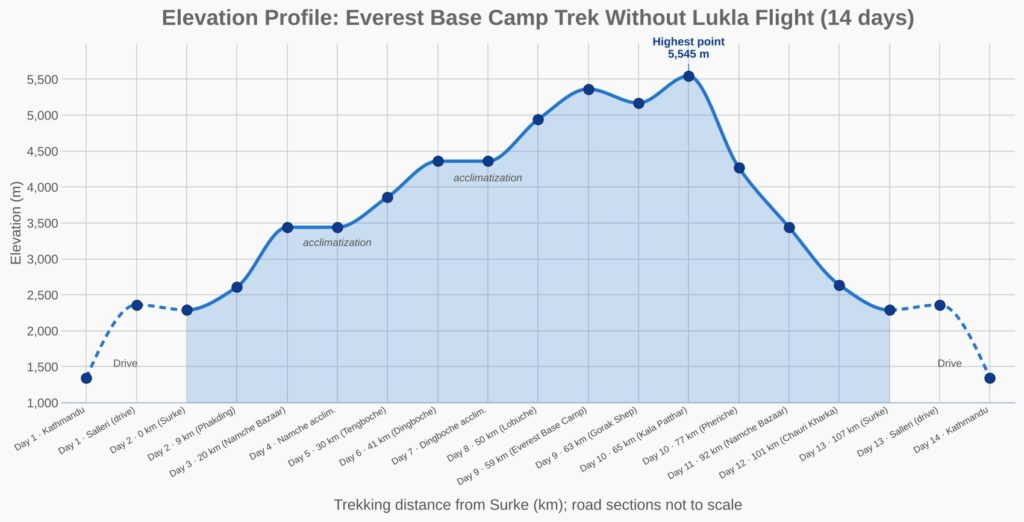
EBC Trek without Lukla flight 14 day elevation profile November 2026

Who this trek suits

  • Trekkers who want to avoid domestic mountain flights and weather-related flight delays
  • Travelers with 14 days who are happy to spend two days on mountain roads
  • Trekkers with moderate to good fitness who want the full Everest Base Camp route, including Kala Patthar
  • First-time Himalayan trekkers who want a longer, steadier build-up to altitude, with two acclimatization days

May not suit

  • Travelers short on time, since the drives add about two days compared with flying
    Anyone who gets severe motion sickness on winding roads
  • Trekkers who need a guaranteed schedule in monsoon, when the road can be blocked


Without Lukla flight (this trek)

With Lukla flight

Days

14

14

Flight needed

None

Kathmandu or Ramechhap to Lukla

Weather delay risk at the start

Low (road, not flight)

High in peak season

Road risk

Landslides on the Salleri–Surke road in monsoon

None

Drive

About 9 to 10 hr + 5 to 6 hr (one way)

None

First night

Salleri, 2,362 m

Phakding, 2,610 m

Best for

Trekkers who avoid mountain flights or dislike airport delays

Trekkers short on time

Why trekkers skip the Lukla flight

Many trekkers choose to skip the Lukla flight for practical reasons:

  • Weather delays. Flights to Lukla depend on clear mountain weather, and cancellations can leave trekkers waiting for days.
  • Early starts and airport changes. In busy seasons, flights may leave very early in the morning or from a different airport than Kathmandu.
  • Comfort with flying. The Lukla runway is short and sloped, and some trekkers prefer not to fly into it.
  • Cost. The Lukla flight is a separate cost on most itineraries. This trek does not need it.

The trade-off is two long driving days, one at the start and one at the end.

What does the road really look like?

Kathmandu to Salleri (Day 1, about 9 to 10 hours). Most of the road is paved and winding, with long stretches through hills and river valleys. Expect an early start and several rest stops.

Salleri to Surke (Day 2, about 5 to 6 hours). This section is mostly unpaved: narrow, steep in places, and bumpy. We use a 4WD jeep with an experienced driver.

Weather and delays. Heavy rain, especially in monsoon (June to August), can cause landslides and block the road. We check the road before every departure and adjust the plan if needed. On the way back, Day 13 includes a short walk from Chaurikharka to Surke before the drive to Salleri, and Day 14 returns to Kathmandu.

Tip: Bring motion-sickness tablets if you are prone to car sickness, and keep a small snack and water in your daypack.
Inclusion

  • All ground transportation as per the itinerary.
  • Accommodation during the trek in basic tea houses/lodges.
  • Three meals a day (breakfast, lunch, and dinner) during the trek.
  • Experienced, English speaking, government-licensed trekking guide.
  • Porter service (1 porter for every 2 trekkers).
  • Applicable permits
  • All applicable taxes and service charges.
  • Comprehensive first aid kit.
  • Insurance for guide and porters.

Exclusions

  • International airfare to and from Nepal.
  • Nepal entry visa fee.
  • Personal trekking gear and equipment.
  • Travel insurance (must cover high altitude trekking).
  • Tips for guides, porters, and drivers.
  • Personal expenses (drinks, laundry, phone calls).
  • Meals not specified in the itinerary.
  • Extra expenses due to unforeseen circumstances.

Itinerary

  • Day
    1

    Drive from Kathmandu to Salleri

    Altitude: 2,370 m / 7,775 ft
    Driving time: 9 to 10 hours

    Depart Kathmandu early and drive toward Salleri in the Solu region. The road passes through mid-hill towns, river valleys, and agricultural terraces before reaching Salleri. Overnight in a local lodge.

  • Day
    2

    Drive from Salleri to Surke, Trek to Phakding.

    Start altitude: 2,370 m / 7,775 ft
    End altitude: 2,610 m / 8,563 ft
    Driving time: 5 to 6 hours
    Walking time: 3 to 4 hours
    Distance: Approx. 8 to 10 km

    Continue by road toward Surke. From the road point, begin trekking along forested trails and local settlements before reaching Phakding along the Dudh Koshi River.

  • Day
    3

    Trek from Phakding to Namche Bazaar

    Altitude: 3,440 m / 11,286 ft
    Walking time: 6 to 7 hours
    Distance: Approx. 10 to 12 km

    Follow the Dudh Koshi River, cross suspension bridges, and enter Sagarmatha National Park. A steady ascent leads to Namche Bazaar.

  • Day
    4

    Acclimatization Day in Namche Bazaar

    Altitude: 3,440 m / 11,286 ft
    Optional hike altitude: Up to 3,880 m / 12,729 ft
    Walking time: 3 to 4 hours optional

    Short acclimatization hike toward higher viewpoints before returning to Namche for the night.

  • Day
    5

    Trek from Namche Bazaar to Tyangboche

    Altitude: 3,860 m / 12,664 ft
    Walking time: 5 to 6 hours
    Distance: Approx. 9 to 10 km

    The trail contours above the valley before descending and climbing toward Tyangboche Monastery.

  • Day
    6

    Trek from Tyangboche to Dingboche

    Altitude: 4,360 m / 14,305 ft
    Walking time: 5 to 6 hours
    Distance: Approx. 10 to 11 km

    Descend to the river, cross into the Imja Valley, and continue gradually upward toward Dingboche.

  • Day
    7

    Acclimatization Day in Dingboche

    Altitude: 4,360 m / 14,305 ft
    Optional hike altitude: Up to 4,900 m / 16,076 ft
    Walking time: 3 to 4 hours optional

    Short acclimatization hike before returning to Dingboche.

  • Day
    8

    Trek from Dingboche to Lobuche

    Altitude: 4,940 m / 16,207 ft
    Walking time: 5 to 6 hours
    Distance: Approx. 8 to 9 km

    Gradual ascent toward Thukla Pass and continue along glacial terrain to Lobuche.

  • Day
    9

    Trek from Lobuche to Gorakshep and Everest Base Camp

    Base Camp altitude: 5,364 m / 17,598 ft
    Overnight altitude: 5,170 m / 16,961 ft
    Walking time: 7 to 8 hours
    Distance: Approx. 12 to 14 km

    Trek to Gorakshep and continue to Everest Base Camp. After spending time at Base Camp, return to Gorak Shep for the night.

  • Day
    10

    Hike up to Kalapatthar, Trek to Pheriche

    Highest altitude: 5,545 m / 18,192 ft
    Overnight altitude: 4,270 m / 14,009 ft
    Walking time: 7 to 8 hours
    Distance: Approx. 13 to 14 km

    Early ascent to Kalapatthar. Descend to Gorakshep and continue downhill toward Pheriche.

  • Day
    11

    Trek from Pheriche to Namche Bazaar

    Altitude: 3,440 m / 11,286 ft
    Walking time: 6 to 7 hours
    Distance: Approx. 14 to 15 km

    Descend through Pangboche and Tyangboche before returning to Namche Bazaar.

  • Day
    12

    Trek from Namche Bazaar to Chaurikharka

    Walking time: 6 to 7 hours
    Trekking distance: Approx. 14 km

    Retrace the main trail down from Namche Bazaar, crossing the Dudh Koshi on the high suspension bridges to Jorsalle and leaving Sagarmatha National Park at Monjo. Continue through Phakding and Ghat, then climb gently to Chheplung. Here, instead of going up to Lukla, take the lower trail to Chaurikharka, a quiet Sherpa village of farms and stone houses and set up for the next day's descent to Surke.

  • Day
    13

    Trek from Chaurikharka to Surke, drive to Salleri

    Walking time: 2 to 3 hours
    Driving time: 5 to 6 hours
    Trekking distance: Approx. 5 km

    Leave Chaurikharka on the trail that drops steadily through terraced fields, forest and small farming settlements to Surke. It’s a short, easy walk, with your last views back toward the Khumbu. At Surke, meet the road and drive by jeep to Salleri, the district headquarters of Solukhumbu, for the night.

  • Day
    14

    Drive back to Kathmandu

    Driving time: 9 to 10 hours

    Return to Kathmandu by road. Arrival time depends on traffic and road conditions.

Frequently Asked Questions

About this route

Why trek Everest Base Camp without the Lukla flight?

This trek removes the Lukla flight and its weather delays by driving from Kathmandu to Salleri and Surke, then walking to Phakding. You avoid mountain flights and early-morning airport departures. The trade-off is two long driving days.

Can you drive all the way to Everest Base Camp?

No. Roads reach Salleri and Surke in the Solu region, but the final route to Everest Base Camp (5,364 m) on the Nepal side is on foot. This trek drives to Surke, then walks about 9 days to Everest Base Camp and Kala Patthar. (North Base Camp in Tibet can be reached by road, but needs Chinese permits/visa and is a different trip.)

How is it different from the classic Everest Base Camp trek?

The trail from Phakding to Everest Base Camp is the same, so difficulty is similar. The differences are the road approach at the start and the Chaurikharka return instead of a flight back from Lukla.

Is it safer than flying to Lukla?

It removes flight risk and weather delays, but adds road risk on the unpaved Salleri–Surke section, especially in monsoon. Both routes are safe with an experienced driver and a flexible schedule.

Road and logistics

How long is the drive?

Kathmandu to Salleri takes about 9 to 10 hours, and Salleri to Surke about 5 to 6 hours. The first part is paved; the second is mostly unpaved. The same route returns on Days 13 and 14.

What vehicle do you use?

Private 4WD jeep for your group.

What happens if the road is blocked?

We check the road before each departure. If a landslide blocks it, we adjust the schedule or arrange an alternative start (Lukla flight), and the guide decides on the safest option.

When is the road open?

The route is best from October to early December and March to May. We do not recommend the drive in monsoon (June to August).

Difficulty, fitness and altitude

How difficult is this trek?

Moderate to challenging, similar to the classic Everest Base Camp trek. You walk 3 to 8 hours a day, and Day 9 and Day 10 are the longest (7 to 8 hours each). You need moderate to good fitness but no climbing skills.

How do you manage altitude?

The itinerary includes two acclimatization days (Namche Bazaar and Dingboche) and follows "climb high, sleep low". Guides check oxygen levels regularly. Your first nights are lower (Salleri 2,362 m, Phakding 2,610 m), and the highest overnight is Gorak Shep at 5,170 m.

How should I prepare?

Train for 8 to 12 weeks with hiking, stair climbing and cardio, and practice long days with a daypack. For a week-by-week plan, see our Everest Base Camp training guide.

Cost, permits and booking

How much does the trek cost?

USD 1,345 per person (for 2 or more). It includes private transport, a licensed guide, 1 porter per 2 trekkers, tea houses, meals, permits and crew insurance. You travel insurance and tips are extra.

What permits are included?

All required permits and fees are included: Sagarmatha National Park permit and the Khumbu Pasang Lhamu Rural Municipality entry fee.

How do I book?

Choose a date, pay a 20% deposit and pay the balance on arrival in Kathmandu. Private departures are available on request.

Do I need travel insurance?

Yes, it is mandatory. It must cover trekking up to 6,000 m and helicopter evacuation.

What happens if there is a delay or bad weather?

The schedule has flexibility. Your guide adjusts the plan for road, weather or health reasons. Safety comes first.

What happens in an emergency?

Your guide carries a first aid kit and arranges the nearest safe descent. In serious cases, helicopter evacuation is possible from the Everest region. Your insurance must cover this.

Accommodation and food

What are the tea houses like?

Locally run tea houses, usually twin sharing and more basic at altitude. Hot showers, charging and Wi-Fi cost extra at higher stops.

Do you offer private departures?

Yes, on request.

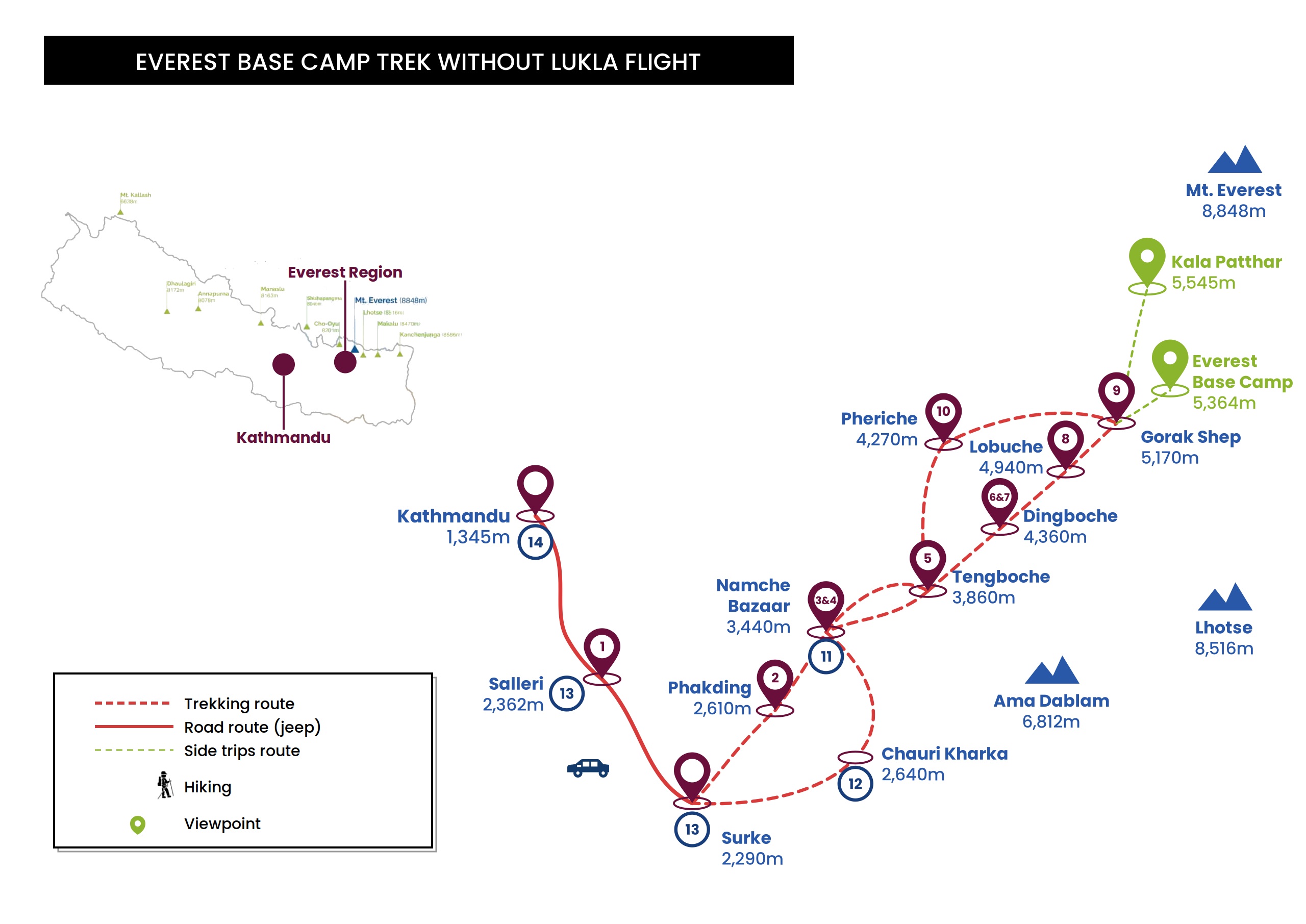
Everest Base Camp Trek Without Lukla Flight: Route Map

EBC Trek without Lukla flight 14 day map 2026

More Information: Everest Base Camp Trek Without Lukla Flight

Why walk in by road instead of flying to Lukla

The flight to Lukla is the weak point of the classic Everest Base Camp trek. It is often delayed or cancelled by cloud, and in the busy months flights leave in the dark from Ramechhap. On this trek you skip the airstrip altogether. You drive from Kathmandu to Salleri, the district headquarters of Solukhumbu, then by jeep to Surke, and you walk to Phakding to join the main Everest trail. A traveller on one of our trips told us that their Lukla flight was cancelled by the weather, and they switched to this route and still reached Base Camp. You also finish the trek on foot, and you bypass Lukla on the way back.

This trek and the Lukla-flight trek, side by side

Without the Lukla flight (this trip)With the Lukla flight
Days1414
How you startDrive Kathmandu to Salleri, then jeep to Surke and walk to PhakdingFly Kathmandu or Ramechhap to Lukla
Weather delay at the startLow. No flight to cancel.High in the peak seasons
Road riskLandslides can delay the Salleri to Surke road, mostly in the monsoonNone
DrivingAbout 9 to 10 hours at each end, plus 5 to 6 hours by jeep to and from SurkeNone
First nightSalleri, 2,370 m / 7,776 ftPhakding, 2,610 m / 8,563 ft
Last night on the trailChaurikharka, then SalleriLukla

The trade-off is two long days on the road. If you are short of time, or if you get very car sick, the flight may suit you better.

The road, in numbers

DaySectionVehicleTime
1Kathmandu to SalleriPrivate vehicle9 to 10 hours
2Salleri to Surke, then walk to Phakding4WD jeep, then on foot5 to 6 hours by jeep, then 3 to 4 hours on foot
13Chaurikharka to Surke on foot, then jeep to SalleriOn foot, then jeep2 to 3 hours on foot, 5 to 6 hours by jeep
14Salleri to KathmanduPrivate vehicle9 to 10 hours

The first part of the road, from Kathmandu to Salleri, goes through mid-hill towns and river valleys. The section from Salleri to Surke is mostly unpaved, with a few paved stretches, and is bumpy and winding. Our drivers know it well, and the jeep has four-wheel drive. Bring motion sickness tablets if you tend to get car sick, sit in the front if you can, and keep snacks and water in your daypack, not in the luggage.

If the road is blocked

Landslides and heavy rain can slow the Salleri to Surke road, and in the monsoon (June to August) it can be blocked for hours or days. We check the road before every departure, and we change the plan if we have to. We cannot promise the road will be open on a given day, which is why we recommend the dry seasons.

The best time to go

Spring (March to mid-June) and autumn (September to early December) are the trekking seasons. The best weather is from mid-November to early December, when the sky is clear and the weather is steady, though it is cold at night. Spring has warmer days and the rhododendron forests are in flower, but the mountains can be hazy. The page lists the tour as available all year, but we do not recommend the monsoon on this route because of the road. Winter is possible and cold, and some lodges at height close.

Altitude on this route: where the gains are big

The drive in is a gentle start, because you sleep in Salleri at 2,370 m / 7,776 ft, and your first walking night, in Phakding, is at 2,610 m / 8,563 ft. After that the trek follows the classic route, with two acclimatization days (Day 4 in Namche and Day 7 in Dingboche). Above 3,000 m we advise sleeping no more than 300 to 500 m higher than the night before. Two nights go beyond that:

NightSleeping altitudeGain from the night before
Day 3, Namche Bazaar3,440 m / 11,286 ftAbout 830 m. Day 4 is a rest day for this reason.
Day 5, Tyangboche3,860 m / 12,664 ftAbout 420 m
Day 6, Dingboche4,360 m / 14,304 ftAbout 500 m
Day 8, Lobuche4,940 m / 16,207 ftAbout 580 m, after the Dingboche rest day
Day 9, Gorak Shep5,170 m / 16,962 ftAbout 230 m
Day 10, Pheriche4,270 m / 14,009 ftYou go down about 900 m

The descent from Gorak Shep on Day 10 helps a lot. Our guides check your oxygen level and symptoms every day, and they follow the rule of climb high, sleep low. Know the warning signs: a headache that gets worse, nausea or vomiting, unusual tiredness, loss of balance, a wet cough or breathlessness at rest. Tell your guide early. Going down is the treatment, and altitude sickness can be fatal if it is ignored. One traveller on this route was evacuated by helicopter from Gorak Shep after becoming ill, and still spoke well of the trek. Please see your doctor before you book, especially if you have a heart or lung condition. This is general information and not medical advice.

What the trek asks of you

The trek is moderate to challenging. You walk about 3 to 8 hours a day, and the longest days are Day 9 (7 to 8 hours to Everest Base Camp and back to Gorak Shep) and Day 10 (7 to 8 hours down from Kala Patthar to Pheriche). The Kala Patthar climb starts before sunrise and is cold, and the summit is at 5,545 m / 18,192 ft. Moderate to good fitness is needed, and we advise you to train for several weeks before you come. Practice long walks with a daypack, hills and stairs.

Teahouses and food

You sleep in teahouses and local lodges, apart from Salleri, where the lodge is local and simple. Rooms are basic, with twin beds and blankets, and are not heated. The dining room is the only warm place. Toilets are shared, and above Namche they get simpler. Breakfast, lunch and dinner are included on the trek. On Day 1 you have lunch and dinner, and on Day 14 breakfast and lunch. Hot showers, charging and Wi-Fi are paid extras at most lodges, and the signal can be weak at height. Bottled water is not included, so bring a bottle and purification tablets or a filter.

Gear: what is lent and what you bring

You can borrow a sleeping bag, a down jacket and a duffel bag from us at no charge. You bring the rest: broken-in boots, layers, a hard-shell jacket, gloves, a warm hat, sunglasses, trekking poles, a head torch and a daypack. The gear list is on the page and we send it before you travel. One porter carries the bags of every two trekkers.

Guides, porters and group size

Your guide is a certified, English-speaking, government-licensed trekking guide. Travellers have named many of our guides in their reviews, and the nine reviews of this trip are all five stars. The group is a maximum of 12 people, and private departures are available for your own dates. Our guides and porters are insured by us.

Permits, insurance and the visa

All the required permits and entry fees are included in the price. The Nepal visa is not included: you can get a tourist visa on arrival or online, for USD 30 for 15 days, USD 50 for 30 days or USD 125 for 90 days. Please check the current fees before you travel. Travel insurance is required and is not included. It must cover trekking up to 6,000 m and helicopter evacuation. Please read the policy in detail and check the maximum altitude in writing.

Booking, deposit and payment

The price is USD 1,345 per person. You secure your place with a 20% deposit, and you pay the balance when you arrive in Kathmandu. Click "View dates and book" to choose a date, or ask us for a private departure. Please read our terms and conditions for the cancellation policy.

On the day you come back to Kathmandu

The drive from Salleri to Kathmandu on Day 14 takes 9 to 10 hours, and the arrival time depends on the traffic and the road. Please do not book an onward or international flight for the evening of Day 14. We advise a flight on Day 15 or later. If the road is delayed, the extra nights in Kathmandu are at your own cost, and your insurance may cover some costs.

Keeping in touch

You can reach our office on WhatsApp at +977 982 381 6556 before the trip and when you have a signal. Tell your family that you may not have a signal for a few days at height.

Other Everest trips

If you want to fly to Lukla, we have the classic Everest Base Camp trek. If you want to fly back and save the long walk out, ask us about the Everest Base Camp trek with a helicopter return. If you want a longer trip, ask us about the Everest Base Camp and Gokyo Lakes trek.

Last updated: November 2026. Road conditions, fees and entry rules can change, so please confirm the current details with us when you book.