Khopra Danda Trek: 8 Days from Pokhara

8 Days
The Khopra Danda trek (also called Khopra Dada or Khopra Ridge) is a loop through the Annapurna hills, from Ghandruk to the high ridge at Khopra, a day trip to holy Khayer Lake, and back via Swanta, Ghorepani and Poon Hill. We run it over 8 days with two nights at Khopra, so your body has time to adjust to the height. It is a private trip for your own group, minimum 2 people, with a licensed local guide and a porter. The price is USD 645 per person and includes permits, private transfers, lodges and meals on the trail.

Key facts

ItemDetails
Duration8 days (7 nights), Pokhara to Pokhara
PriceUSD 645 per person
GroupPrivate, your own group. Minimum 2 people. We do not join groups together.
RouteGhandruk, Tadapani, Dobato, Chistibung, Khopra Danda, Khayer Lake (day trip), Swanta, Ghorepani, Poon Hill, Ulleri
Walking per dayAbout 3 to 10 hours (see itinerary)
Highest sleeping altitudeKhopra Danda, about 3,660 m / 12,008 ft
Highest pointKhayer Lake, about 4,600 m / 15,092 ft (day trip, if conditions allow)
DifficultyModerate to demanding. Long days, steep ground and altitude.
AccommodationTeahouses and community lodges, twin sharing, mostly shared bathrooms
MealsFull board on the trail. Breakfast not included on Day 1 and dinner not included on Day 8.
CrewLicensed local guide, and 1 porter for every 2 trekkers
Best seasonMarch to May and September to November
Starts / endsPokhara (hotel pickup on Day 1 and drop-off on Day 8)
IncludedPrivate transfers, permits, guide, porter, lodges, meals on the trail
Booking and paymentClick "View dates and book", choose the number of people (minimum 2) and pay a deposit of USD 145 per person. Pay the remaining USD 500 per person in cash to your guide.

The Khopra Danda Trek at a glance

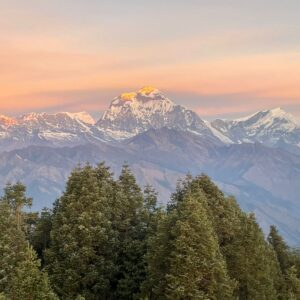
Khopra Danda is a high grassy ridge at about 3,660 m in the Annapurna region of western Nepal. The trail to it goes through rhododendron forests, Gurung and Magar villages and open hillside, and the lodge at the top faces Annapurna South, Annapurna I and Dhaulagiri. People often compare it with the Poon Hill trek, and it shares part of the same ground, but it goes much higher and further. It tends to be quieter than the main Annapurna routes, though Ghandruk and Poon Hill can be busy in the high season.

We start from Ghandruk by road, which keeps the first day easy, and we finish with Poon Hill sunrise on the last morning, when you have walked for a week and your legs and lungs are ready for it. The 8 days include two nights at Khopra Danda. Khayer Lake is a long, high day trip on the middle day, and the guide decides on the day whether to go.

Highlights

  • Khopra Danda ridge at about 3,660 m, with the Annapurna and Dhaulagiri ranges in front of the lodge
  • Muldai viewpoint at sunrise on Day 3, and Poon Hill sunrise on Day 8
  • Khayer Lake, a holy lake at about 4,600 m (weather and health allowing)
  • Rhododendron forests, in flower in March and April
  • Gurung and Magar villages: Ghandruk, Swanta and the villages on the way down to Ulleri
  • Two nights at Khopra, so the Khayer Lake day is not a rush
  • A private trip: your own group, your own guide and porter, no joining with strangers

Eight days in one line each

  • Day 1: Drive Pokhara to Ghandruk, trek to Tadapani
  • Day 2: Tadapani to Dobato
  • Day 3: Muldai viewpoint, then trek to Chistibung
  • Day 4: Trek to Khopra Danda
  • Day 5: Day trip to Khayer Lake
  • Day 6: Khopra Danda to Swanta
  • Day 7: Swanta to Ghorepani
  • Day 8: Poon Hill sunrise, trek to Ulleri, drive to Pokhara
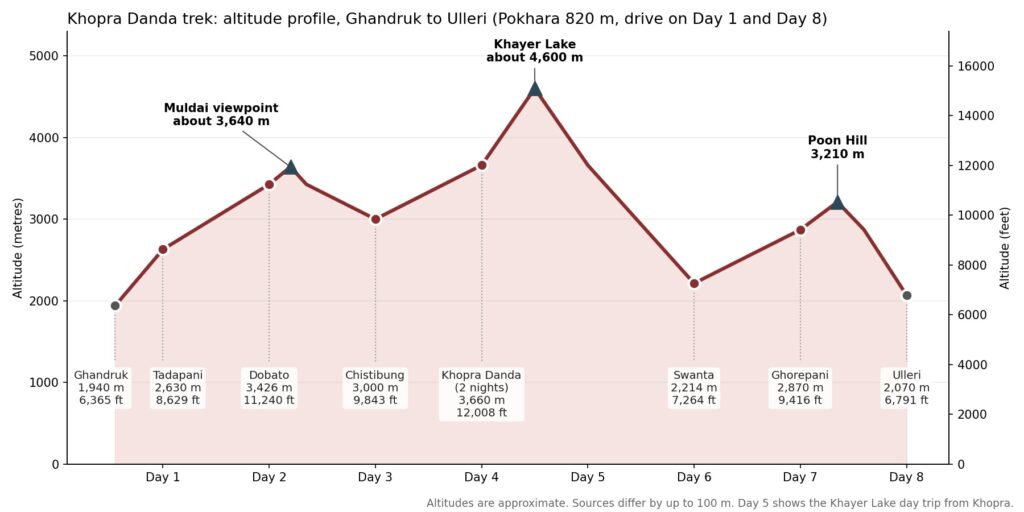
Altitude profile of the 8-day Khopra Danda trek from Ghandruk over Khopra Danda, Khayer Lake and Poon Hill to Ulleri
The trail from Ghandruk to Ulleri, with the Khayer Lake day trip and Poon Hill. Altitudes are approximate.

Who is this trek for?

  • Good for: people who are fit and have walked for several days in the hills before, or who are ready to put in the training. Couples, friends, and families with teenagers who are strong walkers.
  • Think again if: you have heart or lung problems, you have had altitude sickness before, or you cannot walk 5 to 6 hours a day on steep trails with a daypack. Talk to your doctor first.
  • Not for: people who want a very easy walk. Day 5 is up to 10 hours, and Day 6 and Day 8 are long steep descents.

Why trek with Mosaic Adventure?

  • We are a local company, owned and run by people from Nepal, and our guides are licensed, local, English-speaking and insured
  • Guides are trained in wilderness first aid, emergency handling, our code of conduct and customer service
  • Our first aid kit includes a pulse oximeter, Diamox, general medicines, a thermometer, plasters and other first aid items
  • Private trips only, for your own group of 2 or more
  • Clear price with permits, transfers, lodges, meals, guide and porter included
  • You can message us on WhatsApp before you book: +977 982 381 6556

Included

  • Private transfer from Pokhara to Ghandruk (Day 1) and from Ulleri to Pokhara (Day 8)
  • Licensed, English-speaking local guide
  • Porter (1 porter for every 2 trekkers)
  • Annapurna Conservation Area permit and TIMS card
  • Lodges and teahouses on the trail, twin sharing
  • Meals on the trail: breakfast, lunch and dinner every day, except breakfast on Day 1 and dinner on Day 8
  • Guide and porter salary, food, lodging, insurance and equipment
  • First aid kit with pulse oximeter, Diamox, thermometer, plasters and general medicines
  • All government taxes and our service charge

Not Included

  • Hotels in Pokhara before and after the trek (we can book them for you)
  • Travel to Pokhara, and flights to Nepal
  • Nepal visa fee
  • Travel insurance with emergency evacuation (required)
  • Drinks, including bottled water, tea, coffee and alcohol
  • Hot showers, device charging and wifi where lodges charge for them
  • Tips for the guide and porter
  • Personal trekking gear, and a sleeping bag if you need to rent one
  • Rescue and helicopter costs
  • Extra costs from delays or changes outside our control, such as landslides, bad weather or strikes

Khopra Danda Trek Itinerary: Day by Day

  • Day
    01

    Drive from Pokhara to Ghandruk, trek to Tadapani

    We pick you up from your hotel in Pokhara after breakfast and drive to Ghandruk, a big Gurung village on the hillside with stone-paved lanes, about 3 hours by road. After a cup of tea you start walking. The trail climbs through the village, then through rhododendron and oak forest to Tadapani, a small settlement in the forest on a ridge. If the sky is clear, Annapurna South, Hiunchuli and Machhapuchhre show up in the evening. It is an easy first day for the legs, and the lunch stop gives you time to settle into the walking pace.

    • Drive: Pokhara to Ghandruk, about 3 hours
    • Walking: Ghandruk to Tadapani, about 3 to 4 hours
    • Altitude: Ghandruk 1,940 m / 6,365 ft to Tadapani 2,630 m / 8,629 ft, up 690 m
    • Sleep: teahouse in Tadapani, 2,630 m / 8,629 ft
    • Meals: lunch and dinner (breakfast not included on this day)

  • Day
    02

    Trek from Tadapani to Dobato

    A long day, and the first one that really tests you. You leave the forest of Tadapani and follow the trail up and down through thick rhododendron and bamboo forest, with a few stretches where the path is rough and can be muddy or slippery after rain. In spring the whole hillside is red and pink. After lunch the forest thins out and you climb to Dobato, a simple lodge on an open ridge. Walk slowly today, drink water often, and tell your guide how you feel. This is the first night above 3,000 m.

    • Walking: about 5 to 6 hours
    • Altitude: Tadapani 2,630 m / 8,629 ft to Dobato 3,426 m / 11,240 ft, net up 796 m (the trail has extra ups and downs)
    • Sleep: lodge in Dobato, 3,426 m / 11,240 ft
    • Meals: breakfast, lunch and dinner

  • Day
    03

    Morning hike to Muldai viewpoint, trek to Chistibung

    We get up early and walk up to the Muldai viewpoint, a short climb from Dobato with a wide view of the Annapurna and Dhaulagiri ranges, and sunrise if the sky is clear. You come back to the lodge for breakfast, pack up, and walk on along the ridge. The trail goes through open pasture and forest and down to Chistibung. The day is shorter than yesterday, so you reach the lodge with time to rest.

    • Walking: Muldai about 2 hours round trip, then Dobato to Chistibung about 4 hours
    • Altitude: Muldai about 3,640 m / 11,942 ft (hike from Dobato, about 200 m up and back), then down to Chistibung about 3,000 m / 9,843 ft, down 426 m from Dobato
    • Sleep: lodge in Chistibung, about 3,000 m / 9,843 ft
    • Meals: breakfast, lunch and dinner

  • Day
    04

    Trek to Khopra Danda

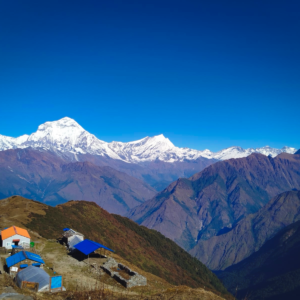
    From Chistibung the trail climbs steadily on open hillside to Khopra Danda (also written Khopra Dada, and called Khopra Ridge by many trekkers). The walk is short, about 3 to 4 hours, and we do it that way on purpose, so you arrive early in the day and can rest at height before the long day tomorrow. Khopra sits on a wide, windswept ridge, with Annapurna South, Annapurna I, Dhaulagiri, Nilgiri and Machhapuchhre in front of the lodge. It is cold up here at night. In the colder months, water left in your room can freeze overnight.

    • Walking: about 3 to 4 hours
    • Altitude: Chistibung about 3,000 m / 9,843 ft to Khopra 3,660 m / 12,008 ft, up 660 m
    • Sleep: community lodge at Khopra Danda, 3,660 m / 12,008 ft (2 nights)
    • Meals: breakfast, lunch and dinner

  • Day
    05

    Day trip to Khayer Lake

    This is the hardest and the highest day of the trip. After an early breakfast you walk up the ridge and across open slopes to Khayer Lake, a small holy lake at about 4,600 m, also called Khayar Tal. The trail is steep in parts, and in cold months snow and ice can cover the path, so poles are useful. You carry a daypack with lunch, water and warm clothes, and we pack your lunch from the lodge. Your guide decides the turning-back time, and if the weather is bad or you are not feeling well, we turn back or skip the lake and rest at Khopra instead. There is no shame in that. The views from the ridge are good with or without the lake. You come back to the same lodge for a second night at Khopra.

    • Walking: about 8 to 10 hours round trip
    • Altitude: Khopra 3,660 m / 12,008 ft up to Khayer Lake about 4,600 m / 15,092 ft and back, up and down about 940 m (sources put the lake between 4,500 m and 4,660 m)
    • Sleep: community lodge at Khopra Danda, 3,660 m / 12,008 ft
    • Meals: breakfast, packed lunch and dinner

  • Day
    06

    Trek from Khopra Danda to Swanta

    Today is mostly downhill, and long. You leave the ridge and descend through pasture, then oak and rhododendron forest, to the Gurung and Magar village of Swanta, where the air feels much warmer after the nights at Khopra. The knees will tell you about it, so use your poles, take small steps, and rest on the way. Swanta is a quiet village with terraced fields around it, and it is a good place to sleep well.

    • Walking: about 5 to 6 hours
    • Altitude: Khopra 3,660 m / 12,008 ft down to Swanta 2,214 m / 7,264 ft, down 1,446 m
    • Sleep: teahouse in Swanta, 2,214 m / 7,264 ft
    • Meals: breakfast, lunch and dinner

  • Day
    07

    Trek from Swanta to Ghorepani

    A steady climb out of the valley through villages, terraces and rhododendron forest, and a long uphill after lunch to Ghorepani, a busy trekkers' village on the main Poon Hill route. After the quiet of Khopra and Swanta you will see many more people here. Take your time on the stone stairs near the end of the day. Ghorepani has more lodges and a wider choice of food than anywhere else on this route, and hot showers and wifi are usually available for a fee. It can be crowded in the main season, so we recommend an early night, because Poon Hill is tomorrow before sunrise.

    • Walking: about 4 to 5 hours
    • Altitude: Swanta 2,214 m / 7,264 ft to Ghorepani 2,870 m / 9,416 ft, up 656 m
    • Sleep: teahouse in Ghorepani, 2,870 m / 9,416 ft
    • Meals: breakfast, lunch and dinner

  • Day
    08

    Poon Hill sunrise, trek to Ulleri, drive to Pokhar

    We leave the lodge very early, in the dark, with headtorches and warm clothes, and climb for about an hour to Poon Hill. Dawn lights up Dhaulagiri, Tukuche, Annapurna South, Annapurna I and Machhapuchhre, one after another. After the view we go back to the lodge for breakfast and pack up, then start the long descent on the stone steps to Ulleri, through forest and past villages. The steps are steep and hard on the knees. From Ulleri, our private vehicle takes you to Pokhara. You reach Pokhara in the afternoon, and the trip ends there. Have a spare day? Our Full Day in Pokhara tour is a good way to rest your legs.

    • Walking: Poon Hill about 1 hour up and 40 minutes down, then Ghorepani to Ulleri about 3 hours
    • Altitude: Ghorepani 2,870 m / 9,416 ft to Poon Hill 3,210 m / 10,531 ft and back, then down to Ulleri 2,070 m / 6,791 ft, down 800 m for the day
    • Drive: Ulleri to Pokhara, about 2 to 3 hours
    • Meals: breakfast and lunch (dinner not included on this day)

Physical Preparation for the Khopra Danda Trek

This is a moderate to demanding trek. There is no technical climbing, but you walk 4 to 6 hours most days, one day is up to 10 hours, and you spend 3 nights above 3,000 m (2 of them at about 3,660 m). The steep stone steps and the long descents on Day 6 and Day 8 are what catch people out. Good preparation makes the trek far more enjoyable. Start at least 8 to 12 weeks before.

What the trek asks of your body

  • Stamina: 4 to 6 hours of walking on 6 days, and 8 to 10 hours on Day 5 (Khayer Lake)
  • Strong legs for climbing: Day 2 gains about 800 m, and Day 4 about 660 m
  • Strong legs for descending: Day 6 drops about 1,450 m and Day 8 about 800 m, on steps and rough path
  • Breathing at altitude: you sleep at 3,000 to 3,660 m, and go up to about 4,600 m on Day 5
  • Cold tolerance: nights at Khopra are cold in every season

A simple 12-week plan

WeeksWhat to doHow often
1 to 4Build a base. Brisk walking, cycling, swimming or running, 40 to 60 minutes. Add stairs or a hill walk once a week.3 to 4 days a week
5 to 8Longer walks with a loaded daypack (5 to 7 kg), on hills if you can. Build up to 3 to 4 hours. Add squats, lunges and step-ups for the legs.4 days a week, one long walk
9 to 11Back-to-back long days: 4 to 5 hours on Saturday and 3 to 4 hours on Sunday, with your boots and pack. Practise going downhill with poles.4 to 5 days a week
12Ease off. Short walks, stretching and rest. Check your gear and break in your boots.2 to 3 easy days

Training tips that work

  • Train going downhill. Most knee and thigh pain on this trek comes from the descents, not the climbs. Stair descents, step-downs and walking downhill with poles all help.
  • Walk in your boots and your pack, so you know where your feet rub before you get to Nepal.
  • Use poles. Practise with them. They take a lot of load off the knees on Day 6 and Day 8.
  • Do some long days. If you can walk 6 hours on a weekend and feel fine the next morning, you are in good shape for this trek.
  • Altitude cannot be trained at home. Fitness helps, but fit people also get altitude sickness. The slow pace, the rest at Khopra and honest talk with your guide are what protect you.

Talk to your doctor

See your doctor before you book, and tell them you will sleep at about 3,660 m and go up to about 4,600 m. This is especially important with heart, lung, blood pressure or blood conditions, diabetes, pregnancy, or if you have had altitude sickness before. This page is general information and not medical advice.

Khopra Danda Trek: Frequently Asked Questions

Price and booking

How much is the Khopra Danda trek?

USD 645 per person for 8 days from Pokhara to Pokhara, for a private group of 2 or more. The price includes private transfers to and from the trail, a licensed guide, a porter (1 for every 2 trekkers), permits, lodges and meals on the trail, except breakfast on Day 1 and dinner on Day 8.

What is included in the Khopra Danda trek price?

Private transfers from Pokhara to Ghandruk and from Ulleri to Pokhara, the ACAP permit and TIMS card, a licensed local guide, a porter for every 2 trekkers, lodges, full board meals on the trail (except breakfast on Day 1 and dinner on Day 8), the first aid kit, and taxes. Hotels in Pokhara, drinks, tips, travel insurance and your visa are not included.

What is not included?

Hotels in Pokhara before and after the trek (we can book them), your visa, travel insurance, drinks, paid showers, charging and wifi, tips for the guide and porter, personal gear, and rescue costs. You also need to get yourself to Pokhara.

What is the minimum group size?

The minimum is 2 people. The trek is private and runs for your own group, and we do not join separate groups or strangers together. If you are travelling alone, message us and we will tell you what is possible.

Can I choose my own dates?

Yes, in the trekking season. Because the trip is private, you pick the start date. March to May and September to November are best. Tell us your dates and we confirm.

How do I book and pay?

Click "View dates and book" on the trip page, choose your date and the number of people (minimum 2), and pay a deposit of USD 145 per person. You pay the remaining USD 500 per person in cash to your guide, in US dollars or in Nepali rupees converted at the current rate. The cancellation and refund rules are in our terms and conditions. You can also message us on WhatsApp at +977 982 381 6556 before you book.

How much is the deposit?

The deposit is USD 145 per person, paid when you book online. The remaining USD 500 per person is paid in cash to your guide on the trail. The total is USD 645 per person.

Can I pay the balance by card or bank transfer?

The balance of USD 500 per person is collected in cash by your guide, in US dollars or Nepali rupees. Please bring the cash with you. There are no ATMs on the trail, so get it in Pokhara or Kathmandu before you start.

The trek

How many days is the Khopra Danda trek?

Our trek is 8 days from Pokhara to Pokhara, with 7 nights on the trail and two nights at Khopra Danda. Some operators sell 5 to 7 day versions, but they leave less time to adjust to the altitude, and they often skip Khayer Lake.

How hard is the Khopra Danda trek?

It is moderate to demanding. There is no technical climbing, but the days are long (4 to 6 hours most days and up to 10 hours on Day 5), the trail is steep with many stone steps, and you sleep as high as about 3,660 m. The long descents on Day 6 and Day 8 are hard on the knees. If you have walked several days in the hills and train for it, it is a realistic trek.

Is Khopra Danda harder than Poon Hill?

Yes. The Poon Hill trek stays below about 3,200 m and is shorter. The Khopra Danda trek goes to about 3,660 m with a day trip to about 4,600 m, and the trail is rougher and less busy. Our itinerary also ends with Poon Hill on Day 8.

What is the highest point on the Khopra Danda trek?

Khayer Lake, at about 4,600 m (sources give between 4,500 m and 4,660 m), is the highest point and is a day trip from Khopra. The highest place you sleep is Khopra Danda, at about 3,660 m.

What is the difference between Khopra Danda, Khopra Dada and Khopra Ridge?

They are the same place. Danda (or Dada) means ridge or hill in Nepali. Many trekkers call it Khopra Ridge.

Do we have to go to Khayer Lake?

No. It is optional, and your guide decides on the day. We turn back or skip the lake if you feel unwell, if snow or ice is on the path, or if the weather is bad. You still enjoy the views from Khopra, and the second night at Khopra gives you a rest.

What is Khayer Lake like?

A small holy lake at the foot of Annapurna South, at about 4,600 m. The walk to it is long and steep, and in cold months the path can be covered with snow and ice. The walk and the mountain scenery are as much the reason to go as the lake itself.

Season and weather

When is the best time to do the Khopra Danda trek?

March to May and September to November. Spring has rhododendron flowers on the lower slopes. Autumn has the clearest air and mountain views. December to February is cold and snow can block the Khayer Lake path. We do not recommend June to August because of rain, leeches and cloud.

How cold does it get at Khopra?

It is cold in every season, and below freezing on most nights from late autumn to early spring. Bring a warm sleeping bag or ask us about renting one in Pokhara, a down jacket, a warm hat and gloves.

Is it safe to trek Khopra Danda in winter?

It can be done with the right gear and a guide, but snow can block the ridge and Khayer Lake, and the lodges are very cold. We do not recommend Khayer Lake in winter. Ask us before you book.

Health, safety and planning

Is there a risk of altitude sickness on the Khopra Danda trek?

Yes. You sleep at 3,426 m (Dobato), about 3,000 m (Chistibung) and 3,660 m (Khopra), and go up to about 4,600 m on Day 5. We plan a short walk on Day 4 and two nights at Khopra to help you adjust. Tell your guide at once about a headache, nausea, dizziness or poor sleep, and do not go higher with symptoms. If they get worse, you must go down. This is general information and not medical advice, so see your doctor before you book.

Do your guides carry a first aid kit?

Yes. Our first aid kit includes a pulse oximeter, Diamox, general medicines, a thermometer, plasters and other first aid items. Our guides are trained in wilderness first aid and emergency handling.

Should I take Diamox?

Ask your doctor before the trip. Diamox (acetazolamide) is a prescription medicine in many countries, and it does not replace a slow pace or listening to your body. Our guides carry it in the first aid kit and use their judgement with you on the trail.

Do I need travel insurance?

Yes. Insurance is not included. Your policy must cover trekking to at least 4,600 m, medical care and emergency evacuation by helicopter. A rescue from the trail can take many hours.

What happens if I get sick or injured?

Your guide looks after you with the first aid kit, and decides whether to rest, go down or call for help. Our guides are insured and trained in emergency handling. Serious cases need evacuation, which your insurance should cover.

Do I need a guide for the Khopra Danda trek?

Nepal now requires trekkers on the main routes to go with a registered company and a licensed guide, and the guide is also the safest option on this trail, which is less busy and has snow, steep slopes and few other trekkers. Your licensed guide is included.

How fit do I need to be?

You should be able to walk 5 to 6 hours a day for several days in a row, uphill and downhill, carrying a daypack. Start training at least 8 to 12 weeks before. See the physical preparation tab for a plan.

On the trail

What are the lodges like at Khopra?

Basic. Rooms are simple and cold, bathrooms are shared, and meals are cooked in the lodge. The lodge at Khopra is run by the community. Your guide handles the rooms.

What food will we eat?

Three meals a day in the lodges: breakfast (eggs, porridge, toast or pancakes), lunch and dinner (dal bhat, noodles, soup, fried rice, momo). Tell us about vegetarian or other food needs when you book. Menus get simpler higher up.

Can I charge my phone and get wifi?

At some lodges, for a fee. Wifi is slow, and not available everywhere. Mobile coverage is patchy. Bring a power bank.

What should I pack?

Boots you have worn, layers, a down jacket, waterproofs, a warm sleeping bag, a headtorch, poles, a daypack and your personal medicines. See the full list in the more info tab. Pack light: the porter carries bags for 2 trekkers.

How do I get to Pokhara?

From Kathmandu, you can fly (about 30 minutes) or go by tourist bus or private car (about 6 to 8 hours). We can arrange your hotels and transfers in Pokhara and the rest of your trip.

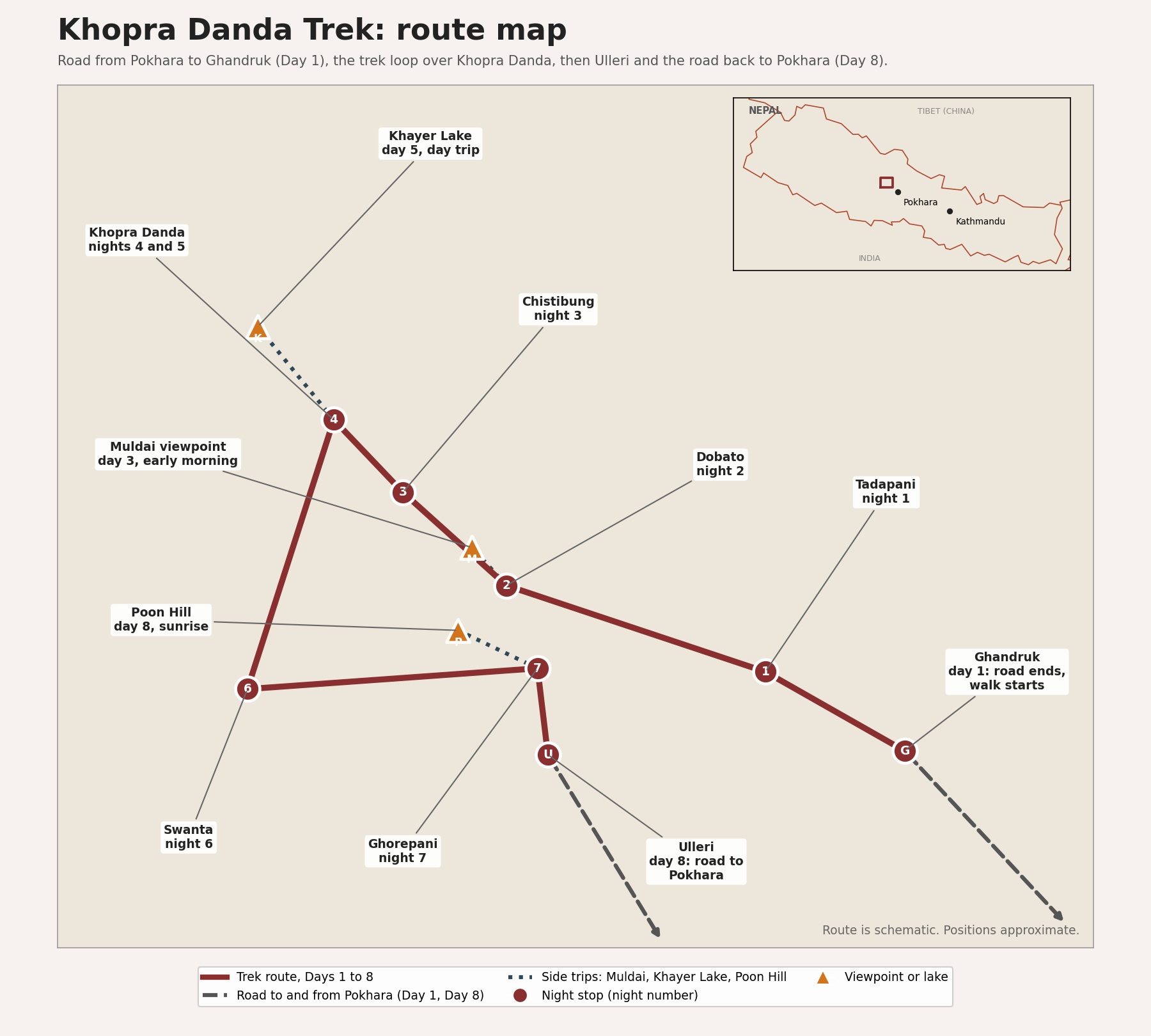
Khopra Danda Trek Route Map

Route map of the 8-day Khopra Danda trek in Nepal from Ghandruk over Dobato, Khopra Danda and Swanta to Ghorepani, Poon Hill and Ulleri, with Khayer Lake and an inset showing the trek location near Pokhara

Before You Go: Season, Altitude, Permits and Gear

Best time to trek

MonthsConditionsNotes
March to MayRhododendrons in flower, mostly clear mornings, mild days and cold nights at the ridge. Cloud and haze build up by late May.Good season. Rhododendron forests on Days 1 to 3 are at their best in March and April.
September to NovemberClear air and good mountain views after the monsoon. Cold nights at the high lodges.Good season. October and early November have the clearest views, and also the most trekkers.
December to FebruaryCold, with snow on the ridge and the Khayer Lake path. Short days.Possible with proper gear, but snow can block the Khayer Lake path.
June to AugustMonsoon: rain, mud, leeches and cloud. The ridge is often in cloud.Best avoided. We do not recommend it.

Altitude and health

You sleep at 3,426 m (Dobato), about 3,000 m (Chistibung) and 3,660 m (Khopra, two nights), and the Khayer Lake day goes up to about 4,600 m. We plan the trip with a short walk on Day 4 and two nights at Khopra, so you have time to adjust before the lake day.

  • Walk slowly, drink 3 to 4 litres of water a day, and eat even if you do not feel hungry.
  • Tell your guide at once about a headache, nausea, dizziness, unusual tiredness or poor sleep. Do not go higher with symptoms. If they get worse, you must go down.
  • Your guide has a pulse oximeter and can check your oxygen level and pulse. It is a guide, not a diagnosis, and the guide decides whether you continue to Khayer Lake or not.
  • Our first aid kit includes Diamox (acetazolamide). Ask your doctor before the trip whether it is right for you. Diamox does not replace a slow pace, and it is not a reason to climb higher than the guide advises. It is a prescription medicine in many countries.
  • Travel insurance that covers trekking to at least 4,600 m and emergency evacuation (helicopter) is required. A rescue from the trail can take many hours.
  • This page is general information and not medical advice.

Permits and rules

  • Permits: the Annapurna Conservation Area permit (ACAP) and a TIMS card are needed for this route. We arrange them and they are included in the price. At the time of writing the fees are about NPR 3,000 (ACAP) and NPR 2,000 (TIMS), set by the Nepal authorities, who can change them.
  • Guide: Nepal now requires trekkers on the main trekking routes to go with a registered trekking company and a licensed guide. Your guide is included.
  • Leave no trace: carry your rubbish down, do not use plastic bottles if you can, and respect village customs. Our guides and porters follow our code of conduct.

Lodges, food and water

  • Rooms: simple twin-share rooms with a bed and blankets, and mostly shared bathrooms. Rooms at Khopra are basic and cold at night.
  • Meals: dal bhat, noodles, soup, eggs, momo, fried rice and pancakes are on every menu. Tell us about vegetarian or other food needs when you book. Menus get simpler higher up.
  • Water: bottled water is not sold on most of the route. Boiled or filtered water is sold at lodges. Bring a water bottle and purification tablets or a filter.
  • Charging and wifi: charging and hot showers may cost extra, and wifi is slow and not available at every lodge. Mobile coverage is patchy. Bring a power bank.
  • Money: there are no ATMs on the trail. Bring enough Nepali rupees for drinks, snacks, showers, charging and tips, and the USD 500 balance per person for your guide (in US dollars or Nepali rupees).

What to bring

  • Trekking boots that you have already worn, and warm socks
  • Base layers, fleece, down jacket, waterproof jacket and trousers
  • Warm hat, gloves, sun hat, sunglasses and sunscreen
  • A sleeping bag with a comfort rating of about -5 to -10°C, or ask us about renting one in Pokhara
  • Headtorch (you need it for the Poon Hill and Muldai starts), trekking poles and a water bottle
  • A daypack of 25 to 30 litres for what you carry, and a duffel bag for the porter. Pack light: plan about 10 kg per person for the porter.
  • Personal medicines, blister kit, hand sanitiser and toilet paper
  • Gaiters or a good pair of waterproof trousers if you go in the monsoon or winter

Getting to Pokhara

The trek starts and ends in Pokhara. From Kathmandu you can fly (about 30 minutes) or take a tourist bus or a private vehicle (about 6 to 8 hours). Hotels in Pokhara are not included, but we can arrange transfers, hotels and the rest of your Nepal trip. We can also help if you want to combine the trek with a day in Pokhara or a trip to Chitwan or Lumbini.

Nepal visa

Most visitors need a Nepal visa. You can apply online before you travel or get it on arrival at Kathmandu airport. At the time of writing a 15-day visa costs about USD 30 and a 30-day visa about USD 50. Check the Department of Immigration website for the current fees and rules.