Phobjikha Gangtey Valley Trek

11 Days

Bhutan on foot, with black-necked cranes in winter

An 11-day private Bhutan trip with a 3-day camping trek from the Phobjikha valley over Tselela Pass and Shobju La (3,400 m / 11,155 ft) to Chazam, plus Paro, Thimphu and Punakha.

You see Taktsang, the Tiger's Nest, the dzongs of Paro, Thimphu and Punakha, and the Phobjikha valley, where black-necked cranes spend the winter. You walk for 3 days through forest and across passes, camping on the trail. The altitude is moderate, with a highest point of about 3,400 m / 11,155 ft, and the days are 5 to 7 hours of walking.

USD 4,920 per person, for a private trip for 2 or more people on your own dates. The price includes the flights between Kathmandu and Paro, the Bhutan visa and Sustainable Development Fee, hotels, camping, all meals, a licensed guide and a private vehicle. You pay a 20% non-refundable deposit (USD 984 per person) to confirm. You pay the balance (USD 3,936 per person) in cash in US dollars when you arrive in Kathmandu, or by bank transfer at least 4 weeks before your trip date.

Last updated: November 2026.

Key facts: Phobjikha Gangtey Valley Trek

Plan
Duration
11 days: 3 days of trekking and 8 days of sightseeing and driving
Route
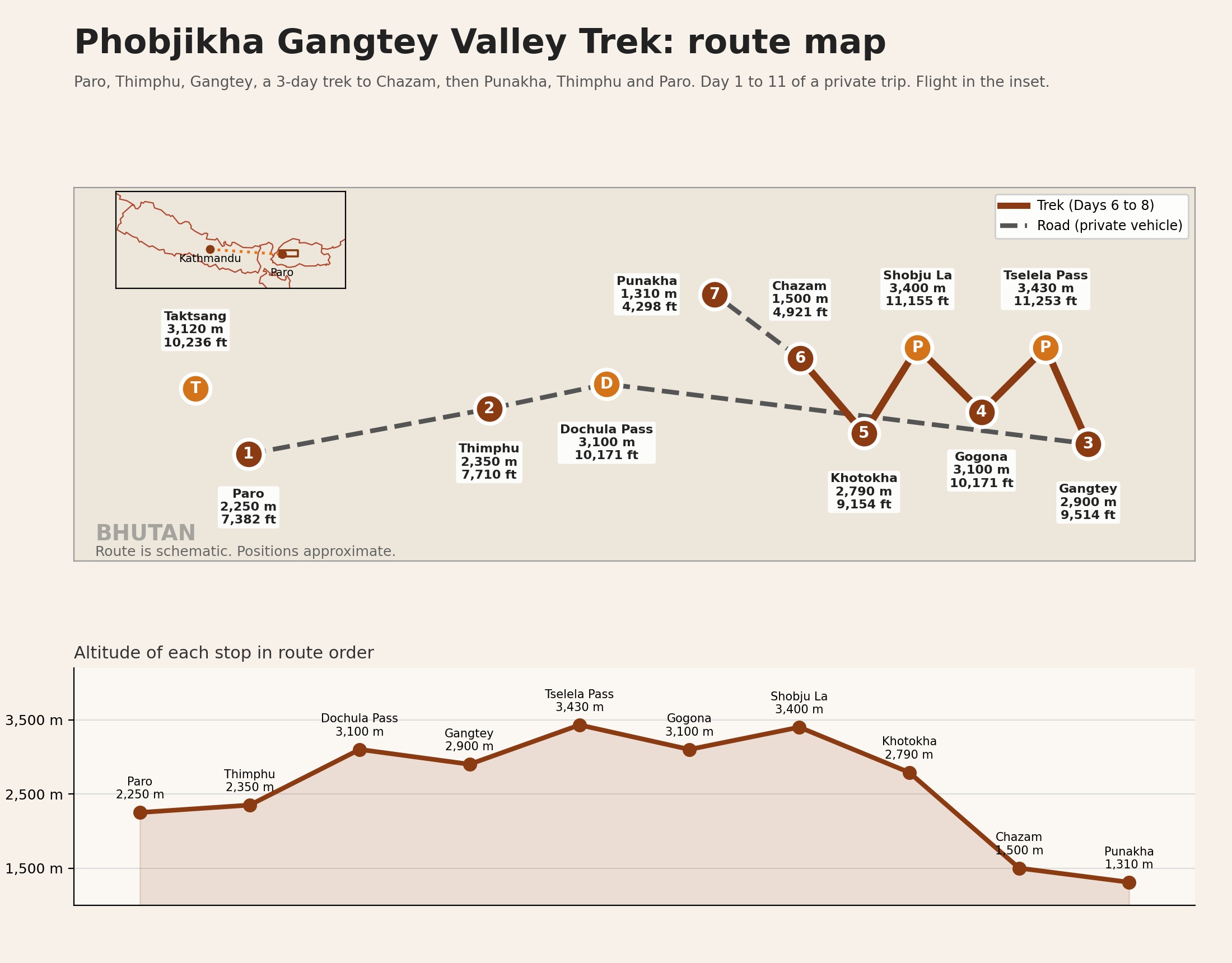
Paro, Thimphu, Gangtey (Phobjikha valley), Gogona, Khotokha, Chazam, Punakha, Thimphu, Paro
Highest point
Shobju La, about 3,400 m / 11,155 ft
Highest sleeping point
Gogona, 3,100 m / 10,171 ft
Starts and ends
Paro airport (flights from and to Kathmandu are included)
Grade
Easy to moderate. Long days of 5 to 7 hours on the trek.
Money
Price
USD 4,920 per person
Dates
Any date you choose. Private trip, no fixed departures.
Group size
Minimum 2 people
Deposit
20% non-refundable (USD 984 per person)
Balance
USD 3,936 per person, in cash in US dollars on arrival in Kathmandu, or by bank transfer at least 4 weeks before the trip date
Included
Flights Kathmandu to Paro and back, Bhutan visa and Sustainable Development Fee, hotels, camping, all meals, guide, vehicle, entry fees
Not included
Travel insurance, drinks, personal expenses, tips, Kathmandu hotel and meals
On the trip
Walking
The trek is about 15 km a day. Taktsang is a hike of about 4 hours.
Transport
Private vehicle with driver, sized to the group
Best seasons
March to May and September to November. Cranes are in the valley from late October to February.
Lodging
Hotels in Paro, Thimphu, Gangtey and Punakha. Tents on Days 6 and 7.
Meals
All meals included. Drinks are not included.
Insurance
Required. Must cover trekking up to 4,000 m.

Use the tabs on this page for the overview, itinerary, inclusions, map, physical preparation, more information, FAQs and reviews.

Phobjikha Gangtey Valley Trek: Bhutan by Foot and by Road

The Phobjikha valley is a wide glacial valley in central Bhutan, at about 2,900 m / 9,514 ft, with the Gangtey Gompa monastery on a ridge above it. In winter, black-necked cranes fly in from Tibet and stay from late October to February. This 11-day trip combines the best of western Bhutan (Paro, Thimphu and Punakha) with a 3-day camping trek that starts in the valley, crosses Tselela Pass (about 3,430 m / 11,253 ft) and Shobju La (about 3,400 m / 11,155 ft), and ends at Chazam, near Wangdue Phodrang.

This is a private trip, so you choose the dates and the size of your group, from 2 people up. You fly from Kathmandu to Paro, hike to Taktsang, the Tiger's Nest, visit the dzongs and museums of Paro and Thimphu, drive over Dochula Pass to Gangtey, and walk for 3 days. After the trek you visit Punakha Dzong and drive back to Paro. The price covers the flights between Kathmandu and Paro, the Bhutan visa and the Sustainable Development Fee, hotels, camping, all meals, a licensed guide, a private vehicle and entry fees.

Phobjikha gangtey valley trek one line itinerary

Day 1: Fly Kathmandu to Paro, hotel (2,250 m / 7,382 ft)
Day 2: Paro sightseeing: National Museum, Rinpung Dzong, Drukgyel Dzong (2,250 m / 7,382 ft)
Day 3: Hike to Taktsang (about 4 h, 3,120 m / 10,236 ft), drive 60 km (1 to 1.5 h) to Thimphu (2,350 m / 7,710 ft)
Day 4: Thimphu sightseeing (2,350 m / 7,710 ft)
Day 5: Drive 150 km (5 to 5.5 h) over Dochula Pass (3,100 m / 10,171 ft) to Gangtey (2,900 m / 9,514 ft)
Day 6: Trek Gangtey to Gogona over Tselela Pass (3,430 m / 11,253 ft), 15 km, 6 to 7 h, camp (3,100 m / 10,171 ft)
Day 7: Trek Gogona to Khotokha over Shobju La (3,400 m / 11,155 ft), 15 to 16 km, 5 to 7 h, camp (2,790 m / 9,154 ft)
Day 8: Trek Khotokha to Chazam over Mulaila Pass (2,800 m / 9,186 ft), 5 to 7 h, then drive 1 h to Punakha (1,310 m / 4,298 ft)
Day 9: Punakha Dzong, drive 76 km (3 h) to Thimphu (2,350 m / 7,710 ft)
Day 10: Drive 56 km (1.5 h) to Paro (2,250 m / 7,382 ft)
Day 11: Transfer to Paro airport, fly to Kathmandu
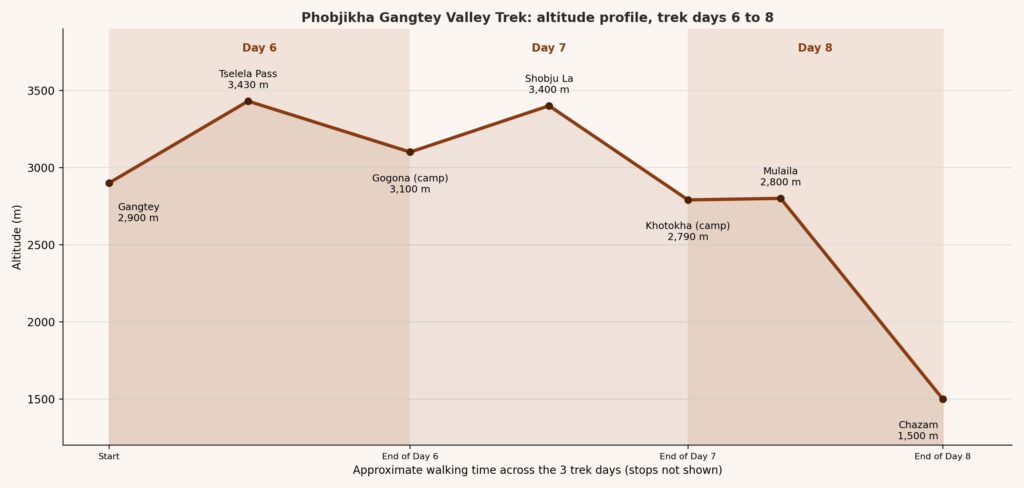
[caption id="attachment_29986" align="alignnone" width="910"]Altitude profile of the Phobjikha Gangtey Valley Trek over Tselela Pass and Shobju La, from Gangtey at 2,900 m to Chazam at 1,500 m Altitude profile of the 3 trek days: Gangtey (2,900 m / 9,514 ft), Tselela Pass (3,430 m / 11,253 ft), Gogona camp (3,100 m / 10,171 ft), Shobju La (3,400 m / 11,155 ft), Khotokha camp (2,790 m / 9,154 ft), Mulaila (2,800 m / 9,186 ft) and Chazam (1,500 m / 4,921 ft).[/caption]

Highlights

  • The hike to Taktsang, the Tiger's Nest, a monastery on a cliff about 900 m above the Paro valley
  • Dzongs and museums in Paro, Thimphu and Punakha, including Punakha Dzong, built in 1637
  • Dochula Pass (about 3,100 m / 10,171 ft), with views of the Himalaya on a clear day
  • The Phobjikha valley and Gangtey Gompa, with black-necked cranes from late October to February
  • A 3-day camping trek through rhododendron and fir forest, over two passes, away from the crowds
  • Shobju La (about 3,400 m / 11,155 ft), the highest point of the trek
  • A private trip on your own dates, with flights, visa, fees, meals and a guide included

Who it suits

This trip suits people who want to see Bhutan's culture and nature and are happy to walk for 5 to 7 hours a day for 3 days. It is easy to moderate: the altitude is modest (you sleep at no more than 3,100 m / 10,171 ft), but the days are long and the descent on Day 8 is steep, about 1,300 m. You do not need previous trekking experience, but you do need good fitness. Our guide manages the pace. Bhutan allows visitors only with a licensed guide, which is included.
Cost Includes

  • Flights from Kathmandu to Paro and from Paro to Kathmandu
  • Airport pickup and drop-off in Paro
  • Bhutan visa and processing fee
  • Bhutan Sustainable Development Fee (USD 100 per person per night) and other government fees and taxes
  • Hotels for 8 nights in Paro, Thimphu, Gangtey and Punakha, in government-approved hotels, double, twin or triple sharing
  • Camping on the trek (2 nights), with tents, mattresses, a dining tent, a cook and a kitchen crew, and staff to carry the camping gear
  • Private vehicle with driver for all transfers and sightseeing, sized to the group
  • English-speaking licensed Bhutanese guide
  • All meals during the trip (breakfast, lunch and dinner), and bottled water in the vehicle
  • Museum, temple and monument entry fees listed in the itinerary

Cost Excludes

  • Travel insurance. It is required, and it must cover trekking up to 4,000 m and medical evacuation.
  • International flights to and from Kathmandu, and your hotel and meals in Kathmandu
  • Drinks, including soft drinks, juice, tea, coffee and alcohol
  • Personal expenses, such as laundry, phone calls and shopping
  • Upgrades to higher-category hotels, which we can arrange on request
  • Tips for your guide, driver and trek crew, which are optional
  • Extra costs caused by weather, flight changes or road closures, such as extra nights or meals

Phobjikha Gangtey Valley Trek Itinerary: Day by Day

  • Day
    01

    Arrive in Paro (2,250 m / 7,382 ft)

    You fly from Kathmandu to Paro, and our guide meets you at Paro airport and takes you to your hotel. If there is time, you can walk around Paro town. Rest and get used to the height.

    • Flight Kathmandu to Paro included
    • Airport pickup included
    • Sleeping altitude: Paro, 2,250 m / 7,382 ft
    • Overnight: hotel in Paro

  • Day
    02

    Paro sightseeing (2,250 m / 7,382 ft)

    A day to see Paro with your guide. You visit the National Museum, Rinpung Dzong (the fortress monastery above the town) and the ruins of Drukgyel Dzong. The walking is light.

    • Walking: light, with some stairs
    • Sleeping altitude: Paro, 2,250 m / 7,382 ft
    • Overnight: hotel in Paro

  • Day
    03

    Hike to Taktsang, then drive to Thimphu (2,350 m / 7,710 ft)

    Today you hike to Taktsang (the Tiger's Nest), a monastery clinging to a cliff about 900 m above the valley, at about 3,120 m / 10,236 ft. The hike takes about 4 hours in total with a lunch break at a cafeteria on the way. It is a good test of your fitness and a gentle first step on the way up to the altitude of the trek. In the afternoon you drive about 60 km to Thimphu, about 1 to 1.5 hours.

    • Walking: about 4 hours, with a steady climb
    • Highest point: Taktsang viewpoint, about 3,120 m / 10,236 ft
    • Drive: about 60 km, 1 to 1.5 hours
    • Sleeping altitude: Thimphu, 2,350 m / 7,710 ft
    • Overnight: hotel in Thimphu

  • Day
    04

    Thimphu sightseeing (2,350 m / 7,710 ft)

    A day in the capital. Depending on the day of the week, you visit the National Library, the National Institute for Zorig Chusum (where students learn the 13 traditional arts), the National Memorial Chorten, Semthoka Dzong and Tashichhodzong. If you are here at the weekend, you can also see the vegetable market.

    • Walking: light
    • Sleeping altitude: Thimphu, 2,350 m / 7,710 ft
    • Overnight: hotel in Thimphu

  • Day
    05

    Drive to Gangtey, in the Phobjikha valley (2,900 m / 9,514 ft)

    You drive about 150 km to the Phobjikha valley, about 5 to 5.5 hours with stops. The road crosses Dochula Pass (about 3,100 m / 10,171 ft), where you can see the mountains on a clear day, and goes through Wangdue Phodrang. You arrive in Gangtey in the afternoon and, if there is time, you visit Gangtey Gompa. From late October to February, black-necked cranes winter in this valley.

    • Drive: about 150 km, 5 to 5.5 hours
    • Highest point on the road: Dochula Pass, about 3,100 m / 10,171 ft
    • Sleeping altitude: Gangtey, 2,900 m / 9,514 ft (about 550 m higher than Thimphu)
    • Overnight: hotel in Gangtey

  • Day
    06

    Trek from Gangtey to Gogona (3,100 m / 10,171 ft)

    The trek starts. After a visit to Gangtey Gompa you walk across the Phobjikha valley and climb through forest of rhododendron and fir to Tselela Pass (about 3,430 m / 11,253 ft), where you stop for lunch. Then you walk down through forest to the camp at Gogona. The day is about 15 km and takes 6 to 7 hours. Your crew sets up the tents.

    • Walking: about 15 km, 6 to 7 hours
    • Highest point: Tselela Pass, about 3,430 m / 11,253 ft
    • Sleeping altitude: Gogona, 3,100 m / 10,171 ft (about 200 m higher than Gangtey)
    • Overnight: tent

  • Day
    07

    Trek from Gogona to Khotokha (2,790 m / 9,154 ft)

    You climb to Shobju La (about 3,400 m / 11,155 ft), the highest point of the trek, and stop there for a well-earned lunch. Then you walk down through forest and past Chorten Karpo to the camp at Khotokha, a farming valley. The day is about 15 to 16 km and takes 5 to 7 hours.

    • Walking: about 15 to 16 km, 5 to 7 hours
    • Highest point: Shobju La, about 3,400 m / 11,155 ft
    • Sleeping altitude: Khotokha, 2,790 m / 9,154 ft (about 310 m lower than Gogona)
    • Overnight: tent

  • Day
    08

    Trek from Khotokha to Chazam, drive to Punakha (1,310 m / 4,298 ft)

    The last trek day. You climb to Mulaila Pass (about 2,800 m / 9,186 ft) and then descend steeply, about 1,300 m, through forest to the bridge at Chazam, near Tikke Zampa (about 1,500 m / 4,921 ft), where your vehicle meets you. The day takes 5 to 7 hours. There is very little water on the trail, so carry enough. Then you drive to Punakha, about 1 hour, to a hotel and a hot shower.

    • Walking: about 12 to 16 km, 5 to 7 hours
    • Highest point: Mulaila Pass, about 2,800 m / 9,186 ft
    • Descent: about 1,300 m / 4,265 ft
    • Sleeping altitude: Punakha, 1,310 m / 4,298 ft
    • Overnight: hotel in Punakha

  • Day
    09

    Punakha, then drive to Thimphu (2,350 m / 7,710 ft)

    In the morning you visit Punakha Dzong, built in 1637 at the meeting of two rivers, one of the most beautiful dzongs in Bhutan. Then you drive about 76 km back to Thimphu, about 3 hours, over Dochula Pass.

    • Drive: about 76 km, about 3 hours
    • Sleeping altitude: Thimphu, 2,350 m / 7,710 ft
    • Overnight: hotel in Thimphu

  • Day
    10

    Thimphu to Paro (2,250 m / 7,382 ft)

    An easy drive of about 56 km, about 1.5 hours, back to Paro. You have a relaxed afternoon, with time for lunch in town and last-minute shopping.

    • Drive: about 56 km, about 1.5 hours
    • Sleeping altitude: Paro, 2,250 m / 7,382 ft
    • Overnight: hotel in Paro

  • Day
    11

    Departure

    After breakfast we take you to Paro airport for your flight to Kathmandu.

    • Airport transfer included
    • Flight Paro to Kathmandu included

Physical Preparation for the Phobjikha Gangtey Valley Trek

The trek is easy to moderate. The altitude is modest, with a high point of about 3,400 m / 11,155 ft and a highest sleeping point of 3,100 m / 10,171 ft, so altitude sickness is less likely than on the big Nepal treks, though it can still happen. The challenge is the length of the days: 5 to 7 hours of walking on 3 days in a row, with a steep descent of about 1,300 m on Day 8, and a 4-hour hike to Taktsang on Day 3. You do not need trekking experience, but you do need to be fit. Start training 8 weeks before you come, and see your doctor first if you have any health condition. This is general information and not medical advice.

8-week training plan

WeeksFocusWhat to do
1 to 2Base fitness3 sessions a week of 30 to 40 minutes of walking fast, running, cycling or swimming, plus one walk of 1.5 to 2 hours.
3 to 4StrengthAdd squats, lunges and step-ups twice a week. Do a hill walk of 3 hours at the weekend.
5 to 6Trek-like daysWalk 5 to 6 hours with a 5 to 6 kg daypack, with a lot of uphill and downhill, in the shoes or boots you will wear. Do it two days in a row once.
7Peak weekOne long day of 6 to 7 hours with steep descents. Walk down stairs or a hill for 30 minutes to train your knees.
8TaperReduce the load, rest, check your gear, and do not start anything new.

What the trip asks of you

  • Taktsang on Day 3: about 4 hours return, with a climb of about 900 m from the valley floor, at about 3,120 m / 10,236 ft
  • Day 6: 6 to 7 hours and about 15 km, over Tselela Pass (about 3,430 m / 11,253 ft)
  • Day 7: 5 to 7 hours and 15 to 16 km, over Shobju La (about 3,400 m / 11,155 ft)
  • Day 8: 5 to 7 hours, with a steep descent of about 1,300 m to the road at Chazam
  • Two nights in a tent, cold in winter, with temperatures that can fall below freezing
  • Long drives on winding roads on Days 3, 5, 9 and 10, which can be hard if you get carsick

Altitude and acclimatization

The advice for above 3,000 m is to sleep no more than 300 to 500 m higher each night. This trip stays within that, and you spend the first 4 days between 2,250 m / 7,382 ft and 2,350 m / 7,710 ft, which helps your body adjust.

DayNight atSleeping altitudeChange from the night before
5Gangtey2,900 m / 9,514 ftAbout +550 m / +1,804 ft (from Thimphu)
6Gogona3,100 m / 10,171 ftAbout +200 m / +656 ft
7Khotokha2,790 m / 9,154 ftAbout -310 m / -1,017 ft
8Punakha (hotel)1,310 m / 4,298 ftAbout -1,480 m / -4,856 ft

Drink 3 liters of water a day. Tell your guide at once if you have a headache that gets worse, vomiting, loss of balance, a wet cough or breathlessness at rest. Going down is the treatment, and on this trip the road is never far away.

Before you book

  • See your doctor if you have a heart, lung, blood or knee condition, or if you are pregnant
  • Break in your boots well before you come, and bring trekking poles for the descent on Day 8
  • Check that your insurance covers trekking up to 4,000 m and medical evacuation
  • Tell us about any medical condition, allergy or food restriction when you book

Phobjikha Gangtey Valley Trek: Frequently Asked Questions

Booking, price and dates

How much does the Phobjikha Gangtey Valley Trek cost?

The trip costs USD 4,920 per person for a private trip for 2 or more people. The price includes the flights between Kathmandu and Paro, the Bhutan visa and Sustainable Development Fee, 8 hotel nights, 2 nights of camping, all meals, a licensed guide, a private vehicle and entry fees. It does not include travel insurance, drinks, tips, personal expenses or your hotel and meals in Kathmandu.

Is this a private trip or a group trip?

It is a private trip. You choose any date you like, and you travel with your own group and your own guide. The minimum is 2 people. There are no fixed departure dates.

How do I pay?

You pay a 20% non-refundable deposit (USD 984 per person) to confirm your booking. You pay the balance (USD 3,936 per person) either in cash in US dollars when you arrive in Kathmandu, or by bank transfer at least 4 weeks before your trip date. For the full cancellation policy, see our terms and conditions.

What is included and what is not included?

Included: flights between Kathmandu and Paro, Bhutan visa and processing fee, the Sustainable Development Fee (USD 100 per person per night), 8 hotel nights, camping with tents, mattresses and a cook, a private vehicle with driver, a licensed English-speaking guide, breakfast, lunch and dinner, bottled water in the vehicle, and entry fees to the sites in the itinerary. Not included: travel insurance, international flights, your hotel and meals in Kathmandu, drinks, tips, personal expenses and hotel upgrades.

Is the Bhutan visa included?

Yes. We apply for the visa for you and the fee is included in the price. We need a scan of your passport (valid for at least 6 months) and a photo, and the visa is confirmed before you fly. Citizens of India, Bangladesh and the Maldives do not need a visa and pay different fees, so please tell us if this applies to you.

What is the Sustainable Development Fee?

It is a daily fee that Bhutan charges every visitor to support the country's environment, culture and services. It is currently USD 100 per person per night, and it is included in the price. Government fees can change, and we confirm them when you book.

When is the best time to do the trek?

Spring (March to May) and autumn (September to November) are the best seasons, with clear skies and stable weather. Black-necked cranes are in the Phobjikha valley from late October to about the end of February. Summer is the monsoon, with rain and leeches, and winter can bring snow to the passes, so check with us before booking the trek in winter.

When do the black-necked cranes arrive?

The first cranes usually arrive in late October, and most have left by the end of February. The Gangtey Crane Festival is usually held on 11 November in the courtyard of Gangtey Gompa, but the date can change, so please check it with us.

The route and the days

What is the itinerary?

The trip lasts 11 days. You arrive in Paro on Day 1, see Paro on Day 2, hike to Taktsang and drive to Thimphu on Day 3, see Thimphu on Day 4, and drive over Dochula Pass to Gangtey on Day 5. You trek for 3 days (Gangtey to Gogona, Gogona to Khotokha, Khotokha to Chazam), visit Punakha Dzong and drive to Thimphu on Day 9, drive to Paro on Day 10, and fly to Kathmandu on Day 11.

How many days do you walk, and how far?

You walk for 3 days on the trek: Day 6 is about 15 km in 6 to 7 hours, Day 7 is 15 to 16 km in 5 to 7 hours, and Day 8 is 5 to 7 hours with a steep descent. On Day 3 you also hike to Taktsang, about 4 hours return. Times are approximate and include stops.

What is the highest point?

The highest point of the trek is Shobju La, about 3,400 m / 11,155 ft. The highest sleeping point is Gogona, 3,100 m / 10,171 ft. Tselela Pass on Day 6 is about 3,430 m / 11,253 ft, and Taktsang is at about 3,120 m / 10,236 ft.

Where do I sleep?

You sleep in hotels in Paro, Thimphu, Gangtey and Punakha for 8 nights, and in tents at Gogona and Khotokha for 2 nights. Hotels are government-approved and shared as double, twin or triple rooms. On the trek, our crew carries the tents, mattresses, a dining tent and the food, and a cook prepares the meals.

What happens on the last trek day?

On Day 8 you climb to Mulaila Pass, about 2,800 m / 9,186 ft, and then descend about 1,300 m through forest to the bridge at Chazam, at about 1,500 m / 4,921 ft. Then you drive about 1 hour to your hotel in Punakha. The descent is steep, so trekking poles help your knees.

Can I do the trek without the sightseeing days?

The trip is built as one package, because Bhutan requires visitors to travel with a licensed guide and to pay the daily fee for every night. A shorter trip with fewer sightseeing days is possible, but the price changes. Message us and we will give you a quote.

Difficulty, fitness and altitude

How hard is the Phobjikha Gangtey Valley Trek?

It is easy to moderate. The altitude is modest, but the days are long, 5 to 7 hours for 3 days in a row, and the descent on Day 8 is steep. You do not need previous trekking experience, but you should be able to walk for 6 hours with a light daypack and climb about 600 to 800 m in a day.

Is altitude sickness a risk?

It is less likely than on high Himalayan treks, because you sleep at no more than 3,100 m / 10,171 ft, but it can still happen above 2,500 m. You spend the first 4 days between 2,250 m / 7,382 ft and 2,350 m / 7,710 ft, which helps your body adjust, and no night is more than about 550 m higher than the one before. Drink plenty of water, and tell your guide if you have a headache, nausea or breathlessness at rest.

How should I train?

Start about 8 weeks before the trip. Walk or hike 3 to 4 times a week, include a long walk of 5 to 6 hours with a daypack every week or two, and add squats, lunges and step-ups. Practice walking downhill, because the descent on Day 8 is about 1,300 m. Break in your boots before you come.

Can children or older people join?

Yes, if they are fit and healthy. We have taken families and people over 60 on this kind of trip. Children should be able to walk 5 to 6 hours a day, and everyone should be comfortable camping for 2 nights. Tell us your ages when you enquire.

Visa, rules and planning

Do I need a guide?

Yes. Bhutan requires visitors, except citizens of India, Bangladesh and the Maldives, to travel with a licensed guide, and the guide is included. Your guide is with you from the airport to the airport.

How do I get to Bhutan?

You fly from Kathmandu to Paro, and the flight is included in the price. Only a few flights run each week, and they can be delayed by weather, so we recommend a spare day in Kathmandu before you leave. You arrange your international flight to Kathmandu.

What should I wear in dzongs and temples?

Wear long sleeves and long trousers or a long skirt, and take off your hat and shoes when asked. Do not take photos inside temples, and walk clockwise around chortens and prayer wheels.

What should I pack?

Bring broken-in trekking boots, a warm jacket, a waterproof jacket, a hat and gloves, a sleeping bag rated to -5 C (or ask to borrow one), a daypack, trekking poles, a headlamp, sun protection and a water bottle. Bring modest clothes for temples. We send the full list when you book.

Do I need travel insurance?

Yes. It is required and not included. It must cover trekking up to 4,000 m, medical costs and emergency evacuation. Get it before you book, so you are covered if you have to cancel.

Is there mobile signal, wifi and charging?

Signal and wifi work in Paro, Thimphu, Punakha and most hotels, and SIM cards can be bought at the airport. Signal is weak or missing on the trek, and there is no charging in the camps, so bring a power bank.

Is the trip safe?

Bhutan is one of the safest countries to visit. Your guide is first-aid trained, watches the weather and your health, and the road is never far from the trek. The main risks are mild altitude symptoms, slippery trails after rain, and steep descents. You must have insurance.

Last updated: November 2026. Still have a question? Message us on WhatsApp at +977 982 381 6556.

Phobjikha Gangtey Valley Trek Route Map

Route map of the 11-day Phobjikha Gangtey Valley Trek in Bhutan, from Paro and Thimphu over Dochula Pass to Gangtey, the 3-day trek to Chazam, and Punakha, with an altitude strip

Phobjikha Gangtey Valley Trek: More Information

Bhutan visa and fees

Every visitor except citizens of India, Bangladesh and the Maldives needs a visa to enter Bhutan, and the visa must be arranged before you arrive. We apply for it for you, and the visa fee is included in the price. You send us a scan of your passport (valid for at least 6 months) and a photo, and the visa is confirmed before you fly. Bhutan also charges a Sustainable Development Fee (SDF) of USD 100 per person per night, and this is included in the price. Rules and fees are set by the Bhutan government and can change, so we confirm them when you book. If you are a citizen of India, Bangladesh or the Maldives, the fees are different, so please tell us when you enquire.

Flights to Paro

Paro is the only international airport in Bhutan, and only a few flights a week connect it to Kathmandu, run by Drukair and Bhutan Airlines. The flights are included in the price. The flight is one of the most scenic in the world, with views of Everest, Kanchenjunga and other peaks on a clear morning, so sit on the left side going to Paro if you can. Flights can be delayed or cancelled by weather, and your arrival date depends on the flight schedule, so we recommend a spare day in Kathmandu before you leave.

Best time to go

SeasonMonthsWhat to expect
SpringMarch to MayRhododendrons in bloom, warm days, clear views. Very good for the trek.
SummerJune to AugustMonsoon rain, leeches and cloud on the trek. We do not recommend it.
AutumnSeptember to NovemberClear skies and stable weather. The best season. Cranes arrive in late October.
WinterDecember to FebruaryCold, with snow on the passes at times. Black-necked cranes are in the valley. Check with us before booking the trek.

Black-necked cranes in Phobjikha

The black-necked crane is a rare bird that breeds on the Tibetan plateau and spends the winter in Phobjikha. The first birds usually arrive in late October and most leave by the end of February. The Gangtey Crane Festival is usually held on 11 November in the courtyard of Gangtey Gompa. The date can change, so please check it with us if it matters to you. The cranes are protected, and your guide will show you where to watch them without disturbing them.

Camping on the trek

You camp for 2 nights, at Gogona and Khotokha. Our crew carries the tents, mattresses, the dining tent and the food, and a cook prepares your meals. Staff and pack animals carry the camping gear, and you carry only a daypack with water, a jacket, a camera and your personal things. Water is scarce on parts of the trail, so we carry it, and your guide tells you where to fill your bottles. Camps are basic and have no electricity or showers.

Dress code and temple rules

  • In dzongs and temples, wear long sleeves and long trousers or a long skirt, and take off your hat and shoes when asked
  • Do not take photos inside temples
  • Walk clockwise around chortens, prayer wheels and mani walls
  • Do not point your feet at an altar, and do not touch religious objects

Your guide

Bhutan requires visitors to travel with a licensed guide, and your guide, who speaks English, is with you from the airport to the airport. The guide explains the sites, handles permits, manages the pace on the trek and takes care of you if you are unwell.

What to bring

  • Broken-in trekking boots, a warm jacket, a waterproof jacket and trousers, a hat and gloves
  • A sleeping bag rated to -5 C (we can lend one, please ask), and a daypack of 25 to 30 liters
  • Trekking poles, a headlamp, sun protection and a water bottle
  • Modest clothes for dzongs and temples
  • A passport valid for at least 6 months, copies of your insurance, and cash for tips and shopping

Money and connectivity

Bhutan's currency is the ngultrum (BTN), which is tied to the Indian rupee. ATMs work in Paro and Thimphu, and many shops take cards. SIM cards can be bought at the airport, and mobile signal is weak or missing on the trek.

Insurance

Travel insurance is required and not included. It must cover trekking up to 4,000 m, medical costs and emergency evacuation. Bring a copy of the policy and the emergency number. Get it before you book, so you are covered if you have to cancel.

Booking and payment

You pay a 20% non-refundable deposit (USD 984 per person) to confirm. You pay the balance (USD 3,936 per person) in cash in US dollars when you arrive in Kathmandu, or by bank transfer at least 4 weeks before your trip date. For the cancellation policy, please see our terms and conditions. To ask a question, message us on WhatsApp at +977 982 381 6556.