Everest Base Camp and Gokyo Lakes Trek (Cho La Pass Trek)

19 Days

Join us for a 19-day Everest Base Camp and Gokyo Lakes Trek through the Everest Himalayas. You trek to Everest Base Camp, climb Kala Patthar for sunrise views of Everest, cross the Cho La Pass at 5,420 m / 17,782 ft, and reach the sacred Gokyo Lakes and Gokyo Ri.

You also visit Namche Bazaar and Tengboche Monastery, and learn about Sherpa culture. The price of USD 1,630 per person includes your Lukla flights, a licensed English-speaking guide, a porter for every two trekkers, teahouse stays, all trek meals, permits, and 3-star hotels in Kathmandu with breakfast. It is a challenging trek, so check your fitness and read the preparation guide below.

Key Facts: 19-Day Everest Base Camp and Gokyo Lakes Trek via Cho La Pass
Cost
USD 1,630 per person
Deposit
20% to secure your spot, balance on arrival in Kathmandu
Duration
19 days (14 days on the trail, including 3 acclimatization and rest days)
Trek route
Lukla, Namche Bazaar, Everest Base Camp, Cho La Pass, Gokyo Lakes, Namche Bazaar, Lukla
Difficulty
Challenging to strenuous
Guided by
Certified, experienced local guide
Maximum altitude
5,545 m / 18,192 ft at Kala Patthar
Highest overnight stay
5,170 m / 16,962 ft at Gorak Shep
High pass
Cho La Pass, 5,420 m / 17,782 ft (glacier crossing with icy sections)
Group size
Fixed departures take up to 12 trekkers. You can also book a private trip for dates that are not listed.
Daily walking
About 4 to 8.5 hours a day (3 hours on Day 3), with the longest days on the Kala Patthar to Dzongla stage and the Cho La crossing
Best season
Spring (March to mid-June) and Autumn (September to early December)
Highly recommended time
Late March to early June and mid-October to mid-November, offer clear skies and the most stable conditions compared with other times of the year.
Tour availability
Available year-round, but please speak to us before booking if you plan to travel during the off-season.
Meeting point
Tribhuvan International Airport, Kathmandu
Flights
Return flights between Kathmandu and Lukla. In peak seasons (mid-March to mid-May and late September to late November), Lukla flights depart from Ramechhap (Manthali Airport), about 4 hours by road from Kathmandu, with a very early start. Flights depend on the weather and delays are common, so please keep spare days at the end of your trip.
Accommodation
Tea houses during the trek and 3-star hotel in Kathmandu
Meals
All trek meals included. In Kathmandu, breakfast is included (a packed breakfast on the Lukla flight day); other meals are extra.
Fitness level
Good fitness required; previous multi-day trekking experience recommended
Permits & fees
All required permits and entry fees included
Travel insurance
Required; must cover trekking up to 6,000 m and helicopter evacuation
Connectivity
Paid Wi-Fi and charging at most lodges; signal can be limited at higher altitudes
Equipment
Gear list provided; sleeping bag, down jacket and duffel bag available to use free of charge, on request.
Safety
Strong safety standards with clear emergency and evacuation protocols. Guides check oxygen levels regularly at altitude and we follow the rule of climb high, sleep low.

Use the tabs on this page to find all key information about the Everest Base Camp and Gokyo Lakes Trek, including itinerary, departure dates, cost, inclusions, FAQs and more.

Overview

The Everest Base Camp and Gokyo Lakes Trek, also known as the Cho La Pass Trek, is one of the most adventurous and challenging treks in the Everest Himalayas. It takes 19 days, with 14 days on the trail, and costs USD 1,630 per person with Lukla flights, a guide, a porter for every two trekkers, permits and hotel stays in Kathmandu included.

The trek follows the standard Everest Base Camp Trek route, passing through the vibrant town of Namche Bazaar and Tengboche, where a magnificent monastery sits amid a snow-capped mountain panorama.

After reaching Everest Base Camp and soaking up the icy wilderness sanctuary, you climb Kala Patthar (5,545 m / 18,192 ft), a spectacular viewpoint to appreciate Everest in all her glory.

You will be truly amazed by the vistas from here, mountains as far as the eye can see, covered in a blanket of snow.

We then leave the base camp trekkers behind and head out to cross the Cho La Pass at 5,420 m / 17,782 ft. Steep inclines and rocky paths await you but your efforts will be rewarded as you walk through a magnificent high altitude mountain pass.

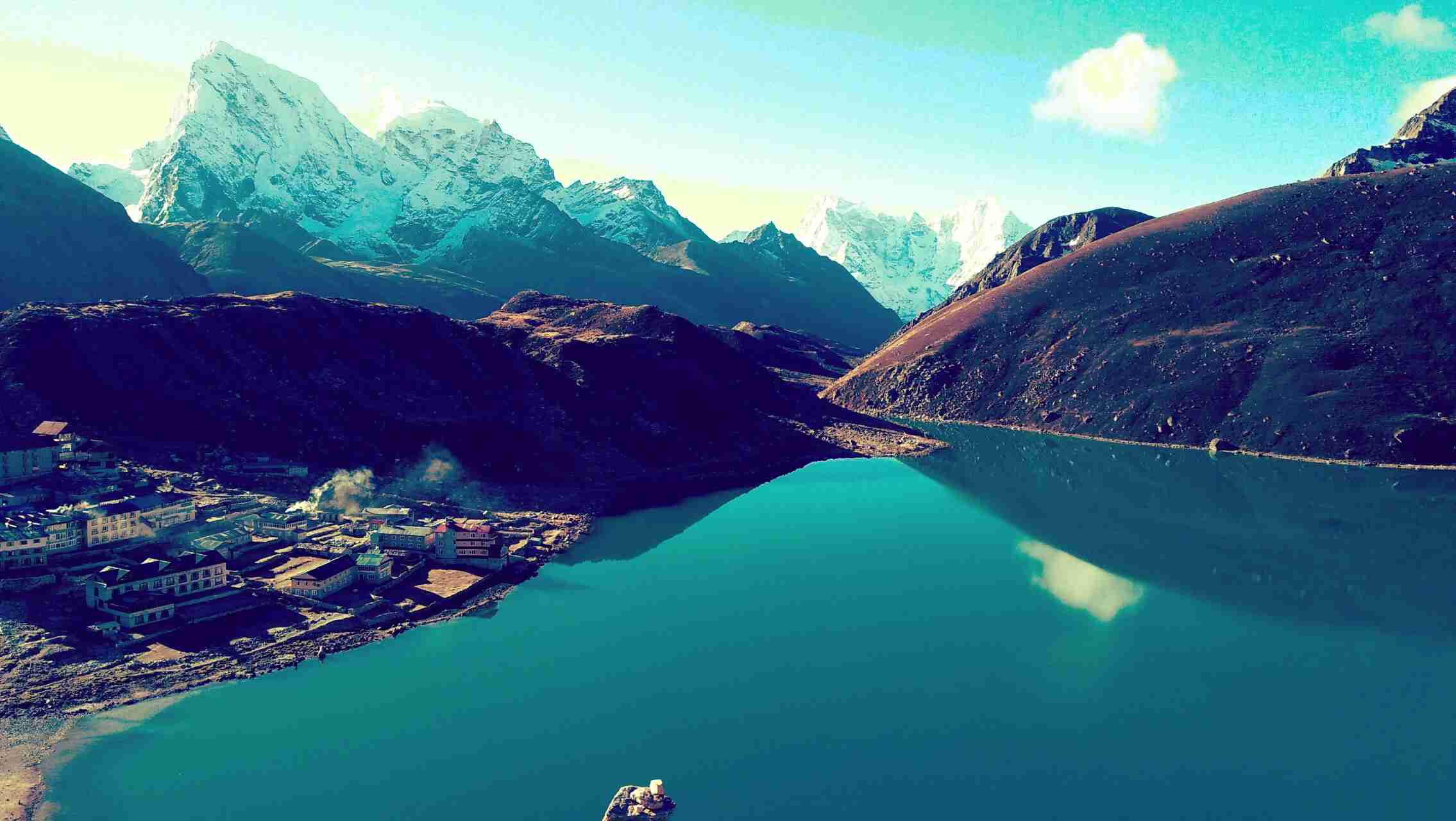
If this was not enough, we then carry on further to the glistening waters of the the Gokyo Lakes, a system of fresh water and sacred lakes, hidden in the high Himalaya.

This trek has it all: high-altitude trekking, spectacular views that are hard to match, the welcoming culture of the Sherpa people and a visit to the iconic Everest Base Camp.

You also climb Gokyo Ri (5,357 m / 17,575 ft), with panoramic views of Cho Oyu, Everest and Makalu.

So what are you waiting for? Dig out your hiking boots and come and join us on this unforgettable Cho La Pass Trek.

19-Day EBC and Gokyo Lakes Trek Itinerary

Day 1: Arrival in Kathmandu (1,345 m / 4,412 ft), meet us at the airport; transfer to hotel.

Day 2: Pre-trek meeting and a free day in Kathmandu to adjust to the time difference, relax and do any last-minute gear shopping.

Day 3: Short flight to Lukla (2,840 m / 9,320 ft)-Trek to Phakding (2610m/8560ft)-approximately 3 hours

Day 4: Trek to Namche Bazaar (3,440 m / 11,286 ft) - Approximately 6 hrs

Day 5: Acclimatization day trip around Namche Bazaar.

Day 6: Trek to Tengboche (3,860 m / 12,660 ft) - Approximately five hours

Day 7: Trek to Dingboche (4,360 m / 14,300 ft) - Approx. 5 hrs

Day 8: Acclimatization day trip around Dingboche.

Day 9: Lobuche (4,940 m / 16,207 ft) - Approx. 5 hrs.

Day 10: Trek to Everest Base Camp (5,364 m / 17,598 ft), then back to Gorak Shep (5,170 m / 16,962 ft).

Day 11: Hike up Kala Patthar (5,545 m / 18,192 ft), then trek to Dzongla (4,830 m / 15,846 ft)

Day 12: Trek to Gokyo over the Cho La Pass (5,420 m / 17,782 ft)

Day 13: Gokyo Ri (5,357 m / 17,575 ft) day trip.

Day 14: Trek to Dole (4,110 m) - approx 4 hours.

Day 15: Trek to Namche Bazaar - approx 6 hours.

Day 16: Trek to Lukla (2,840 m / 9,318 ft) -approx 7 hours.

Day 17: Fly back to Kathmandu.

Day 18: Rest day Shopping/ Leisure

Day 19: Departure, or extend your tour for other activities in Nepal.
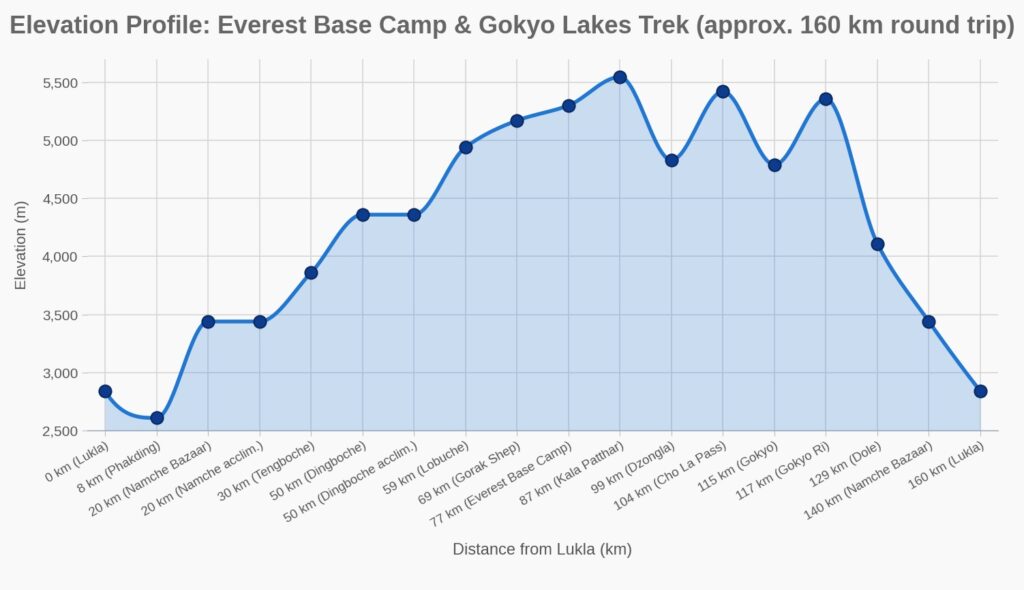
Everest Base Camp Gokyo Lakes and Cho La Pass Trek Altitude Profile Updated October 2026

Lukla flights from Ramechhap in peak season

In the peak seasons (mid-March to mid-May and late September to late November), the Civil Aviation Authority of Nepal diverts Lukla flights to Manthali Airport in Ramechhap, about 145 km / 4 hours by road from Kathmandu. This means a drive of about 4 hours each way, starting at about 2:30 to 3:00 am, to catch your flight to Lukla, and 4 hours back to Kathmandu after your flight from Lukla. We arrange the drive at no extra cost. At other times, flights leave from Kathmandu. This may change as airport conditions change, so we will tell you what applies to your dates.

Highlights of our Everest Base Camp and Gokyo Lakes Trek

  • A tour of Kathmandu, experiencing its rich cultural heritage and vibrant atmosphere.
  • Experience an exciting flight to Lukla with breathtaking views of the Himalayas before beginning the trek.
  • Explore the colorful and popular Sherpa town of Namche Bazaar, known for stunning mountain vistas and popular as the gateway to Everest.
  • Visit the famous Tengboche Monastery, a spiritual center with panoramic views of Everest, Lhotse and Ama Dablam.
  • Reach the famous Everest Base Camp at 5,364 m / 17,598 ft.
  • Hike to Kala Patthar at sunrise for one of the best panoramic views in the area, looking at Mount Everest, Lhotse, Nuptse and surrounding peaks.
  • Walk over the challenging Cho La Pass, offering breathtaking vistas of the Himalayas.
  • Explore the breathtaking and beautiful Gokyo Lakes, a series of crystal clear glacial lakes surrounded by towering Himalayan peaks.
  • Climb Gokyo Ri for unparalleled panoramic views of Everest, Cho Oyu, Makalu, and other peaks reflected in the shimmering Gokyo Lakes.
  • Learn about Sherpa culture and the role Sherpa climbers and guides play in the Everest region.
  • Trek through diverse landscapes, from lush rhododendron forests and high altitude passes to glacial moraines and rocky terrain.
  • Challenge yourself with high elevation trekking routes while acclimatizing carefully to the changing elevations.
  • Enjoy the million opportunities to take stunning photographs of snow capped peaks, pristine lakes, colorful prayer flags and traditional Sherpa villages.
Cost Includes

  • Arrival/departure, international and domestic airport transfers.
  • Three star hotel in Kathmandu with breakfast (twin/double sharing room)
  • All your standard Meals (breakfast, lunch and dinner) during the trek.
  • Teahouse accommodation during the trek.
  • Government licensed English speaking Guide and Porters to carry your luggage during the trek (1 porter Between 2 Person basis), their food, accommodation, salary, insurance, equipment, medicine.
  • Round Trip flight fare to Lukla.
  • Transfers between Kathmandu and Manthali (Ramechhap) airport when Lukla flights depart from there
  • All required trekking permits and entry fees.
  • Mosaic Adventure duffel bag, down jacket and sleeping bag to use free of charge during the trek (on request)
  • Travel & Rescue arrangements if required in case of emergency.
  • All applicable taxes.

Cost Excludes

  • Lunch and dinner during your stay in Kathmandu.
  • Personal expenses such as laundry, telephone calls, sweets, snacks, wi-fi, electric devices charging etc.,
  • All beverages and bar bills (tea/coffee, bottled water, coke etc)
  • Travel insurance (required). It must cover trekking up to 6,000 m / 19,685 ft and emergency helicopter evacuation.
  • Personal trekking equipment except stated above.
  • Tips for your guide and porters (see More Info for a guide)
  • Your Nepal visa
  • Extra costs caused by events outside our control, such as flight delays, weather, strikes or natural events

Itinerary

  • Day
    1

    Welcome to Nepal!

    Activities: We will meet you at the airport and drive you to your hotel, just relax for
    the rest of the day to recover from your long journey.

    Elevation: 1345m/4412ft.

    Highlights: Bustling Thamel, an array of restaurants, bars and shops.

    Accommodation: Kathmandu 3 star hotel.

  • Day
    2

    Meeting with trekking guide, last minute shopping for your trek.

    Meet with our team for a pre-trek briefing to discuss the trek, review the itinerary etc. The rest of the day is free to relax, recover from your journey and adjust to the time difference. You will also have time for any last-minute trekking gear shopping or personal preparations. If you wish, you can book a guided Kathmandu Heritage Day Tour to explore the city's fascinating cultural and historical sites or enjoy sightseeing independently at your own pace.

    Accomnodation: Kathmandu 3 star hotel.

    Breakfast
  • Day
    3

    Flight to Lukla (45 minutes) and trek to Phakding.

    Hours of walking: 3.

    Difficulty: Easy.

    Elevation reached: 2840m/9318ft in Lukla and 2610m/8563ft in Phakding.

    Terrain: Flat and downhill, well developed paths, stone steps.

    Views on offer: Amazing Himalayan views on approach to Lukla.

    Highlights: The breathtaking flight between the mountains.

    What’s to see?: The traditional Sherpa people and Buddhist shrines

    Accommodation: Basic Teahouse.

    Breakfast + Lunch + Dinner
  • Day
    4

    Namche Bazaar.

    Hours of walking: 6.

    Difficulty: Moderate.

    Elevation reached: 3440m/11286ft.

    Terrain: Rocky and dirt tracks, stone steps, mostly uphill, gradual with some steep inclines.

    Views on offer: Spectacular approaching views of Namche Bazaar, snow capped peaks and the river valley.

    Highlights: The colourful Sherpa town of Namche Bazaar – the gateway to the high Himalaya and crossing some impressive suspension bridges over the river valley.

    What’s to see?: The milky waters of the Dudh Kosi River, thick rhododendron, magnolia and fir tree forests, herds of yaks carrying supplies.

    Accommodation: Basic Teahouse.

    Breakfast + Lunch + Dinner
  • Day
    5

    The world’s highest hotel, Khumjung Village and back to Namche Bazaar. (Acclimatization day.)

    Hours walking: 4.

    Difficulty: Easy – moderate.

    Elevation reached: 3962m/12998ft at Mountain View Hotel, 3790m/12434ft at Khumkung.

    Terrain: Hilly, grassy trails, some steep inclines and flat tracks.

    Views on offer: Everest, Lhotse, Lhotse Shar, Taboche Peak and Ama Dablam.

    Highlights: Your first sight of Everest!

    What’s to see?: Khumjung Edmund Hillary School, Sherpa museum, shops and markets around Namche Bazaar.

    Accommodation: Basic Teahouse.

    Breakfast + Lunch + Dinner
  • Day
    6

    Tyangboche.

    Hours of walking: 5

    Difficulty: Moderate.

    Elevation reached: 3860m/12664ft.

    Terrain: River bank path, some steep inclines, some flat and some short descents.

    Views on offer: Kwangde, Nuptse, Lhotse, Kangtega, Ama Dablam and Everest.

    Highlights: Tyangboche monastery, magnificent panoramic views from Tyangboche.

    What’s to see?: The Lamas and Monks in the stunning Tyangboche Monastery, ornate wall hangings and a 20 foot statue of Lord Buddha.

    Accommodation: Basic Teahouse.

    Breakfast + Lunch + Dinner
  • Day
    7

    Dingboche.

    Hours of walking: 5. (We spend 2 days here to acclimatize)

    Difficulty: Moderate.

    Elevation reached: 4360m/14304ft.

    Terrain: Rocky uphill tracks, stone steps, a gentle riverbank trail.

    Views on offer: Lhotse, Island Peak, Ama Dablam.

    Highlights: The beautiful location of Dingboche under Ama Dablam, the mountain views from your teahouse.

    What’s to see?: A Yeti scalp in the Pangboche Gompa, the fast flowing waters of the Imja Khola, sacred mani stone walls.

    Accommodation: Basic Teahouse.

    Breakfast + Lunch + Dinner
  • Day
    8

    Dingboche.

    Second day in Dingboche acclimating.

    Breakfast + Lunch + Dinner
  • Day
    9

    Lobuche.

    Hours of walking: 5.

    Difficulty: Moderate to difficult.

    Elevation reached: 4940m/16207ft.

    Terrain: Some steep inclines and rocky tracks where you will need to scramble for a short time.

    Views on offer: The Khumbu Icefall and Pumori amongst other beautiful Himalayan mountains.

    Highlights: Reaching the top of a steep incline for breathtaking panoramic views amongst Buddhist chortens.

    What’s to see?: Memorial sight for people who sadly lost their lives attempting to summit Everest, traditional Sherpa houses.

    Accommodation: Basic Teahouse.

    Breakfast + Lunch + Dinner
  • Day
    10

    Everest Base Camp and Gorak Shep.

    Hours of walking: 8.

    Difficulty: Difficult/strenuous.

    Elevation reached: 5364m/17598ft at Base Camp and 5170m/16962ft at Gorak Shep.

    Terrain: Uneven, ridge tracks, rocky, uphill and flat trails.

    Views on offer: Too many to mention! You will be surrounded by an icy wonderland, get your cameras at the ready!

    Highlights: Congratulations, you made it! You reached the base camp to the highest mountain in the world.

    What’s to see?: You may see a group of mountaineers preparing to attempt an Everest summit. Sunset views from your Gorak Shep teahouse.

    Accommodation: Basic Teahouse.

    Breakfast + Lunch + Dinner
  • Day
    11

    Kala Patthar and Zongla.

    Hours of walking: 8.

    Difficulty: Strenuous.

    Elevation reached: 5545m/18192ft at Kala Patthar, 4830m/15846ft at Zongla.

    Terrain: Steep, rocky climb to Kala Patthar, uneven rocky and glacial paths to Zongla

    Views on offer: Everest and the surrounding Himalayas.

    Highlights: The most spectacular, panoramic views from the top of Kala Patthar, crossing the Changri Shar Glacier.

    What’s to see?: Sunrise from 5545m amidst a mountain wonderland, simply amazing.

    Accommodation: Basic Teahouse.

    Breakfast + Lunch + Dinner
  • Day
    12

    Trek to Gokyo via the Chola-la Pass.

    Hours of walking: Approximately 8.5 hours.

    Difficulty: Difficult/Strenuous.

    Elevation reached: 5420m/17782ft when crossing the Cho La Pass.

    Terrain: Uneven tracks, large rocky areas where you will need to climb and jump off the rocks.

    Views on offer: Some pretty spectacular Himalayan peaks from the icy wilderness of the Cho La Pass.

    Highlights: The Nagozumpa Glacier, standing on the Pass.
    What’s to see?: The high altitude pass, glaciers and lots of snow capped peaks!

    Accommodation: Basic Teahouse.

    Breakfast + Lunch + Dinner
  • Day
    13

    Gokyo Ri and back to Gokyo.

    Hours of walking: 6.

    Difficulty: Strenuous.

    Elevation reached: 5357m/17575ft.

    Terrain: Steep incline to the top of Gokyo Ri, rocky and uneven.

    Views on offer: Magnificent views of some of the world’s “eight thousanders.”

    Highlights: Reaching the summit of another Himalayan peak where the views are out of this world.

    What’s to see: Even more stupendous views of the Himalayas.

    Accommodation: Basic Teahouse.

    Breakfast + Lunch + Dinner
  • Day
    14

    Dole.

    Hours of walking: 4. Difficulty: Moderate to difficult. Elevation reached: 4110m/13484ft. Terrain: Glacial paths and steep descents. Views on offer: The first (Longpongo) and second (Tajung Tso) of the Gokyo Lakes. Highlights: Returning to lower altitudes! Walking alongside the Nagozumpa glacier. What’s to see: The villages of Machermo and Luzo. Accommodation: Basic Teahouse.

    Breakfast + Lunch + Dinner
  • Day
    15

    Namche Bazaar.

    Hours of walking: 6.

    Difficulty: Easy to moderate.

    Elevation reached: 3440m/11286ft.

    Terrain: Descents through forest paths.

    Views on offer: Thick forests and a magnificent mountain backdrop.

    Highlights: Soaking up the vibrant atmosphere of Namche Bazaar with its array of bars, cafes and restaurants.

    What’s to see: Rhododemdron and fir trees, wild mountain goats and the lophophorus bird which is the national bird of Nepal.

    Accommodation: Basic Teahouse.

    Breakfast + Lunch + Dinner
  • Day
    16

    Lukla.

    Hours of walking: 7.

    Difficulty: moderate.

    Elevation reached: 2840m/9318ft.

    Terrain: By the banks of the river, stone steps and some descents and last ascents up to Lukla.

    Views on offer: The glistening river amidst a mountain backdrop.

    Highlights: Last day of walking in the Khumbu region. Well done, you completed your trip!

    What’s to see: Thick forests, an array of birds and some final views of the mountains.

    Accommodation: Basic Teahouse.

    Breakfast + Lunch + Dinner
  • Day
    17

    Flight back to Kathmandu.

    Highlights: Another breathtaking airplane ride on a twin-engine otter amidst the mighty Himalayas.

    Accommodation: 3 star hotel in Kathmandu.

    Breakfast
  • Day
    18

    Free time!

    Highlights: Time to shop, relax, get a massage.

    Accommodation: 3 star hotel in Kathmandu.

    Breakfast
  • Day
    19

    Departure.

    Goodbye and farewell from Nepal!

    Breakfast

Step-by-Step 3-Month Preparation Guide for the Everest Base Camp and Gokyo Lakes Trek

Are you planning to trek to Everest Base Camp and Gokyo Lakes? This 19-day trip is one of the most beautiful and challenging routes in Nepal. To enjoy it fully, you need to prepare your body and mind in advance.

At Mosaic Adventure, our licensed local guides lead groups to Everest Base Camp, Gokyo Lakes and across the Cho La Pass. This guide gives you a clear three-month training plan, with tips on gear, food and mental preparation. With the right preparation you can lower your risk of altitude sickness, build your stamina and enjoy the views of Everest, Cho Oyu, Makalu and Ama Dablam.

Why train for 3 months?

The Everest Base Camp and Gokyo Lakes Trek is not an ordinary walk. It needs strong legs, good heart and lung fitness, and mental focus. On average, you walk 4 to 8.5 hours a day on rocky trails, steep climbs and high passes such as the Cho La Pass (5,420 m / 17,782 ft). A three-month plan helps you to:

  • Build endurance for long days of trekking
  • Strengthen your legs and core for steep paths
  • Lower the chance of injury and speed up recovery
  • Improve your mental strength for remote conditions in the mountains

Our itinerary includes acclimatization days at Namche Bazaar, Dingboche and Gokyo. Combined with good preparation, this gives you the best chance of reaching Kala Patthar, the Cho La Pass and Gokyo Ri comfortably.

Month 1: Build your base

Start slowly and build a steady routine. Train 4 to 5 times a week for 45 to 60 minutes each session.

Cardio training

  • Walk or hike 5 to 8 km three times a week on flat ground
  • Add one session of stair climbing or hill walking each week

Strength training

  • Squats, lunges, push-ups and planks (3 sets of 10 to 15 reps)
  • Core exercises such as planks and twists, to prepare for carrying a backpack

Flexibility and recovery

  • Stretching or yoga twice a week
  • Take rest days to avoid injury

Weekly goal: 16 to 24 km of walking in total.

Guide's tip: Walk on small hills whenever you can. It is the best preparation for the steep climb from Lukla to Namche Bazaar.

Month 2: Build strength and stamina

Raise the intensity to get closer to real trekking conditions. Train 5 times a week for 60 to 90 minutes.

Cardio training

  • Hike 8 to 13 km with 150 to 300 m of climbing, three to four times a week
  • Carry a backpack of 5 to 7 kg

Strength training

  • Step-ups, calf raises and deadlifts (3 sets of 12 to 20 reps)
  • Focus on strong legs and stable knees for rocky trails

Altitude practice

  • Use stairs or a treadmill incline if you have one
  • Practice slow, deep breathing to prepare for thinner air

Weekly goal: 32 to 48 km of walking, including one long hike of 13 to 16 km.

Month 3: Trek-specific training

This month is about simulating the trek. Push yourself for the first three weeks, then ease off in the last week so you are rested before you leave.

Cardio training

  • Hike 13 to 19 km with 450 to 600 m of climbing, three to four times a week
  • Do back-to-back hikes on consecutive days to train for multi-day walking

Strength training

  • Hill repeats, lunges and balance exercises (3 sets of 15 to 25 reps)
  • Train with the same gear and boots you will use on the trek

Mental preparation

  • Read stories from Sherpas and trekkers, or watch documentaries about Everest
  • Practice meditation or breathing exercises to stay calm on long climbs

Taper week

  • Cut back to light walks of 3 to 5 km, three times in the final week
  • Focus on eating well and sleeping properly

Essential gear checklist

Pack light but smart. Above 4,500 m the temperature can fall to minus 20°C. Mosaic Adventure provides a duffel bag, down jacket and sleeping bag to use free of charge, on request.

Clothing

  • Base layers, a fleece, a down jacket, and a waterproof jacket and trousers
  • Hiking boots that are already broken in
  • Wool or thermal socks

Essentials

  • A 30 to 35 L backpack
  • Trekking poles, a headlamp, sunglasses and a reusable water bottle

Health kit

  • Diamox (for altitude), sunscreen and a personal first-aid kit

Tech

  • A power bank or solar charger, since charging in teahouses costs extra

The baggage limit for the Lukla flight is 15 kg in total. You can store extra luggage at our Kathmandu hotel free of charge. This is only an outline of what to pack. See our complete packing list for the EBC trek for more.

Food and health tips

Your body burns more energy at high altitude, so plan for around 3,000 to 4,000 calories a day.

  • Eat high-carbohydrate meals such as rice, pasta, bread, lentils and potatoes
  • Add protein such as eggs and lentils for strength
  • Choose vegetarian food on the trek to avoid stomach problems
  • Drink 3 to 4 liters of water a day, and use purification tablets
  • Avoid alcohol and smoking
  • Take acclimatization seriously and let your body adjust gradually

Our guides carry pulse oximeters and check your oxygen level daily, and we have full rescue support if it is needed.

With the right preparation and guidance, the Everest Base Camp and Gokyo Lakes Trek is achievable. Follow this 3-month plan, pack smart and listen to your body. We at Mosaic Adventure take care of the rest, so you can focus on the journey and the views that will stay with you.

Everest Base Camp and Gokyo Lakes Trek FAQs

Cost, booking and permits

What is the cost of the Everest Base Camp and Gokyo Lakes Trek?

The cost is USD 1,630 per person. This includes 3-star hotel accommodation in Kathmandu with breakfast, round-trip flights to Lukla, airport transfers, a licensed English-speaking guide, a porter for every two trekkers, all meals during the trek, teahouse accommodation, the required permits and entry fees, and government taxes.

How do I book and pay?

Choose your date and book online. You can pay a 20% deposit to secure your trip or pay the full amount. If you pay the deposit, you pay the remaining 80% in cash on arrival in Kathmandu, in USD or widely accepted currencies such as AUD, CAD, EUR, GBP or SGD. Cancellations follow our terms and conditions at https://mosaicadventure.com/terms-and-conditions/.

Can I join a group or book a private trip?

You can join one of our fixed departure dates, which take up to 12 trekkers, or book a private trip for dates that are not listed. Contact us to arrange a private trip.

Are the permits included?

Yes. All required trekking permits and entry fees are included in the price, and we arrange them for you.

Is travel insurance required?

Yes. Travel insurance is required for this trek. It must cover trekking up to 6,000 m / 19,685 ft and emergency helicopter evacuation. The highest point on the trek is Kala Patthar at 5,545 m / 18,192 ft.

Is it recommended to get a Nepal visa in advance or at the airport?

Most people can get a visa on arrival in Nepal. A few nationalities need to get one before travelling, and you can check the list on the Nepal Department of Immigration website. Since August 2026 you can also apply for an e-visa online. To get a visa on arrival you fill in a landing card, pay the fee and show a passport photo. The fees are USD 30 for 15 days, USD 50 for 30 days and USD 125 for 90 days, multiple entry. Bring US dollars to pay, as most major currencies are also accepted but the exchange rate at the airport may be poor.

How much money per day do you think I will need? What currency should I take?

The local currency is the Nepali rupee. We recommend bringing US dollars and exchanging them in Kathmandu. Allow about USD 200 to 250 in rupees for personal expenses on the trek, such as drinks, snacks, Wi-Fi, charging and hot showers, and about USD 20 a day for lunch and dinner in Kathmandu.

Difficulty, fitness and altitude

How fit do I have to be?

The Everest Base Camp and Gokyo Lakes Trek via Cho La Pass is a challenging to strenuous trek. You do not need previous trekking or mountaineering experience, and no technical climbing skills are required. You do need to be in good physical condition and able to walk 4 to 8 hours a day over hilly terrain with a light daypack, and up to 8.5 hours on the Cho La Pass day. If you are not an experienced trekker or do not exercise regularly, we recommend a training program well before the trek. The pace is slow, with rest days to help you acclimatize.

How much tougher is the Gokyo and EBC route than the classic Everest Base Camp trek? I'm fit but have zero high-altitude experience.

If you are fit, the Everest Base Camp and Gokyo Lakes trek is doable, but it is more challenging than the standard EBC route. The main reason is the Cho La Pass (5,420 m / 17,782 ft), which is the most demanding day. It is a rocky, steep and sometimes icy climb and descent. You need good stamina, strong legs and a steady pace, but no technical climbing experience.

Do I need previous high-altitude experience?

No. Being reasonably fit matters most. This trip includes acclimatization days at Namche Bazaar, Dingboche and Gokyo, and your guide sets a safe, controlled pace. If you can be on your feet for 5 to 7 hours a day and are ready for one big day crossing the pass, you are ready for this trek.

What if I get sick while on the trek?

It depends on the sickness. Usually you descend to a lower altitude with the help of the guide and porters. If you are seriously ill, we arrange an emergency helicopter evacuation, so make sure your insurance covers it. Altitude sickness can affect anyone, including young and healthy people. If you feel dizzy or have palpitations or a severe headache, go down immediately, and tell your guide even about mild symptoms. Our guides check your oxygen level daily with a pulse oximeter, and carry basic medicine and first aid, including painkillers, altitude sickness tablets, bandages, muscle balm and medication for diarrhea and vomiting.

Season and flights

When is the best time to go?

Spring (March to mid-June) and autumn (September to early December) are the best seasons. The most stable conditions and clearest skies are in late March to early June and mid-October to mid-November. We run the trek all year, but please talk to us before booking if you want to travel in the off-season. It gets very cold above 4,500 m, down to about minus 15 to 20°C in spring and minus 20 to 25°C in autumn, particularly in mid-November.

How do the flights to Lukla work?

Round-trip flights between Kathmandu and Lukla are included. In peak seasons (mid-March to mid-May and late September to late November), the flights depart from Manthali Airport in Ramechhap, about 4 hours by road from Kathmandu. You leave at about 2:30 to 3:00 am, and we arrange the drive at no extra cost. At other times flights depart from Kathmandu. Flights depend on the weather and delays are common, so keep spare days at the end of your trip.

How do I get from the airport to my hotel?

We arrange a free pickup at any time of day or night. A Mosaic Adventure representative meets you on arrival, so send us your flight details. Look for the sign with our logo or your name. We recommend carrying your own bags, because people at the airport may offer to carry them and expect payment. You do not have to pay them. Just say no, thank you.

Accommodation and facilities

What is the level of accommodation like?

In Kathmandu you stay in a 3-star hotel, usually with an attached bathroom, air conditioning, reception and a dining room, on a twin or double-sharing basis. If you want an upgrade to a 4-star or 5-star hotel, it is available at extra cost. On the trek you stay in teahouses. Rooms range from a private single or double to a bed in a dormitory, and are more limited the higher you go. Mattresses are firm, and showers and toilets are usually shared. Teahouses are basic but clean, with a communal dining room that has a limited menu.

Is enough drinking water available? How many liters should we carry in our daypack?

Bring a water bottle and water purification tablets. They can be bought in Kathmandu. We support responsible tourism and do not encourage buying bottled water in the mountains, because there is no proper disposal for plastic bottles. You can fill your bottle along the way, and most tablets take about 30 minutes. Drink at least 3 to 4 liters of water a day.

Can we take showers during the trek?

Showers are available at the teahouses, but they are usually shared, especially higher up. You pay for a hot shower per person. It gets colder as you climb, so you may prefer to wait until your descent.

Can I recharge my phone, camera and batteries on the mountain?

Yes, in the teahouses, for a fee of about USD 2 to 3 per hour. Plugs may be different from home, so bring an adapter, and a power bank. Wi-Fi is available at extra cost but may not be reliable.

Where can I keep my luggage?

Luggage that you will not need on the trek can be kept free of charge at your hotel in Kathmandu or in our office store room.

Packing and gear

What do I have to carry with me on the trek?

You carry a daypack with your personal items, water, camera, snacks, sunscreen, hat, a fleece jacket and gloves. Your main bag is carried by a porter, up to 10 kg per person (a porter carries up to 20 kg for two trekkers). The Lukla flight limit is 15 kg in total, which is 10 kg in your checked bag and 5 kg in your carry-on.

What gear do you provide?

On request, you can use a Mosaic Adventure duffel bag, down jacket and sleeping bag during the trek, free of charge. We send a gear list after you book.

Do I need to take walking poles?

Poles are not essential, but they are useful, especially on the way down, where they help your balance and take strain off your legs. You can buy or hire them in Kathmandu, and they collapse to fit on your pack.

Can I buy any equipment in Kathmandu before the start of the trip?

Yes. There are many trekking shops in Kathmandu, and equipment is cheaper than at home, although the quality is not always guaranteed. If you do not want to risk it, buy major items such as boots before you arrive, and buy boots well in advance so you can break them in and avoid blisters.

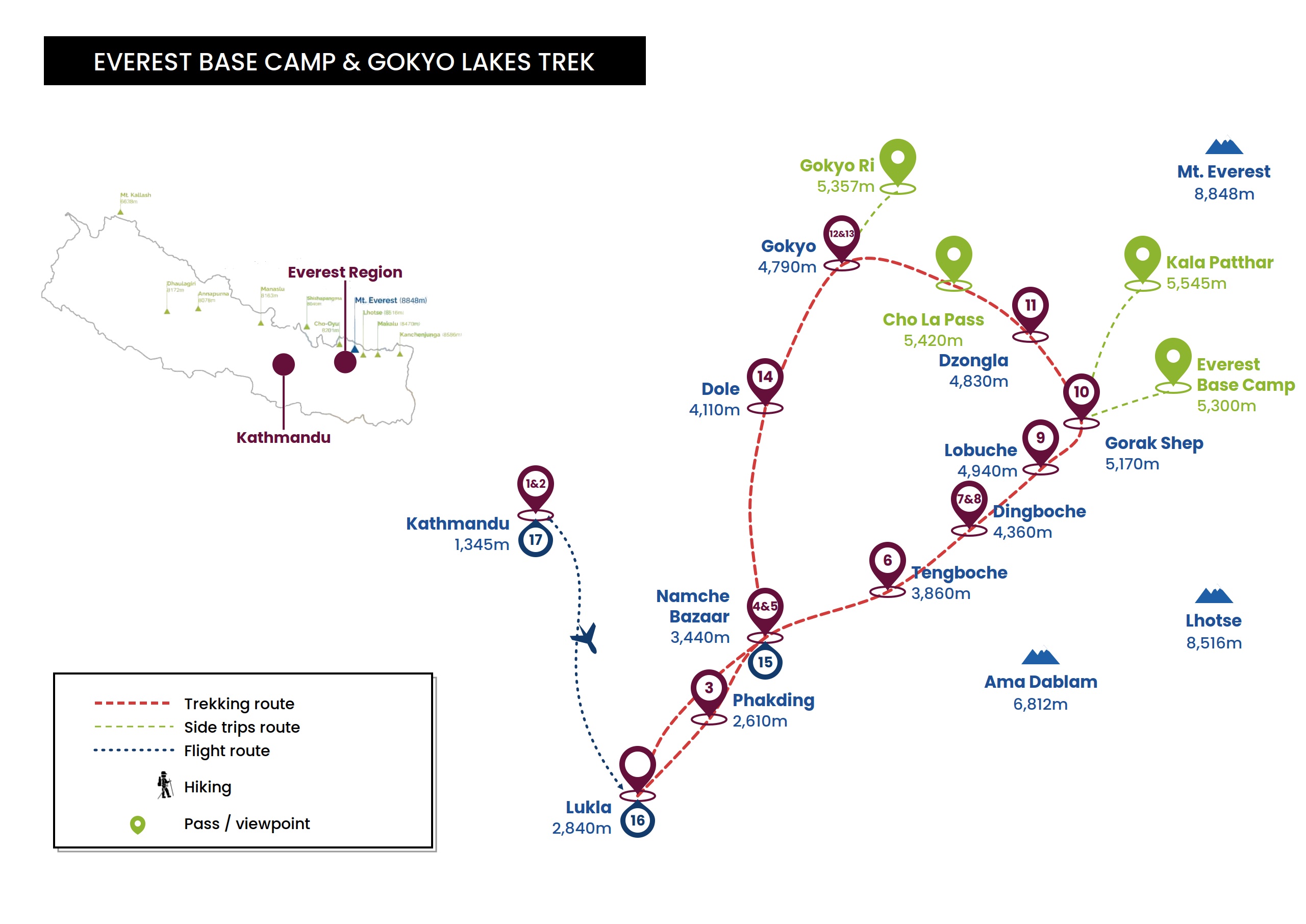
Everest Base Camp and Gokyo Lakes Trek Route Map

Everest Base Camp Gokyo Lakes and Cho La Pass Trek Map Updated October 2026

Everest Base Camp and Gokyo Lakes Trek: More Information

Everything below is here to help you book, plan and prepare for the 19-day Everest Base Camp and Gokyo Lakes Trek via Cho La Pass.

Booking your trek

We offer many dates for the Everest Base Camp and Gokyo Lakes Trek, so you can choose one that suits your schedule. You can join one of our fixed departures, which take up to 12 trekkers, or book a private trip for dates that are not listed. When you book, you go to the payment page and choose between two options: pay a 20% deposit to secure your trip, or pay the full amount. If you choose the deposit, you pay the remaining 80% in cash on arrival in Kathmandu, in USD or widely accepted currencies such as AUD, CAD, EUR, GBP or SGD.

Booking your international flight

For this 19-day trek, plan to arrive in Kathmandu on Day 1 and depart on Day 19. We include 2 nights in Kathmandu before the trek, so you can recover from the journey and the time difference and meet your guide. After the trek you spend 2 nights in Kathmandu (Day 17 and Day 18). Day 18 is a spare day in case your flight from Lukla is delayed, or for your own sightseeing and rest.

Flights to and from Lukla are often delayed or cancelled by weather. If you can, add extra days at the end of your trip before your international flight.

Arrival information

After you book your flight, please send us the details. We pick you up from Tribhuvan International Airport at any time of day or night, free of charge. Look for our representative holding a Mosaic Adventure sign as you leave the terminal. If you arrive earlier, we can arrange a room at the same hotel for an extra fee and still pick you up.

Flights to Lukla and back

In the peak seasons (mid-March to mid-May in spring and late September to late November in autumn), flights to and from Lukla operate from Manthali Airport in Ramechhap, about 145 km / 4 hours by road from Kathmandu. This means you leave Kathmandu at about 2:30 to 3:00 am, and you drive about 4 hours back after the flight from Lukla. We arrange the drive at no extra cost. At other times of the year, flights depart from Kathmandu. This can change as airport conditions change, and we will tell you what applies to your dates.

Trek starting and ending days

The trekking days run from Day 3 to Day 16. You fly to Lukla on Day 3 to start the trek, and you walk back to Lukla on Day 16. On Day 17 you fly back to Kathmandu and we transfer you to your hotel. For example, if your tour runs from 5 to 23 January 2027, you fly to Lukla on 7 January 2027 and return to Kathmandu on 21 January 2027.

Daily walking and altitude

Times are approximate and include rests along the way. Altitudes are the place you reach or sleep, unless noted.

Day Plan Walking time Altitude
3 Fly to Lukla, trek to Phakding About 3 hours Lukla 2,840 m / 9,318 ft. Phakding 2,610 m / 8,563 ft
4 Phakding to Namche Bazaar About 6 hours 3,440 m / 11,286 ft
5 Acclimatization day: Khumjung and back to Namche About 4 hours Khumjung 3,790 m / 12,434 ft
6 Namche Bazaar to Tengboche About 5 hours 3,860 m / 12,664 ft
7 Tengboche to Dingboche About 5 hours 4,360 m / 14,304 ft
8 Acclimatization day in Dingboche Short hike 4,360 m / 14,304 ft
9 Dingboche to Lobuche About 5 hours 4,940 m / 16,207 ft
10 Lobuche to Gorak Shep and Everest Base Camp About 8 hours Base Camp 5,364 m / 17,598 ft. Gorak Shep 5,170 m / 16,962 ft
11 Kala Patthar, then to Dzongla About 8 hours Kala Patthar 5,545 m / 18,192 ft. Dzongla 4,830 m / 15,846 ft
12 Dzongla over the Cho La Pass to Gokyo About 8.5 hours Cho La Pass 5,420 m / 17,782 ft
13 Gokyo Ri and back to Gokyo About 6 hours Gokyo Ri 5,357 m / 17,575 ft
14 Gokyo to Dole About 4 hours 4,110 m / 13,484 ft
15 Dole to Namche Bazaar About 6 hours 3,440 m / 11,286 ft
16 Namche Bazaar to Lukla About 7 hours 2,840 m / 9,318 ft

The three acclimatization days are Day 5, Day 8 and Day 13. The longest days are Day 10, Day 11 and Day 12 (the Cho La Pass day).

Altitude and acclimatization

We follow the rule of climbing high and sleeping low, and the itinerary includes rest days at Namche Bazaar, Dingboche and Gokyo to help your body adjust. Our guides check your oxygen level daily with a pulse oximeter. Tell your guide at once about any headache, nausea, dizziness or trouble sleeping. If symptoms get worse, the answer is to go down. If you are seriously ill, we arrange an emergency helicopter evacuation with your insurance company.

A standard trekking day

You spend 14 days on the trail and 14 nights in teahouses, in villages such as Phakding, Namche Bazaar, Tengboche, Dingboche, Lobuche, Gorak Shep, Dzongla, Gokyo, Dole and Lukla. Each day's trek starts at about 7:30 am and finishes in the late afternoon, with breaks along the way. You have breakfast and dinner at the same teahouse where you sleep, and lunch on the trail. Your guide gives regular briefings about timing and stops, and there are many chances for photographs.

Accommodation

In Kathmandu you stay in a 3-star hotel on a twin or double-sharing basis. On the trek you stay in teahouses, which are basic but clean and give you a comfortable night's rest. Rooms range from a private double to a bed in a dormitory, and bathrooms are usually shared. A sleeping bag is useful, and you can use ours free of charge (on request).

Meals

In Kathmandu, breakfast is included and is usually a buffet, except on the day of your Lukla flight, when you get a packed breakfast. On the trek, breakfast, lunch and dinner are included, and you choose from a menu of local and international dishes. We recommend eating vegetarian meals from the day you arrive in Kathmandu until the end of the trek, because meat on the trail can easily upset your stomach.

Baggage allowance

The baggage allowance for the flight to Lukla is 15 kg (33 lb) in total, checked and carry-on together. Pack no more than 10 kg in your checked bag and 5 kg in your carry-on. Your porter carries your main bag, up to 10 kg per person, and you carry a daypack. You can leave anything you do not need at the Kathmandu hotel, free of charge. Take a photo of your bag tag so it is easy to identify.

Water

Bottled water is available, but we ask you to bring a reusable bottle and water purification tablets to cut down on plastic waste in the mountains. Aim to drink 3 to 4 liters of water a day.

Electricity, charging and Wi-Fi

Charging and Wi-Fi are available at extra cost in most teahouses, but they may not be reliable, and the signal gets weaker at altitude. Do not plan work or online meetings during the trek. Bring a power bank or solar charger and a plug adapter.

Money and tipping

Carry Nepali rupees for drinks, snacks, charging, hot showers and Wi-Fi. Allow around USD 200 to 250 in rupees for personal expenses on the trek, and about USD 20 a day for lunch and dinner in Kathmandu. Tipping is optional. A usual amount is around USD 250 to 300 per trekker, shared between your guide and porters, depending on the service.

Temperatures

Temperatures fall as you climb. It is coldest above 4,500 m, in places like Lobuche, Gorak Shep, Dzongla and Gokyo. Temperatures can drop to about minus 15 to minus 20°C in spring and minus 20 to minus 25°C in autumn, particularly around mid-November.

Permits and insurance

All required permits and entry fees are included in the price. Travel insurance is required and must cover trekking up to 6,000 m / 19,685 ft and emergency helicopter evacuation. The highest point on the trek is Kala Patthar at 5,545 m / 18,192 ft.

Nepal visa

The Nepal visa is not included. Many nationalities can get a visa on arrival in Kathmandu: USD 30 for 15 days, USD 50 for 30 days or USD 125 for 90 days, multiple entry. A few nationalities must apply before travelling, and since August 2026 you can also apply for an e-visa online. Check the Nepal Department of Immigration website for the latest fees and rules.

Packing essentials

What you pack depends on the season and your own preferences. Check our Ultimate Packing List for EBC, and see the gear checklist in the Physical Prep tab.

Extending your stay

To see more of Kathmandu, you can add day tours to Bhaktapur or Changunarayan. Our tour coordinator can help you plan extra activities. You can also add an acclimatization trek before your trip, such as Poon Hill or Mardi Himal, or other side trips around Kathmandu. Contact us to talk through these options after you book.