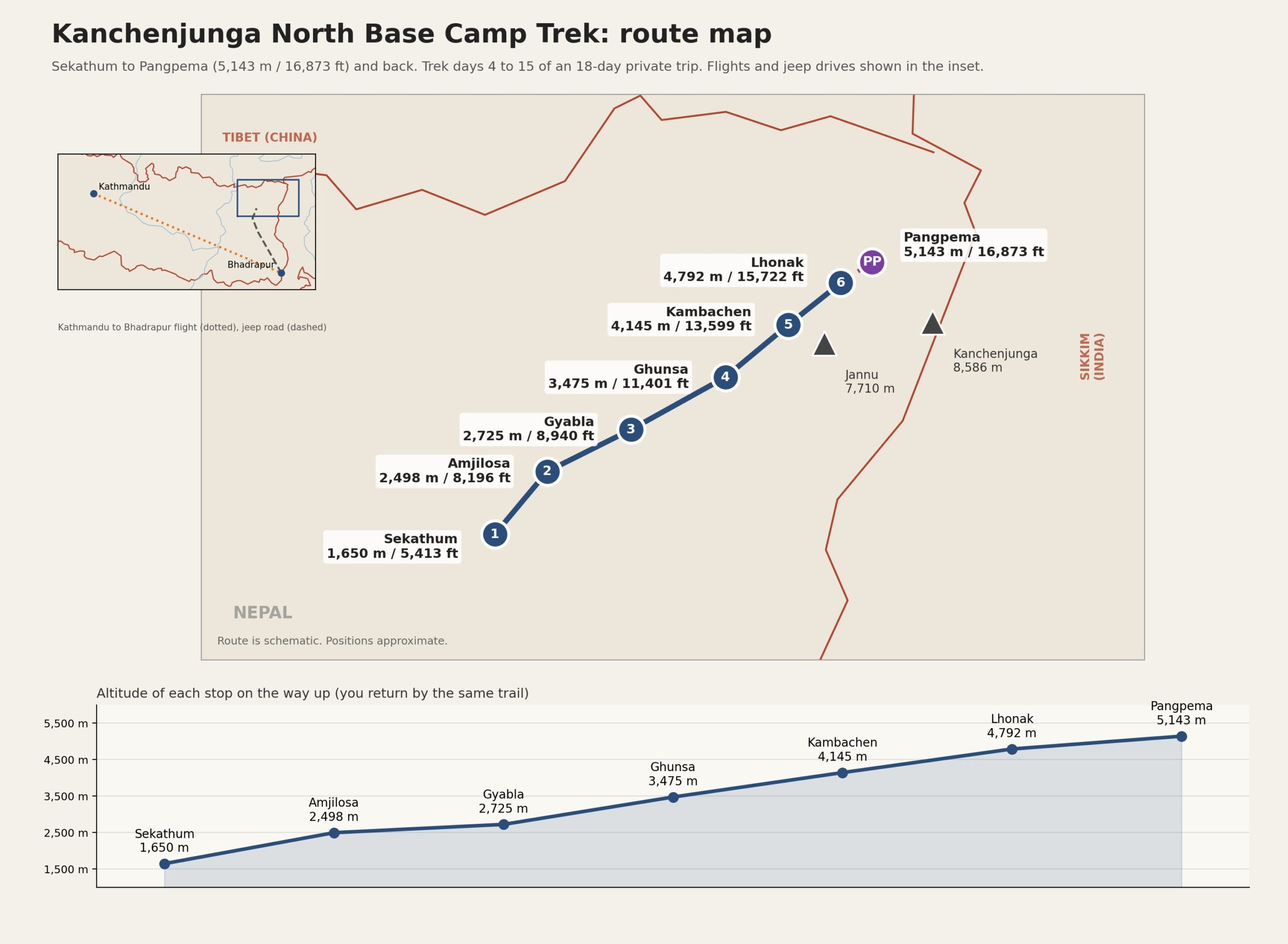
Why this trek is remote, and what that means
Kanchenjunga is in the far northeast of Nepal, next to Sikkim and Tibet. The only road access is by a long drive from Bhadrapur, in the lowlands, and the trail beyond Sekathum has no road. Above Kambachen there are almost no medical facilities, and bad weather can ground rescue helicopters for days. Your guide carries a first-aid kit and has first-aid and altitude training, and we have evacuation procedures, but this is a trek where you need to be fit, well insured and prepared to be self-reliant.
Altitude: please read this
The highest night is at Lhonak (4,792 m / 15,722 ft), and the highest point is Pangpema (5,143 m / 16,873 ft). The trek has two rest days, at Ghunsa and Kambachen, but some of the daily gains are above the 300 to 500 m a night that we advise above 3,000 m. This is why the pace is slow and your guide checks you each day.
| Day | Night at | Sleeping altitude | Change from the night before |
|---|
| 3 | Sekathum | 1,650 m / 5,413 ft | About +380 m / +1,247 ft from Phidim, by road |
| 4 | Amjilosa | 2,498 m / 8,196 ft | About +850 m / +2,789 ft |
| 5 | Gyabla | 2,725 m / 8,940 ft | About +230 m / +755 ft |
| 6 | Ghunsa | 3,475 m / 11,401 ft | About +750 m / +2,461 ft |
| 7 | Ghunsa | 3,475 m / 11,401 ft | Rest day |
| 8 | Kambachen | 4,145 m / 13,599 ft | About +670 m / +2,198 ft |
| 9 | Kambachen | 4,145 m / 13,599 ft | Rest day, optional hike to about 4,450 m / 14,600 ft |
| 10 | Lhonak | 4,792 m / 15,722 ft | About +650 m / +2,133 ft |
| 11 | Lhonak | 4,792 m / 15,722 ft | Day trip to Pangpema, 5,143 m / 16,873 ft |
Walk slowly, drink 3 to 4 liters of water a day, and tell your guide at once if you have a headache that gets worse, vomiting, unusual tiredness, loss of balance, a wet cough or breathlessness at rest. Going down is the treatment, and your guide may turn you back if you are not well. If you have a heart, lung or blood condition, see your doctor before you book. This is general information and not medical advice.
Daily walking and altitude
Times are approximate and include rests.
| Day | Plan | Time | Altitude |
|---|
| 1 | Arrive Kathmandu | n/a | 1,345 m / 4,413 ft |
| 2 | Fly to Bhadrapur, drive to Phidim | Flight 45 to 50 min, drive about 6 h | 1,270 m / 4,167 ft |
| 3 | Drive to Sekathum via Taplejung | About 8 to 10 h by jeep | Taplejung 1,820 m / 5,971 ft. Sekathum 1,650 m / 5,413 ft |
| 4 | Trek to Amjilosa | 5 to 6 h | 2,498 m / 8,196 ft |
| 5 | Trek to Gyabla | About 5 h | 2,725 m / 8,940 ft |
| 6 | Trek to Ghunsa | About 5 h | 3,475 m / 11,401 ft |
| 7 | Rest day at Ghunsa | Easy walk | 3,475 m / 11,401 ft |
| 8 | Trek to Kambachen | 5 to 7 h | 4,145 m / 13,599 ft |
| 9 | Rest day at Kambachen | Optional hike, about 4 h | 4,145 m / 13,599 ft |
| 10 | Trek to Lhonak | 4 to 5 h | 4,792 m / 15,722 ft |
| 11 | Pangpema and back to Lhonak | 6 to 7 h | Pangpema 5,143 m / 16,873 ft |
| 12 | Trek to Ghunsa | 7 to 8 h | 3,475 m / 11,401 ft |
| 13 | Trek to Gyabla | 5 to 6 h | 2,725 m / 8,940 ft |
| 14 | Trek to Amjilosa | 4 to 5 h | 2,498 m / 8,196 ft |
| 15 | Trek to Sekathum, drive to Taplejung | Walk 4 to 5 h, drive 5 to 6 h | 1,820 m / 5,971 ft |
| 16 | Drive to Bhadrapur, fly to Kathmandu | Drive 8 to 9 h, flight 45 to 50 min | 1,345 m / 4,413 ft |
| 17 | Free day in Kathmandu | Free | 1,345 m / 4,413 ft |
| 18 | Departure | Airport transfer | |
The long drives and the flights
The flight from Kathmandu to Bhadrapur takes 45 to 50 minutes. From Bhadrapur the road to Taplejung is about 260 km and takes 8 to 10 hours in all. We split it: you sleep in Phidim on Day 2 (about 6 hours), and on Day 3 you drive on through Taplejung to Sekathum (8 to 10 hours). On the way back the walk from Amjilosa to Sekathum and the jeep to Taplejung are one day (Day 15), and the drive of 8 to 9 hours from Taplejung to Bhadrapur, with the flight to Kathmandu, is one day (Day 16). Landslides, rain and road works can delay the jeep, and flights can be cancelled in bad weather. This is why Day 17 is a free day: it is your buffer, so you can still catch your international flight on Day 18.
Day 17: free day in Kathmandu
After the trek you have a free day in Kathmandu. You can rest at the hotel, walk around Thamel, or book a Kathmandu sightseeing day tour or a massage through us, at an extra cost. If your road or flight was delayed during the trip, this day is used to catch up, and your plans stay the same.
Pangpema day
On Day 11 you walk from Lhonak to Pangpema, about 3 to 4 hours up, and about 6 to 7 hours in all with the return. The trail is over moraine and the weather changes quickly, so your guide sets a turn-around time. It is cold and often windy, so wear warm layers, gloves, a hat and sunglasses. The north face of Kanchenjunga is above you, and the views can be cloudy.
Culture and the conservation area
The trek is inside the Kanchenjunga Conservation Area. Ghunsa is a Tibetan-style village with a monastery, and Gyabla and the lower villages are home to Limbu and Sherpa people. Please ask before you take photographs of people, walk clockwise around chortens and mani walls, and do not leave litter. Your guide will explain the local customs.
The best time to go
Spring (March to May) and autumn (late September to November) are the best seasons. In October and November the skies are clearest, and the lodges are busiest around the Dashain and Tihar festivals, so book early for those dates. In spring, rhododendrons flower in the lower forest. From December to February there is snow and it is very cold, and in late November or early December a blizzard can trap an unprepared group. June to August is the monsoon, with rain, leeches and landslides, and we do not recommend it. Because this is a private trek, you can choose your date.
Teahouses and food
You sleep in teahouses and guesthouses, in basic twin rooms, with shared toilets. The rooms are not heated. Lhonak is the most basic stop, with simple rooms near a dry lake bed, and water can be hard to find. Meals on the trek are included, with dal bhat, noodles, soup, eggs and bread, and vegetarian food is easy to find. Hot showers, charging and Wi-Fi are limited, may cost extra, and are often not available above Ghunsa.
Gear
You bring your own gear. The packing list we send after you book includes a sleeping bag rated to about -15 C, a down jacket, a hard-shell jacket, warm layers, a warm hat, gloves, sunglasses, sunscreen, broken-in waterproof boots, trekking poles, a head torch, a water bottle with purification tablets, and a personal first-aid kit. A porter carries your bag, up to 10 to 12 kg, and you carry a daypack.
Permits and rules
All the permits are included: the Restricted Area Permit for Kanchenjunga, the Kanchenjunga Conservation Area entry permit and the TIMS card. Kanchenjunga is a restricted area, so you cannot trek on your own. You need at least 2 trekkers and a licensed guide, and we arrange everything through our registered agency. Please send us a clear copy of your passport photo page and passport photos after you book.
Travel insurance
Travel insurance is required and is not included. It should cover trekking up to 5,500 m / 18,045 ft, medical treatment and emergency helicopter evacuation. Please check the maximum altitude in your policy in writing, because some policies stop at 4,000 m or 5,000 m.
Nepal visa
The Nepal visa is not included. Many nationalities can get a tourist visa on arrival in Kathmandu: USD 30 for 15 days, USD 50 for 30 days or USD 125 for 90 days. Please check the current rules and fees before you travel.
Booking and payment
The price is USD 2,150 per person, for a private trek with a minimum of 2 people. You pay a 20% deposit (USD 430 per person) to confirm your booking, and the balance (USD 1,720 per person) when you arrive in Kathmandu. There are no fixed departures, so tell us your dates and your group size. Please read our terms and conditions for the cancellation policy.
Money, signal and safety
Carry Nepali rupees in cash for drinks, snacks, charging and showers, because there are no ATMs on the trail. Mobile signal is patchy in the villages and is usually missing at Lhonak. You can reach our office on WhatsApp at +977 982 381 6556 when you have a signal. Tell your family that you may be out of touch for several days.
Other treks to consider
If you want a shorter high-altitude trek with a lower commitment, see our Everest Base Camp trek, or ask us about our other treks in eastern Nepal.
Last updated: November 2026. Road conditions, permit fees and entry rules can change, so please confirm the current details with us when you book.


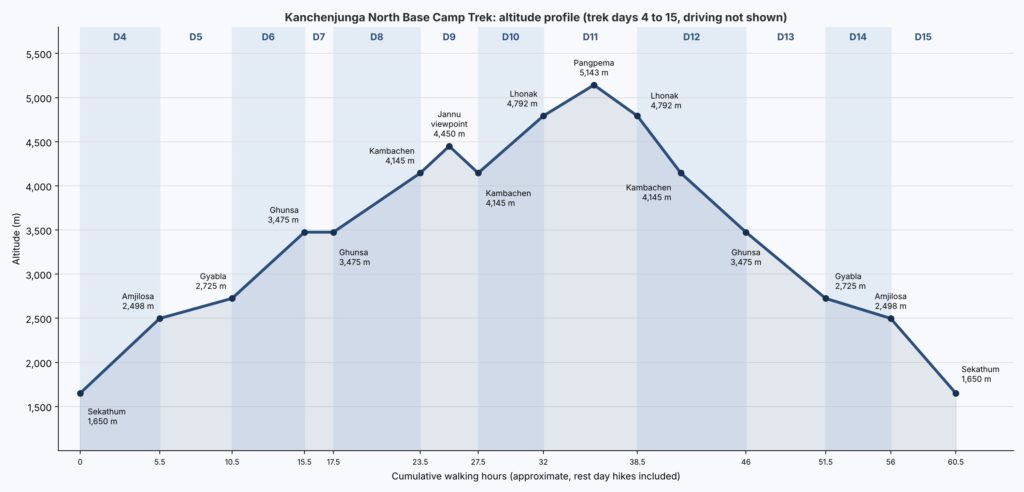 Altitude profile of the 18-day Kanchenjunga North Base Camp Trek, trek days 4 to 15. Rest days at Ghunsa (3,475 m / 11,401 ft) and Kambachen (4,145 m / 13,599 ft), with Pangpema (5,143 m / 16,873 ft) on Day 11.[/caption]