Up the Barun Valley to the fifth highest mountain in the world
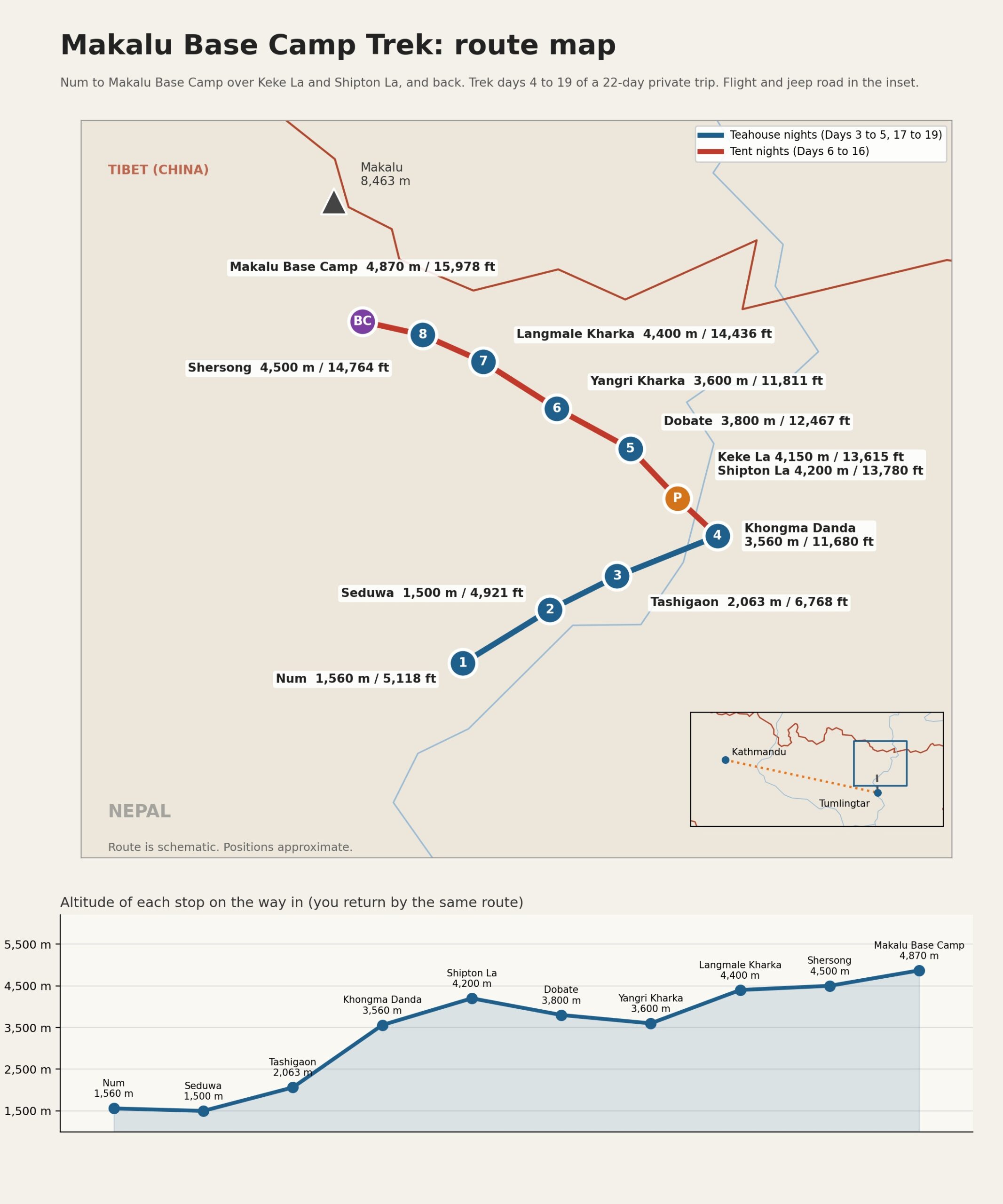
A 22-day private trek to Makalu Base Camp (4,870 m / 15,978 ft) in eastern Nepal, over Keke La and Shipton La, with rest days, a buffer day and tents above Tashigaon.
You fly to Tumlingtar and drive to Num, then walk through the Arun valley to Tashigaon, climb to Khongma Danda, and cross two passes into the Barun valley. You camp at Langmale Kharka and Shersong and reach Makalu Base Camp, below Makalu (8,463 m / 27,766 ft). It is remote and strenuous, with few other trekkers, rest days at Khongma Danda and Langmale Kharka, and almost no medical facilities above Tashigaon.
USD 2,980 per person, for a private trek for 2 or more people on your own dates. The price includes the Kathmandu to Tumlingtar flights, 4 nights in a Kathmandu hotel, a guide, cook and porters, teahouses and tents, meals on the trek, and the permits. You pay a 20% deposit (USD 596) to confirm, and the balance (USD 2,384) in cash on arrival in Kathmandu.
Last updated: November 2026. Trail and flight conditions in eastern Nepal can change, so we confirm the route with you before you travel.
Key facts: Makalu Base Camp Trek
Plan
Duration
22 days in total, with 16 days on the trail from Num to Num
Route
Kathmandu, Tumlingtar, Num, Seduwa, Tashigaon, Khongma Danda, Dobate, Yangri Kharka, Langmale Kharka, Shersong, Makalu Base Camp, and back the same way
Highest point
Makalu Base Camp, 4,870 m / 15,978 ft
Highest passes
Keke La 4,150 m / 13,615 ft and Shipton La 4,200 m / 13,780 ft
Starts and ends
Tribhuvan International Airport, Kathmandu (pickup on Day 1, drop-off on Day 22)
Grade
Strenuous. Good fitness and multi-day trekking experience needed.
Money
Price
USD 2,980 per person
Dates
Any date you choose. Private trek, no fixed departures.
Group size
Minimum 2 people. Your own group can be any size.
Deposit
20% (USD 596 per person) to confirm
Balance
USD 2,384 per person, in cash on arrival in Kathmandu
Included
Flights Kathmandu to Tumlingtar and back, 4 Kathmandu hotel nights, guide, cook, porters, teahouses and tents, meals on the trek, permits, ground transport
Not included
Travel insurance, international flights, visa, meals in Kathmandu, drinks, tips
On the trail
Walking
About 4 to 8 hours a day. Rest days at Khongma Danda and Langmale Kharka. Days 8 and 16 over the passes are 7 to 8 and 5 to 6 hours.
Transport
Flight Kathmandu to Tumlingtar (about 45 min), private jeep to Num, jeep and flight home
Best seasons
March to May and late September to November
Lodging
Teahouses on Days 3 to 5 and 17 to 19 (6 nights). Twin-sharing tents on Days 6 to 16 (11 nights).
Permits
All required permits are included
Insurance
Required. Must cover trekking up to 5,000 m and helicopter evacuation.
Use the tabs on this page for the overview, itinerary, inclusions, map, physical preparation, more information, FAQs and reviews.
Makalu Base Camp Trek: Into the Barun Valley
Makalu (8,463 m / 27,766 ft) is the fifth highest mountain in the world, and it stands east of Everest on the border with Tibet, in a part of Nepal that few trekkers visit. The Makalu Base Camp Trek takes you through the Makalu Barun National Park, from the hot, deep Arun valley, through Rai and Sherpa villages, over two passes and into the wild Barun valley, to Makalu Base Camp at 4,870 m / 15,978 ft.
This is a private trek, so you choose the dates and the size of your group, from 2 people up. You fly from Kathmandu to Tumlingtar and drive to Num, where the trail starts. You walk down to the Arun River, climb to Tashigaon and Khongma Danda, and cross Keke La (4,150 m / 13,615 ft) and Shipton La (4,200 m / 13,780 ft) to Dobate. You follow the Barun River up through forest and open valley to Langmale Kharka and Shersong and reach the base camp on Day 13. The trip has rest days at Khongma Danda and Langmale Kharka, a free day in Kathmandu at the end that doubles as a buffer for flight delays, and the permits, flights and a Kathmandu hotel are included.
You sleep in teahouses on the way in and out, and in twin-sharing tents between Khongma Danda and the base camp, where there are no lodges. A cook and a kitchen crew come with you, and your guide and porters stay with you the whole way.
Makalu base camp trek one line itinerary
Day 1: Arrive Kathmandu (1,345 m / 4,413 ft), airport pickup, hotel Day 2: Kathmandu sightseeing and trek briefing (1,345 m / 4,413 ft) Day 3: Fly Kathmandu to Tumlingtar (45 min), drive 3.5 to 5 h to Num (1,560 m / 5,118 ft) Day 4: Trek Num to Seduwa (1,500 m / 4,921 ft), about 6 h Day 5: Trek Seduwa to Tashigaon (2,063 m / 6,768 ft), 4 to 5 h Day 6: Trek Tashigaon to Khongma Danda (3,560 m / 11,680 ft), 6 to 7 h Day 7: Rest and acclimatization day at Khongma Danda (3,560 m / 11,680 ft), optional hike 3 to 4 h Day 8: Over Keke La (4,150 m / 13,615 ft) and Shipton La (4,200 m / 13,780 ft) to Dobate (3,800 m / 12,467 ft), 7 to 8 h Day 9: Trek Dobate to Yangri Kharka (3,600 m / 11,811 ft), 6 to 7 h Day 10: Trek Yangri Kharka to Langmale Kharka (4,400 m / 14,436 ft), 5 to 6 h Day 11: Rest day at Langmale Kharka (4,400 m / 14,436 ft), optional walk 2 to 3 h Day 12: Trek Langmale Kharka to Shersong (4,500 m / 14,764 ft), about 3.5 h Day 13: Trek Shersong to Makalu Base Camp (4,870 m / 15,978 ft), 4 to 5 h Day 14: Trek down to Yangri Kharka (3,600 m / 11,811 ft), 6 to 7 h Day 15: Trek Yangri Kharka to Dobate (3,800 m / 12,467 ft), about 6 h Day 16: Over the passes to Khongma Danda (3,560 m / 11,680 ft), 5 to 6 h Day 17: Trek Khongma Danda to Tashigaon (2,063 m / 6,768 ft), 4 to 5 h Day 18: Trek Tashigaon to Seduwa (1,500 m / 4,921 ft), about 5 h Day 19: Trek Seduwa to Num (1,560 m / 5,118 ft), 6 to 7 h Day 20: Drive Num to Tumlingtar, 3.5 to 5 h, fly to Kathmandu (1,345 m / 4,413 ft), 45 min, hotel Day 21: Free day in Kathmandu (1,345 m / 4,413 ft): rest, sightseeing tour or massage (extra cost), and buffer day for any delays Day 22: Airport drop-off and departure
[caption id="attachment_29967" align="alignnone" width="910"] Altitude profile of the Makalu Base Camp Trek, trek days 4 to 19. Rest days at Khongma Danda (3,560 m / 11,680 ft) and Langmale Kharka (4,400 m / 14,436 ft), the passes on Days 8 and 16, and Makalu Base Camp (4,870 m / 15,978 ft) on Day 13.[/caption]
Highlights
Makalu Base Camp (4,870 m / 15,978 ft), at the foot of the south-east ridge of the fifth highest mountain in the world
Keke La (4,150 m / 13,615 ft) and Shipton La (4,200 m / 13,780 ft), two passes with long views
The Barun valley, with waterfalls, forest, cliffs and the Barun Glacier
The Makalu Barun National Park, a quiet area with rhododendron and oak forest
Rai and Sherpa villages, with stone steps and mani walls, in the Arun valley
Rest days at Khongma Danda and Langmale Kharka, and a free buffer day in Kathmandu
A private trek on any date, with permits, flights and a Kathmandu hotel included
Who it suits
This trek suits fit people with experience of multi-day trekking, who are ready for long days, camping and cold nights. It is strenuous and remote: you sleep about 1,500 m higher on Day 6 than the night before, Day 8 over the passes is 7 to 8 hours, and above Tashigaon there are almost no medical facilities. It is not for first-time trekkers. If you have not trekked above 4,000 m before, consider our Everest Base Camp trek first. Read the physical preparation and altitude sections of this page before you book.
Cost Includes
Airport pickup in Kathmandu on Day 1 and drop-off on Day 22
Hotel in Kathmandu for 4 nights (Days 1, 2, 20 and 21), with breakfast
Guided Kathmandu sightseeing on Day 2
Flights from Kathmandu to Tumlingtar and from Tumlingtar to Kathmandu, including taxes
Private jeeps from Tumlingtar to Num and from Num to Tumlingtar
Teahouse accommodation on Days 3 to 5 and 17 to 19 (6 nights)
Twin-sharing tents with mattresses on Days 6 to 16 (11 nights), with a dining tent, a toilet tent and a shower tent, kitchen equipment, tables and chairs
Meals during the trek: breakfast, lunch and dinner, cooked by our cook and kitchen crew
English-speaking guide, cook, kitchen crew and porters, with their food, accommodation, salary, insurance, equipment and medicine
All required trekking permits
Sleeping bag, down jacket and duffel bag for the trek, on request
First aid kit
Government and local taxes
Cost Excludes
Travel insurance. It is required, and it must cover trekking up to 5,000 m and helicopter evacuation.
International flights and your Nepal visa
Lunch and dinner in Kathmandu, and drinks and bar bills
A Kathmandu sightseeing tour or a massage on the free day (Day 21), which we can arrange at an extra cost
Tea, coffee, bottled water and other drinks on the trek, hot showers in teahouses, battery charging and laundry
Personal trekking gear and clothing that is not listed above
Extra costs caused by bad weather, flight delays, trail problems or a change of route, such as extra nights, meals or a rebooked flight
Helicopter evacuation and medical costs, which your insurance should cover
Tips for your guide, cook and porters, which are optional
Makalu Base Camp Trek Itinerary: Day by Day
Day 01
Arrive in Kathmandu (1,345 m / 4,413 ft)
Our team meets you at Tribhuvan International Airport and takes you to your hotel. Rest after your flight. In the evening you can meet your guide and ask any questions about the trek.
Hotel in Kathmandu included (3-star)
Airport pickup included
Day 02
Kathmandu sightseeing and trek briefing (1,345 m / 4,413 ft)
A day to see Kathmandu and get ready. With your guide you visit some of Pashupatinath, Boudhanath, Swayambhunath and Patan Durbar Square, depending on the time and your interests. Your guide checks your gear and the paperwork for the permits, and you can buy anything you forgot.
Guided Kathmandu sightseeing included
Overnight: hotel in Kathmandu (included)
Day 03
Fly to Tumlingtar, drive to Num (1,560 m / 5,118 ft)
You take a morning flight of about 45 minutes to Tumlingtar, in the lower Arun valley. A private jeep takes you through Khandbari and over the Chichila ridge to Num, a Sherpa and Rai village on the edge of the Arun valley. The drive takes about 3.5 to 5 hours with stops. You can see the mountains for the first time from the road.
Flight: about 45 minutes
Drive: about 3.5 to 5 hours
Sleeping altitude: Num, 1,560 m / 5,118 ft
Overnight: teahouse
Day 04
Trek to Seduwa (1,500 m / 4,921 ft)
The trek starts. You walk down a steep path for about 2 hours to the Arun River, one of the deepest valleys in the world, and then climb for several hours through forest and farmland to Seduwa. It is a long day of about 6 hours, so start slowly and drink plenty of water.
Walking: about 6 hours
Sleeping altitude: Seduwa, 1,500 m / 4,921 ft
Overnight: teahouse
Day 05
Trek to Tashigaon (2,063 m / 6,768 ft)
A day of 4 to 5 hours on stone steps through forest and past mani walls, with tea stops on the way. Tashigaon is the last village on the route, and the last teahouse night before the tents. Check your gear and charge your batteries tonight.
Walking: about 4 to 5 hours
Sleeping altitude: Tashigaon, 2,063 m / 6,768 ft (about 560 m higher than Seduwa)
Overnight: teahouse
Day 06
Trek to Khongma Danda (3,560 m / 11,680 ft)
This is the hardest climb before the base camp. You walk 6 to 7 hours up through the Makalu Barun National Park, which you enter near Unshisa, through rhododendron and oak forest to a ridge camp at Khongma Danda. Your crew sets up the tents, and from here you sleep in a tent.
Altitude note: you sleep about 1,500 m / 4,921 ft higher than at Tashigaon. That is far more than the 300 to 500 m a night that we advise above 3,000 m, and there is no lodge on the way to break the climb. This is why a rest day follows. Walk slowly, drink plenty of water, and tell your guide at once if you have a worsening headache, vomiting or loss of balance.
Walking: about 6 to 7 hours
Sleeping altitude: Khongma Danda, 3,560 m / 11,680 ft (about 1,500 m higher than Tashigaon)
Overnight: tent
Day 07
Rest and acclimatization day at Khongma Danda (3,560 m / 11,680 ft)
A day to adjust to the height. After breakfast you can walk for 3 to 4 hours up the ridge toward the passes, and come back to sleep at Khongma Danda again. This is the "climb high, sleep low" rule. Rest, drink and eat well in the afternoon.
Walking: about 3 to 4 hours, optional
Sleeping altitude: Khongma Danda, 3,560 m / 11,680 ft
Overnight: tent
Day 08
Over Keke La and Shipton La to Dobate (3,800 m / 12,467 ft)
The big pass day. You climb from the ridge over Keke La (4,150 m / 13,615 ft) and Shipton La (4,200 m / 13,780 ft), with smaller ups and downs between them, and pass a small lake, Kalo Pokhari, near Shipton La. Then you walk down to the camp at Dobate. The day takes 7 to 8 hours. The weather can change fast up here, and snow can cover the trail, so your guide sets a turn-around time and may change the plan.
Walking: about 7 to 8 hours
Highest point: Shipton La, 4,200 m / 13,780 ft
Sleeping altitude: Dobate, 3,800 m / 12,467 ft (about 240 m higher than Khongma Danda)
Overnight: tent
Day 09
Trek to Yangri Kharka (3,600 m / 11,811 ft)
You walk down through forest to the Barun River, cross it on a wooden bridge, and follow the valley up to Yangri Kharka, a camp in a clearing. The day takes 6 to 7 hours, with waterfalls and steep cliffs above you.
Walking: about 6 to 7 hours
Sleeping altitude: Yangri Kharka, 3,600 m / 11,811 ft (about 200 m lower than Dobate)
Overnight: tent
Day 10
Trek to Langmale Kharka (4,400 m / 14,436 ft)
The valley opens up, and you climb through forest and then along the river to Langmale Kharka, with tea stops on the way. The walk takes 5 to 6 hours. Altitude note: you sleep about 800 m higher than at Yangri Kharka, which is above the advised gain. A rest day follows. Walk slowly and tell your guide about any symptoms.
Walking: about 5 to 6 hours
Sleeping altitude: Langmale Kharka, 4,400 m / 14,436 ft (about 800 m higher than Yangri Kharka)
Overnight: tent
Day 11
Rest day at Langmale Kharka (4,400 m / 14,436 ft)
A full rest day at height, with time to eat, drink and sleep well. If you feel fine, you can take a short walk of 2 to 3 hours up the valley and come back to sleep at Langmale again.
Walking: about 2 to 3 hours, optional
Sleeping altitude: Langmale Kharka, 4,400 m / 14,436 ft
Overnight: tent
Day 12
Trek to Shersong (4,500 m / 14,764 ft)
A short day of about 3.5 hours above the treeline, with Makalu ahead of you. You arrive early at Shersong, so there is time to rest before the last climb. Your guide checks how everyone feels.
Walking: about 3.5 hours
Sleeping altitude: Shersong, 4,500 m / 14,764 ft (about 100 m higher than Langmale Kharka)
Overnight: tent
Day 13
Trek to Makalu Base Camp (4,870 m / 15,978 ft)
You walk 4 to 5 hours over moraine and the edge of the Barun Glacier to Makalu Base Camp, at the foot of the south-east ridge of Makalu (8,463 m / 27,766 ft), the fifth highest mountain in the world. This is the highest point of the trek. You have the afternoon to rest and look at the mountain. Your guide sets a turn-around time and may stop the day early if the weather or your health is bad.
Walking: about 4 to 5 hours
Highest point: Makalu Base Camp, 4,870 m / 15,978 ft
Sleeping altitude: 4,870 m / 15,978 ft (about 370 m higher than Shersong)
Overnight: tent
Day 14
Trek down to Yangri Kharka (3,600 m / 11,811 ft)
You walk back down the Barun valley, with the mountain behind you. The day is about 6 to 7 hours, mostly downhill, and you drop about 1,270 m. Use your poles to protect your knees.
Walking: about 6 to 7 hours
Sleeping altitude: Yangri Kharka, 3,600 m / 11,811 ft
Overnight: tent
Day 15
Trek to Dobate (3,800 m / 12,467 ft)
You cross the Barun River and climb through forest to Dobate. The walk takes about 6 hours.
Walking: about 6 hours
Sleeping altitude: Dobate, 3,800 m / 12,467 ft (about 200 m higher than Yangri Kharka)
Overnight: tent
Day 16
Over the passes to Khongma Danda (3,560 m / 11,680 ft)
You climb back over Keke La (4,150 m / 13,615 ft) and Shipton La (4,200 m / 13,780 ft) and descend to Khongma Danda. The day takes 5 to 6 hours. The weather can be cold and windy at the passes, so keep your warm layers handy.
Walking: about 5 to 6 hours
Highest point: Shipton La, 4,200 m / 13,780 ft
Sleeping altitude: Khongma Danda, 3,560 m / 11,680 ft
Overnight: tent
Day 17
Trek to Tashigaon (2,063 m / 6,768 ft)
A long descent of 4 to 5 hours through forest, about 1,500 m down. It is hard on the knees. You sleep in a bed in a teahouse again.
Walking: about 4 to 5 hours
Sleeping altitude: Tashigaon, 2,063 m / 6,768 ft
Overnight: teahouse
Day 18
Trek to Seduwa (1,500 m / 4,921 ft)
You walk about 5 hours down the stone steps and through the forest to Seduwa.
Walking: about 5 hours
Sleeping altitude: Seduwa, 1,500 m / 4,921 ft
Overnight: teahouse
Day 19
Trek to Num (1,560 m / 5,118 ft)
The last trek day. You walk 6 to 7 hours down to the Arun River and then climb up the other side to Num, the end of the trail. You will feel the heat after the cold of the high camps. A farewell evening with your crew follows.
Walking: about 6 to 7 hours
Sleeping altitude: Num, 1,560 m / 5,118 ft
Overnight: teahouse
Day 20
Drive to Tumlingtar, fly to Kathmandu (1,345 m / 4,413 ft)
A private jeep takes you from Num to Tumlingtar, about 3.5 to 5 hours, and you fly to Kathmandu, about 45 minutes. We take you to your hotel. Flights from Tumlingtar can be delayed or cancelled in bad weather. If that happens we help you rebook, and Day 21 is your buffer day.
Drive: about 3.5 to 5 hours
Flight: about 45 minutes
Overnight: hotel in Kathmandu (included)
Day 21
Free day in Kathmandu
A day to rest after the trek. You can stay at the hotel, wander around Thamel at your own pace, or book a Kathmandu sightseeing tour or a massage through us (extra cost). It is also your buffer day. If the flight from Tumlingtar was delayed, this day absorbs it, so you can still make your international flight on Day 22.
Free day: sightseeing tour or massage can be arranged for an extra cost
Overnight: hotel in Kathmandu (included)
Day 22
Departure
We take you to Tribhuvan International Airport for your onward flight.
Airport drop-off included
Physical Preparation for the Makalu Base Camp Trek
This trek is strenuous. You are on the trail for 16 days, with a high point at 4,870 m / 15,978 ft, two passes above 4,100 m, and a lot of steep climbing and descending, including 1,500 m up on Day 6 and 1,500 m down on Day 17. You sleep in tents above Tashigaon, and the nights are cold. You do not need climbing skills, but you do need good fitness and experience of walking for many days in a row. Start training at least 12 to 16 weeks before you come, and see your doctor first if you have any health condition. This is general information and not medical advice.
16-week training plan
Weeks
Focus
What to do
1 to 4
Base fitness
3 to 4 sessions a week: 30 to 45 minutes of running, cycling or swimming, plus one hill walk of 2 to 3 hours.
5 to 8
Strength and long walks
Add squats, lunges and step-ups twice a week. Do a long hike of 4 to 5 hours with a loaded daypack on the weekend.
9 to 13
Trek-like days
Hike 5 to 8 hours with a 7 to 8 kg pack on two or three days in a row, with a lot of uphill and downhill, in the boots you will wear.
14 to 15
Peak weeks
One very long day of 7 to 8 hours with steep climbs and descents, to prepare for Day 8 over the passes. Practice sleeping in a tent if you can.
16
Taper
Reduce the load, rest well, check your gear, and do not start anything new.
What the trek asks of you
Long days: Day 4 is about 6 hours, Day 6 is 6 to 7 hours of climbing, Day 8 over the passes is 7 to 8 hours, and Day 19 is 6 to 7 hours
Steep descents: Day 14 drops about 1,270 m and Day 17 about 1,500 m, so train for your knees as well as your lungs
Many consecutive days of walking, with rest days only at Khongma Danda and Langmale Kharka
Cold nights in a tent above Tashigaon, below freezing at Langmale Kharka, Shersong and the base camp
Rough trail with rockfall, moraine and snow in places, and a remote area with few other trekkers
Altitude and acclimatization
Your body needs time to adjust to height, and this trek gives you two rest days. The nights are:
Day
Night at
Sleeping altitude
Change from the night before
6
Khongma Danda
3,560 m / 11,680 ft
About +1,500 m / +4,921 ft (rest day follows)
8
Dobate
3,800 m / 12,467 ft
About +240 m / +787 ft
10
Langmale Kharka
4,400 m / 14,436 ft
About +800 m / +2,625 ft (rest day follows)
12
Shersong
4,500 m / 14,764 ft
About +100 m / +328 ft
13
Makalu Base Camp
4,870 m / 15,978 ft
About +370 m / +1,214 ft
The advice for above 3,000 m is to sleep no more than 300 to 500 m higher each night. Two of these steps are larger than that, so your guide watches you closely, the pace is slow, and the rest days and the "climb high, sleep low" hike are part of the plan. Drink 3 to 4 liters of water a day. Tell your guide at once if you have a headache that gets worse, vomiting, loss of balance, a wet cough or breathlessness at rest. Going down is the treatment.
Before you book
See your doctor if you have a heart, lung, blood or kidney condition, or if you are pregnant
Ask about altitude medication, and do not take it without medical advice
Have a dental check and any vaccinations done early
Check that your insurance covers trekking up to 5,000 m and helicopter evacuation
Makalu Base Camp Trek: Frequently Asked Questions
Booking, price and dates
How much does the Makalu Base Camp Trek cost?
The Makalu Base Camp Trek costs USD 2,980 per person for a private trek for 2 or more people. The price includes the flights between Kathmandu and Tumlingtar, 4 nights in a Kathmandu hotel with breakfast, airport pickup and drop-off, the private jeeps, a guide, a cook and porters, teahouses and tents, meals on the trek, and all the permits. It does not include travel insurance, international flights, your visa, lunch and dinner in Kathmandu, drinks or tips. The Cost tab has the full list.
How do I book and pay for the Makalu Base Camp Trek?
Tell us your dates and your group size on this page or on WhatsApp at +977 982 381 6556. You pay a 20% deposit (USD 596 per person) to confirm your booking, and the balance (USD 2,384 per person) in cash, in US dollars or a convertible currency, when you arrive in Kathmandu. For the cancellation policy, please read our terms and conditions.
Are there fixed departures, and can I join a group?
No. This is a private trek only, so there are no fixed departure dates and no shared groups. You choose your own dates, and your group can be any size from 2 people up.
Can I trek to Makalu Base Camp alone?
This trek runs as a private trek for a minimum of 2 people. If you are traveling alone, tell us, and we can suggest a date when another trekker is going, or discuss the options with you.
The route and the itinerary
How many days is the Makalu Base Camp Trek?
The trek is 22 days in total: 2 days in Kathmandu at the start, the flight and the drive to Num, 16 days on the trail (with rest days at Khongma Danda and Langmale Kharka), the drive and the flight back, a free day in Kathmandu, and the departure day.
Where does the trek start and how do I get there?
You fly from Kathmandu to Tumlingtar (about 45 minutes) and take a private jeep to Num, about 3.5 to 5 hours through Khandbari and over the Chichila ridge. The trek starts and ends at Num. The flights and the jeeps are included.
Which passes do you cross?
You cross Keke La (4,150 m / 13,615 ft) and Shipton La (4,200 m / 13,780 ft), from Khongma Danda to Dobate on Day 8 (7 to 8 hours) and back on Day 16 (5 to 6 hours). Sources give slightly different heights for each pass, so we use an average. Snow can cover the trail, and your guide may change the plan if the weather is bad.
How high is Makalu Base Camp?
Makalu Base Camp is at 4,870 m / 15,978 ft. Some sources give other figures, from about 4,800 m to 5,000 m, because the base camp moves with the glacier and because an upper base camp is higher. The mountain itself is 8,463 m / 27,766 ft, the fifth highest in the world.
What is the free day in Kathmandu for?
Day 21 is a free day. You can rest at the hotel, walk around Thamel, or book a Kathmandu sightseeing day tour or a massage through us at an extra cost. It is also your buffer day. If the flight from Tumlingtar was delayed, the day absorbs the delay, so you can still catch your international flight on Day 22.
What happens if the flight from Tumlingtar is delayed or cancelled?
Flights in the hills are often delayed or cancelled in bad weather. If you miss the flight on Day 20, we help you rebook, and the free day (Day 21) is your buffer. Please do not book your international flight before Day 22.
Difficulty, fitness and altitude
How difficult is the Makalu Base Camp Trek?
It is strenuous. You are on the trail for 16 days, with walks of 4 to 8 hours, a climb of 1,500 m on Day 6, a pass day of 7 to 8 hours, and a long descent on Day 17. The highest point is 4,870 m / 15,978 ft, and you camp in tents above Tashigaon. You need good fitness and experience of long multi-day treks. The Physical Prep tab has a 16-week plan.
Is altitude sickness a risk on this trek?
Yes. Altitude sickness can happen on this trek, and it can be serious. The trek has rest days at Khongma Danda and Langmale Kharka, but two nights are much higher than the night before: Khongma Danda is about 1,500 m above Tashigaon, and Langmale Kharka is about 800 m above Yangri Kharka. Walk slowly, drink 3 to 4 liters of water a day, and tell your guide at once if you have a headache that gets worse, vomiting, loss of balance or breathlessness at rest. Going down is the treatment.
How remote is the trek, and what if I get sick?
Remote. There are almost no medical facilities above Tashigaon, and bad weather can ground rescue helicopters for days. Your guide has first-aid and altitude training and carries a first-aid kit, and we have evacuation procedures, but you must carry travel insurance that covers helicopter evacuation up to 5,000 m.
Do I need previous trekking experience?
Yes. This is not a first trek. We recommend several multi-day treks, including at least one above 4,000 m, such as the Everest Base Camp trek. Fitness and stamina matter more than technical skill, because there are no climbing sections. If you are not sure, contact us before you book.
What is the best time for the Makalu Base Camp Trek?
The best seasons are March to May and late September to November. October and November have the clearest skies. From December to February there is snow and it is very cold, and the passes can close. The monsoon (June to August) has rain, leeches, landslides and flight delays. Since this is a private trek, you can choose the date.
How cold does it get?
The nights are cold from Khongma Danda up, and below freezing at Langmale Kharka, Shersong and the base camp in the main seasons, and colder in winter. You need a warm sleeping bag, a down jacket, a hat and gloves. We can lend you a sleeping bag and a down jacket on request.
Permits, insurance and money
Are the permits included?
Yes. All the permits you need for the Makalu Barun National Park and the trek are included in the price, and we arrange them through our registered agency. We need your original passport and your insurance details on Day 2 in Kathmandu.
What travel insurance do I need?
Travel insurance is required and is not included. It should cover trekking up to 5,000 m / 16,404 ft, medical treatment and emergency helicopter evacuation. Please check the maximum altitude in your policy in writing.
Do I need a visa for Nepal, and how much cash should I carry?
Many nationalities can get a tourist visa on arrival in Kathmandu: USD 30 for 15 days, USD 50 for 30 days or USD 125 for 90 days. This trek is 22 days, so you need the 30 day visa or longer. Please check the current rules and fees before you travel.
Carry Nepali rupees in cash for drinks, snacks, charging and showers, because there are no ATMs on the trail.
On the trail
Do I sleep in teahouses or tents?
Both. You sleep in simple teahouses on Days 3 to 5 and 17 to 19 (6 nights), and in twin-sharing tents on Days 6 to 16 (11 nights), because there are no lodges above Tashigaon. Our crew carries the tents, mattresses, a dining tent, a toilet tent and a shower tent, and sets up the camp. In Kathmandu you stay in a hotel for 4 nights.
What food is included?
Meals on the trek are included: breakfast, lunch and dinner, cooked by our cook, with dal bhat, noodles, soup, eggs and bread. Vegetarian food is easy to arrange. In Kathmandu breakfast is included, but lunch and dinner are not.
What should I pack?
Bring a sleeping bag rated to about -15 C (or ask to borrow one), a down jacket, a hard-shell jacket, warm layers, a warm hat, gloves, sunglasses, sunscreen, broken-in waterproof boots, trekking poles, a head torch, a water bottle with purification tablets, and a personal first-aid kit. Ask your guide about microspikes for snow on the passes. We send the full list after you book.
Is there mobile signal, wifi or charging?
Mobile signal is patchy in the villages and is usually missing above Tashigaon. Charging is limited and may cost extra in the teahouses, and in the tents you need a power bank. Tell your family that you may be out of touch for several days.
Is the trek safe?
Our guides are first-aid trained and altitude trained, and we watch the weather and the flights. The main risks are altitude sickness, cold, rough trails, rockfall and landslides on the road. We choose a safe pace, we can turn you back at any point, and you must have insurance.
Last updated: November 2026. Still have a question? Message us on WhatsApp at +977 982 381 6556.
Makalu Base Camp Trek Route Map
Makalu Base Camp Trek: More Information
The route in short
The trek has three parts. First you walk through the Arun valley, from Num to Seduwa and Tashigaon, in forest and farmland. Then you climb to Khongma Danda and cross Keke La and Shipton La to Dobate. Finally you follow the Barun River up through Yangri Kharka, Langmale Kharka and Shersong to Makalu Base Camp, and come back by the same route. The route is 22 days, with 16 days on the trail and two rest days on the way in.
Why this trek is remote, and what that means
Makalu is in the east of Nepal, between Everest and Kanchenjunga, and the Makalu Barun National Park is one of the least visited trekking areas in the country. There are no roads above Num and almost no medical facilities above Tashigaon, and bad weather can ground rescue helicopters for days. Your guide carries a first-aid kit and has first-aid and altitude training, and we have evacuation procedures, but this trek needs you to be fit, well insured and prepared for basic conditions.
Altitude: please read this
The highest point is Makalu Base Camp (4,870 m / 15,978 ft), and the highest pass is Shipton La (4,200 m / 13,780 ft). The trek has two rest days, at Khongma Danda and Langmale Kharka, and a "climb high, sleep low" hike on Day 7, but two of the daily gains are above the 300 to 500 m a night that we advise above 3,000 m.
Day
Night at
Sleeping altitude
Change from the night before
4
Seduwa
1,500 m / 4,921 ft
About -60 m / -197 ft, after a descent to the Arun River
5
Tashigaon
2,063 m / 6,768 ft
About +560 m / +1,837 ft
6
Khongma Danda
3,560 m / 11,680 ft
About +1,500 m / +4,921 ft (rest day follows)
8
Dobate
3,800 m / 12,467 ft
About +240 m / +787 ft
9
Yangri Kharka
3,600 m / 11,811 ft
About -200 m / -656 ft
10
Langmale Kharka
4,400 m / 14,436 ft
About +800 m / +2,625 ft (rest day follows)
12
Shersong
4,500 m / 14,764 ft
About +100 m / +328 ft
13
Makalu Base Camp
4,870 m / 15,978 ft
About +370 m / +1,214 ft
Walk slowly, drink 3 to 4 liters of water a day, and tell your guide at once if you have a headache that gets worse, vomiting, unusual tiredness, loss of balance, a wet cough or breathlessness at rest. Going down is the treatment, and your guide may turn you back if you are not well. If you have a heart, lung or blood condition, see your doctor before you book. This is general information and not medical advice.
Daily walking and altitude
Times are approximate and include rests.
Day
Plan
Time
Altitude
1
Arrive Kathmandu
n/a
1,345 m / 4,413 ft
2
Sightseeing and briefing
Free
1,345 m / 4,413 ft
3
Fly to Tumlingtar, drive to Num
Flight 45 min, drive 3.5 to 5 h
1,560 m / 5,118 ft
4
Trek to Seduwa
About 6 h
1,500 m / 4,921 ft
5
Trek to Tashigaon
4 to 5 h
2,063 m / 6,768 ft
6
Trek to Khongma Danda
6 to 7 h
3,560 m / 11,680 ft
7
Rest day at Khongma Danda
Optional hike, 3 to 4 h
3,560 m / 11,680 ft
8
Over Keke La and Shipton La to Dobate
7 to 8 h
Shipton La 4,200 m / 13,780 ft. Dobate 3,800 m / 12,467 ft
9
Trek to Yangri Kharka
6 to 7 h
3,600 m / 11,811 ft
10
Trek to Langmale Kharka
5 to 6 h
4,400 m / 14,436 ft
11
Rest day at Langmale Kharka
Optional walk, 2 to 3 h
4,400 m / 14,436 ft
12
Trek to Shersong
About 3.5 h
4,500 m / 14,764 ft
13
Trek to Makalu Base Camp
4 to 5 h
4,870 m / 15,978 ft
14
Trek down to Yangri Kharka
6 to 7 h
3,600 m / 11,811 ft
15
Trek to Dobate
About 6 h
3,800 m / 12,467 ft
16
Over the passes to Khongma Danda
5 to 6 h
3,560 m / 11,680 ft
17
Trek to Tashigaon
4 to 5 h
2,063 m / 6,768 ft
18
Trek to Seduwa
About 5 h
1,500 m / 4,921 ft
19
Trek to Num
6 to 7 h
1,560 m / 5,118 ft
20
Drive to Tumlingtar, fly to Kathmandu
Drive 3.5 to 5 h, flight 45 min
1,345 m / 4,413 ft
21
Free day in Kathmandu
Free
1,345 m / 4,413 ft
22
Departure
Airport transfer
Days 8 and 16: the passes
On Day 8 you cross Keke La (4,150 m / 13,615 ft) and Shipton La (4,200 m / 13,780 ft) from Khongma Danda to Dobate, 7 to 8 hours, and on Day 16 you cross them again on the way back, 5 to 6 hours. Sources give different heights for each pass (Keke La from about 4,127 m to 4,170 m, Shipton La from about 4,125 m to 4,257 m), so we give an average. The weather can change fast, and snow can cover the trail. If the passes are closed, your guide chooses an alternative plan. Carry enough water and snacks, and keep close to your guide.
Makalu Base Camp
On Day 13 you walk from Shersong to the base camp (4,870 m / 15,978 ft), 4 to 5 hours, and spend the night there, at the foot of the south-east ridge of Makalu. You have the afternoon and the next morning to rest and look at the mountain. It is cold and often windy, so wear warm layers, gloves, a hat and sunglasses. Views can be cloudy, and your guide sets a turn-around time. Some operators go on to an upper base camp, but we do not include this, because it adds height and time.
The flights and the drive
The flight from Kathmandu to Tumlingtar takes about 45 minutes, and the jeep from Tumlingtar to Num takes about 3.5 to 5 hours. The flights are small-plane flights in the hills and are often delayed or cancelled in bad weather, mostly in the monsoon and in winter. This is why Day 21 is a free day: it is your buffer, so you can still catch your international flight on Day 22. If you miss the flight on Day 20, we help you rebook.
Day 21: free day in Kathmandu
After the trek you have a free day in Kathmandu. You can rest at the hotel, walk around Thamel, or book a Kathmandu sightseeing day tour or a massage through us, at an extra cost. If your flight from Tumlingtar was delayed, this day is used to catch up, and your plans stay the same.
Culture and the national park
The trek is inside the Makalu Barun National Park, home to Rai and Sherpa communities in the lower villages. Please ask before you take photographs of people, walk clockwise around mani walls, and do not leave litter. Your guide will explain the local customs.
The best time to go
Spring (March to May) and autumn (late September to November) are the best seasons. In October and November the skies are clearest, and Dashain and Tihar can make flights busy, so book early for those dates. In spring the rhododendrons flower in the forest. From December to February there is snow and it is very cold, and the passes can close. June to August is the monsoon, with rain, leeches, landslides and flight delays, and we do not recommend it. Because this is a private trek, you can choose your date.
Teahouses, tents and food
You sleep in a Kathmandu hotel with breakfast, in simple teahouses on Days 3 to 5 and 17 to 19 (6 nights), and in twin-sharing tents on Days 6 to 16 (11 nights). Our crew carries the tents, mattresses, a dining tent, a toilet tent and a shower tent, and sets up and takes down the camp. The tents are not heated, so bring a warm sleeping bag. Meals on the trek are included, cooked by our cook, with dal bhat, noodles, soup, eggs, bread and fresh vegetables when available. Vegetarian food is easy to arrange. Please tell us about any allergies when you book.
Gear
You bring your own gear. We can lend you a sleeping bag, a down jacket and a duffel bag on request. The packing list we send after you book includes a sleeping bag rated to about -15 C, a down jacket, a hard-shell jacket, warm layers, a warm hat, gloves, sunglasses, sunscreen, broken-in waterproof boots, trekking poles, a head torch, a water bottle with purification tablets, and a personal first-aid kit. Microspikes can help if there is snow on the passes, so ask your guide. Porters carry your duffel bag, up to about 10 to 12 kg, and you carry a daypack.
Permits and rules
All the permits you need for the Makalu Barun National Park and the trek are included, and we arrange them through our registered agency. On Day 2 we need your original passport and your insurance details. Please also send us a clear copy of your passport photo page and passport photos after you book.
Travel insurance
Travel insurance is required and is not included. It should cover trekking up to 5,000 m / 16,404 ft, medical treatment and emergency helicopter evacuation. Please check the maximum altitude in your policy in writing, because some policies stop at 4,000 m.
Nepal visa
The Nepal visa is not included. Many nationalities can get a tourist visa on arrival in Kathmandu: USD 30 for 15 days, USD 50 for 30 days or USD 125 for 90 days. This trek is 22 days, so you need the 30 day visa or longer. Please check the current rules and fees before you travel.
Booking and payment
The price is USD 2,980 per person, for a private trek with a minimum of 2 people. You pay a 20% deposit (USD 596 per person) to confirm your booking, and the balance (USD 2,384 per person) in cash, in US dollars or a convertible currency, when you arrive in Kathmandu. There are no fixed departures, so tell us your dates and your group size. Please read our terms and conditions for the cancellation policy.
Money, signal and safety
Carry Nepali rupees in cash for drinks, snacks, charging and showers, because there are no ATMs on the trail. Mobile signal is patchy in the villages and is usually missing above Tashigaon. You can reach our office on WhatsApp at +977 982 381 6556 when you have a signal. Tell your family that you may be out of touch for several days.



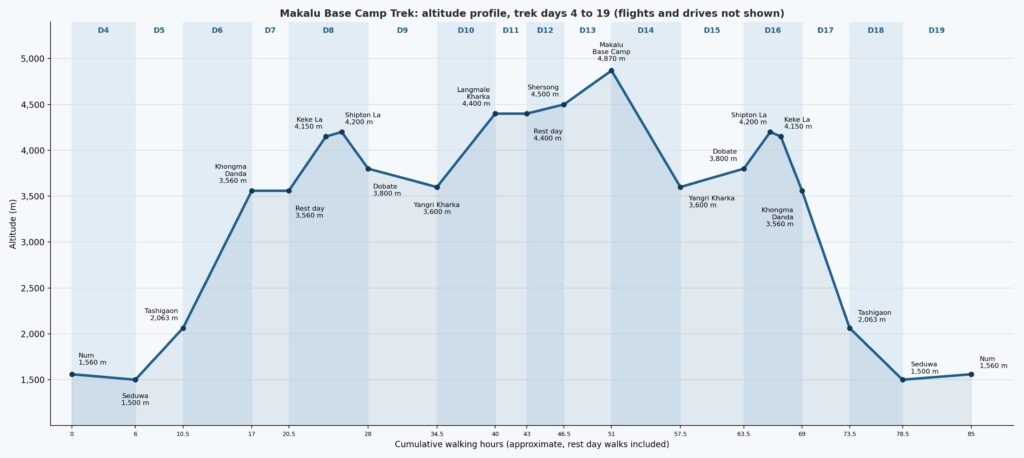 Altitude profile of the Makalu Base Camp Trek, trek days 4 to 19. Rest days at Khongma Danda (3,560 m / 11,680 ft) and Langmale Kharka (4,400 m / 14,436 ft), the passes on Days 8 and 16, and Makalu Base Camp (4,870 m / 15,978 ft) on Day 13.[/caption]