Mardi Himal Trek 4 Days from Pokhara

4 Days
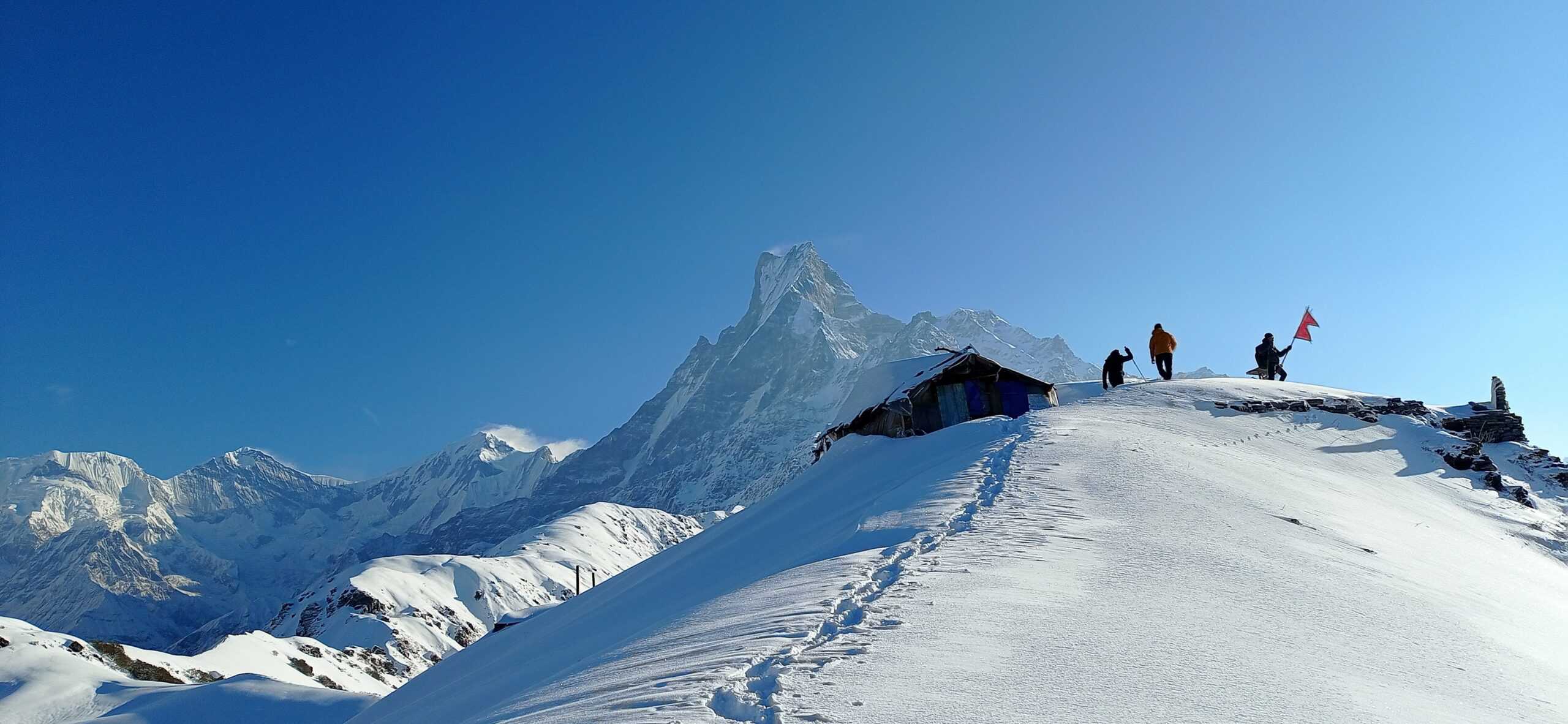
The Mardi Himal Trek is one of the best short treks from Pokhara. In just four days, you walk from quiet villages and forests up to open ridges with close views of Machhapuchre and Annapurna. This popular 4-day trek takes you through quiet villages, green forests and open highlands, giving you a mix of nature and culture. It’s one of the best short treks in Nepal. Pick your date and book this adventure now by clicking "View Dates and Book." It’s that easy! Book this amazing 4 days long Mardi Himal trek on a date of your choice.
Key Facts: 4-Day Mardi Himal Trek
Cost US$ 330 per person Trip duration 4 days
Difficulty Moderate Group size 2 or more
Maximum altitude 4,200 meters / 13,780 feet Best season Spring and autumn, and also winter until the end of December
Tour availability All year round Meeting point Lakeside, Pokhara
Transportation Private vehicle to the starting point and from the ending point Guided by Professional local expert guide
Accommodation Local teahouses providing basic lodge facilities Meals Breakfast, lunch and dinner included (by Mosaic Adventure).
Fitness level Moderate, suitable for trekkers with average physical fitness Permits & fees All necessary trekking permits and national park fees are included and handled by Mosaic Adventure
Travel insurance Highly recommended. Please ensure your policy covers emergency evacuation if required.

Overview

This 4 days Mardi Himal Trek is becoming increasingly popular as the best overall trekking route in Nepal.

What makes it special compared to most other treks is that it allows you to take in a lot of the giant Himalayan mountains in a relatively short period of time.

This destination is still considered something of a 'hidden gem,'. It sits on the same side as the Annapurna Base Camp route, but the trail is quieter. 

Starting from the beautiful city of Pokhara, which is situated at an altitude of 850 meters, Mardi Himal Trek will take you to an altitude of 4200 meters at the base camp for Mardi Himal peak.

Our 4-day trek to the Mardi Himal base camp passes through beautiful forests and wild open spaces, allowing you to catch sight of many Himalayan wildlife species and an eye catching series of Himalayan peaks.

If you're looking for an amazing Himalayan experience on one of Nepal's less crowded trails, then you should book and plan this Mardi Himal Trek for 4 Days before it's too late.

This trek is ideal for those looking to experience everything from lush green forests to spectacular valleys, villages and farmland, from Himalayan ice-melted rivers to superb vistas of legendary Himalayan peaks like Annapurna, Machhapuchre and Hiunchuli.

Mardi Himal Trek Itinerary:

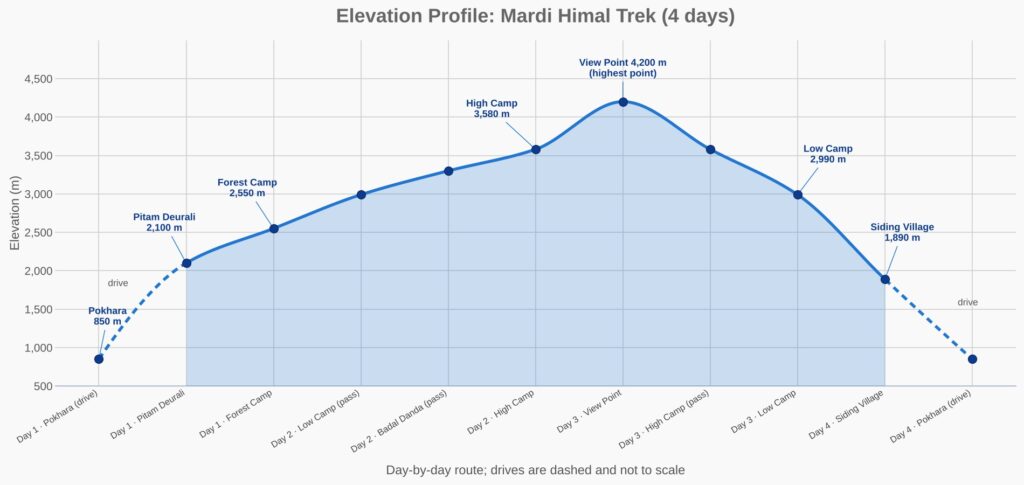
Day 1: Drive to Pitam Deurali and start trekking to Forest Camp (2550m, 8365ft/ 4 hours trek after 2 hours' drive).
Day 2: Trek from Forest Camp to High Camp (3580m, 11745ft/ 6.5 hours).
Day 3: Trek from High Camp to View Point (4200m, 13779ft) and return to Low Camp (2990m, 9810ft) / (6 hours)
Day 4: Trek from Low Camp to Siding Village (1890m, 6200ft/ 4 hours), then drive back to Pokhara (1.5 hours).

This itinerary is based on our years of guiding trekkers in the Annapurna region, including Mardi Himal, Annapurna Base Camp, and Poon Hill.

[caption id="attachment_29636" align="alignnone" width="910"]Elevation profile of the 4-day Mardi Himal trek from Pokhara, rising from Pitam Deurali to Forest Camp, High Camp and the 4,200 m View Point, then descending to Low Camp and Siding Village Mardi Himal trek elevation profile: Pokhara (850 m) to the View Point (4,200 m) and back to Siding Village (1,890 m). Drives are dashed and not to scale.[/caption]
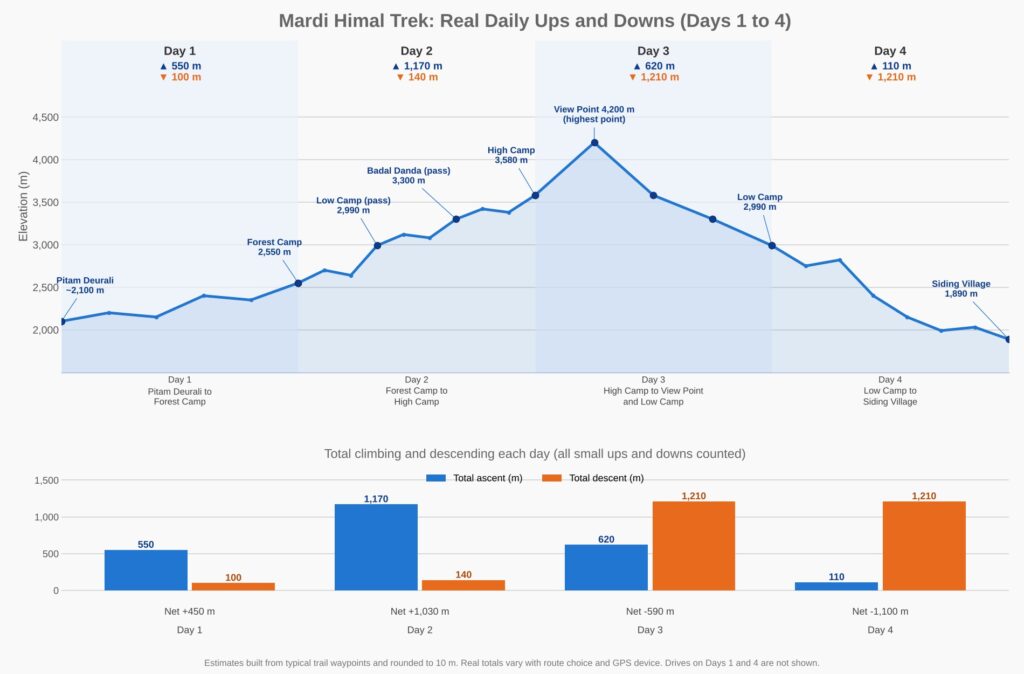
 

[caption id="attachment_29634" align="alignnone" width="910"]Chart of daily climbing and descending on the 4-day Mardi Himal trek, showing Day 2 as the biggest climb at about 1,170 m and Days 3 and 4 as the biggest descents at about 1,210 m each Real daily ascent and descent on the Mardi Himal trek, including small ups and downs. Estimates, rounded to 10 m.[/caption]

Highlights of Mardi Himal Trek:

  • See stunning views of the Annapurna range, with peaks like Machhapuchhre (Fishtail) and Annapurna South.
  • Walk through beautiful rhododendron forests with colorful blooms in spring and colorful forests all year round.
  • Mardi Himal trek is peaceful and less crowded.
  • Meet local communities, experience Gurung and Magar cultures.
  • Visit traditional villages, learn local customs, enjoy warm hospitality.
  • Stay at scenic spots with mountain views like High Camp and Low Camp.
  • Watch amazing sunrise and sunset views from places like High Camp and Low Camp.
  • Trek through diverse landscapes , meadows, rough terrain, high passes.
  • Enjoy the calm of the Himalayas away from city life.

The Cost Includes

  • Pokhara to Pitam Deurali transfers.
  • Licensed English Speaking guide.
  • Teahouse accommodation on trek (twin/trip sharing and dorm rooms).
  • Breakfast, lunch and dinner.
  • Required trekking area entry permits.
  • Siding - Pokhara transfers.
  • Government imposed taxes

What is not included

  • All kind of beverages(tea/coffee, bottled water etc)
  • Tipping to guide.
  • Hiring porter.
  • Any loss arising due to unforeseen circumstances which is beyond Mosaic Adventure control.

Mardi Himal Trek Detailed Day-by-Day Itinerary

  • Day
    1

    Drive from Pokhara to Pitam Deurali and Trek to Forest Camp (2,550 m / 8,365 ft)

    Trail Description:

    The adventure begins with a scenic two-hour drive from Pokhara’s Lakeside area (850 m) to Pitam Deurali. The road winds through terraced farmlands, small settlements, and forested hills. From Pitam Deurali, the trek starts on a gradual uphill trail leading through lush subtropical forests filled with rhododendron trees that bloom beautifully in spring. The route includes stone steps, dirt paths, and gentle ascents with a few steeper sections. Along the way, trekkers can enjoy birdsong, quiet hamlets, and occasional views of the Annapurna peaks.

    Accommodation:

    Overnight at a basic teahouse in Forest Camp (also known as Kokar), offering simple rooms with shared bathrooms and limited but beautiful mountain views.

    Meals:

    Breakfast in Pokhara. Lunch and dinner at the teahouse with options such as dal bhat (lentil curry with rice), noodle soup, or momos (dumplings). Vegetarian and vegan meals are available.

    Walking Hours and Distance:

    6 to 7 hours, covering approximately 10 to 12 km.

    Altitude Gain:

    Around 1,030 m.

    Lunch + Dinner
    Teahouse
  • Day
    2

    Trek from Forest Camp to High Camp (3,580 m / 11,745 ft)

    Trail Description:

    After breakfast, we climb above the forest line and follow the ridge toward High Camp. The air feels cooler and the views start opening up. On a clear day, Machhapuchre begins to show its full shape. From experience, this is the day we remind guests to walk slow and drink water often. The views improve if you save energy.

    Accommodation:

    Teahouse at High Camp with basic shared facilities. The dining area is warm and cozy, and trekkers often gather here in the evening to relax and share stories.

    Meals:

    Breakfast at Forest Camp, lunch on the way, and dinner at High Camp. Choices often include fried rice, vegetable curry, noodles, and other simple teahouse meals.

    Walking Hours:

    About 5 to 7 hours, depending on trail conditions and your pace.

    Breakfast + Lunch + Dinner
    Teahouse
  • Day
    3

    Hike to Mardi Himal Viewpoint (4,200 m / 13,779 ft) and Descend to Low Camp (2,990 m / 9,810 ft)

    Trail Description:

    Start early to reach the Mardi Himal Viewpoint, the highlight of the trek. The trail is steep and rocky with some loose gravel and snow patches during winter. The climb rewards trekkers with breathtaking views of Mardi Himal, Annapurna I, Hiunchuli, and Gangapurna at close range. After spending time enjoying the panorama, descend along the same trail before branching off toward Low Camp through grasslands and rhododendron forests. The descent is easier and offers wonderful views of valleys and wildflowers in season.

    Accommodation:

    Teahouse at Low Camp with shared facilities and a friendly, relaxed atmosphere. Many trekkers gather around the dining area for warmth and conversation in the evening.

    Meals:

    Breakfast at High Camp, packed lunch for the viewpoint, and dinner at Low Camp. Choices often include fried rice, vegetable curry, or pizza.

    Walking Hours and Distance:

    About 6 hours in total (3 to 4 hours up and 2 to 3 hours down), covering roughly 8 to 10 km.

    Altitude Gain/Loss:

    Gain of 620 m to the viewpoint and descent of 1,210 m to Low Camp.

    Breakfast + Lunch + Dinner
    Teahouse
  • Day
    4

    Trek from Low Camp to Siding Village (1,890 m / 6,200 ft) and Drive Back to Pokhara

    Trail Description:

    The final day of the trek descends gradually through thick forests and terraced farmlands. The trail passes several Gurung villages where you can interact with locals and experience their traditional lifestyle. The route is mostly downhill with stone paths and small bridges crossing streams. The trek ends at the peaceful Siding Village surrounded by farmland and hills. From here, drive back to Pokhara.

    Accommodation:

    Not included. You will return to Pokhara for your preferred hotel stay.

    Meals:

    Breakfast at Low Camp and lunch in Siding Village with simple local food such as chapati and vegetables.

    Walking Hours and Distance:

    About 4 hours of trekking, covering 7 to 9 km, followed by a 1.5-hour drive to Pokhara.

    Altitude Loss:

    Approximately 1,100 m.

    Breakfast + Lunch

Mardi Himal Trek FAQs

About the trek

What is the 4-day Mardi Himal Trek?

It's a short teahouse trek in the Annapurna region, starting and ending in Pokhara. You walk up through rhododendron forest to High Camp, climb to the Mardi Himal Viewpoint at 4,200 m (13,780 ft), then come down a different way to Siding Village and drive back to Pokhara. It's a good option if you have only a few days.

Where does the trek start and end?

It starts in Pokhara, where we collect you from your hotel and drive about 2 hours to Pitam Deurali. It ends at Siding Village, from where it's about 1.5 hours back to Pokhara by road.

What will I see on the Mardi Himal Trek?

Machhapuchhre (Fishtail) shows up on clear days from the ridge. From the viewpoint you see Mardi Himal, Annapurna I, Hiunchuli and Gangapurna. Lower down you walk through rhododendron forest, grassland and terraced farmland, and you pass Gurung villages on the last day.

Does this trek go to Mardi Himal Base Camp?

No. Our 4-day itinerary stops at the Mardi Himal Viewpoint at 4,200 m. Base Camp is higher, at roughly 4,500 m, and needs extra time. If you'd like to visit Base Camp, you can discuss it with your guide, and it may be possible to arrange it on the spot, depending on your stamina, pace, and preferences.

Is the Mardi Himal Trek crowded?

It's quieter than the Annapurna Base Camp or Everest Base Camp treks because the route only opened in 2012 and hasn't become as popular as other trekking routes. It's busiest in autumn and spring, so expect to share teahouses with other trekkers during these seasons. In winter, you'll often have the trail almost to yourself.

Around the Nepali festivals of Dashain and Tihar, however, teahouses tend to fill up faster, as Mardi Himal is high on the list of popular trekking destinations during these extended festival holidays.

How does Mardi Himal compare with Poon Hill and Annapurna Base Camp?

Poon Hill is easier and lower, with a famous sunrise view. Annapurna Base Camp takes longer and goes deeper into the mountains. Mardi Himal sits in between: you get a close view of the Annapurna range and a night above 3,500 m in just 4 days.

Is the Mardi Himal Trek worth it?

If you want a quiet, moderately challenging trek with big mountain views in a short time, yes. If you only have a weekend or you hate early starts, a shorter Pokhara hike might suit you better.

Price, booking and payment

How much does the 4-day Mardi Himal Trek cost?

The trek costs USD 330 per person.

What's included in the price?

A licensed English-speaking guide, transfers from Pokhara to Pitam Deurali and from Siding back to Pokhara, teahouse accommodation, breakfast, lunch and dinner on the trek, the required trekking permits and government taxes.

What's not included?

Drinks such as tea, coffee and bottled water, tips for your guide, a porter if you want one, your hotel in Pokhara, your sleeping bag and personal gear, and travel insurance. Charging, hot showers and Wi-Fi in the teahouses cost extra, too.

Is this a private trek? Can I choose my own date?

Yes. It's a private trek on any date you choose, for a minimum of 2 people, and nobody else joins you. Pick your date in the booking form and book online.

Can one person book the trek?

The minimum is 2 people. If you're travelling alone, you'll need a friend or travel partner to book with.

How do I pay?

You pay the full amount when you book online.

What's your cancellation policy?

Cancellations follow our general terms and conditions, which you can read here. Please read them before you book.

What time will you pick me up on Day 1?

We collect you from your hotel in Pokhara. Once you send us your hotel name and address, we confirm the exact pickup time.

Do I need to book a hotel in Pokhara?

Yes, for the night before the trek. Lakeside is the easiest place to stay, but we can collect you from anywhere in Pokhara. Your hotel isn't included in the trek price.

How do I get to Pokhara from Kathmandu?

You can fly, which takes about 25 minutes, or drive for 6 to 7 hours. Travel from Kathmandu isn't part of this package.

Difficulty and fitness

Is the Mardi Himal Trek suitable for beginners?

Yes, if you have good fitness and can walk 5 to 7 hours a day. Plenty of first-time trekkers finish it comfortably, as long as they go slowly and rest. You don't need any climbing skills.

How challenging is the Mardi Himal Trek?

It's a moderate trek. You walk about 4 to 7 hours a day, with steep sections both up and down. Your guide keeps a steady pace and stops for regular breaks.

Which is the hardest day?

Day 3. The climb to the viewpoint is steep and rocky, you start early, and you finish by dropping more than 1,200 m to Low Camp. Day 2 is also long, as it climbs above the forest to High Camp.

How many hours do I walk each day?

Day 1 is about 6 to 7 hours, Day 2 about 5 to 7 hours, Day 3 about 6 hours and Day 4 about 4 hours, followed by the drive back to Pokhara.

How should I train for the Mardi Himal Trek?

Spend 6 to 8 weeks before you travel on hikes, stair climbing or jogging, and try some hills with a loaded backpack. Your legs will thank you on the long downhill on Days 3 and 4.

Can children do the Mardi Himal Trek?

It depends on the child. The days are long and steep, with a night at 3,580 m. If you're thinking of bringing kids, tell us their ages and fitness, and we'll tell you honestly whether it suits them.

Do I need trekking poles for the Mardi Himal Trek?

They're not essential, but most trekkers find them very helpful, especially on the steep descent on Days 3 and 4. Bring your own or buy a pair in Pokhara.

Altitude

How high does the Mardi Himal Trek go?

The highest point is the Mardi Himal Viewpoint at 4,200 m (13,780 ft). You sleep at Forest Camp (2,550 m), High Camp (3,580 m) and Low Camp (2,990 m).

Is altitude sickness common on the Mardi Himal Trek?

It's possible at 4,200 m, mostly because the climb is quick. Day 2 gains over 1,000 m in a single day, which is more than the usual advice. Walk slowly, drink plenty of water and tell your guide at once if you get a headache, nausea, tingling fingers or poor sleep.

What happens if I get sick at altitude?

Your guide checks on you throughout the trek. If symptoms get worse, you go down, because the fastest cure is losing height. Don't push on with symptoms, and don't hide them to keep your place on the schedule.

Can I add a day to acclimatize?

Yes. Adding an extra day, for example at High Camp or in the forest, makes the trek gentler. Tell us before you book and we'll adjust the plan and the price.

Is travel insurance included?

No. We strongly recommend it, and your policy should cover trekking to at least 4,500 m and emergency helicopter evacuation.

Accommodation, food and water

What type of accommodation is on the Mardi Himal Trek?

Basic teahouses, with twin-share or dorm rooms. Each bed has a mattress, pillow, blanket and bedsheet, and bathrooms are shared. Rooms get simpler the higher you go.

Where do we stay each night?

Day 1 at Forest Camp (also called Kokar), Day 2 at High Camp and Day 3 at Low Camp. On Day 4 you're back in Pokhara.

Are hot showers, charging and Wi-Fi included?

No. Some teahouses have hot showers, while others sell buckets of hot water, and most charge extra for charging devices and Wi-Fi, usually in cash. These services get rarer and pricier at higher camps, so bring a power bank.

Which meals are included?

Lunch and dinner on Day 1, all three meals on Day 2, breakfast, a packed lunch and dinner on Day 3, and breakfast at Low Camp and lunch in Siding on Day 4. Breakfast on Day 1 and dinner on Day 4 are on your own, in Pokhara.

What food is available on the trail?

Mostly Nepali dishes such as dal bhat, with noodles, soup, eggs, momos and some Western breakfasts. Dal bhat comes with refills, which is great after a long day.

Why is it recommended to be vegetarian on the Mardi Himal Trek?

Meat doesn't keep well on the trail, since everything has to be carried up the mountain. Stomach problems are the last thing you want on a steep walk, so a vegetarian diet is the safest choice. It helps to eat lighter in the days before you start.

Is the water safe to drink?

Don't drink straight from taps or streams. Buy bottled water, ask the teahouse for boiled water, or bring purification tablets or a filter bottle, which saves plastic too.

Is there mobile network or Wi-Fi on the Mardi Himal Trek?

Mobile signal is available in some villages but gets weak or disappears higher up. A few teahouses have Wi-Fi for an extra charge, but it can be slow. Plan on limited connectivity.

Guide, permits and safety

Do I need a guide for the Mardi Himal Trek?

A guide isn't mandatory for every trekker, but we strongly recommend one, and your trek includes a licensed English-speaking guide. They handle the route, the pace and the permits, and they know what to do if something goes wrong.

Can I trek to Mardi Himal independently?

Rules for trekking without a guide in the Annapurna region have been changing, and the trail is poorly marked in places. Solo trekkers in particular have been facing tighter checks. We recommend going with a licensed guide, and we include one.

Is the Mardi Himal Trek safe?

It's a well-used trail, and our guides know it well. The main risks are altitude, slippery steps in wet weather and snow in winter, and your guide manages all three. Bring good boots, tell your guide how you feel and buy insurance.

Is a porter included?

No. A 4-day trek is fine with a light backpack. If you'd like a porter, ask us and we'll arrange one for an extra cost.

Packing, weather and best time

What should I pack for the 4-day Mardi Himal Trek?

Warm layers, a waterproof jacket, broken-in trekking shoes, a hat, gloves, sunscreen, sunglasses, a water bottle, a head torch and a small first-aid kit. A 40 to 50 L backpack is plenty. Keep your total weight to about 9 to 10 kg.

Do I need a sleeping bag?

Yes, bring one. You can bring your own or rent one in Pokhara, and a bag rated to around -10 °C is a good choice for the cold nights at High Camp.

When is the best time to do the Mardi Himal Trek?

September to November and March to May, when skies are clearest. Autumn temperatures are around 5 to 15 °C, and spring is 10 to 20 °C, with rhododendrons in bloom.

Can I do the Mardi Himal Trek in winter?

Yes, until the end of December. It's dry and quiet, but nights at the higher camps can drop to around -10 °C, and snow can make the steep sections slippery. Pack warm clothing and a good sleeping bag.

Can I do the Mardi Himal Trek in the monsoon?

We don't recommend it. From June to August the trail is wet and slippery, leeches are common in the forest, and cloud often hides the mountains.

How much cash should I bring?

Bring Nepali rupees for drinks, snacks, charging, hot showers and tips, because there are no ATMs on the trail. Take out cash in Pokhara before you go.

How much should I tip my guide?

Tips are at your discretion. Guides plan on about USD 80 to 100 for a 4-day trek.

Extending your trip

Can I extend the 4-day Mardi Himal Trek?

Yes. You can add days, or continue to Annapurna Base Camp or Poon Hill. Tell us what you'd like and we'll plan it with you.

Map of Mardi Himal Trek 4 Days

Map of Mardi Himal Trek 4 days

Important Information for Trekkers

Why Choose Mosaic Adventure for Your Mardi Himal Trek

At Mosaic Adventure, we are proud to be one of Nepal’s most trusted trekking companies, officially licensed by the Nepal Tourism Board and the Ministry of Tourism, Government of Nepal. With years of experience and an excellent reputation, we organize safe and well-planned treks that combine breathtaking mountain views with genuine cultural encounters.

Expert and Certified Local Guides

Our guides are 100% certified by the Nepal Tourism Board and trained under the Tourism Ministry of Nepal. They are fluent in English, highly knowledgeable about the Annapurna region, and trained in first aid and altitude safety. Many of them have guided for more than ten years, ensuring that every guest enjoys a safe, informative, and rewarding trekking experience.

Responsible and Ethical Tourism

Mosaic Adventure follows responsible tourism practices. We collaborate with local Gurung and Magar communities to support the regional economy through fair wages and community partnerships. Our team promotes eco-friendly travel by managing waste responsibly and maintaining low-impact trekking standards that protect Nepal’s pristine natural environment.

Customizable and Safe Itineraries

We keep our group sizes small, with a maximum of 12 trekkers, so each participant receives personal attention. Every trek includes experienced comprehensive insurance coverage for our field staff. We customize itineraries to match your fitness, travel dates, and interests.

Trusted by Thousands of Trekkers

Mosaic Adventure is a top-rated company with hundreds of positive reviews on TripAdvisor, Bookmundi, and other travel platforms. Our transparent pricing policy ensures that you get fair value without hidden costs. The Mardi Himal Trek package starts at USD 300 per person, including all necessary permits, transport, and professional guidance.

More Than Trekking

As experts in adventure travel across Nepal, Tibet, and Bhutan, we also offer optional activities such as scenic day tours, rafting, or paragliding. These add-on experiences make your Himalayan journey even more memorable.
Choose Mosaic Adventure for a well-organized, ethical, and unforgettable Mardi Himal experience guided by certified professionals.

Mardi Himal Trek Difficulty

The Mardi Himal Trek is a moderate-grade trek suitable for beginners with basic fitness as well as experienced hikers seeking a short adventure. No previous trekking experience is required, but physical preparation helps ensure comfort and enjoyment. If you are reasonably fit and comfortable walking 5 to 7 hours a day, this trek is suitable even if it is your first Himalayan trek.

Fitness Level: Expect to walk 5 to 7 hours daily with some steep ascents and descents. To prepare, practice hiking, jogging, or stair climbing 6 to 8 weeks before the trek.

Altitude: The trek reaches a maximum of about 4,200 m. Daily altitude gain can be up to 1,000 m. Our guides monitor your health closely and carry oximeters to check oxygen levels.

Challenging Sections: The route includes steep ridges and rocky sections, especially near High Camp and the viewpoint. Trails may be slippery in rain or snow, so trekking poles are helpful.

Suitability: The trek is ideal for anyone in good health. It may not suit those with severe knee or heart conditions. Families, solo travelers, and small groups are all welcome.
With the guidance of our certified team, the Mardi Himal Trek offers a perfect mix of challenge and reward without overwhelming demands.

Guide tip: the ridge near High Camp can feel windy and cold, even in good seasons. We start early so you get the best views before clouds build.

Best Time for Mardi Himal Trek

The best seasons for the Mardi Himal Trek are spring (March to May) and autumn (September to November) when weather conditions are stable and mountain views are at their best.

Spring (March-May): Pleasant daytime temperatures between 10 °C and 20 °C, with rhododendrons and wildflowers in bloom. Clear skies and mild weather make it an excellent time to trek, although late May can bring light rain.

Autumn (September-November): Cool and dry with crisp air and superb visibility. Temperatures range from 5 °C to 15 °C. This season coincides with major Nepalese festivals like Dashain and Tihar. Trails can be busy in October, but conditions are ideal for photography.

Summer/Monsoon (June-August): The trails are green but wet. Heavy rainfall may cause leeches and slippery paths. Recommended only for experienced trekkers.

Winter (December-February): Cold but peaceful, offering quiet trails and cultural immersion in mountain villages. Temperatures can drop to -10 °C at higher points, and some sections may have snow.

While we operate treks throughout the year, we highly recommend spring and autumn for the best overall experience.

Mardi Himal Trek Packing List

Packing light and smart will make your trek more comfortable. We recommend keeping your total bag weight between 9 and 10 kg. Porters are available to assist with your luggage.

Clothing

Base layers: 2-3 moisture-wicking t-shirts and thermal tops/bottoms for evenings

Mid layers: Fleece jacket and lightweight trekking pants (2 pairs)

Outer layers: Waterproof jacket and pants (Gore-Tex recommended), down jacket for high altitudes

Accessories: Warm hat, gloves, scarf or buff, and UV-protected sunglasses

Footwear: Trekking boots with good ankle support (well broken-in), comfortable camp shoes or sandals, 3-4 pairs of wool socks and thin liners

Gear and Equipment

  • 40-50 L backpack with rain cover,
  • Sleeping bag rated to -10 °C
  • Trekking poles for balance on steep paths
  • Headlamp with spare batteries
  • Water bottle or purification tablets (boiled water available at teahouses)

Persona Items

  • Toiletries: biodegradable soap, toothbrush, sunscreen (SPF 50+), lip balm, wet wipes
  • First-aid kit: blister plasters, painkillers, altitude medicine (consult your doctor), and personal prescriptions
  • Documents: passport, permits (ACAP included, and any other required paperwork arranged by us).
  • Optional: snacks, camera, and power bank (limited charging available)

For Mardi Himal Trek cost details and inclusions such as meals, transport, and guide services, please see the other sections or contact us directly for a customized quote.