Dhaulagiri Circuit Trek

20 Days

A hard, remote, high-pass trek in west Nepal

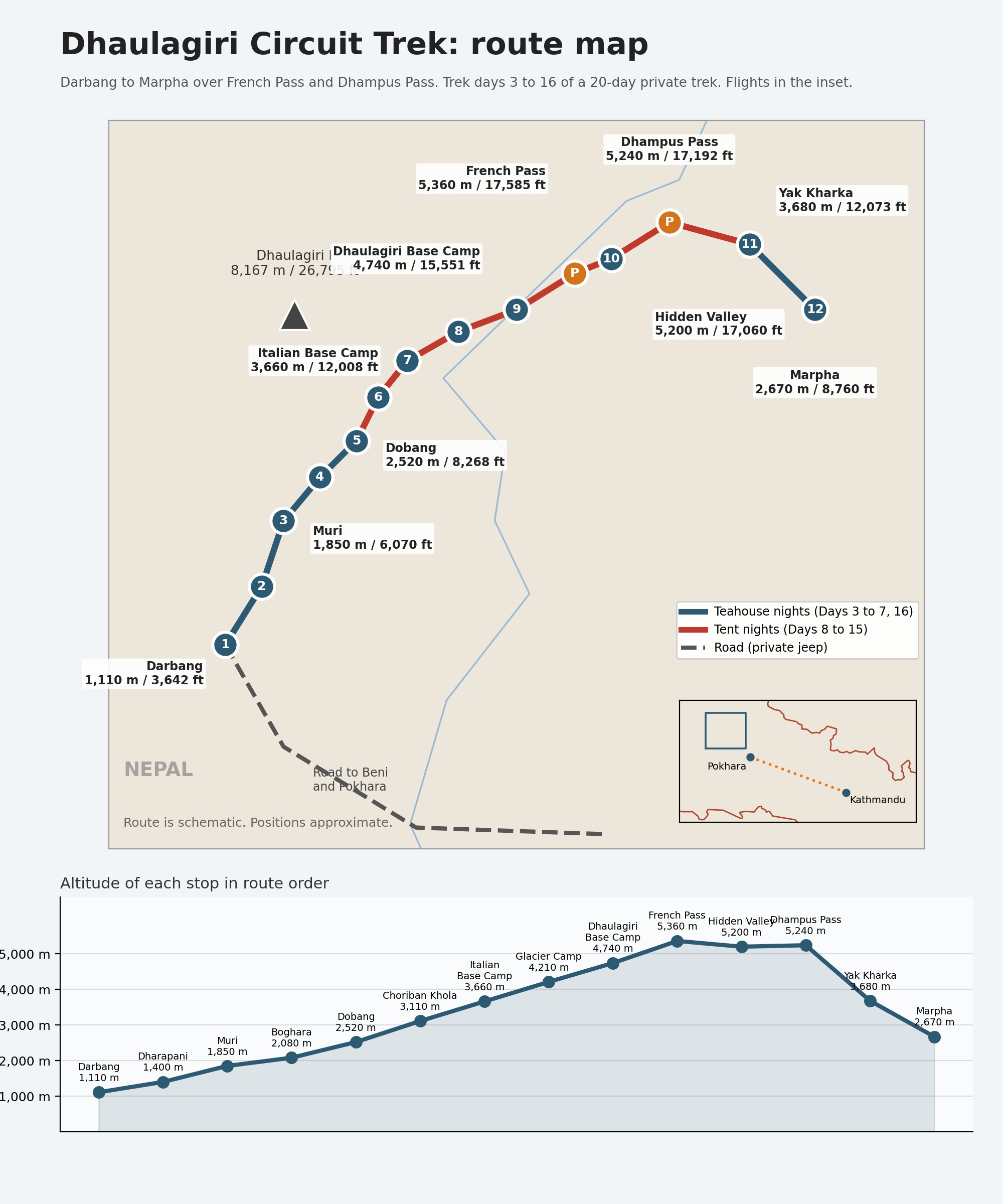
A 20-day private trek around Dhaulagiri (8,167 m / 26,795 ft), over French Pass (5,360 m / 17,585 ft) and Dhampus Pass (5,240 m / 17,192 ft), with two rest days and a spare day.

You walk up the Myagdi Khola from Darbang, camp at Italian Base Camp and Dhaulagiri Base Camp, cross two snowy passes above 5,200 m, and walk down to Marpha in the Kali Gandaki valley. It is a hard trek with long days, cold nights and very few other trekkers. You need good fitness and some experience of walking at altitude.

USD 3,050 per person, for a private trek for 2 or more people on your own dates. The price includes the flights between Kathmandu and Pokhara, hotels, private jeeps, teahouses, tents, all meals on the trek, a guide, a cook, porters and the permits. You pay a 20% deposit (USD 610 per person) to confirm. You pay the balance (USD 2,440 per person) in cash in US dollars or a convertible currency when you arrive in Kathmandu.

Last updated: November 2026.

Key facts: Dhaulagiri Circuit Trek

Plan
Duration
20 days: 15 days of trekking, 2 rest days and a spare day in Kathmandu
Route
Darbang, Italian Base Camp, Dhaulagiri Base Camp, French Pass, Hidden Valley, Dhampus Pass, Yak Kharka, Marpha
Highest point
French Pass, 5,360 m / 17,585 ft
Highest sleeping point
Hidden Valley, 5,200 m / 17,060 ft
Starts and ends
Kathmandu. Flights to and from Pokhara are included.
Grade
Hard. Long days, snow and ice on the passes, and nights above 4,000 m.
Money
Price
USD 3,050 per person
Dates
Any date you choose. Private trek, no fixed departures.
Group size
Minimum 2 people
Deposit
20% (USD 610 per person)
Balance
USD 2,440 per person, in cash in US dollars or a convertible currency on arrival in Kathmandu
Included
Flights Kathmandu to Pokhara and back, hotels, private jeeps, teahouses and tents, meals on the trek, guide, cook, porters, permits
Not included
Travel insurance, international flights, Nepal visa, lunch and dinner in Kathmandu and Pokhara, drinks, tips
On the trail
Walking
3 to 9 hours a day. The pass days (14 and 15) are the longest and hardest.
Transport
Private jeep from Pokhara to Darbang and from Marpha to Pokhara, and flights Kathmandu to Pokhara and back
Best seasons
October to November and March to April
Lodging
Teahouses on 6 nights, tents on 8 nights, hotels in Kathmandu and Pokhara
Meals
Breakfast, lunch and dinner on the trek, cooked by our cook
Insurance
Required. Must cover trekking above 5,000 m and helicopter evacuation.

Use the tabs on this page for the overview, itinerary, inclusions, map, physical preparation, more information, FAQs and reviews.

Dhaulagiri Circuit Trek: Around the White Mountain

Dhaulagiri I (8,167 m / 26,795 ft) is the seventh highest mountain in the world, and its name means "white mountain". The Dhaulagiri Circuit goes around the massif, from the Myagdi Khola valley in the south, over French Pass (5,360 m / 17,585 ft) and Dhampus Pass (5,240 m / 17,192 ft), to the Kali Gandaki valley in the north. It is one of the hardest and most remote treks in Nepal, and few trekkers do it. It is a trek for people who want ice, rock and silence, not tea houses with a view.

This is a private trek, so you choose the dates and the size of your group, from 2 people up. You fly from Kathmandu to Pokhara and drive to Darbang, then walk for 15 days. You sleep in simple teahouses on the first 5 nights, in tents for 8 nights from Choriban Khola, and in a teahouse in Marpha. You have a rest day at Italian Base Camp and another at Dhaulagiri Base Camp. After the trek you drive from Marpha to Pokhara, fly back to Kathmandu, and have a free day that also serves as a spare day. The price covers the flights, hotels, private jeeps, accommodation, meals on the trek, a guide, a cook, porters and the permits.

Dhaulagiri circuit trek itinerary

Day 1: Arrive in Kathmandu (1,345 m / 4,413 ft)
Day 2: Briefing, gear check and sightseeing in Kathmandu
Day 3: Fly to Pokhara, drive 5 to 6 h to Darbang (1,110 m / 3,642 ft)
Day 4: Trek to Dharapani, 3 to 4 h (1,400 m / 4,593 ft)
Day 5: Trek to Muri, 5 to 7 h (1,850 m / 6,070 ft)
Day 6: Trek to Boghara, about 6 h (2,080 m / 6,824 ft)
Day 7: Trek to Dobang, about 5 h (2,520 m / 8,268 ft)
Day 8: Trek to Choriban Khola, about 6 h, tent (3,110 m / 10,203 ft)
Day 9: Trek to Italian Base Camp, 6 to 7 h (3,660 m / 12,008 ft)
Day 10: Rest day at Italian Base Camp (3,660 m / 12,008 ft)
Day 11: Trek to Glacier Camp, about 6 h (4,210 m / 13,812 ft)
Day 12: Trek to Dhaulagiri Base Camp, about 7 h (4,740 m / 15,551 ft)
Day 13: Rest day at Dhaulagiri Base Camp (4,740 m / 15,551 ft)
Day 14: Over French Pass (5,360 m / 17,585 ft) to Hidden Valley, 7 to 9 h (5,200 m / 17,060 ft)
Day 15: Over Dhampus Pass (5,240 m / 17,192 ft) to Yak Kharka, about 7 h (3,680 m / 12,073 ft)
Day 16: Trek to Marpha, 5 to 6 h (2,670 m / 8,760 ft)
Day 17: Drive to Pokhara, 6 to 8 h (830 m / 2,723 ft)
Day 18: Fly to Kathmandu
Day 19: Free day in Kathmandu (spare day)
Day 20: Departure
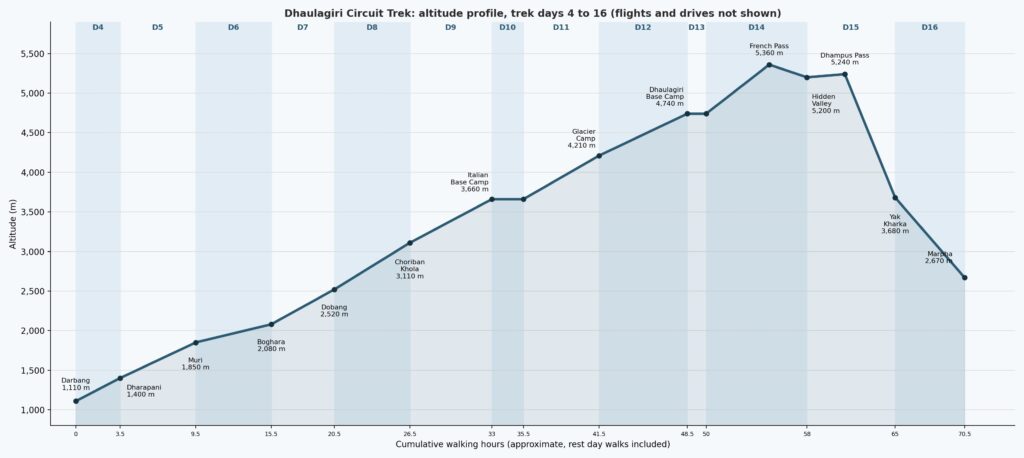
[caption id="attachment_29995" align="alignnone" width="910"]Altitude profile of the 20-day Dhaulagiri Circuit Trek from Darbang over French Pass and Dhampus Pass to Marpha, with the highest sleeping point at Hidden Valley, 5,200 m Altitude profile of the Dhaulagiri Circuit Trek, trek days 4 to 16. Rest days at Italian Base Camp (3,660 m / 12,008 ft) and Dhaulagiri Base Camp (4,740 m / 15,551 ft), French Pass (5,360 m / 17,585 ft) on Day 14, and Dhampus Pass (5,240 m / 17,192 ft) on Day 15.[/caption]

Highlights

  • The view of Dhaulagiri I (8,167 m / 26,795 ft) from Italian Base Camp and Dhaulagiri Base Camp (4,740 m / 15,551 ft)
  • French Pass (5,360 m / 17,585 ft), a snowy high pass, and a night in Hidden Valley (5,200 m / 17,060 ft)
  • Dhampus Pass (5,240 m / 17,192 ft), with views over the Kali Gandaki valley and the Annapurna range
  • A walk on moraine and glacier, with almost no other trekkers
  • Marpha, a Thakali village with apple orchards and white-washed houses
  • Two rest days and a spare day, because the weather on the passes decides when you cross
  • A private trek on your own dates, with the flights, permits, meals and crew included

Who it suits

This trek suits people who are very fit, have walked for many days in a row, and have been above 4,000 m before. You do not need climbing skills, but you must be happy to walk on snow and rough ground, to sleep in a cold tent, and to walk for up to 9 hours on the pass day. It is not a good choice for a first trek in Nepal. If you are new to the Himalaya, ask us about a shorter trek first.
Cost Includes

  • Airport pickup and drop-off in Kathmandu
  • Flights from Kathmandu to Pokhara (Day 3) and from Pokhara to Kathmandu (Day 18)
  • 4 nights in a 3-star hotel in Kathmandu and 1 night in a 3-star hotel in Pokhara, with breakfast, double or twin sharing
  • A guided sightseeing tour in Kathmandu
  • Private jeep from Pokhara to Darbang and from Marpha to Pokhara
  • 6 nights in teahouses (Darbang, Dharapani, Muri, Boghara, Dobang and Marpha)
  • 8 nights in twin-sharing tents with mattresses, and a dining tent, a toilet tent and a kitchen tent
  • Breakfast, lunch and dinner on the trek, cooked by our cook
  • English-speaking licensed trekking guide, a cook, a kitchen crew, and porters to carry the camping gear and your duffel bag
  • Salary, food, accommodation, insurance and equipment for our field staff
  • All the permits and entry fees required for the trek
  • Sleeping bag, down jacket and duffel bag on request, to be returned after the trek
  • A first-aid kit and government taxes

Cost Excludes

  • Travel insurance. It is required, and it must cover trekking above 5,000 m, medical costs and helicopter evacuation.
  • International flights to and from Kathmandu
  • Your Nepal visa (USD 50 for 30 days on arrival, for most nationalities, and this trek takes 20 days)
  • Lunch and dinner in Kathmandu and Pokhara
  • Drinks, including bottled water, soft drinks and alcohol, and hot showers where they cost extra
  • Personal expenses, such as laundry, phone calls and snacks
  • Personal trekking gear that is not listed above, such as boots, trekking poles and microspikes
  • Tips for your guide and crew, which are expected but not mandatory
  • Extra costs caused by weather, flight changes or road closures, such as extra nights, meals or a helicopter

Dhaulagiri Circuit Trek Itinerary: Day by Day

  • Day
    01

    Arrive in Kathmandu (1,345 m / 4,413 ft)

    Our team meets you at Tribhuvan International Airport and takes you to your hotel. Rest after your flight, and meet your guide in the evening if you arrive early enough.

    • Airport pickup included
    • Sleeping altitude: Kathmandu, 1,345 m / 4,413 ft
    • Overnight: 3-star hotel in Kathmandu

  • Day
    02

    Briefing, gear check and sightseeing in Kathmandu (1,345 m / 4,413 ft)

    You meet your guide for a trek briefing and a check of your gear. You can rent or buy anything you are missing in Thamel. In the afternoon, a guided tour takes you to one or two of the old city's sites. We also check your travel insurance, which must cover trekking above 5,000 m with helicopter evacuation.

    • Guided sightseeing included
    • Sleeping altitude: Kathmandu, 1,345 m / 4,413 ft
    • Overnight: 3-star hotel in Kathmandu

  • Day
    03

    Fly to Pokhara, drive to Darbang (1,110 m / 3,642 ft)

    After an early breakfast you fly to Pokhara, a flight of about 25 minutes. There our private jeep takes you through Beni and Babiyachaur, along the Myagdi Khola, to Darbang, the road head and the start of the trek. The drive takes about 5 to 6 hours, on a paved road as far as Beni and on a rough road after that. You arrive in the afternoon and walk around the village.

    • Flight Kathmandu to Pokhara included
    • Drive: about 5 to 6 hours by private jeep
    • Sleeping altitude: Darbang, 1,110 m / 3,642 ft
    • Overnight: teahouse

  • Day
    04

    Trek to Dharapani (1,400 m / 4,593 ft)

    A short first day to warm up. You walk up the valley of the Myagdi Khola through terraced fields and villages, with the first views of the hills ahead. If you feel good, you can walk on and enjoy the afternoon in the village.

    • Walking: 3 to 4 hours
    • Sleeping altitude: Dharapani, 1,400 m / 4,593 ft
    • Overnight: teahouse

  • Day
    05

    Trek to Muri (1,850 m / 6,070 ft)

    You follow the river on a trail that goes up and down, through Takam, to Muri, a Magar village with views of the valley. The day is longer than yesterday, and the climb is steady.

    • Walking: 5 to 7 hours
    • Sleeping altitude: Muri, 1,850 m / 6,070 ft
    • Overnight: teahouse

  • Day
    06

    Trek to Boghara (2,080 m / 6,824 ft)

    The trail climbs through forest and crosses side streams on a long suspension bridge, and you walk on rough ground along the gorge. Some people call Boghara by the name Bagar.

    • Walking: about 6 hours
    • Sleeping altitude: Boghara, 2,080 m / 6,824 ft
    • Overnight: teahouse

  • Day
    07

    Trek to Dobang (2,520 m / 8,268 ft)

    You climb through bamboo and rhododendron forest, on a narrow trail above the river, and the Dhaulagiri range starts to show through the trees. Dobang is a forest clearing with a basic lodge, and it is the last night under a roof until Marpha.

    • Walking: about 5 hours
    • Sleeping altitude: Dobang, 2,520 m / 8,268 ft
    • Overnight: teahouse

  • Day
    08

    Trek to Choriban Khola (3,110 m / 10,203 ft)

    The forest thins out as you cross the Choriban Khola by a bridge and climb to a camp beside the river. This is the first tent night. It is also the biggest gain in sleeping altitude on the trek, about 590 m, a little above the usual advice of 300 to 500 m a night, so go slowly and drink a lot of water.

    • Walking: about 6 hours
    • Sleeping altitude: Choriban Khola, 3,110 m / 10,203 ft, about +590 m from Dobang
    • Overnight: tent

  • Day
    09

    Trek to Italian Base Camp (3,660 m / 12,008 ft)

    A hard day. You climb along the moraine of the Chhonbardan glacier, with big views of the Dhaulagiri massif, to Italian Base Camp, a meadow at the foot of the south face. You gain about 550 m in sleeping altitude.

    • Walking: 6 to 7 hours
    • Sleeping altitude: Italian Base Camp, 3,660 m / 12,008 ft, about +550 m
    • Overnight: tent

  • Day
    10

    Rest day at Italian Base Camp (3,660 m / 12,008 ft)

    A rest day to get used to the height. You can take a short walk up the valley to see the glacier and the peaks, and then come back to sleep at the same height ("climb high, sleep low"). If the weather has delayed the trek, your guide can use this day to catch up.

    • Walking: optional, 2 to 3 hours
    • Sleeping altitude: Italian Base Camp, 3,660 m / 12,008 ft
    • Overnight: tent

  • Day
    11

    Trek to Glacier Camp (4,210 m / 13,812 ft)

    You walk on rocky moraine and across the edge of the glacier, on a rough trail, to Glacier Camp, a camp that some operators call Japanese Camp. The ground is stony and exposed, and the afternoon wind can be strong. You gain about 550 m in sleeping altitude.

    • Walking: about 6 hours
    • Sleeping altitude: Glacier Camp, 4,210 m / 13,812 ft, about +550 m
    • Overnight: tent

  • Day
    12

    Trek to Dhaulagiri Base Camp (4,740 m / 15,551 ft)

    The trail climbs on moraine and glacier to Dhaulagiri Base Camp, below Dhaulagiri I (8,167 m / 26,795 ft), the seventh highest mountain in the world. The camp is the highest you reach before the passes, and the nights are very cold. You gain about 530 m in sleeping altitude.

    • Walking: about 7 hours
    • Sleeping altitude: Dhaulagiri Base Camp, 4,740 m / 15,551 ft, about +530 m
    • Overnight: tent

  • Day
    13

    Rest day at Dhaulagiri Base Camp (4,740 m / 15,551 ft)

    The last rest day before the passes. Rest, eat well and drink a lot. You can take an easy walk around the base camp. Your guide checks your health and the weather, and decides whether the pass day goes ahead. If the weather is bad, this day is also the spare day for the crossing.

    • Walking: optional, 1 to 2 hours
    • Sleeping altitude: Dhaulagiri Base Camp, 4,740 m / 15,551 ft
    • Overnight: tent

  • Day
    14

    Cross French Pass to Hidden Valley (5,200 m / 17,060 ft)

    The hardest day. You start before dawn and climb on snow and rock to French Pass (5,360 m / 17,585 ft), the highest point of the trek. From the pass you look back on Dhaulagiri and ahead into Hidden Valley, a high, wide, empty basin. Then you descend to camp at 5,200 m / 17,060 ft. This is the highest and coldest night of the trek. The route can have snow, ice and strong wind, and the way is not always marked, so we only cross when your guide is sure about the weather and your health.

    • Walking: 7 to 9 hours
    • Highest point: French Pass, 5,360 m / 17,585 ft
    • Sleeping altitude: Hidden Valley, 5,200 m / 17,060 ft, about +460 m
    • Overnight: tent

  • Day
    15

    Cross Dhampus Pass to Yak Kharka (3,680 m / 12,073 ft)

    You climb to Dhampus Pass (5,240 m / 17,192 ft) in the morning, with wide views over the Kali Gandaki valley and the Annapurna range. Then a long descent of about 1,500 m takes you down a steep trail to Yak Kharka, a grassy camp, where the air feels thick after the nights up high.

    • Walking: about 7 hours
    • Highest point: Dhampus Pass, 5,240 m / 17,192 ft
    • Sleeping altitude: Yak Kharka, 3,680 m / 12,073 ft
    • Overnight: tent

  • Day
    16

    Trek to Marpha (2,670 m / 8,760 ft)

    You walk down through juniper and pine and into the Kali Gandaki valley, one of the deepest in the world, to Marpha, a neat Thakali village known for its apple orchards, apple brandy and white-washed houses. You sleep in a teahouse with a hot shower.

    • Walking: 5 to 6 hours
    • Sleeping altitude: Marpha, 2,670 m / 8,760 ft
    • Overnight: teahouse

  • Day
    17

    Drive to Pokhara (830 m / 2,723 ft)

    After breakfast our private jeep takes you down the Kali Gandaki valley through Tatopani and Beni to Pokhara. The road is rough gravel in the upper part and paved from Beni. The drive takes about 6 to 8 hours with stops, depending on the road. In the evening you can walk by Phewa Lake.

    • Drive: about 6 to 8 hours by private jeep
    • Sleeping altitude: Pokhara, 830 m / 2,723 ft
    • Overnight: 3-star hotel in Pokhara

  • Day
    18

    Fly to Kathmandu (1,345 m / 4,413 ft)

    A flight of about 25 minutes takes you back to Kathmandu, and we take you to your hotel. The rest of the day is free for shopping and a celebration dinner.

    • Flight Pokhara to Kathmandu included
    • Sleeping altitude: Kathmandu, 1,345 m / 4,413 ft
    • Overnight: 3-star hotel in Kathmandu

  • Day
    19

    Free day in Kathmandu (1,345 m / 4,413 ft)

    A free day, and also our spare day. If the weather has delayed the trek or a flight, we use this day to catch up, so you do not miss your international flight. Otherwise, you are free to explore Kathmandu.

    • Sleeping altitude: Kathmandu, 1,345 m / 4,413 ft
    • Overnight: 3-star hotel in Kathmandu

  • Day
    20

    Departure

    We take you to Tribhuvan International Airport for your flight home.

    • Airport transfer included

Physical Preparation for the Dhaulagiri Circuit Trek

This is a hard trek. You are on the trail for 15 days, with 8 nights in tents, two passes above 5,200 m, and a highest sleeping point of 5,200 m / 17,060 ft. The pass days are 7 to 9 hours on snow and rough ground, and the nights above 4,000 m are cold. There is no easy exit above Italian Base Camp. You do not need climbing skills, but you do need very good fitness, and we strongly recommend that you have trekked above 4,000 m before. Start training at least 12 to 16 weeks before you come, and see your doctor first. This is general information and not medical advice.

16-week training plan

WeeksFocusWhat to do
1 to 4Base fitness3 to 4 sessions a week: 30 to 45 minutes of running, cycling or swimming, plus one hill walk of 2 to 3 hours.
5 to 8Strength and long walksAdd squats, lunges and step-ups twice a week. Do a long hike of 4 to 5 hours with a loaded daypack at the weekend.
9 to 13Trek-like daysHike 5 to 8 hours with a 7 to 8 kg pack on two or three days in a row, with a lot of uphill and downhill, in the boots you will wear. If you can, walk on snow or rough ground.
14 to 15Peak weeksOne very long day of 8 to 9 hours with steep climbs, to prepare for Day 14. Sleep in a tent if you can.
16TaperReduce the load, rest well, check your gear, and do not start anything new.

What the trek asks of you

  • Day 5 and Day 14 are long: 5 to 7 hours on Day 5 and 7 to 9 hours over French Pass on Day 14
  • Day 15 is about 7 hours, with a descent of about 1,500 m from Hidden Valley to Yak Kharka, which is hard on the knees
  • 8 nights in a tent, with temperatures well below freezing at Dhaulagiri Base Camp and Hidden Valley
  • Snow, ice, moraine and strong afternoon wind on and around the passes
  • A remote route with few other trekkers and no quick way out above Italian Base Camp

Altitude and acclimatization

The advice for above 3,000 m is to sleep no more than 300 to 500 m higher each night. This route is at or slightly above that limit, and the two rest days are there to make up for it. These are the nights:

DayNight atSleeping altitudeChange from the night before
8Choriban Khola3,110 m / 10,203 ftAbout +590 m / +1,936 ft
9Italian Base Camp3,660 m / 12,008 ftAbout +550 m / +1,804 ft (rest day follows)
11Glacier Camp4,210 m / 13,812 ftAbout +550 m / +1,804 ft
12Dhaulagiri Base Camp4,740 m / 15,551 ftAbout +530 m / +1,739 ft (rest day follows)
14Hidden Valley5,200 m / 17,060 ftAbout +460 m / +1,509 ft
15Yak Kharka3,680 m / 12,073 ftAbout -1,520 m / -4,987 ft

Four of these steps are above 500 m, so your guide watches you closely, the pace is slow, and you must not skip the rest days. Drink 3 to 4 liters of water a day. Tell your guide at once if you have a headache that gets worse, vomiting, loss of balance, a wet cough or breathlessness at rest. Going down is the treatment, but above Italian Base Camp going down takes time, so it is important to speak up early.

Before you book

  • See your doctor if you have a heart, lung, blood or kidney condition, or if you are pregnant
  • Ask your doctor about altitude medication, and do not take it without medical advice
  • Check that your insurance covers trekking above 5,000 m and helicopter evacuation
  • Break in your boots well before you come, and bring trekking poles and microspikes
  • Tell us about any medical condition, allergy or food restriction when you book

Dhaulagiri Circuit Trek: Frequently Asked Questions

Booking, price and dates

How much does the Dhaulagiri Circuit Trek cost?

The Dhaulagiri Circuit Trek costs USD 3,050 per person for a private trek for 2 or more people. The price includes the flights between Kathmandu and Pokhara, 4 nights in a Kathmandu hotel and 1 night in a Pokhara hotel with breakfast, private jeeps, teahouses and tents, all meals on the trek, a guide, a cook, porters and the permits. It does not include travel insurance, international flights, your Nepal visa, lunch and dinner in Kathmandu and Pokhara, drinks, tips or personal gear.

Is this a private trek or a group trek?

It is a private trek. You choose any date you like, and you walk with your own group and your own guide. The minimum is 2 people. There are no fixed departure dates.

How do I pay?

You pay a 20% deposit (USD 610 per person) to confirm your booking. You pay the balance (USD 2,440 per person) in cash in US dollars or a convertible currency when you arrive in Kathmandu. For the cancellation policy, see our terms and conditions.

What is included and what is not included?

Included: airport transfers, the flights between Kathmandu and Pokhara, hotels in Kathmandu and Pokhara with breakfast, a guided Kathmandu tour, private jeeps from Pokhara to Darbang and from Marpha to Pokhara, 6 nights in teahouses, 8 nights in tents, all meals on the trek, a guide, a cook, a kitchen crew, porters, all the permits, and government taxes. Not included: travel insurance, international flights, your Nepal visa, lunch and dinner in Kathmandu and Pokhara, drinks, tips and personal gear.

When is the best time for the Dhaulagiri Circuit Trek?

October and November are the best months, with clear skies and stable weather. March and April are the second best, but there can still be snow on the passes. We do not recommend the monsoon (June to September) because of rain and landslides, or winter (December to February) because of snow, ice and gales on the passes.

Do I need a permit, and do you arrange it?

Yes, you need trekking permits, and we arrange them for you. All the permits needed for the trek are included in the price. We need a scan of your passport at least 2 weeks before the trip. Nepal also requires you to trek with a licensed guide, and the guide is included.

Do I need a Nepal visa?

Yes, most nationalities need one, and you can get it on arrival at Kathmandu airport. The fees are USD 30 for 15 days, USD 50 for 30 days and USD 125 for 90 days. This trip takes 20 days, so you need the 30-day visa or longer. The visa is not included. Please check the current rules and fees before you travel.

The route and the days

What is the itinerary?

The trek takes 20 days. You arrive in Kathmandu on Day 1 and have a briefing and sightseeing on Day 2. On Day 3 you fly to Pokhara and drive to Darbang. You trek from Day 4 to Day 16: Dharapani, Muri, Boghara, Dobang, Choriban Khola, Italian Base Camp, a rest day, Glacier Camp, Dhaulagiri Base Camp, a rest day, French Pass to Hidden Valley, Dhampus Pass to Yak Kharka, and Marpha. On Day 17 you drive to Pokhara, on Day 18 you fly to Kathmandu, Day 19 is a free spare day, and Day 20 is departure.

Where does the trek start and end?

It starts at Darbang, a road head that a private jeep reaches from Pokhara in 5 to 6 hours, and it ends in Marpha, in the Kali Gandaki valley. From Marpha a private jeep takes you to Pokhara, which takes about 6 to 8 hours on a rough road, and you fly to Kathmandu the next day.

How many hours do you walk each day?

Between 3 and 9 hours. The first day is short (3 to 4 hours), most days are 5 to 7 hours, and the crossing of French Pass on Day 14 is 7 to 9 hours. The two rest days have only an optional walk. Times are approximate and include stops.

What are the highest points?

French Pass is the highest point, at 5,360 m / 17,585 ft. Dhampus Pass is 5,240 m / 17,192 ft. The highest sleeping point is Hidden Valley, 5,200 m / 17,060 ft, and Dhaulagiri Base Camp is 4,740 m / 15,551 ft. Dhaulagiri I, the mountain you walk around, is 8,167 m / 26,795 ft.

Where do I sleep?

You sleep in simple teahouses from Darbang to Dobang (5 nights) and in Marpha (1 night), in tents for 8 nights from Choriban Khola to Yak Kharka, and in 3-star hotels in Kathmandu (4 nights) and Pokhara (1 night). Our crew carries the tents, mattresses, a dining tent, a toilet tent and the food.

What if the weather stops us from crossing French Pass?

Your guide decides each morning whether it is safe. The rest days at Italian Base Camp and Dhaulagiri Base Camp are also weather days, so we can swap a rest day for a pass day. The free day in Kathmandu is the spare day at the end. If the pass cannot be crossed safely, your guide may turn back or wait, and in that case the plan changes.

Why do you end in Marpha and not in Jomsom?

Because the flight from Jomsom to Pokhara is often cancelled by wind, and it leaves no real fallback. A private jeep from Marpha to Pokhara is more reliable, and Marpha is a pleasant last night.

Difficulty, fitness and altitude

How hard is the Dhaulagiri Circuit Trek?

It is a hard trek, one of the toughest in Nepal. You walk for 15 days, with 8 nights in tents, two passes above 5,200 m, snow and ice on the passes, strong wind and very cold nights. It is not a good choice for a first trek in Nepal, and we strongly recommend that you have trekked above 4,000 m before.

Is altitude sickness a risk?

Yes, it is the main risk. The nights from Choriban Khola to Dhaulagiri Base Camp are 530 to 590 m higher than the night before, a little above the usual advice of 300 to 500 m, and Hidden Valley (5,200 m) is a high, cold night. The two rest days help, but you must not skip them. Drink 3 to 4 liters of water a day, and tell your guide at once if you have a worsening headache, vomiting, loss of balance or breathlessness at rest.

What happens if I get sick high on the trek?

Going down is the treatment. Your guide checks you every day and will tell you to go down if you have serious symptoms. Above Italian Base Camp there is no quick exit, so it is very important to speak up early. Helicopter evacuation is possible when the weather allows, and your insurance must cover it.

How should I train?

Start 12 to 16 weeks before the trip. Walk or hike 3 to 4 times a week, include a long walk of 5 to 8 hours with a daypack, and add squats, lunges and step-ups. Practice downhill walking, because Day 15 drops about 1,500 m. If you can, spend a weekend above 3,000 m and sleep in a tent before you come.

Do I need previous trekking experience?

You do not need climbing skills, but you do need experience of walking for many days in a row, and we strongly recommend that you have trekked above 4,000 m before, for example on the Annapurna, Langtang or Everest regions. If you are not sure, message us and tell us what you have done.

Do I need crampons or an ice axe?

You do not need climbing skills or an ice axe. The passes can have snow and ice, so bring microspikes, and ask your guide about crampons before you leave. Trekking poles help on the snow and the steep descent on Day 15.

Gear, food and safety

What should I pack?

Bring broken-in waterproof boots, a sleeping bag rated to about -20 C (or ask to borrow one), a down jacket, a hard-shell jacket and trousers, warm layers, a warm hat, gloves with liners, sunglasses with side shields, sun protection, trekking poles, microspikes, a headlamp, a water bottle with purification tablets, and a personal first-aid kit. We send the full list after you book.

What food is included?

All breakfast, lunch and dinner on the trek are included, cooked by our cook, with dal bhat, soup, noodles, eggs and bread. Vegetarian food is easy to arrange. In Kathmandu and Pokhara breakfast is included, but lunch and dinner are not. Drinks are not included.

Is there mobile signal, wifi or charging?

Signal is patchy in the villages and is usually missing above Dobang. There is no electricity in the camps, so bring a power bank. Tell your family that you may be out of touch for many days.

Do I need travel insurance?

Yes. It is required and not included. It must cover trekking above 5,000 m, medical costs and helicopter evacuation, and many policies stop at a lower height, so check yours. Get it before you book, so you are covered if you have to cancel.

Is the trek safe?

It is a remote and demanding route, with altitude, cold, snow, rockfall and strong wind as the main risks. Your guide is first-aid and altitude trained, watches the weather and your health, and makes the final decision on whether to cross a pass. The route is not always marked above Dhaulagiri Base Camp, which is why a guide is essential.

Still have a question? Message us on WhatsApp at +977 982 381 6556.

Dhaulagiri Circuit Trek Route Map

Route map of the 20-day Dhaulagiri Circuit Trek in west Nepal, from Darbang past Dhaulagiri Base Camp over French Pass and Dhampus Pass to Marpha, with a locator inset and an elevation strip

Dhaulagiri Circuit Trek: More Information

Best time to go

SeasonMonthsWhat to expect
AutumnOctober to NovemberThe best season. Clear skies, stable weather, and cold nights. Book early.
SpringMarch to AprilGood, with rhododendron lower down. There can still be snow on the passes, and early in the season the passes can be blocked.
Late springMayWarmer, with more cloud and haze. Possible, but less clear views.
MonsoonJune to SeptemberHeavy rain, landslides on the roads and leeches. We do not recommend it.
WinterDecember to FebruarySnow, ice and gales on the passes. We do not run the trek.

Weather and the passes

The crossing of French Pass and Dhampus Pass depends on the weather and the snow, and it can be dangerous after a heavy snowfall. The route over the pass is not marked, and people have lost the way in the upper terrain, so a guide is essential. The rest days at Italian Base Camp and Dhaulagiri Base Camp are also weather days, and the free day in Kathmandu is the spare day at the end. If the pass cannot be crossed safely, your guide may decide to turn back or wait,.

Permits

All the permits needed for the trek are included in the price, and we arrange them for you. We need a scan of your passport and your arrival dates at least 2 weeks before the trip. Nepal also requires trekkers in this area to travel with a licensed guide, which is included.

Nepal visa

Most nationalities get a visa on arrival at Kathmandu airport. The fees are USD 30 for 15 days, USD 50 for 30 days and USD 125 for 90 days, and this trip takes 20 days, so you need the 30-day visa or longer. The visa is not included. Please check the current rules and fees before you travel.

Flights and roads

The flights between Kathmandu and Pokhara are included, and they take about 25 minutes. They can be delayed by weather, and when this happens we change the plan or drive. The road from Pokhara to Beni is paved, and from Beni to Darbang and from Marpha to Beni it is rough gravel. Landslides in the monsoon can close it, and the free day on Day 19 is there for this reason.

Camping and food

You sleep in simple teahouses from Darbang to Dobang and in Marpha, and in tents from Choriban Khola to Yak Kharka. Our crew carries the tents, mattresses, a dining tent, a toilet tent and the food, and a cook prepares all the meals, with dal bhat, soup, noodles, eggs and bread. Vegetarian food is easy to arrange. Water at the camps is boiled or treated. There is no electricity, shower or signal in the camps, so bring a power bank.

What to bring

  • Broken-in waterproof trekking boots, and spare warm socks
  • A sleeping bag rated to -20 C (we can lend one, please ask) and a down jacket
  • A hard-shell jacket and trousers, warm layers, a warm hat, and gloves with liners
  • Trekking poles, microspikes (ask your guide about crampons for the passes), sunglasses with side shields and sun protection
  • A headlamp, a water bottle with purification tablets and a personal first-aid kit
  • A passport valid for at least 6 months and copies of your insurance policy

Porters and your bag

Porters carry your duffel bag and the camping gear. Please keep your duffel bag to about 10 to 12 kg, and carry your own daypack with water, a jacket, a camera and your valuables.

Money and connectivity

Carry Nepali rupees in cash for drinks, snacks, charging and showers in the teahouses. There are no ATMs on the trail. Signal is patchy in the villages and missing above Dobang, so tell your family that you may be out of touch for many days.

Insurance

Travel insurance is required and not included. It must cover trekking above 5,000 m, medical costs and helicopter evacuation. Make sure that the policy does not stop at a lower height, because many do. Get it before you book, so you are covered if you have to cancel.

Booking and payment

You pay a 20% deposit (USD 610 per person) to confirm. You pay the balance (USD 2,440 per person) in cash in US dollars or a convertible currency when you arrive in Kathmandu. For the cancellation policy, please see our terms and conditions. To ask a question, message us on WhatsApp at +977 982 381 6556.