
The Langtang Gosaikunda Helambu Trek, also called the Langtang Circuit Trek, is a 13-day trek close to Kathmandu that joins three regions in one loop: the Langtang valley as far as Kyanjin Gompa (3,798 m / 12,461 ft), the holy lakes of Gosaikunda (4,300 m / 14,108 ft), and the Helambu villages. On the way you cross the Laurebina Yak Pass (4,610 m / 15,125 ft), walk through forests of rhododendron, oak, maple and alder, and stay in Tamang villages of Tibetan origin. On Day 5 you can climb Tsergo Ri (4,984 m / 16,352 ft) or Kyanjin Ri (4,773 m / 15,659 ft) for the views. The price is USD 775 per person, for a private trip on any date you choose, for 2 or more people. You do not need any flights: a private jeep takes you from Kathmandu to Thulo Syabru on Day 1, and you drive back from Sundarijal on Day 13.
It is a moderate to challenging trek. The walking days are 4 to 7 hours, and the biggest altitude gains are on Days 8 and 9, before and after Singompa. It suits fit trekkers with some multi-day trekking experience, and the Physical Prep tab explains the altitude plan in detail.
| Cost USD 775 per person, with the private jeep included | Deposit 15% to secure your place |
| Duration 13 days, with 12 nights in teahouses | Difficulty Moderate to challenging |
| Route Kathmandu, Thulo Syabru, Lama Hotel, Langtang Village, Kyanjin Gompa, back to Thulo Syabru, Singompa, Gosaikunda, Laurebina Yak Pass, Ghopte, Kutumsang, Chisapani, Sundarijal and Kathmandu | |
| Highest pass Laurebina Yak Pass, 4,610 m / 15,125 ft | Highest point Tsergo Ri, 4,984 m / 16,352 ft (optional, Day 5) |
| Highest night Gosaikunda, 4,300 m / 14,108 ft | Kyanjin Gompa 3,798 m / 12,461 ft |
| Booking Private trip on any date you choose, for a minimum of 2 people. The group size can be larger. | Transport Private jeep from Kathmandu to Thulo Syabru on Day 1 (about 6 hours), and a vehicle from Sundarijal to Kathmandu on Day 13. No flights needed. |
| Staff A licensed guide and porters (1 porter for every 2 trekkers) | Permits All required permits and entry fees are included |
| Accommodation Teahouses throughout the trek | Meals Breakfast, lunch and dinner during the trek |
| Best season March to early June, and mid-September to early December | Walking time 4 to 7 hours a day. The longest day is Day 10 over the Laurebina Yak Pass. |
| Insurance Mandatory. It must cover high-altitude trekking up to 5,000 m / 16,404 ft and emergency evacuation at that altitude. | Cancellation Per our terms and conditions |
Use the tabs on this page for the itinerary, cost, route map, altitude profile, physical preparation, more information, FAQs and reviews.
Langtang Gosaikunda Helambu Trek Overview
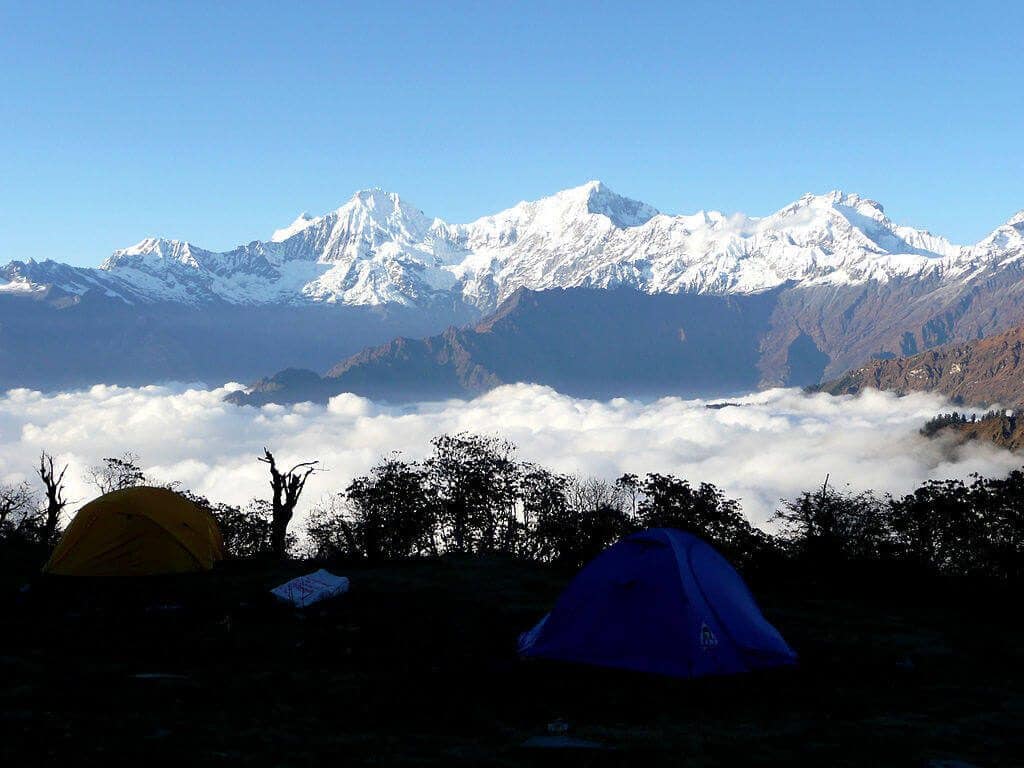
The Langtang Gosaikunda Helambu Trek, also known as the Langtang Circuit Trek, joins the remote Langtang valley, the high mountain lakes of Gosaikunda and the Helambu valley in one loop of 13 days. It goes through one of the most unspoiled national parks in Nepal, and it is the most accessible high-mountain area from Kathmandu, with no flights. The trek is enclosed by snow peaks, with Langtang Lirung (7,246 m / 23,773 ft) at the top of the valley.
A private jeep takes you from Kathmandu to Thulo Syabru on Day 1. You then walk up the Langtang valley, following the Langtang Khola through forests of rhododendron, oak, maple and alder and through villages of Tibetan origin, to Kyanjin Gompa, where you have a full day to climb Tsergo Ri or Kyanjin Ri. You walk back down to Thulo Syabru, climb to Singompa and then to the holy lakes of Gosaikunda. On Day 10 you cross the Laurebina Yak Pass and come down through the Helambu villages of Kutumsang and Chisapani to Sundarijal, where a vehicle takes you back to Kathmandu.
The forests around Ghora Tabela and below Gosaikunda are red panda habitat. The Himalayan views include Langtang Lirung, the Ganesh Himal, Manaslu and the Tibetan peaks, and on clear days Annapurna.
Itinerary at a glance
- Day 1: Private jeep from Kathmandu (1,300 m / 4,265 ft) to Thulo Syabru (2,250 m / 7,382 ft). About 6 hours.
- Day 2: Trek to Lama Hotel (2,500 m / 8,202 ft). About 6 hours.
- Day 3: Trek to Langtang Village (3,307 m / 10,850 ft). About 5 hours.
- Day 4: Trek to Kyanjin Gompa (3,798 m / 12,461 ft). About 4 hours.
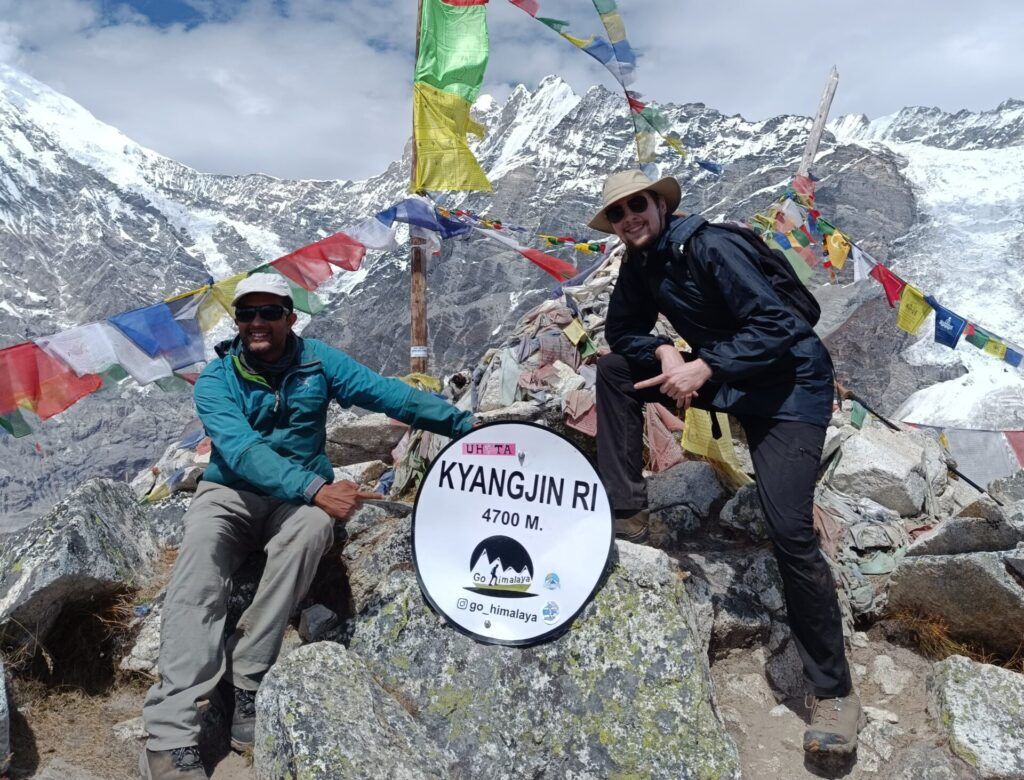
- Day 5: Exploration day: Tsergo Ri (4,984 m / 16,352 ft) or Kyanjin Ri (4,773 m / 15,659 ft).
- Day 6: Trek back to Lama Hotel (2,500 m / 8,202 ft). About 6 hours.
- Day 7: Trek to Thulo Syabru (2,250 m / 7,382 ft). About 5.5 hours.
- Day 8: Trek to Singompa (3,250 m / 10,663 ft). About 5 hours.
- Day 9: Trek to Gosaikunda (4,300 m / 14,108 ft). About 5 hours.
- Day 10: Cross the Laurebina Yak Pass (4,610 m / 15,125 ft) to Ghopte (3,430 m / 11,253 ft). About 7 hours.
- Day 11: Trek to Kutumsang (2,470 m / 8,104 ft). About 6 hours.
- Day 12: Trek to Chisapani (2,215 m / 7,267 ft). About 5.5 hours.
- Day 13: Trek to Sundarijal (about 4 hours) and drive to Kathmandu (1,300 m / 4,265 ft), about 1 hour.

Who is this trek for?
This is a moderate to challenging trek for fit walkers. The walking days are 4 to 7 hours, and you need some experience of multi-day trekking and the ability to climb and descend steep ground for many days in a row. You do not need any climbing skills. The most demanding days are Day 9, to Gosaikunda, which has the biggest altitude gain of the trek, and Day 10, a long day over the Laurebina Yak Pass. Read the Physical Prep tab before you book.
Highlights of the Langtang Gosaikunda Helambu Trek
- Three regions in one trek: the Langtang valley, the Gosaikunda lakes and Helambu
- No flights: a private jeep from Kathmandu to Thulo Syabru, and a drive back from Sundarijal
- Kyanjin Gompa (3,798 m / 12,461 ft), with its monastery, the government cheese factory and the views of Langtang Lirung
- An exploration day with a choice of Tsergo Ri (4,984 m / 16,352 ft) or Kyanjin Ri (4,773 m / 15,659 ft)
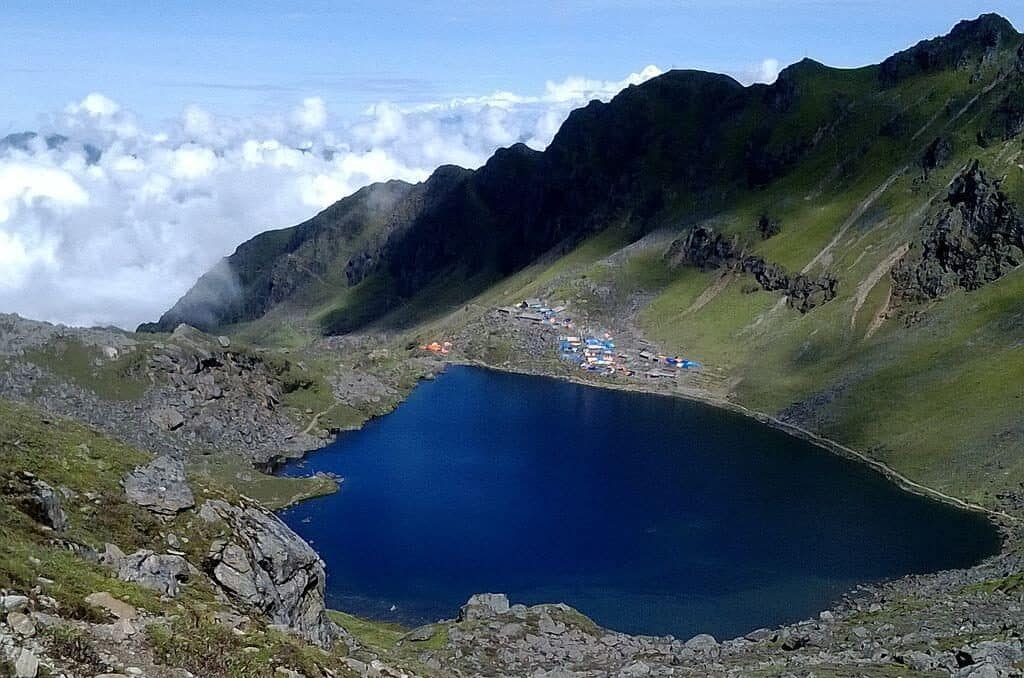
- The holy lakes of Gosaikunda (4,300 m / 14,108 ft), with Saraswatikunda, Bhairabkunda and Gosaikunda, and the legend of Shiva
- The Laurebina Yak Pass (4,610 m / 15,125 ft), the highest pass of the trek
- Forests of rhododendron, oak, maple and alder, and red panda habitat around Ghora Tabela and below Gosaikunda
- Tamang villages of Tibetan origin, with water mills, prayer wheels and monasteries
- Views of Langtang Lirung, the Ganesh Himal, Manaslu and the Tibetan peaks, and Annapurna on clear days
- Helambu villages such as Kutumsang, and the view of the central Himalayas from Chisapani
- A private trip on any date you choose, for 2 or more people
The trip is private and runs on the date you choose, for a minimum of 2 people. Contact us to check dates and book.
Langtang Gosaikunda Helambu Trek Cost: What Is Included and Excluded
Cost Includes
- Private jeep from Kathmandu to Thulo Syabru on Day 1
- Vehicle from Sundarijal to Kathmandu on Day 13
- English-speaking, licensed and experienced guide
- Porters (1 porter for every 2 trekkers). Each porter carries up to 20 kg in total, shared by the two trekkers
- Food, accommodation, salary and insurance for the guide and porters
- All required permits and entry fees
- Teahouse accommodation during the trek
- Breakfast, lunch and dinner during the trek, as set out in the itinerary
- A first-aid kit, carried by the guide
- A sleeping bag, down jacket and duffel bag for the trek, at no extra cost
- Government and local taxes
Cost Excludes
- Hotel in Kathmandu, and meals in Kathmandu
- Travel insurance. It is mandatory, and must cover high-altitude trekking and emergency evacuation at that altitude.
- Drinks, such as tea, coffee, soft drinks and bottled water
- Extras such as device charging, Wi-Fi and other personal expenses
- Tips for your guide and porters, which are at your discretion (see the FAQ for a guide to budgeting)
- Personal gear and clothing suitable for the trek
- Your Nepal visa and international flights
- Any costs not stated in the trip information
Langtang Gosaikunda Helambu Trek Detailed Itinerary
Your driver picks you up from your hotel in Kathmandu in the early morning, and you drive by private jeep towards the Langtang region, usually through Trishuli and Dhunche. The road climbs into the hills, with views of terraced fields, and the Ganesh Himal and Langtang ranges as you get closer. You reach Thulo Syabru, a large Tamang village on a ridge, in the afternoon, and you have time to walk around the village before dinner. Since you start at 2,250 m / 7,382 ft, this first night gives you time to settle in before the trek.
Drive: About 6 hours by private jeep
Elevation: Thulo Syabru, 2,250 m / 7,382 ft
Meals: Lunch and dinner
Overnight: Teahouse in Thulo Syabru
You walk down from Thulo Syabru to the river, join the trail along the Langtang Khola, and follow it upstream through forests of rhododendron, oak, maple and alder, with Bamboo and Rimche on the way. The trail climbs gently and then levels out to Lama Hotel, a small settlement in the forest. You may see monkeys, and with luck red pandas or other wildlife, although sightings cannot be guaranteed.
Walking: About 6 hours
Elevation: 2,500 m / 8,202 ft
Meals: Breakfast, lunch and dinner
Overnight: Teahouse in Lama Hotel
The trail climbs gradually, and then more steeply, through the forest and out into open country, with yak pastures and Tamang villages of Tibetan origin, with water mills and prayer wheels. You pass Ghora Tabela and reach Langtang Village, which is the headquarters of Langtang National Park, with Langtang Lirung (7,246 m / 23,773 ft) above you.
Walking: About 5 hours
Elevation: 3,307 m / 10,850 ft
Meals: Breakfast, lunch and dinner
Overnight: Teahouse in Langtang Village
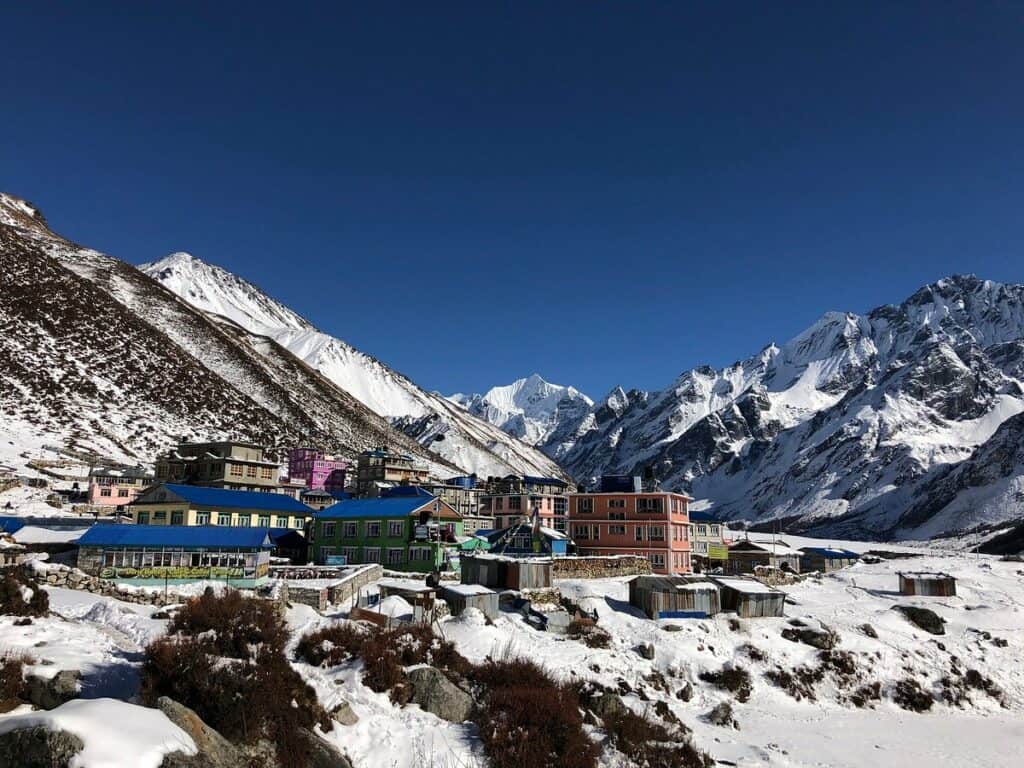
A shorter walk through yak pastures and the villages of Muna and Singdun, over a wooden bridge and across the moraine, to Kyanjin Gompa. The village has a small monastery and a government cheese factory, and snow peaks all around. You arrive early enough to rest and walk around.
Walking: About 4 hours
Elevation: 3,798 m / 12,461 ft
Meals: Breakfast, lunch and dinner
Overnight: Teahouse in Kyanjin Gompa
You choose between two viewpoint climbs, depending on the group, the weather and how you feel. Tsergo Ri is the longer and higher one, and the highest point of the trip. Kyanjin Ri is shorter and gives wide views over the valley and the glaciers. Your guide decides if it is safe to go. You return to Kyanjin Gompa for the night, so you sleep at the same altitude as the night before.
Walking: Your guide sets the time on the day (the Tsergo Ri climb is the longer one)
Elevation: Tsergo Ri, 4,984 m / 16,352 ft. Kyanjin Ri, 4,773 m / 15,659 ft. Kyanjin Gompa, 3,798 m / 12,461 ft
Meals: Breakfast, lunch and dinner
Overnight: Teahouse in Kyanjin Gompa
After a morning around Kyanjin Gompa, you walk back down the valley via Langtang Village and Ghora Tabela to Lama Hotel. Going down is faster, but it is a long day on your knees, so use your poles.
Walking: About 6 hours
Elevation: 2,500 m / 8,202 ft
Meals: Breakfast, lunch and dinner
Overnight: Teahouse in Lama Hotel
A gentle descent, then a steep climb to Thulo Syabru, with views of the Ganesh Himal and the Langtang Himal, and more chances to see wildlife in the forest. You spend the night in the same village where you started.
Walking: About 5.5 hours
Elevation: 2,250 m / 7,382 ft
Meals: Breakfast, lunch and dinner
Overnight: Teahouse in Thulo Syabru
A steep climb past Dursagang to Foprang Danda, followed by a level walk to Singompa (also called Sing Gompa), where there is a small monastery and a cheese factory. This is the start of the high part of the trek.
Walking: About 5 hours
Elevation: 3,250 m / 10,663 ft
Meals: Breakfast, lunch and dinner
Overnight: Teahouse in Singompa
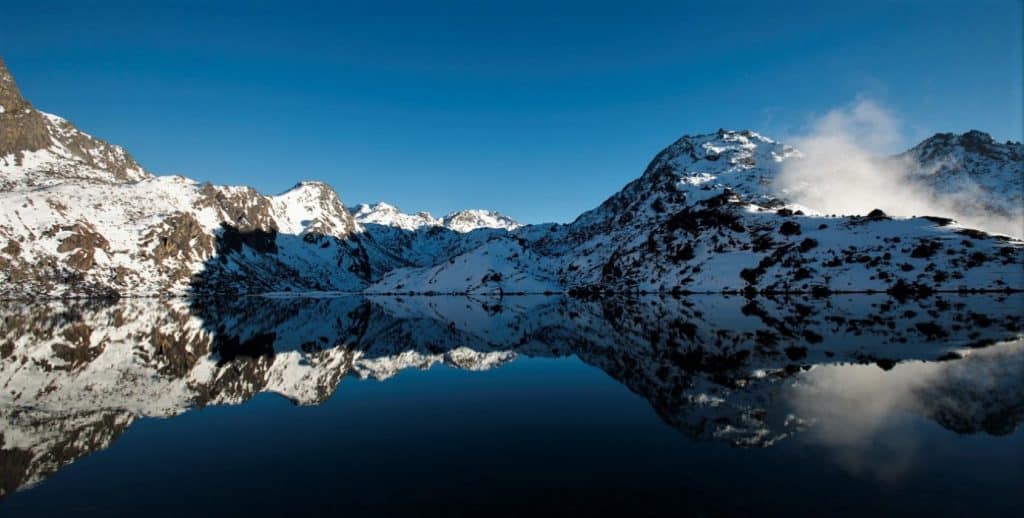
You climb to Lauribina, cross a ridge, and then get your first views of Gosaikunda, a group of holy lakes. About a dozen lakes lie in the basin, and the main three are Saraswatikunda, Bhairabkunda and Gosaikunda. According to the legend, Shiva made the lake by striking the mountain with his trident to get water to cool his throat after he drank poison. Today is the biggest altitude gain of the trek, about 1,050 m / 3,445 ft, so walk slowly and drink a lot of water.
Walking: About 5 hours
Elevation: 4,300 m / 14,108 ft
Meals: Breakfast, lunch and dinner
Overnight: Teahouse in Gosaikunda
The longest day. You climb past four small lakes to the Laurebina Yak Pass, the highest pass of the trek, with views of the Ganesh Himal, Manaslu and the Tibetan peaks, and on clear days Annapurna. Then a steep descent takes you down to Ghopte, through forest where red pandas live.
Walking: About 7 hours
Elevation: Laurebina Yak Pass, 4,610 m / 15,125 ft. Ghopte, 3,430 m / 11,253 ft
Meals: Breakfast, lunch and dinner
Overnight: Teahouse in Ghopte
Mostly downhill, with one small ridge, to Kutumsang, a traditional Helambu village. The forest around the trail has rhododendron and oak, and the village has a view of the mountains and a quiet evening.
Walking: About 6 hours
Elevation: 2,470 m / 8,104 ft
Meals: Breakfast, lunch and dinner
Overnight: Teahouse in Kutumsang
A shorter day, with two descents and two climbs, to Chisapani. From the ridge you see the central Himalayas, and a great sunset and sunrise if the sky is clear.
Walking: About 5.5 hours
Elevation: 2,215 m / 7,267 ft
Meals: Breakfast, lunch and dinner
Overnight: Teahouse in Chisapani
You walk down through oak and rhododendron forest to Sundarijal, past the waterworks that supply water to Kathmandu. A vehicle takes you from Sundarijal to your hotel in Kathmandu, and you arrive around midday.
Drive: About 1 hour from Sundarijal to Kathmandu
Walking: About 4 hours
Elevation: Kathmandu, 1,300 m / 4,265 ft
Meals: Breakfast. Lunch in Kathmandu is not included
Physical Preparation for the Langtang Gosaikunda Helambu Trek
This is a moderate to challenging trek. Read this tab before you book, and talk to your doctor. It is general information and is not medical advice.
Is the Langtang Gosaikunda Helambu Trek right for you?
It suits you if
- you are fit, and have done multi-day treks before
- you can walk 5 to 7 hours a day, with steep climbs and long descents
- you want mountains, lakes and villages without taking a flight
- you are comfortable with basic teahouses and cold nights at altitude
- you want a quieter trek that is close to Kathmandu
Think again, or talk to us, if
- you have never trekked above 3,000 m / 9,843 ft
- you have a heart, lung or blood condition (see your doctor first)
- you are not comfortable with long, steep descents
- you want a shorter trip. Ask us about the Langtang valley trek on its own.
- you want hot showers and Wi-Fi every day
The fitness this trek asks for
Walking days are 4 to 7 hours, and the longest is Day 10 (about 7 hours, over the Laurebina Yak Pass). Days 6, 10, 11 and 13 have long descents. On Day 5 you can climb Tsergo Ri or Kyanjin Ri, which adds a hard climb on top of the trek. The aim of your training is to walk 5 to 7 hours on consecutive days with a daypack, including steep downhill, and still feel strong. Start 10 to 12 weeks before you go.
| Weeks | Focus | What to do |
|---|---|---|
| Weeks 1 to 4 | Base fitness | Cardio 3 times a week (running, cycling or swimming, 30 to 45 minutes). One hike a week of 2 to 3 hours. Strength work for legs and core twice a week. |
| Weeks 5 to 8 | Build endurance | Cardio 3 to 4 times a week. A long hike each weekend, building to 4 to 5 hours with a loaded daypack. Add stairs or hills. |
| Weeks 9 to 10 | Trek-specific | Back-to-back hikes on a weekend, 5 to 6 hours each day, with the boots and pack you will use. Train going downhill, because Days 6, 10, 11 and 13 have long descents. |
| Last 2 weeks | Taper | Keep a few long walks, then reduce the load in the last week. Rest well, and check your gear and your insurance. |
If you can, spend a few days at altitude first. It helps, but it does not replace a slow, careful ascent on the trek.
How the itinerary handles altitude
You sleep at 3,000 m / 9,843 ft or higher for 6 nights (Days 3, 4, 5, 8, 9 and 10), and the highest night is Gosaikunda, 4,300 m / 14,108 ft. The table shows where you sleep each night and how much it changes.
| Day | Night at | Sleeping altitude | Change from the night before |
|---|---|---|---|
| 1 | Thulo Syabru | 2,250 m / 7,382 ft | Start (from Kathmandu, 1,300 m / 4,265 ft) |
| 2 | Lama Hotel | 2,500 m / 8,202 ft | +250 m / +820 ft |
| 3 | Langtang Village | 3,307 m / 10,850 ft | +807 m / +2,648 ft |
| 4 | Kyanjin Gompa | 3,798 m / 12,461 ft | +491 m / +1,611 ft |
| 5 | Kyanjin Gompa (exploration day) | 3,798 m / 12,461 ft | No change |
| 6 | Lama Hotel | 2,500 m / 8,202 ft | -1,298 m / -4,259 ft |
| 7 | Thulo Syabru | 2,250 m / 7,382 ft | -250 m / -820 ft |
| 8 | Singompa | 3,250 m / 10,663 ft | +1,000 m / +3,281 ft |
| 9 | Gosaikunda | 4,300 m / 14,108 ft | +1,050 m / +3,445 ft |
| 10 | Ghopte | 3,430 m / 11,253 ft | -870 m / -2,854 ft |
| 11 | Kutumsang | 2,470 m / 8,104 ft | -960 m / -3,150 ft |
| 12 | Chisapani | 2,215 m / 7,267 ft | -255 m / -837 ft |
- Langtang valley (Days 2 to 4): the sleeping altitude rises by 250, 807 and 491 m. The gain on Day 3 is the first night above 3,000 m, and Day 4 is within the usual advice of 300 to 500 m a day.
- Exploration day (Day 5): you climb as high as 4,984 m / 16,352 ft, and you sleep at 3,798 m / 12,461 ft again, so you walk high and sleep low.
- Going down (Days 6 and 7): you go back down to 2,500 m and 2,250 m. This means that the time you spent at altitude in the Langtang valley will not fully protect you on Days 8 and 9.
- Days 8 and 9: the sleeping altitude rises by 1,000 m and then by 1,050 m (3,445 ft). The second one is more than the usual advice of 300 to 500 m a day above 3,000 m, and it is the biggest altitude gain of the trek. Walk slowly, drink a lot of water, and tell your guide at once about any headache, nausea, dizziness or trouble sleeping. Your guide decides on the day how to go on.
- Day 10: after the pass (4,610 m / 15,125 ft), you sleep lower at Ghopte (3,430 m / 11,253 ft), which helps you to recover.
Warning signs: when to go down
- Mild symptoms (headache, nausea, loss of appetite, dizziness, trouble sleeping): rest, drink water, do not go higher, and tell your guide.
- Emergency signs: a headache that gets worse, vomiting, confusion or loss of balance (possible cerebral edema), or a cough, breathlessness at rest or a rattling chest (possible pulmonary edema). The person must go down at once, and your guide arranges help. In a serious case we arrange evacuation, by helicopter if needed, through your insurance company.
- Never go up with symptoms of altitude sickness, and never let someone with these signs go alone.
Before you book
- See your doctor if you have a heart, lung or blood condition, if you are pregnant, or if you take regular medication. Ask whether altitude medication is right for you.
- Check that your insurance covers high-altitude trekking up to 5,000 m / 16,404 ft and emergency evacuation at that altitude.
- Tell us about any health condition when you book.
Langtang Gosaikunda Helambu Trek FAQs
Trip basics
It is a 13-day trek close to Kathmandu, also called the Langtang Circuit Trek, that joins the Langtang valley as far as Kyanjin Gompa (3,798 m / 12,461 ft), the holy lakes of Gosaikunda (4,300 m / 14,108 ft), and the Helambu villages, with a crossing of the Laurebina Yak Pass (4,610 m / 15,125 ft).
The trip is 13 days. On Day 1 you drive by private jeep from Kathmandu to Thulo Syabru (about 6 hours). You walk to Lama Hotel on Day 2, Langtang Village on Day 3 and Kyanjin Gompa on Day 4. Day 5 is an exploration day, with a choice of Tsergo Ri or Kyanjin Ri. You walk back to Lama Hotel on Day 6 and to Thulo Syabru on Day 7. You go to Singompa on Day 8 and Gosaikunda on Day 9, cross the Laurebina Yak Pass to Ghopte on Day 10, and walk to Kutumsang on Day 11 and Chisapani on Day 12. On Day 13 you walk to Sundarijal and drive to Kathmandu.
The trek starts with a private jeep drive from your hotel in Kathmandu to Thulo Syabru on Day 1, and ends at Sundarijal on Day 13, where a vehicle takes you to your hotel in Kathmandu.
No. You travel by road both ways, with a drive of about 6 hours on Day 1 and about 1 hour on Day 13.
On Day 1 a private jeep takes you to Thulo Syabru, where you sleep at 2,250 m / 7,382 ft. On Day 2 you walk from there into the Langtang valley, and on Day 7 you return to Thulo Syabru before you continue to Gosaikunda.
The highest point is Tsergo Ri, 4,984 m / 16,352 ft, on the optional exploration day (Day 5). The highest pass is the Laurebina Yak Pass, 4,610 m / 15,125 ft, and the highest night is Gosaikunda, 4,300 m / 14,108 ft.
On a clear day you see Langtang Lirung, the Ganesh Himal, Manaslu and the Tibetan peaks, and sometimes Annapurna. You also walk through forests of rhododendron, oak, maple and alder, see Tamang villages, monasteries and the Gosaikunda lakes. The forests around Ghora Tabela and below Gosaikunda are red panda habitat, but sightings are rare. Views depend on the weather.
About a dozen lakes lie in the basin. The main three are Saraswatikunda, Bhairabkunda and Gosaikunda. The lake is sacred to Hindus and Buddhists, and according to the legend Shiva made it with his trident.
Difficulty, fitness and training
It is a moderate to challenging trek. The paths are not technical, but you walk 4 to 7 hours a day for many days, with steep climbs and long descents, and you cross a pass at 4,610 m / 15,125 ft. The hardest days are Day 9, with the biggest altitude gain, and Day 10, over the pass.
You should be able to walk 5 to 7 hours a day for many days in a row, with a daypack, including on steep ground. Strong aerobic fitness and leg strength matter most.
Start 10 to 12 weeks before you go. Build up to hiking 5 to 6 hours with a loaded daypack on hills or stairs, add cardio such as running, cycling or swimming, and do strength work for legs and core. Practise going downhill, because there are long descents on Days 6, 10, 11 and 13. Talk to your doctor before any high-altitude trip.
You do not need climbing experience. Multi-day trekking experience helps a lot, and experience at altitude helps even more. If you are not sure, ask us before you book.
Tsergo Ri (4,984 m / 16,352 ft) is the longer and higher climb and the highest point of the trip. Kyanjin Ri (4,773 m / 15,659 ft) is shorter and still gives wide views of the valley. Your guide decides on the day, depending on the group, the weather and how you feel.
Day 10, which is about 7 hours over the Laurebina Yak Pass with a steep descent to Ghopte, is the longest. Day 9, which is about 5 hours to Gosaikunda, is the biggest altitude gain, about 1,050 m / 3,445 ft in sleeping altitude.
Altitude and safety
The risk is real on any trek above 3,000 m / 9,843 ft. On this trek you sleep at 3,000 m or higher for 6 nights, and the highest night is Gosaikunda, 4,300 m / 14,108 ft. Tell your guide at once about any headache, nausea, dizziness or trouble sleeping.
You sleep at 3,307 m on Day 3 and 3,798 m on Days 4 and 5, and the exploration day lets you walk high and sleep at the same altitude. You then go back down to 2,250 m for two nights, so the time at altitude in the Langtang valley will not fully protect you on Days 8 and 9. The sleeping altitude rises by about 1,000 m on Day 8 and about 1,050 m on Day 9, which is more than the usual advice of 300 to 500 m a day above 3,000 m. Go slowly, drink water, and tell your guide about any symptoms.
Your guide is trained to recognize altitude sickness and carries a first-aid kit. If symptoms get worse, the answer is to go down. In a serious case we arrange evacuation, by helicopter if needed, through your insurance company. Mobile coverage can be limited.
A headache that gets worse, vomiting, confusion, clumsy walking or loss of balance can be signs of cerebral edema. A cough, breathlessness at rest, a rattling chest or unusual weakness can be signs of pulmonary edema. These are emergencies. The person must go down at once, and your guide arranges help. This is general information and is not medical advice.
Yes, it is mandatory. It must cover high-altitude trekking up to 5,000 m / 16,404 ft and emergency evacuation at that altitude. Check that your policy names this altitude, because some policies stop at 4,000 m. Send us your policy details when you book.
Yes. Talk to your doctor before any high-altitude trip, especially if you have a heart, lung or blood condition, if you are pregnant, or if you take regular medication. This page is general information and is not medical advice.
This is a question for your doctor. Some trekkers take medication to help with altitude, and your doctor can say if it is right for you, and in what dose. Medication does not replace slow ascent, and going down is the answer if symptoms get worse.
The pass can be closed by snow or high wind, especially in winter and early spring. Your guide decides on the day if it is safe to cross, and may change the plan. Extra costs for this are at your own cost.
Accommodation, meals and facilities
In teahouses on all 12 nights. They are basic but clean, with simple rooms and shared bathrooms. At Gosaikunda it is much colder and more basic. Hotels in Kathmandu are not included.
Breakfast, lunch and dinner during the trek, as set out in the itinerary. Drinks are not included, and meals in Kathmandu are not included.
Charging and Wi-Fi are extras that you pay for in the teahouses, and they are basic and not always working. Bring a power bank.
You can buy bottled or boiled water in the teahouses, at extra cost. Bring a reusable bottle and purification tablets, to cut down on plastic waste.
Yes. A sleeping bag, down jacket and duffel bag for the trek are provided at no extra cost.
Cost, booking and permits
The trip costs USD 775 per person, and the private jeep from Kathmandu to Thulo Syabru is included.
The private jeep to Thulo Syabru and the vehicle from Sundarijal to Kathmandu, a licensed guide, porters, teahouse stays, meals during the trek, all required permits and entry fees, a first-aid kit carried by the guide, a sleeping bag, down jacket and duffel bag for the trek, and government taxes.
Hotels and meals in Kathmandu, travel insurance, drinks, extras such as charging and Wi-Fi, tips, personal gear, your visa and international flights.
The trip is private and runs on any date you choose. A minimum of 2 people is needed, and the group can be larger. When you book, you pay a 15% deposit to secure your place. Contact us with your dates.
The trip needs a minimum of 2 people. If you are traveling alone, contact us, and we will check whether others are interested in your dates.
Please see our terms and conditions at https://mosaicadventure.com/terms-and-conditions/ for the cancellation policy.
Yes. All required permits and entry fees are included in the price.
Tipping is at your discretion, and guides and porters expect a tip. As a guide for budgeting, set aside about USD 120 to 150 per trekker in total, to be shared between your guide and porters.
Most visitors need a visa, which is not included in the price. You can get a visa on arrival at Kathmandu airport: USD 30 for 15 days, USD 50 for 30 days or USD 125 for 90 days. Check the Nepal Department of Immigration website for the latest rules.
Season and logistics
March to early June and mid-September to early December are the best seasons, with clearer weather. Winter is very cold, with snow at Gosaikunda and on the pass, and the monsoon brings rain, leeches and landslides.
It is possible for experienced trekkers, but it is very cold, the pass can be closed by snow, and some teahouses at higher levels are shut. Contact us first if you want to go between mid-December and February.
It is a Hindu festival, usually in August, when many pilgrims walk to the lakes of Gosaikunda. August is also the monsoon, so it is not the best time to trek, and the trail and teahouses are busy.
Porters carry your duffel bag, and each porter carries up to 20 kg in total, shared by two trekkers. Keep your own pack to about 10 kg. You carry a daypack with what you need during the day. Because there are no flights, there is no airline limit.
Yes. The valley was badly hit by the earthquake in 2015, and Langtang Village was destroyed. The village and the teahouses have been rebuilt, and your stay supports local families.
Yes. You can add days in Kathmandu, or other trips in Nepal. Contact us and we will plan it around you.
Langtang Gosaikunda Helambu Trek Route Map

Langtang Gosaikunda Helambu Trek: More Information
Everything below is here to help you book and plan the 13-day Langtang Gosaikunda Helambu Trek. For fitness, altitude and safety, see the Physical Prep tab.
Booking your trek
This is a private trip, and it runs on any date you choose. A minimum of 2 people is needed, and the group can be larger. Contact us with your dates. When you book, you pay a 15% deposit to secure your place. For the cancellation policy, please see our terms and conditions at https://mosaicadventure.com/terms-and-conditions/.
Before Day 1
Day 1 starts with an early pick-up from your hotel in Kathmandu, so we recommend that you arrive at least one night before. Send us your insurance details, your arrival details and your hotel name when you book. Hotels and meals in Kathmandu are not included. Leave the things you do not need at your Kathmandu hotel, and ask them to store the bag when you book.
The drive on Day 1 and Day 13
On Day 1 a private jeep takes you from your hotel to Thulo Syabru, which takes about 6 hours, usually through Trishuli and Dhunche. The road is mountain road, and it can be bumpy, with delays in the monsoon season from landslides. On Day 13 a vehicle takes you from Sundarijal to your hotel in Kathmandu, which takes about 1 hour. You do not need to take a flight on this trek.
When to trek
The trek can be done in all seasons, but we recommend March to early June and mid-September to early December. The trip runs on any date you choose.
| Season | Months | Weather and trail | Our advice |
|---|---|---|---|
| Spring | March to early June | Warmer, with rhododendron in bloom in the forests at lower levels. Clear mornings, with clouds in the afternoon later in the season. The Laurebina Yak Pass is usually open, with snow possible in March. | Recommended |
| Monsoon | Mid-June to early September | Rain, cloud and leeches in the forest, with landslides on the roads. The festival of Janai Purnima, usually in August, brings many pilgrims to Gosaikunda. | Not recommended |
| Autumn | Mid-September to early December | Clear skies and the best mountain views. Early autumn can still be wet. The pass is usually open. | Recommended |
| Winter | Mid-December to February | Very cold, with snow at Gosaikunda and on the pass, and some teahouses closed at higher levels. The pass may be closed. | Only for experienced trekkers. Ask us first. |
Langtang Gosaikunda Helambu Trek or Langtang valley trek only?
| Langtang Gosaikunda Helambu Trek | Langtang valley trek only | Gosaikunda or Helambu treks without Langtang | |
|---|---|---|---|
| Regions | Langtang valley, Gosaikunda lakes and Helambu | Langtang valley only | Gosaikunda and Helambu, or Helambu only |
| Kyanjin Gompa | Yes | Yes | No |
| Gosaikunda lakes | Yes | No | Yes (Gosaikunda trek) |
| Laurebina Yak Pass | Yes | No | Yes (Gosaikunda trek) |
| Shape of the route | A loop, with the Langtang valley trail walked up and down | Up and down the same valley | Varies |
| Best for | Trekkers with 13 days who want three areas in one trip | Trekkers with less time | Trekkers who want lakes and villages |
Daily walking and altitude
Times are approximate and include rests. Altitudes are where you reach or sleep, unless noted.
| Day | Plan | Time | Altitude |
|---|---|---|---|
| 1 | Kathmandu to Thulo Syabru | About 6 hours by private jeep | 2,250 m / 7,382 ft |
| 2 | Thulo Syabru to Lama Hotel | About 6 hours | 2,500 m / 8,202 ft |
| 3 | Lama Hotel to Langtang Village | About 5 hours | 3,307 m / 10,850 ft |
| 4 | Langtang Village to Kyanjin Gompa | About 4 hours | 3,798 m / 12,461 ft |
| 5 | Exploration: Tsergo Ri or Kyanjin Ri | Set by your guide on the day | Tsergo Ri 4,984 m / 16,352 ft. Kyanjin Ri 4,773 m / 15,659 ft |
| 6 | Kyanjin Gompa to Lama Hotel | About 6 hours | 2,500 m / 8,202 ft |
| 7 | Lama Hotel to Thulo Syabru | About 5.5 hours | 2,250 m / 7,382 ft |
| 8 | Thulo Syabru to Singompa | About 5 hours | 3,250 m / 10,663 ft |
| 9 | Singompa to Gosaikunda | About 5 hours | 4,300 m / 14,108 ft |
| 10 | Gosaikunda, Laurebina Yak Pass, Ghopte | About 7 hours | Pass 4,610 m / 15,125 ft. Ghopte 3,430 m / 11,253 ft |
| 11 | Ghopte to Kutumsang | About 6 hours | 2,470 m / 8,104 ft |
| 12 | Kutumsang to Chisapani | About 5.5 hours | 2,215 m / 7,267 ft |
| 13 | Chisapani to Sundarijal, then drive to Kathmandu | About 4 hours, then about 1 hour by vehicle | 1,300 m / 4,265 ft |
Your team
- Guide: an English-speaking, licensed and experienced guide walks with you for the whole trek, checks how you feel every day, and carries a first-aid kit.
- Porters: 1 porter for every 2 trekkers. Each porter carries up to 20 kg in total, shared by the two trekkers.
A standard trekking day
Each day’s walk usually starts at about 7:00 to 7:30 am, and finishes in the afternoon, with breaks along the way. You have breakfast and dinner at your teahouse and lunch on the trail. On Day 10, over the pass, the start is earlier.
Accommodation
You stay in teahouses on all 12 nights. They are basic but clean and warm in the dining room, with simple rooms and shared bathrooms. At Gosaikunda it is much colder and more basic. Many teahouses are run by local Tamang families.
Meals
Breakfast, lunch and dinner are included during the trek, as set out in the itinerary. Teahouse menus have local and international dishes, and vegetarian options. Famous local things to try are momos and dal bhat, and Kyanjin Gompa is known for its yak cheese. Tell us about any dietary needs when you book. Drinks are not included.
Baggage
Porters carry your duffel bag, which we provide, and you carry a daypack with what you need during the day. Each porter carries up to 20 kg in total, shared by two trekkers, so keep your pack to about 10 kg. Because there are no flights, there is no baggage limit on a plane.
Water
Bring a reusable bottle and water purification tablets, to cut down on plastic waste. Aim to drink 3 to 4 liters of water a day.
Electricity, charging and Wi-Fi
Device charging and Wi-Fi are extras that you pay for in the teahouses, and they are basic and not always working. Mobile coverage is limited on the trail, especially in the upper Langtang valley and near Gosaikunda. Bring a power bank and a plug adapter.
Money and tips
Carry Nepali rupees for drinks, snacks, charging and extras. Cards are not accepted on the trail. Tipping is at your discretion, and guides and porters expect a tip at the end of the trek. As a guide for budgeting, set aside about USD 120 to 150 per trekker in total, to be shared between your guide and porters.
Temperatures
It gets cold at night above 3,000 m / 9,843 ft, and at Gosaikunda (4,300 m / 14,108 ft) the temperature can drop below freezing, even in the main seasons. Dress in layers. We provide a sleeping bag, a down jacket and a duffel bag for the trek.
Wildlife and the forest
The national park protects red pandas, monkeys, Himalayan black bears and many birds. Sightings of red pandas are rare, and they cannot be guaranteed. Please do not feed animals, and take your waste with you.
Culture, and the 2015 earthquake
The villages along the route are Tamang and Sherpa, with Tibetan Buddhist monasteries, mani walls and prayer wheels, and you pass them with the wall on your right. The Langtang valley was badly hit by the 2015 earthquake, and Langtang Village was destroyed. The village has been rebuilt, and your stay supports local families.
Permits and insurance
All required permits and entry fees are included. Travel insurance is mandatory. It must cover high-altitude trekking up to 5,000 m / 16,404 ft, emergency evacuation at that altitude, and medical costs. Send us your policy details when you book.
Nepal visa
The Nepal visa is not included. Many nationalities can get a visa on arrival in Kathmandu: USD 30 for 15 days, USD 50 for 30 days or USD 125 for 90 days, multiple entry. Since August 2026 you can also apply for an e-visa online. Check the Nepal Department of Immigration website for the latest rules.
What to pack
- Broken-in trekking boots and trekking socks
- Thermal base layers, a fleece and mid layers
- Down jacket and a warm sleeping bag (we provide them for the trek at no extra cost)
- Waterproof jacket and trousers
- Warm hat, sun hat, gloves and a neck gaiter
- Sunglasses, sunscreen and lip balm
- Headlamp with spare batteries, water bottle and purification tablets
- Walking poles, which help on the long descents
- Daypack, power bank, camera and personal medication
We send a full packing list after you book.
Extending your stay
You can add days in Kathmandu to see the city, or other trips in Nepal. Contact us to plan extra activities.
Overall Trip Rating:
- Verified Purchase
 By Felix K April 1, 2025 When the mountains call, you goWhen you are craving adventure in the quiet and less crowded part of the Himalayas, you should go for the Langtang Gosaikunda trek. It’s hard if you are not reasonably fit, but the outcome of the trip is magical. I thought I was fit until I started going over 3,500 meters, but it was worth every gasp! Sleeping in tea houses, stargazing at Kutumsang and the final descent through Chisapani’s woods… this trek is a love letter to adventurers. Bring good boots and an even better attitude! If you’re doing it with Mosaic Adventure, it offers peace of mind and an amazing guide like Pralhad.
- Verified Purchase By Tomas Rivera March 23, 2025 Literally Breathtaking!Leaving the chaos of Kathmandu and walking through the varied trail on this trek is literally breathtaking. How can it be so near to Kathmandu and still be a paradise? The contrast between the bustling capital city and the silence of Gosaikunda’s lakes was surreal. The Laurebina Pass can be a bit tiring, but it was all worth the effort with wonderful views. Shoutout to guide Ramesh and porter Rupak!
- Verified Purchase By Arjun Patel November 5, 2024 Langtang Gosaikunda in Oct 2024Amazing trek of a lifetime. I’ll never forget watching sunrise from Kyanjin Ri, the peaks glowing pink as prayer flags fluttered. Our group of 3 were lucky to have blue skies and sunshine for the whole trip. Excellent guide and porters.
- Verified Purchase By Clara Bennett April 7, 2024 Mix of Landscapes and CulturesFrom the rhododendron forests to the icy serenity of Gosaikunda, every day felt like a new world. The Tibetan villages welcomed us with warm milk tea and crossing Laurebina Yak Pass left me breathless (literally and figuratively!). Our guide, Rudra, shared stories that made the mountains come alive. Don’t miss the momos in Langtang Village!
- Verified Purchase By Nina Sørensen December 17, 2019 Experience of a lifetimeLangtang Gosaikunda trek proved to be an amazing, once in a lifetime adventure. The trails varied from gentle walks to heart-pumping climbs (Tsergo Ri, I’m looking at you). The teahouse stays were basic but heartwarming, specially the grandmother in Singompa who taught me to knit! A raw, real Himalayan adventure.
