
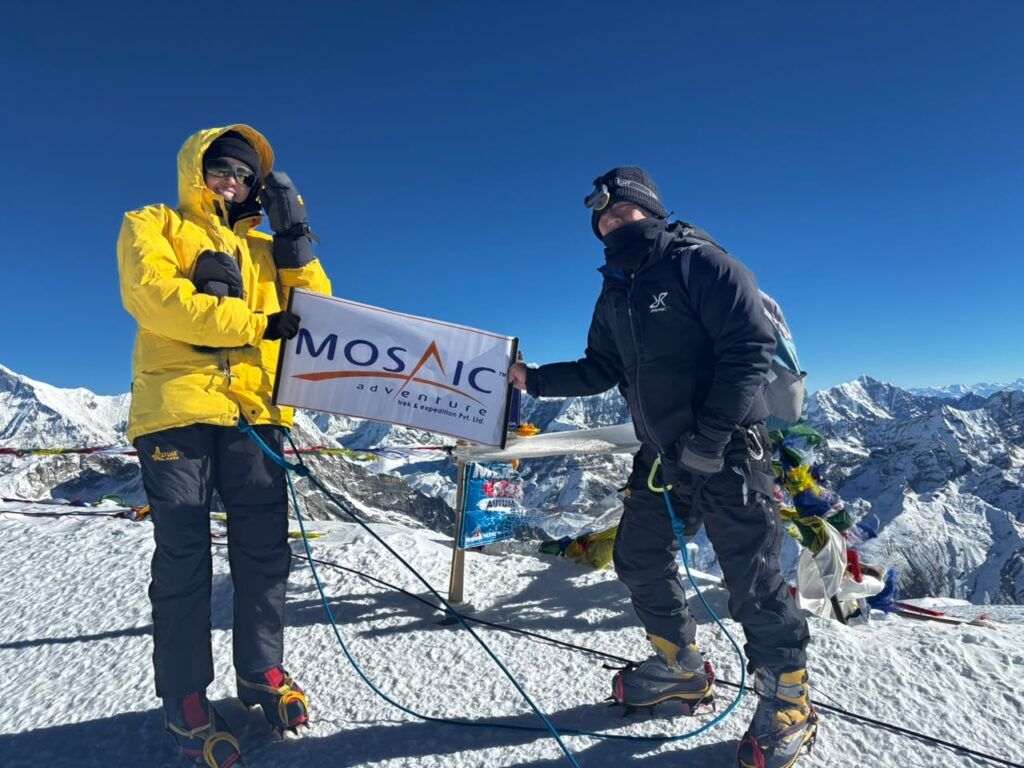
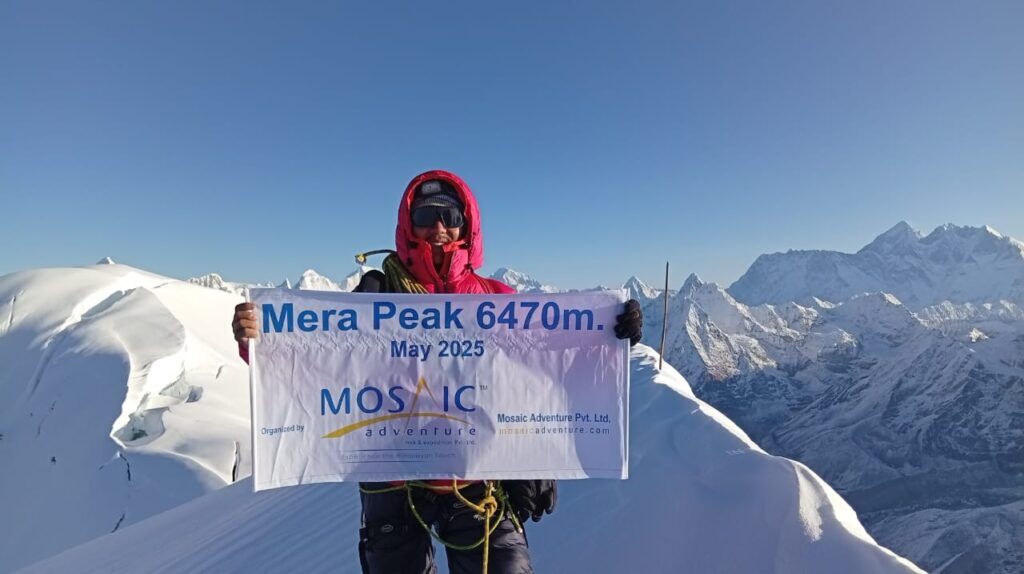
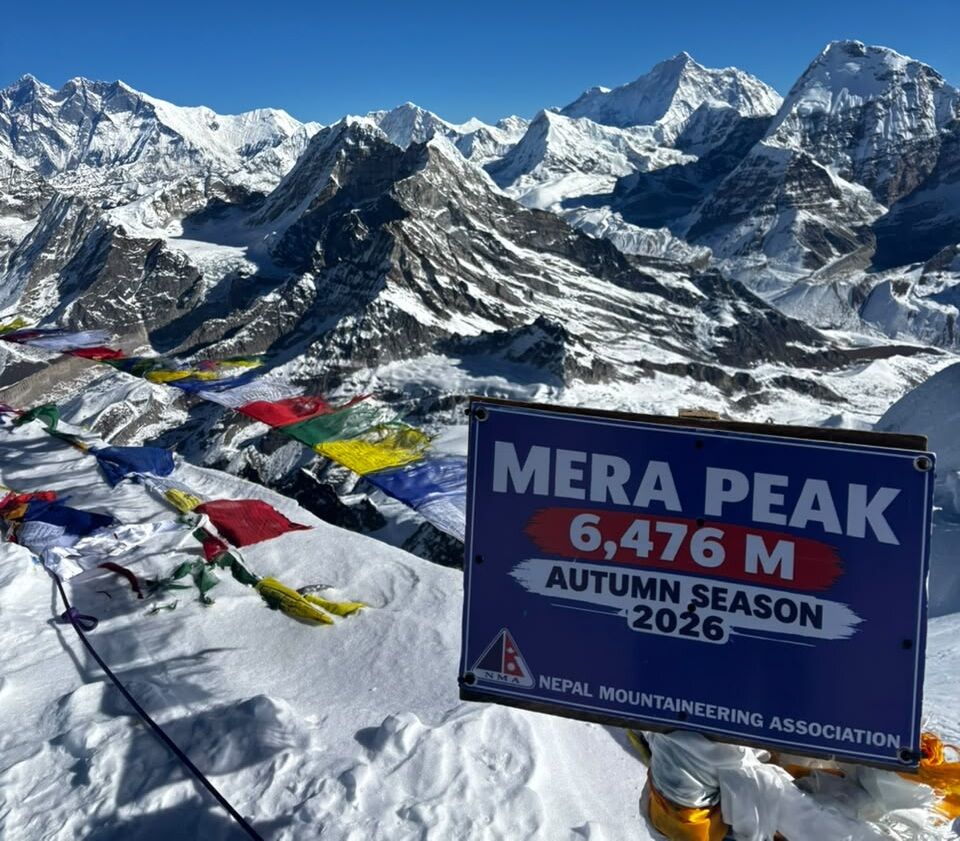
Mera Peak (6,476 m / 21,247 ft) is one of the highest trekking peaks in Nepal. This 18-day trip takes you from Lukla over the Zatrawa La pass into the quiet Hinku valley, with two acclimatization days and a training day at Khare, then to high camp at 5,760 m / 18,898 ft and the summit. From the top, on a clear day, you see five of the world’s six highest mountains: Everest, Lhotse, Makalu, Cho Oyu and Kangchenjunga. The price is USD 2,410 per person. It includes all the climbing equipment, a licensed trek guide, a separate licensed climbing guide from Khare, porters, permits, flights and meals on the mountain.
Mera Peak does not need technical climbing skills, but it is a hard, high and cold climb. It suits fit trekkers who are ready for long days at altitude, and the trip has two spare days to give you a better chance of reaching the summit.
| Cost USD 2,410 per person | Deposit 15% to secure your place. The balance is paid at the pre-climb meeting in Kathmandu. |
| Duration 18 days, 17 nights (4 nights in Kathmandu, 13 nights on the mountain) | Difficulty Challenging. A non-technical glacier climb at high altitude. |
| Route Kathmandu, Lukla, Chuthanga, Zatrawa La, Thuli Kharka, Kothe, Thangnak, Khare, high camp, Mera Peak summit, and back to Lukla and Kathmandu | |
| Summit altitude 6,476 m / 21,247 ft | High camp 5,760 m / 18,898 ft |
| Highest passes and stays Zatrawa La pass 4,610 m / 15,125 ft. Khare 5,045 m / 16,552 ft. | Summit day About 9 to 10 hours from high camp to the summit and down to Khare. Start at around 3 am. |
| Booking Fixed departure dates are on this page. A minimum of 2 people is needed to book, even on those dates. Custom dates are possible for 2 or more, so contact us. If you are traveling solo, we can check whether two others are already booked on a date that suits you and add you to the group. | Spare days Day 12 at Khare for weather, and Day 17 in Kathmandu |
| Staff A licensed trek guide (1 guide for the trek) and porters (1 porter for every 2 trekkers). From Khare, a separate licensed climbing guide takes you up (1 climbing guide for every 2 climbers). | Equipment All climbing equipment is included and hired at Khare at no extra cost: harness, ice axe, ascender, descender, carabiners, fixed rope, climbing boots, crampons, helmet, summit jacket, summit pants, summit gloves and a high-altitude sleeping bag |
| Flights Kathmandu to Lukla and back are included. In peak seasons they leave from Manthali Airport in Ramechhap, about 4 hours by road from Kathmandu. | Accommodation 3-star hotel in Kathmandu (twin or double sharing), teahouses on the trek and tents at high camp |
| Meals Breakfast in Kathmandu. Breakfast, lunch and dinner during the trek and climb, from Day 3 to Day 15, and breakfast on Day 16. | Permits All required permits and entry fees are included |
| Best season March to May and September to November | Insurance Mandatory. It must cover climbing of this kind and height, and emergency evacuation. |
Use the tabs on this page for the itinerary, cost, departure dates, route map, altitude profile, more information, FAQs and reviews.
Mera Peak Climbing Overview
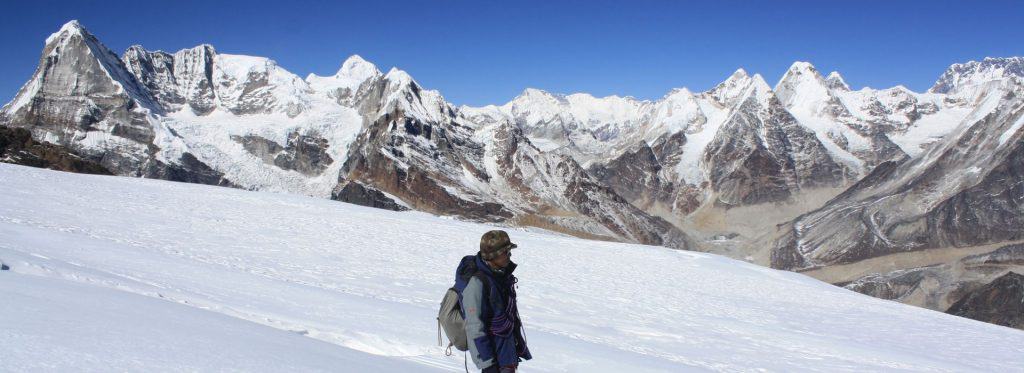
Mera Peak, at 6,476 m / 21,247 ft, is one of the highest trekking peaks in Nepal. It is a non-technical glacier climb, so you do not need to be an experienced mountaineer, but you do need to be fit, comfortable at altitude and ready for long, cold days. On a clear day the summit gives a wide view of five of the world’s six highest mountains: Everest, Lhotse, Makalu, Cho Oyu and Kangchenjunga.
The trip takes 18 days. You fly from Kathmandu to Lukla and trek over the Zatrawa La pass (4,610 m / 15,125 ft) into the Hinku valley, which is far quieter than the main Everest trail. You walk through forest and yak pastures to Kothe and Thangnak, and you take an acclimatization day at Thangnak with a trip to the glacial lake Sabai Tsho (Tam Pokhari), at 4,470 m / 14,665 ft. At Khare (5,045 m / 16,552 ft) you meet your climbing guide, rest for a day, and learn how to use the climbing equipment. Then you climb to high camp at 5,760 m / 18,898 ft, and you go for the summit the next morning, starting at around 3 am. You return to Khare the same day, and then walk back to Lukla and fly to Kathmandu.
The itinerary has two spare days. Day 12 is at Khare, so that you can wait for good weather for the summit, and Day 17 is in Kathmandu, in case of flight delays. We recommend keeping both, and we advise you not to book a flight home on Day 18 without allowing for delays.
Itinerary at a glance
- Day 1: Arrive in Kathmandu (1,345 m / 4,412 ft). Transfer to your hotel.
- Day 2: Pre-climb meeting and last-minute shopping in Kathmandu.
- Day 3: Fly to Lukla (2,840 m / 9,318 ft). Trek to Chuthanga (3,170 m / 10,400 ft). About 3 hours.
- Day 4: Trek to Thuli Kharka, also called Zatrabok (4,250 m / 13,944 ft), via the Zatrawa La pass (4,610 m / 15,125 ft). About 7 hours.
- Day 5: Trek to Kothe (3,840 m / 12,598 ft). About 6 hours.
- Day 6: Trek to Thangnak (4,360 m / 14,304 ft). About 4 hours.
- Day 7: Acclimatization day at Thangnak, with a trip to Sabai Tsho, also called Tam Pokhari (4,470 m / 14,665 ft). About 3 hours return.
- Day 8: Trek to Khare (5,045 m / 16,552 ft). About 4.5 hours.
- Day 9: Rest day at Khare for acclimatization, and climbing training with the ascender, descender and carabiners.
- Day 10: Trek to high camp (5,760 m / 18,898 ft). About 5 to 6 hours.
- Day 11: Climb Mera Peak (6,476 m / 21,247 ft) and return to Khare (5,045 m / 16,552 ft). About 9 to 10 hours.
- Day 12: Spare day (buffer) at Khare.
- Day 13: Trek back to Kothe (3,840 m / 12,598 ft). About 6 hours.
- Day 14: Trek to Thuli Kharka (4,250 m / 13,944 ft). About 7 hours.
- Day 15: Trek to Lukla (2,840 m / 9,318 ft). About 7 hours.
- Day 16: Fly back to Kathmandu (1,345 m / 4,412 ft).
- Day 17: Spare or rest day in Kathmandu.
- Day 18: Departure to your onward destination.

Who is this climb for?
You do not need previous mountaineering experience. We teach the basics at Khare on Day 9. You do need very good fitness, and some trekking at altitude helps a lot. If you have never been above 3,000 m / 9,843 ft, talk to us before you book, and start training at least 3 to 4 months ahead.
Highlights of the Mera Peak Climbing
- The summit of Mera Peak at 6,476 m / 21,247 ft, with views of five of the world’s six highest mountains
- A crossing of the Zatrawa La pass (4,610 m / 15,125 ft) into the quiet Hinku valley
- A low-traffic route through forest, yak pastures and glacial valleys
- An acclimatization day with a trip to the glacial lake Sabai Tsho (Tam Pokhari)
- A day at Khare to learn to use the ascender, descender and carabiners before you climb
- A separate licensed climbing guide, with 1 guide for every 2 climbers
- All climbing equipment included, at no extra cost
- Two spare days, to improve your chance of a summit
Fixed departure dates are shown on this page. A minimum of 2 people is needed to book. You can also choose your own date for 2 or more people, so contact us. If you are traveling solo, we can check whether two others are already booked on a date that suits you.
Mera Peak Climbing Cost: What Is Included and Excluded
Cost Includes
- Airport arrival and departure transfers
- 4 nights in a 3-star hotel in Kathmandu with breakfast (twin or double sharing)
- Teahouse accommodation on the trek, and tents at high camp
- Breakfast, lunch and dinner during the trek and climb, from Day 3 to Day 15, and breakfast on Day 16
- Licensed trek guide (1 guide for the trek)
- Licensed climbing guide from Khare (1 climbing guide for every 2 climbers)
- Porters (1 porter for every 2 trekkers)
- Food, accommodation, salary, insurance and equipment for all guides and porters
- Kathmandu to Lukla and Lukla to Kathmandu flights (and the road transfer to and from Manthali Airport when the flights leave from there)
- All required permits and entry fees
- All climbing equipment, hired at Khare at no extra cost: harness, ice axe, ascender, descender, carabiners, fixed rope, climbing boots, crampons, helmet, summit jacket, summit pants, summit gloves and a high-altitude sleeping bag
- Group climbing equipment, such as ropes, ice screws and snow bars
- Duffel bag, trekking sleeping bag and down jacket for the trek (these are for the trek only, and are not suitable for the climb, so you swap them for the climbing sleeping bag and summit jacket at Khare)
- Government and local taxes
Cost Excludes
- Lunch and dinner in Kathmandu
- Travel insurance. It is mandatory, and must cover climbing of this kind and height, and emergency evacuation.
- All drinks, such as tea, coffee and bottled water
- Personal expenses such as laundry, battery charging, hot showers, phone calls and Wi-Fi
- Personal clothing and gear, such as base layers, trekking boots, gloves and a daypack
- Your Nepal visa and international flights
- Extra costs caused by flight delays or bad weather, such as extra meals and hotel nights
- Tips for your guides and porters, which are optional (see the FAQ for a guide to budgeting)
- Any costs not stated in the trip information
Mera Peak Climbing Dates
- Guaranteed Available PackagesTuesdayMarch 23, 2027FridayApril 9, 2027USD 2,410Available
- Guaranteed Available PackagesTuesdayApril 13, 2027FridayApril 30, 2027USD 2,410Available
- Guaranteed Available PackagesTuesdayApril 27, 2027FridayMay 14, 2027USD 2,410Available
- Guaranteed Available PackagesTuesdayMay 11, 2027FridayMay 28, 2027USD 2,410Available
- Guaranteed Available PackagesTuesdaySeptember 21, 2027FridayOctober 8, 2027USD 2,410Available
- Guaranteed Available PackagesTuesdayOctober 12, 2027FridayOctober 29, 2027USD 2,410Available
- Guaranteed Available PackagesTuesdayOctober 26, 2027FridayNovember 12, 2027USD 2,410Available
- Guaranteed Available PackagesTuesdayNovember 9, 2027FridayNovember 26, 2027USD 2,410Available
Mera Peak Climbing Detailed Itinerary
When you arrive at Tribhuvan International Airport, our representative meets you and takes you to your hotel. The rest of the day is free to rest.
Elevation: 1,345 m / 4,412 ft
Meals: Not included
Overnight: 3-star hotel in Kathmandu
You meet your trek guide for a pre-climb meeting, where you go through the plan, the equipment and the safety rules, and check your documents and insurance. You pay the balance of the trip cost at this meeting. The rest of the day is free for last-minute shopping.
Elevation: 1,345 m / 4,412 ft
Meals: Breakfast
Overnight: 3-star hotel in Kathmandu
You take an early morning flight from Kathmandu to Lukla, which takes about 30 minutes. In the peak seasons the flight leaves from Manthali Airport in Ramechhap, and we arrange the drive from Kathmandu. From Lukla, you start trekking and climb through forest to Chuthanga, a small settlement.
Flight: About 30 minutes
Walking: About 3 hours
Elevation: Lukla, 2,840 m / 9,318 ft. Chuthanga, 3,170 m / 10,400 ft
Meals: Breakfast, lunch and dinner
Overnight: Teahouse in Chuthanga
A long, steep day. You climb to the Zatrawa La pass (4,610 m / 15,125 ft), the highest point of the trek before Khare, with views of the Himalayas on a clear day. Then you walk down to Thuli Kharka, also called Zatrabok, where you spend the night.
Walking: About 7 hours
Elevation: Zatrawa La, 4,610 m / 15,125 ft. Thuli Kharka, 4,250 m / 13,944 ft
Meals: Breakfast, lunch and dinner
Overnight: Teahouse in Thuli Kharka
You descend through forest into the Hinku valley and follow the river up to Kothe. The trail is quiet and mostly in forest.
Walking: About 6 hours
Elevation: 3,840 m / 12,598 ft
Meals: Breakfast, lunch and dinner
Overnight: Teahouse in Kothe
You continue up the Hinku valley, with the mountains getting closer, to the village of Thangnak, where there are yak pastures and lodges.
Walking: About 4 hours
Elevation: 4,360 m / 14,304 ft
Meals: Breakfast, lunch and dinner
Overnight: Teahouse in Thangnak
You rest and acclimatize in Thangnak. The usual way to do this is to walk up to Sabai Tsho, also called Tam Pokhari, a glacial lake at 4,470 m / 14,665 ft, and return to Thangnak, which takes about 3 hours. Spending time a little higher and sleeping at the same altitude helps your body adjust.
Walking: About 3 hours return
Elevation: Sabai Tsho, 4,470 m / 14,665 ft. Thangnak, 4,360 m / 14,304 ft
Meals: Breakfast, lunch and dinner
Overnight: Teahouse in Thangnak
A short walk up to Khare, the last village before the glacier. This is where you meet your climbing guide. You are now above 5,000 m / 16,404 ft, so walk slowly and drink plenty of water.
Walking: About 4.5 hours
Elevation: 5,045 m / 16,552 ft
Meals: Breakfast, lunch and dinner
Overnight: Teahouse in Khare
This is a rest day for acclimatization, and a training day. Your climbing guide fits your equipment and teaches you how to use the ascender, the descender and the carabiners, and how to walk in crampons and clip onto a fixed rope. All climbing equipment is included and hired here at no extra cost. Pay attention, because you use these skills on summit day.
Elevation: 5,045 m / 16,552 ft
Meals: Breakfast, lunch and dinner
Overnight: Teahouse in Khare
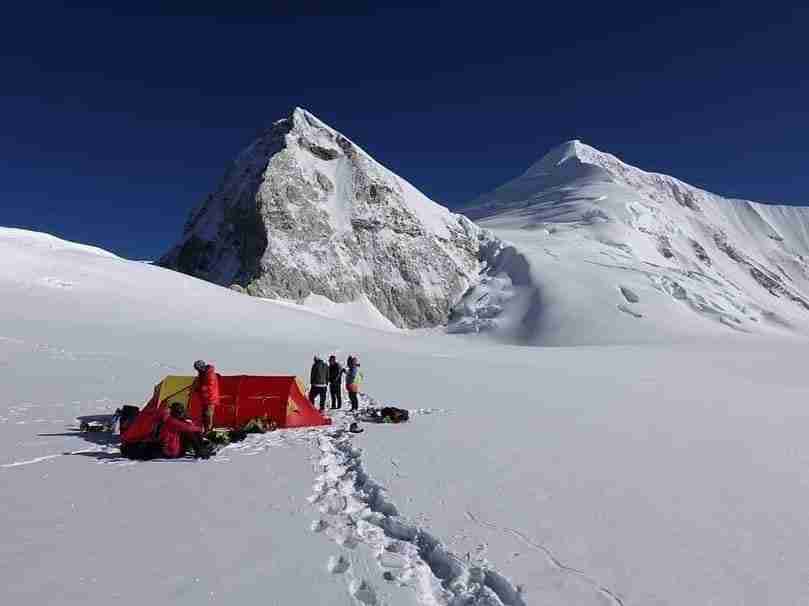
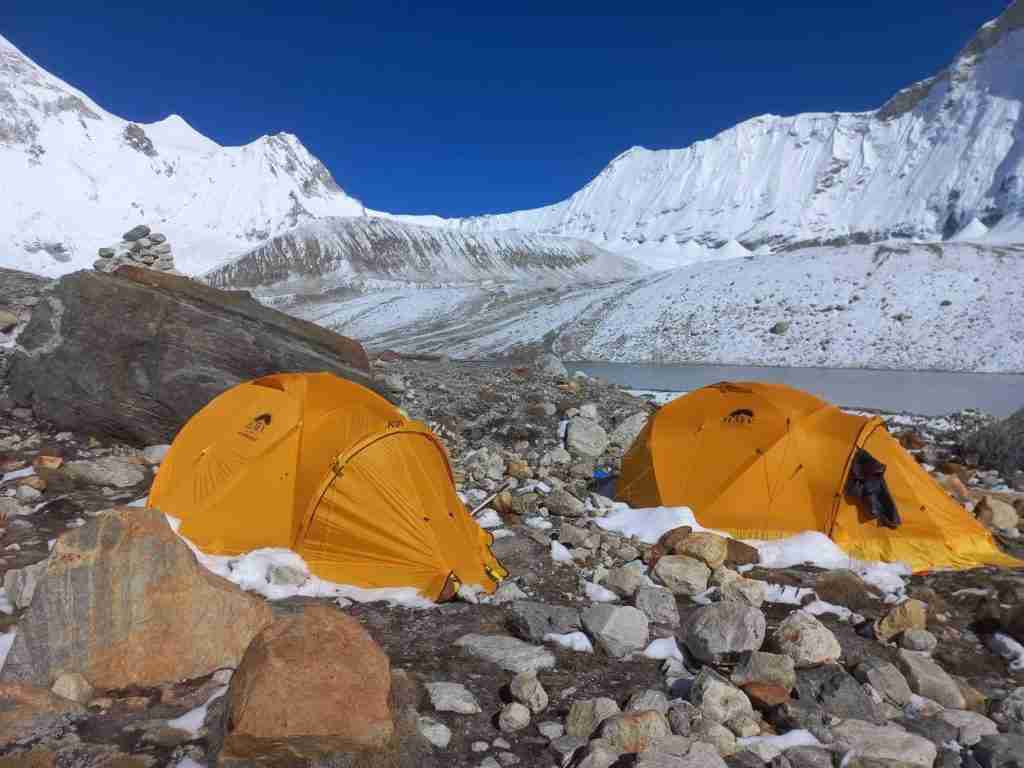
You walk up onto the Mera Glacier to high camp, with your crampons on where needed. The camp is above the glacier, close to the summit slopes, and the views get bigger as you climb. We set up tents and prepare an early dinner, and you go to bed early.
Walking: About 5 to 6 hours
Elevation: 5,760 m / 18,898 ft
Meals: Breakfast, lunch and dinner
Overnight: Tent at Mera high camp
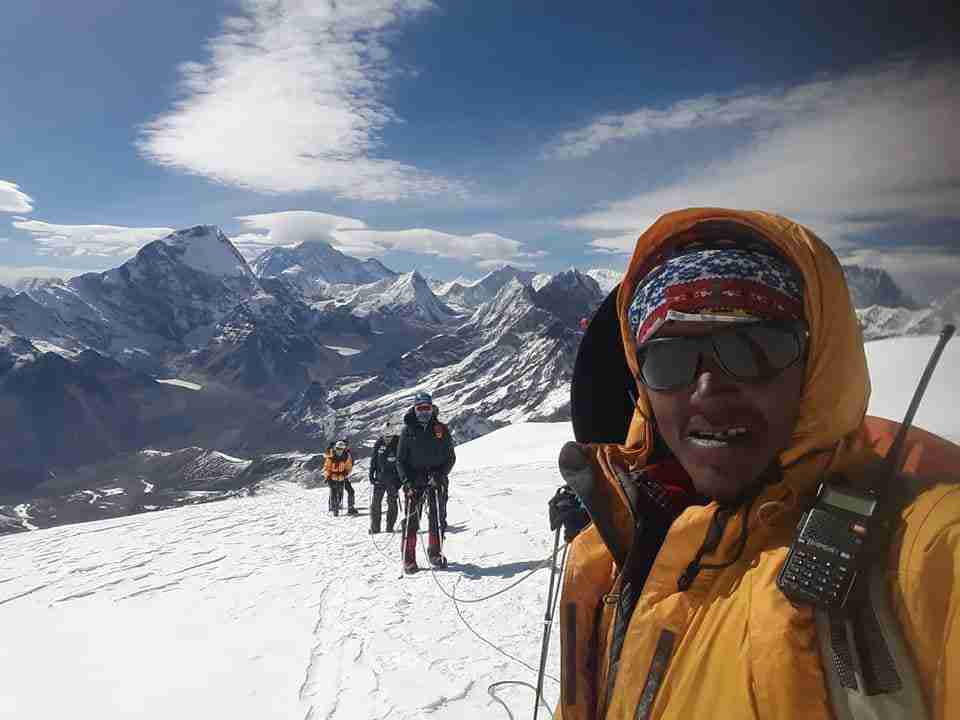
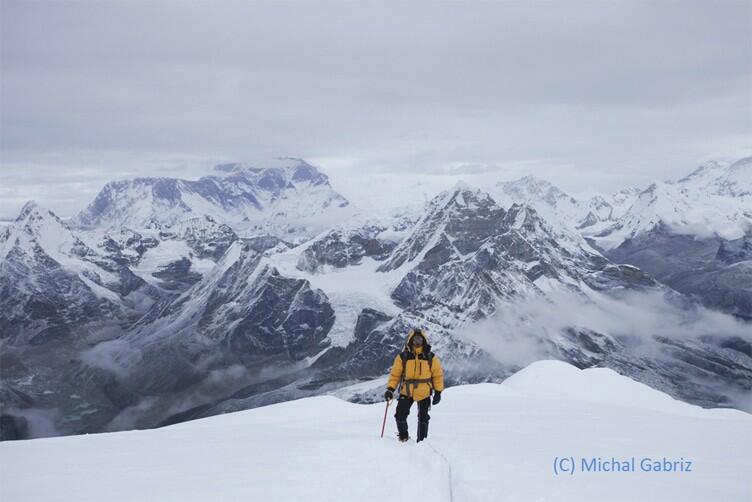
Summit day. You leave high camp at around 3 am, with headlamps, and walk across open snowfields, keeping clear of crevasses. Then you follow a snow ridge, climb a short steep slope, and make the last 50 m to the highest of Mera’s three summits, at 6,476 m / 21,247 ft. On a clear day, you see Everest, Lhotse, Makalu, Cho Oyu and Kangchenjunga. After time for photos, you descend the same way, and you continue down to Khare. The day takes about 9 to 10 hours. If the weather is bad, you can use Day 12 for a second try.
Climbing: About 9 to 10 hours in total
Elevation: Mera Peak, 6,476 m / 21,247 ft. Khare, 5,045 m / 16,552 ft
Meals: Breakfast, lunch and dinner
Overnight: Teahouse in Khare
This day is kept free for bad weather, or for rest. If you did not reach the summit on Day 11, your guides may use this day for another attempt, if the weather and your health allow. If you did summit, you rest at Khare.
Elevation: 5,045 m / 16,552 ft
Meals: Breakfast, lunch and dinner
Overnight: Teahouse in Khare
You walk back down the Hinku valley by the same route. The air gets thicker with every step, and the forest returns.
Walking: About 6 hours
Elevation: 3,840 m / 12,598 ft
Meals: Breakfast, lunch and dinner
Overnight: Teahouse in Kothe
Today you climb again, back up to the Zatrawa La pass, and then go down to Thuli Kharka for the night. It is a long day, so go at a steady pace.
Walking: About 7 hours
Elevation: Zatrawa La, 4,610 m / 15,125 ft. Thuli Kharka, 4,250 m / 13,944 ft
Meals: Breakfast, lunch and dinner
Overnight: Teahouse in Thuli Kharka (Zatrabok)
The last day of trekking. You walk down through forest to Lukla.
Walking: About 7 hours
Elevation: 2,840 m / 9,318 ft
Meals: Breakfast, lunch and dinner
Overnight: Teahouse in Lukla
You take the morning flight from Lukla to Kathmandu, and transfer to your hotel. In the peak seasons the flight lands at Manthali Airport in Ramechhap, and we drive you to Kathmandu. The rest of the day is free.
Flight: About 30 minutes
Elevation: 1,345 m / 4,412 ft
Meals: Breakfast in Lukla. Lunch and dinner in Kathmandu are not included
Overnight: 3-star hotel in Kathmandu
This day is a buffer for flight delays, and otherwise a day to rest or explore Kathmandu. If you need extra days because of weather or flight delays, extra costs for meals and accommodation are at your own cost, and your insurance may cover them.
Meals: Breakfast
Overnight: 3-star hotel in Kathmandu
We transfer you to the airport for your flight home or to your next destination. You can also extend your stay.
Meals: Breakfast
Mera Peak Climbing FAQs
Trip basics
It is an 18-day trip to climb Mera Peak (6,476 m / 21,247 ft), one of the highest trekking peaks in Nepal. You fly to Lukla, trek over the Zatrawa La pass into the Hinku valley, acclimatize at Thangnak and Khare, climb to high camp at 5,760 m / 18,898 ft, and go to the summit with a licensed climbing guide. Then you trek back to Lukla and fly to Kathmandu.
The trip is 18 days with 17 nights. Day 1 is arrival in Kathmandu and Day 2 is the pre-climb meeting. Day 3 you fly to Lukla and trek to Chuthanga. Day 4 you cross Zatrawa La to Thuli Kharka, Day 5 you trek to Kothe and Day 6 to Thangnak. Day 7 is an acclimatization day with a trip to Sabai Tsho. Day 8 you trek to Khare and Day 9 is a rest and training day. Day 10 you go to high camp, and Day 11 is summit day, with a return to Khare. Day 12 is a spare day. Days 13 to 15 you trek back to Lukla, Day 16 you fly to Kathmandu, Day 17 is a spare day, and Day 18 is departure.
The summit is 6,476 m / 21,247 ft. High camp is at 5,760 m / 18,898 ft, and Khare, where you rest and train, is at 5,045 m / 16,552 ft.
On a clear day you can see five of the world's six highest mountains: Everest, Lhotse, Makalu, Cho Oyu and Kangchenjunga. Views depend on the weather and cannot be guaranteed.
Mera Peak is higher (6,476 m / 21,247 ft) and its route through the Hinku valley is quieter than the main Everest trail. The climb is mostly a long walk on a glacier. The trip is also longer, at 18 days, and the high camp is at 5,760 m / 18,898 ft, so it is a harder trip overall. If you want a shorter climb, ask us about other peaks.
You do not need previous mountaineering experience. We teach you the basics on Day 9, at Khare. But you need very good fitness, and the trip is high, cold and long, so some trekking at altitude helps a lot. If you are not sure, ask us before you book.
Difficulty, fitness and training
It is a challenging trip. The climbing itself is not technical, but the altitude, the cold and the long days are hard. Summit day is about 9 to 10 hours, and the days over the Zatrawa La pass are 7 hours.
You should be able to walk 5 to 7 hours a day for many days in a row, with a daypack, and keep going on a 9 to 10 hour summit day. Strong aerobic fitness and leg strength matter more than climbing skills.
Start 3 to 4 months before you go. Build up to hiking 4 to 6 hours with a loaded daypack on hills or stairs, add cardio such as running, cycling or swimming, and do strength work for legs and core. If you can, do a few long hikes on consecutive days, and wear the boots you will use. Talk to your doctor before any high-altitude trip.
No previous climbing experience is needed. Experience of trekking at altitude helps, because it shows you how your body reacts. Your climbing guide teaches you how to use the ascender, descender and carabiners on Day 9.
On Day 9 your climbing guide fits your equipment and teaches you how to use the ascender, the descender and carabiners, how to walk in crampons, and how to clip onto a fixed rope. It is also a rest day for acclimatization.
Altitude and safety
The risk is real on every high trek. You sleep above 5,000 m / 16,404 ft at Khare, and at 5,760 m / 18,898 ft at high camp. The itinerary has an acclimatization day at Thangnak, a rest day at Khare and a spare day, and your guide checks how you feel every day. Tell your guide at once about any headache, nausea, dizziness or trouble sleeping.
The trip climbs slowly after the Zatrawa La pass. You spend two nights at Thangnak (4,360 m / 14,304 ft) with a trip to Sabai Tsho (4,470 m / 14,665 ft), two nights at Khare (5,045 m / 16,552 ft) on Days 8 and 9, and a night at high camp. Spare Day 12 gives you more time.
Your guides are trained to recognize altitude sickness, and if symptoms get worse, the answer is to go down. In a serious case we arrange evacuation, by helicopter if needed, through your insurance company.
Yes, it is mandatory. It must cover climbing of this kind and height, and emergency evacuation. We check your policy at the pre-climb meeting on Day 2, so bring a copy.
Day 12 is a spare day at Khare for this. If the weather or conditions are not safe on Day 11, your climbing guide may wait for Day 12. The final decision is always made by your climbing guide, for safety.
Yes. Your guides decide, for safety, if you should not continue, or if conditions are not safe. We do not promise a summit, because weather, snow conditions and your health decide.
Summit day and climbing equipment
You leave high camp (5,760 m / 18,898 ft) at around 3 am, with headlamps, and walk across open snowfields, keeping clear of crevasses. Then you follow a snow ridge, climb a short steep slope and the last 50 m to the highest of Mera's three summits. The day takes about 9 to 10 hours in total, with the return to Khare.
You have a licensed trek guide (1 guide for the trek) from Kathmandu to Khare. At Khare you meet a separate licensed climbing guide, with 1 climbing guide for every 2 climbers. Porters (1 porter for every 2 trekkers) carry your trekking bags.
All climbing equipment is included at no extra cost, and hired at Khare: harness, ice axe, ascender, descender, carabiners, fixed rope, climbing boots, crampons, helmet, summit jacket, summit pants, summit gloves and a high-altitude sleeping bag.
You receive a duffel bag, a sleeping bag and a down jacket for the trek. These are not suitable for the climb, so at Khare you swap them for the high-altitude sleeping bag and the summit jacket.
Your own base layers, trekking boots, socks, gloves and hats, a daypack, sunglasses or glacier goggles, sunscreen, a water bottle, a headlamp, personal medication and a power bank. We send a full packing list after you book.
The climbing boots and crampons are included. For the trek you need comfortable, broken-in trekking boots. Tell us your shoe size when you book, so that we can have the right climbing boots ready at Khare.
Accommodation, meals and facilities
In Kathmandu you stay in a 3-star hotel on a twin or double sharing basis. On the trek you stay in teahouses, and at high camp you sleep in tents.
Breakfast in Kathmandu. Breakfast, lunch and dinner during the trek and climb from Day 3 to Day 15, and breakfast on Day 16. Lunch and dinner in Kathmandu are not included.
Charging, hot showers and Wi-Fi are sometimes available at extra cost in the teahouses, but they are basic and not always working. At high camp there are none. Bring a power bank.
You can buy bottled or boiled water in the teahouses, at extra cost. Bring a reusable bottle and purification tablets.
Cost, booking and permits
The trip costs USD 2,410 per person.
The price includes airport transfers, 4 nights in a 3-star hotel in Kathmandu with breakfast, teahouses and tents, meals during the trek and climb, a licensed trek guide, a licensed climbing guide, porters, the flights between Kathmandu and Lukla, all required permits and entry fees, all climbing equipment, a duffel bag, a trekking sleeping bag and down jacket, and government taxes.
Lunch and dinner in Kathmandu, travel insurance, drinks, personal expenses, personal clothing and gear, your visa, international flights, extra costs from delays, and tips.
We have fixed departure dates, shown on this page. A minimum of 2 people is needed to book, even on those dates. You can also choose your own date for 2 or more people, so contact us. When you book, you pay a 15% deposit, and the balance is paid at the pre-climb meeting in Kathmandu.
Yes. Contact us, and we will check whether two others are already booked on a date that suits you. If they are, you can join them.
Please see our terms and conditions at https://mosaicadventure.com/terms-and-conditions/ for the cancellation policy.
Yes. All required permits and entry fees are included in the price.
Tipping is optional and up to you. As a guide for budgeting, trekkers usually give around USD 200 to 250 per trekker for the trek guide and the porters together, and another USD 50 to 75 per climber for the climbing guide.
Most visitors need a visa, which is not included in the price. You can get a visa on arrival at Kathmandu airport: USD 30 for 15 days, USD 50 for 30 days or USD 125 for 90 days. Check the Nepal Department of Immigration website for the latest rules. Because this trip is 18 days, a 30-day visa is the usual choice.
Season, flights and logistics
March to May (spring) and September to November (autumn) are the best seasons, with more stable weather. Winter is very cold, and the monsoon (June to August) brings rain and cloud.
In peak seasons (mid-March to mid-May and late September to late November), the Lukla flights leave from Manthali Airport in Ramechhap, about 4 hours by road from Kathmandu. This means you leave Kathmandu at about 2:30 to 3:00 am. We arrange the drive at no extra cost. At other times of the year, the flights leave from Kathmandu.
Flights to and from Lukla are often delayed by weather. That is why the itinerary has a spare day in Kathmandu (Day 17). We advise you not to book your flight home for Day 18 without allowing for delays. Extra costs from delays, such as meals and hotels, are at your own cost, and your insurance may cover them.
The baggage allowance on the Lukla flight is 15 kg (33 lb) in total, checked and carry-on together: no more than 10 kg checked and 5 kg carry-on. Your porter carries your duffel bag on the trek. You carry a daypack with what you need during the day. You can leave extra luggage at your Kathmandu hotel free of charge.
Yes. You can add days in Kathmandu, or other trips in Nepal. Contact us and we will plan it around you.
Mera Peak Climbing Route Map

Mera Peak Climbing: More Information
Everything below is here to help you book, plan and prepare for the 18-day Mera Peak Climbing trip.
Booking your climb
We run fixed departures, with the dates shown on this page. A minimum of 2 people is needed to book, even on a fixed date. You can also choose your own date for 2 or more people, so contact us. If you are traveling solo, tell us your dates, and we will check whether two others are already booked on a date that suits you. When you book, you pay a 15% deposit to secure your place, and you pay the balance at the pre-climb meeting in Kathmandu on Day 2. For the cancellation policy, please see our terms and conditions.
Booking your international flight
Plan to arrive in Kathmandu on Day 1 and depart on Day 18. Because Lukla flights depend on the weather, Day 17 is a spare day in Kathmandu. We advise you not to book a flight home earlier than Day 18, and to keep one or two extra days after it if you can. Extra costs caused by delays, such as meals and hotels, are at your own cost.
Arrival information
After you book your flight, send us the details. We meet you at Tribhuvan International Airport and take you to your hotel. On Day 2 you meet your trek guide for the pre-climb meeting.
Flights to Lukla
The flight from Kathmandu to Lukla takes about 30 minutes. In the peak seasons (mid-March to mid-May and late September to late November), the Lukla flights leave from Manthali Airport in Ramechhap, about 4 hours by road from Kathmandu. This means you leave Kathmandu at about 2:30 to 3:00 am, and we arrange the drive at no extra cost. At other times of the year the flights leave from Kathmandu. The same applies on the way back, on Day 16.
Daily walking and altitude
Times are approximate and include rests. Altitudes are where you reach or sleep, unless noted.
| Day | Plan | Time | Altitude |
|---|---|---|---|
| 3 | Fly to Lukla, trek to Chuthanga | Flight about 30 minutes, walking about 3 hours | Lukla 2,840 m / 9,318 ft. Chuthanga 3,170 m / 10,400 ft |
| 4 | Chuthanga to Thuli Kharka (Zatrabok) via Zatrawa La | About 7 hours | Pass 4,610 m / 15,125 ft. Thuli Kharka 4,250 m / 13,944 ft |
| 5 | Thuli Kharka to Kothe | About 6 hours | 3,840 m / 12,598 ft |
| 6 | Kothe to Thangnak | About 4 hours | 4,360 m / 14,304 ft |
| 7 | Acclimatization day, trip to Sabai Tsho | About 3 hours return | Lake 4,470 m / 14,665 ft |
| 8 | Thangnak to Khare | About 4.5 hours | 5,045 m / 16,552 ft |
| 9 | Rest and training at Khare | Rest day | 5,045 m / 16,552 ft |
| 10 | Khare to high camp | About 5 to 6 hours | 5,760 m / 18,898 ft |
| 11 | Summit day, return to Khare | About 9 to 10 hours | Summit 6,476 m / 21,247 ft |
| 12 | Spare day at Khare | Rest or second summit try | 5,045 m / 16,552 ft |
| 13 | Khare to Kothe | About 6 hours | 3,840 m / 12,598 ft |
| 14 | Kothe to Thuli Kharka | About 7 hours | 4,250 m / 13,944 ft |
| 15 | Thuli Kharka to Lukla | About 7 hours | 2,840 m / 9,318 ft |
Your team
- Trek guide: a licensed trek guide (1 guide for the trek) walks with you from Lukla to Khare and back.
- Porters: 1 porter for every 2 trekkers, carrying your trekking bags.
- Climbing guide: a separate licensed climbing guide, who you meet at Khare, with 1 climbing guide for every 2 climbers.
Climbing equipment
All climbing equipment is included at no extra cost. It is hired at Khare, so you do not need to carry it from Kathmandu. It includes a harness, an ice axe, an ascender, a descender, carabiners, fixed rope, climbing boots, crampons, a helmet, a summit jacket, summit pants, summit gloves and a high-altitude sleeping bag. For the trek itself, you receive a duffel bag, a trekking sleeping bag and a down jacket. The trekking sleeping bag and down jacket are not suitable for the climb, so you swap them at Khare. Tell us your shoe size and height when you book.
Altitude and acclimatization
The itinerary has an acclimatization day at Thangnak (Day 7), a rest and training day at Khare (Day 9) and a spare day (Day 12). Your guide checks how you feel every day. Tell your guide at once about any headache, nausea, dizziness or trouble sleeping. If symptoms get worse, the answer is to go down. In a serious case, we arrange evacuation, by helicopter if needed, through your insurance company.
Summit day
You leave high camp at around 3 am. The route crosses open snowfields, follows a snow ridge, and ends with a short steep slope and the last 50 m to the summit. The day takes about 9 to 10 hours, with the return to Khare. It is cold and tiring, so you need your warm layers, gloves and headlamp. The final decision to go on is always made by your climbing guide, for safety.
A standard trekking day
Each day’s walk usually starts at about 7:30 am, and finishes in the afternoon, with breaks along the way. You have breakfast and dinner at your teahouse and lunch on the trail.
Accommodation
In Kathmandu you stay in a 3-star hotel on a twin or double-sharing basis. On the trek you stay in teahouses, which are basic but clean, with shared bathrooms. At high camp you sleep in tents.
Meals
Breakfast in Kathmandu is included. Breakfast, lunch and dinner are included during the trek and climb, from Day 3 to Day 15, and breakfast on Day 16. Lunch and dinner in Kathmandu are not included. Teahouse menus have local and international dishes, and vegetarian options. Tell us about any dietary needs when you book.
Baggage
The baggage allowance for the Lukla flight is 15 kg (33 lb) in total, checked and carry-on together: no more than 10 kg checked and 5 kg carry-on. Porters carry your duffel bag, and you carry a daypack. You can leave extra luggage at your Kathmandu hotel free of charge.
Water
Bring a reusable bottle and water purification tablets, to cut down on plastic waste. Aim to drink 3 to 4 liters of water a day.
Electricity, charging and Wi-Fi
Charging, hot showers and Wi-Fi are sometimes available at extra cost in the teahouses, but they are basic and not always working. There is none at high camp. Bring a power bank and a plug adapter.
Money and tips
Carry Nepali rupees for drinks, snacks, charging and showers. Cards are not accepted on the trail. Tipping is optional. As a guide for budgeting, trekkers usually give around USD 200 to 250 per trekker for the trek guide and porters together, and another USD 50 to 75 per climber for the climbing guide.
Temperatures
It gets very cold above 4,500 m / 14,764 ft, especially at night, at Khare and at high camp, and on summit day it is much colder, with wind. Dress in layers.
Permits and insurance
All required permits and entry fees are included. Travel insurance is mandatory. It must cover climbing of this kind and height, emergency evacuation and medical costs. We check your policy at the pre-climb meeting on Day 2.
Nepal visa
The Nepal visa is not included. Many nationalities can get a visa on arrival in Kathmandu: USD 30 for 15 days, USD 50 for 30 days or USD 125 for 90 days, multiple entry. Since August 2026 you can also apply for an e-visa online. Check the Nepal Department of Immigration website for the latest rules.
What to pack
- Broken-in trekking boots and trekking socks
- Thermal base layers, a fleece and mid layers
- Waterproof jacket and trousers
- Warm hat, sun hat, gloves and a neck gaiter
- Sunglasses or glacier goggles, sunscreen and lip balm
- Headlamp with spare batteries, water bottle and purification tablets
- Walking poles, which help on the long descents
- Daypack, power bank, camera and personal medication
The climbing equipment, the summit clothing and the climbing sleeping bag are provided. We send a full packing list after you book.
Extending your stay
You can add days in Kathmandu to see the city, or other trips in Nepal. Contact us to plan extra activities.
Overall Trip Rating:
- Verified Purchase
 By Hana I November 19, 2026 The best birthday on Mera PeakMy first experience with Mosaic was back in 2023 on the EBC trek. After such an incredible experience, I knew that one day, when I returned to Nepal, I would definitely use Mosaic again. And so, for my 25th birthday, I found myself back in Nepal climbing Mera Peak with Mosaic! Just like before, the organisation and communication with Madhav was exceptional. I genuinely don't think I've ever dealt with a company that responds faster than Madhav does. I was also very fortunate to have Buddha as my guide. I think it speaks for itself when trekkers from other companies in the teahouses kept telling me how great my guide was. Mera Peak is no walk in the park, and Buddha was an incredible motivator throughout. He kept spirits high, captured amazing photos and videos for me, and made me feel comfortable every step of the way. He and Bikal (porter) were always checking in on me throughout the trip, whether it was offering hot drinks, quickly bringing warm meals at the teahouses, or surprising me with fresh fruit after dinner. As a solo female traveller trekking on a much more remote route than EBC, it was important for me to feel safe and comfortable. The team went above and beyond to make sure that I did! If anyone is considering climbing Mera Peak and is thinking about using Mosaic, I would be more than happy for Mosaic to pass on my contact details if there are any questions about my experience. Thank you to Mosaic for helping to give me the best birthday I could have asked for in the mountains!
- Verified Purchase By Guillaume Gaston June 2, 2024 Best adventureChoosing Mosaic Adventure for our Mera Peak Climbing expedition was the best decision. From the start in Kathmandu, everything was well planned and professional. Our guide, who was experts in mountain climbing, made us feel safe and supported throughout. The journey itself was breathtaking. Walking through the stunning Hinku Valley and reaching the summit of Mera Peak at 6,476 meters with their guidance was truly incredible. I highly recommend Mosaic Adventure for anyone seeking a memorable Himalayan adventure. Their expertise and care exceeded our expectations.
- Verified Purchase By Maria Graciela January 22, 2024 Highly Recommended Trip to Climb MeraLast October we arrived in Nepal with a Mera Peak climbing plan that we weren't yet sure about. However, with the help of Raj from Mosaic Adventure we quickly organized our expedition, which turned out to be a complete success. From the very beginning, we felt a friendly atmosphere, full of trust and assurance that we were receiving good service, thanks to Raj's attention to detail and friendly advice. They arranged our tickets from Kathmandu to Lukla and whenever we faced small unexpected situations, we always received their immediate response. In the midst of our climbing trip, we decided that we wanted to go to EBC after the climb and without any hesitation, Raj made it happen. He also changed our return flight without extra charge. We really appreciate the flexibility and adaptation to our needs, as well as the professionalism of Phurba, a great climbing guide and an even better person! In summary, we are very pleased with the treatment from Mosaic Adventure and we can highly recommend them.
- Verified Purchase By Beth Steely April 14, 2023 10/10 ExperienceWe had an excellent experience with Mosaic Adventure! We wanted to climb Mera Peak and due to our limited availability, we customized it a bit with a helicopter ride back after the climb. We also wanted to ensure proper acclimatization. They adjusted everything perfectly! Madhav, before we even arrived, had everything well organized. The guide (Phurba) and the porter (Subha) on the trip were top notch. Throughout the trek, they adjusted routes and stops to our level and our requests. Highly recommended for anyone who wants to live this experience, which will undoubtedly be unforgettable.
- Verified Purchase By Mike Jarvis October 6, 2022 Unforgettable Trip to the Top of Mera PeakClimbing Mera Peak with Mosaic Adventure was an amazing adventure! The team planned our trip perfectly to match our schedule and everything from our experienced guide to the hardworking porters was even better than we hoped. Exploring Kathmandu with our knowledgeable local guide made our journey even more meaningful. I highly recommend this agency to anyone looking to explore Nepal. We always felt safe and comfortable with these expert guides. Raj, the owner, speaks English well. Despite some flight delays when we arrived in Kathmandu, Mosaic Adventure was there with everything arranged smoothly, so we could start our trip without any problems.
