
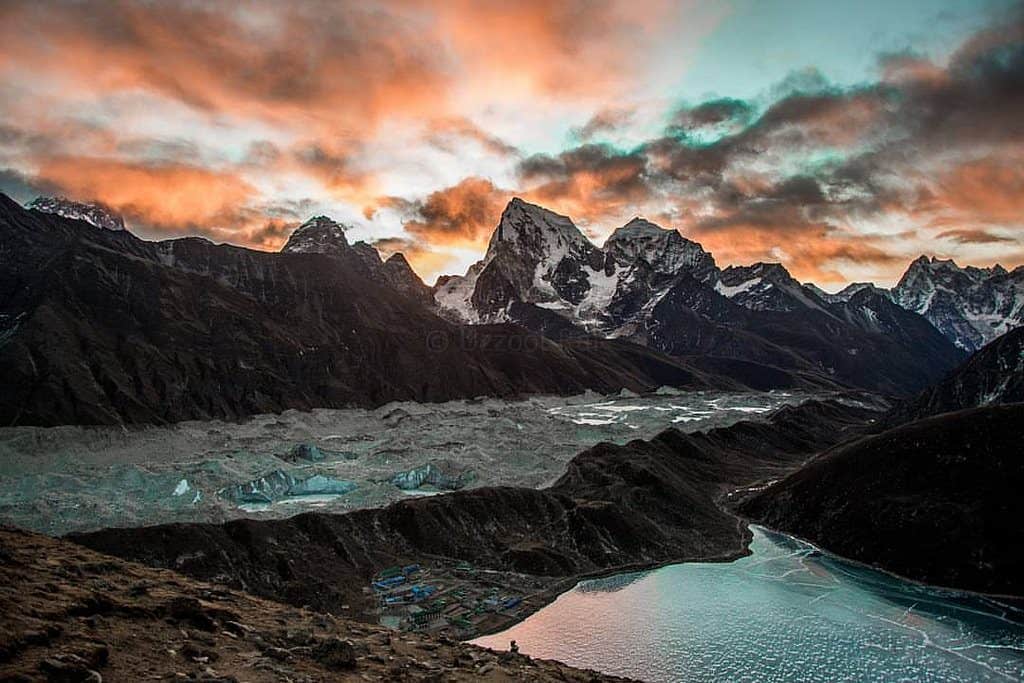
Cho La and Renjo La, with Everest Base Camp and the Gokyo Lakes
An 18-day loop through three Khumbu valleys: Everest Base Camp, the Cho La pass, the Gokyo Lakes and the Renjo La pass, with two passes instead of three, and four days shorter than the full Three Passes circuit.
You walk up the main Everest trail to Base Camp and Kala Patthar, cross Cho La (5,420 m / 17,782 ft) into the Gokyo valley, and cross Renjo La (5,360 m / 17,585 ft) back toward Namche. It is a hard trek, with a 9 to 10 hour day over Cho La, and it suits people who are very fit and have walked at altitude before.
USD 1,630 per person, private trip on any date you choose, minimum 2 people. You pay a 20% deposit (USD 326 per person) when you book and the balance (USD 1,304 per person) in cash when you arrive in Kathmandu. It includes the Lukla flights, permits, teahouses, all meals on the trek, and a licensed guide and porters.
Key facts: Everest Two Passes Trek
Use the tabs on this page for the overview, itinerary, cost, map, physical preparation, more information, FAQs and reviews.
Everest Two Passes Trek: Cho La, Renjo La, Everest Base Camp and Gokyo Lakes
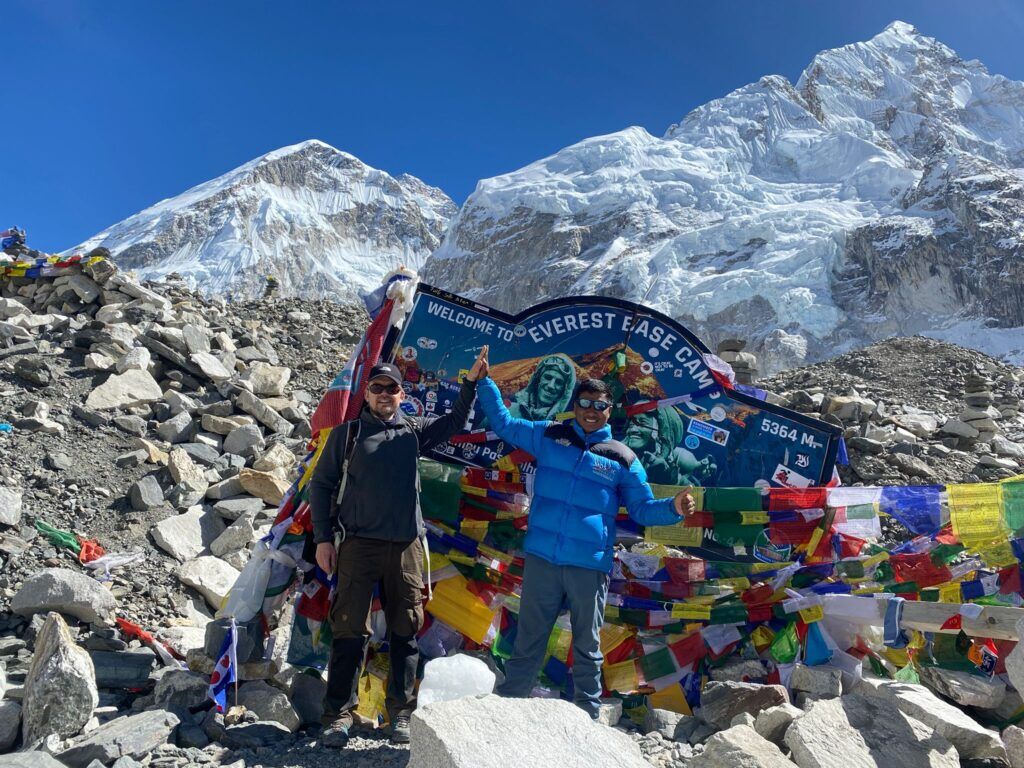
The Everest Two Passes Trek is an 18-day loop in the Khumbu. It joins the classic Everest Base Camp route to the quieter Gokyo valley by two high passes, Cho La and Renjo La, and it ends on the Thame side of Namche, so you do not walk the same trail twice for most of it. You reach Everest Base Camp (5,364 m / 17,598 ft) and Kala Patthar (5,545 m / 18,192 ft), see the turquoise Gokyo Lakes, and cross the two passes in a counter-clockwise direction, with the first pass after your highest night.
Everest two passes trek one line itinerary
Day 1: Arrive in Kathmandu (1,345 m / 4,413 ft)
Day 2: Fly to Lukla (2,840 m / 9,318 ft), trek to Phakding (2,610 m / 8,563 ft)
Day 3: Trek to Namche Bazaar (3,440 m / 11,286 ft)
Day 4: Acclimatization day in Namche
Day 5: Trek to Tengboche (3,860 m / 12,664 ft)
Day 6: Trek to Dingboche (4,360 m / 14,304 ft)
Day 7: Acclimatization day in Dingboche
Day 8: Trek to Lobuche (4,940 m / 16,207 ft)
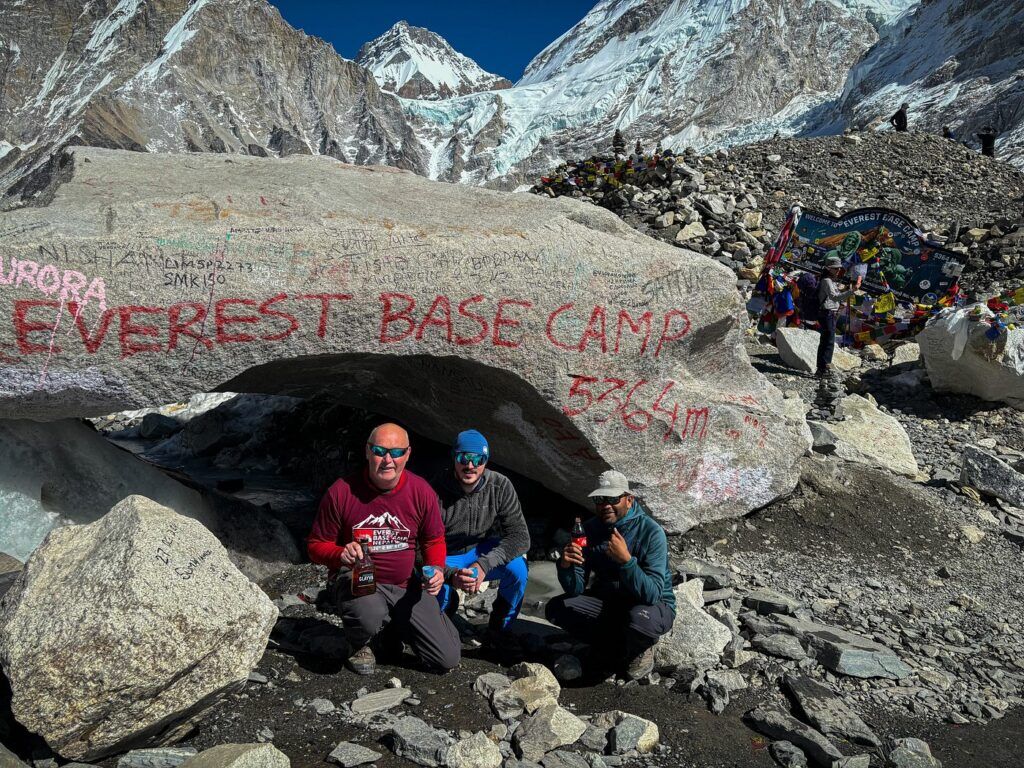
Day 9: Everest Base Camp (5,364 m / 17,598 ft), sleep at Gorak Shep (5,170 m / 16,962 ft)
Day 10: Kala Patthar (5,545 m / 18,192 ft) at sunrise, trek to Dzongla (4,830 m / 15,846 ft)
Day 11: Cross Cho La (5,420 m / 17,782 ft) to Gokyo (4,790 m / 15,715 ft)
Day 12: Explore Gokyo, optional Gokyo Ri (5,357 m / 17,575 ft)
Day 13: Cross Renjo La (5,360 m / 17,585 ft) to Lungden (4,380 m / 14,370 ft)
Day 14: Trek to Thame (3,820 m / 12,533 ft)
Day 15: Trek to Namche Bazaar (3,440 m / 11,286 ft)
Day 16: Trek to Lukla (2,840 m / 9,318 ft)
Day 17: Fly to Kathmandu (1,345 m / 4,413 ft)
Day 18: Departure

Highlights
- Everest Base Camp and a sunrise on Kala Patthar, the highest point of the trek
- Cho La pass (5,420 m / 17,782 ft), with a short glacier crossing near the top
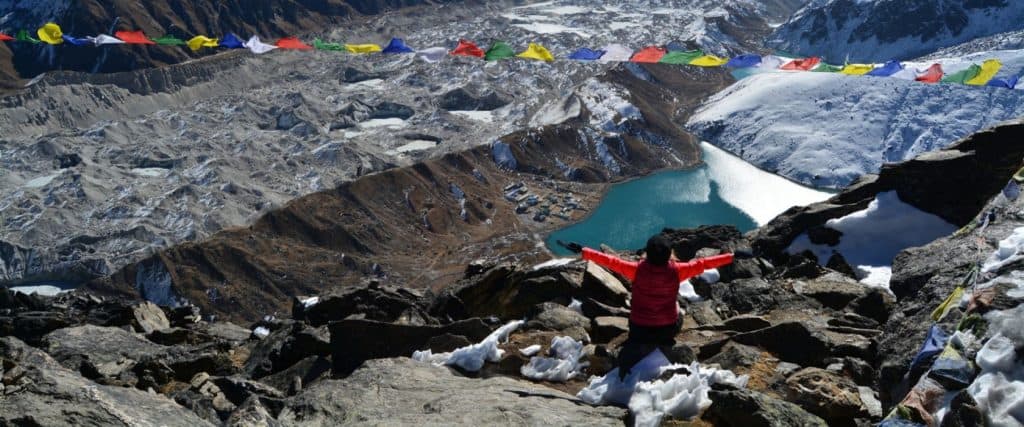
- The Gokyo Lakes and the Ngozumpa Glacier, the biggest glacier in Nepal, with an optional climb of Gokyo Ri (5,357 m / 17,575 ft)
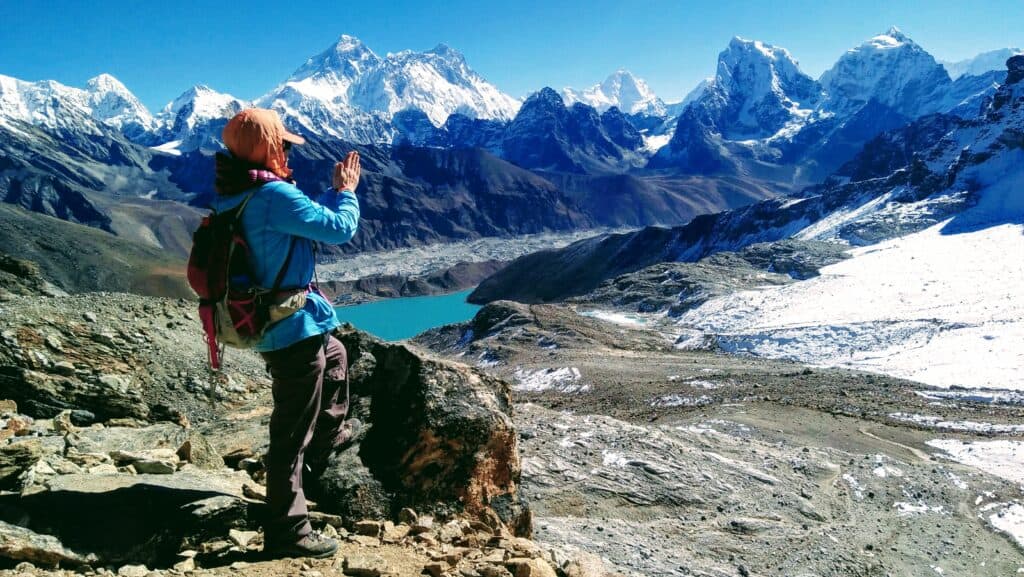
- Renjo La pass (5,360 m / 17,585 ft) and its view back to Everest, Cho Oyu, Makalu and Lhotse
- Namche Bazaar, Tengboche monastery and the Sherpa villages of Khumjung and Thame
- A licensed guide and porters, and permits and Lukla flights included
Two passes or three?
The full Everest Three Passes trek adds Kongma La and runs 22 days. This trek leaves out Kongma La and the Chhukung leg, which saves 4 days and about USD 360, and it keeps Cho La and Renjo La. If you want all three passes, see our Everest Three Passes Trek. If you want Gokyo Lakes with Everest Base Camp and no passes, see our Everest Base Camp and Gokyo Lakes Trek.
Who it suits
This trek suits very fit trekkers who have walked at altitude before and are comfortable with cold, basic teahouses and a few long days. It does not suit first-time trekkers or anyone with a heart, lung or blood condition who has not seen a doctor. Read the Physical Prep tab before you book.
Important Note:
Lukla flights can sometimes be delayed or canceled due to weather conditions. We highly recommend booking an extra day in Kathmandu at the start of the trek to avoid any disruptions to your itinerary.
The price for the Two Passes Trek is 1,630 per person. Please review the inclusions and exclusions list below to see what is included.
Cost Includes
- Airport arrival and departure transfers
- 2 nights in a 3-star hotel in Kathmandu with breakfast (twin or double sharing)
- Pre-trek meeting and briefing
- Kathmandu to Lukla and Lukla to Kathmandu flights (and the road transfer to and from Ramechhap when the flights leave from there)
- Teahouse accommodation on the trek
- Breakfast, lunch and dinner on the trek, from Day 2 to Day 16, and breakfast on Day 17
- Licensed local guide
- Porters (1 porter for every 2 trekkers)
- Food, accommodation, salary, insurance and medicine for the guide and porters
- All required trekking permits and entry fees
- Government and local taxes
Cost Excludes
- International flights
- Your Nepal visa
- Lunch and dinner in Kathmandu
- Travel insurance. It is required, and must cover high-altitude trekking and helicopter evacuation.
- All drinks, such as tea, coffee, soft drinks, beer and bottled water
- Personal expenses such as laundry, battery charging, hot showers, phone calls and Wi-Fi
- Personal trekking gear
- Extra costs caused by flight delays or bad weather, such as extra meals and hotel nights
- Extra Kathmandu activities
- Tips for your guide and porters, which are optional (see the FAQs for a budgeting guide)
Availability of the Everest Two Passes Trek
- Guaranteed Available PackagesFridayDecember 4, 2026MondayDecember 21, 2026USD 1,630Available
- Guaranteed Available PackagesTuesdayDecember 8, 2026FridayDecember 25, 2026USD 1,630Available
- Guaranteed Available PackagesFridayDecember 11, 2026MondayDecember 28, 2026USD 1,630Available
- Guaranteed Available PackagesTuesdayDecember 15, 2026FridayJanuary 1, 2027USD 1,630Available
- Guaranteed Available PackagesFridayDecember 18, 2026MondayJanuary 4, 2027USD 1,630Available
- Guaranteed Available PackagesTuesdayDecember 22, 2026FridayJanuary 8, 2027USD 1,630Available
- Guaranteed Available PackagesFridayDecember 25, 2026MondayJanuary 11, 2027USD 1,630Available
- Guaranteed Available PackagesTuesdayDecember 29, 2026FridayJanuary 15, 2027USD 1,630Available
- Guaranteed Available PackagesFridayJanuary 1, 2027MondayJanuary 18, 2027USD 1,630Available
- Guaranteed Available PackagesTuesdayJanuary 5, 2027FridayJanuary 22, 2027USD 1,630Available
Everest Two Passes Trek Itinerary: 18 Days, Day by Day
Walking times are approximate and include rests. The route, the order of days and the pass crossings can change with weather, snow, flights and the health of the group, and your guide makes the final decision. Cho La (Day 11) and Renjo La (Day 13) are not crossed if the guide judges them unsafe.
Our representative meets you at Tribhuvan International Airport and takes you to your 3-star hotel. Later in the day, or in the evening, you have the pre-trek briefing at your hotel. We go through the plan, which airport your Lukla flight leaves from, the pass days, your kit, your documents and your insurance, and we check what you still need to buy or rent in Thamel, the busy tourist area close to most hotels.
- Transfer: airport to hotel (included)
- Sleeping altitude: Kathmandu, 1,345 m / 4,413 ft
- Meals: not included
- Overnight: 3-star hotel, Kathmandu
You take an early morning flight to Lukla, which takes about 30 to 45 minutes and flies between the mountains. In the busy seasons the flights mostly leave from Manthali Airport in Ramechhap, about 4 hours by road from Kathmandu, so you leave Kathmandu in the middle of the night, and we arrange the drive. At other times of the year the flights usually leave from Kathmandu. We tell you which airport it will be when you arrive in Kathmandu and at the briefing, because it depends on the airlines and the season.
From Lukla you walk on stone-stepped paths, mostly flat or downhill, past Sherpa villages and prayer walls to Phakding. It is an easy first day, to let your body settle.
- Flight: Lukla, about 30 to 45 minutes (included), with the road transfer when the flight is from Ramechhap
- Walking: about 3 to 3.5 hours
- Sleeping altitude: Phakding, 2,610 m / 8,563 ft
- Meals: breakfast, lunch and dinner
- Overnight: teahouse
You cross the Dudh Koshi on several suspension bridges, enter Sagarmatha National Park at Monjo, and climb steadily through pine forest to Namche, the main Sherpa town of the Khumbu. On a clear day you may have your first view of Everest. The walk takes about 6 hours.
Altitude note: Namche is about 830 m higher than Phakding. This is more than the 300 to 500 m a night we advise above 3,000 m, so tomorrow is a rest day, and you walk slowly today.
- Walking: about 6 hours
- Sleeping altitude: Namche Bazaar, 3,440 m / 11,286 ft (about 830 m higher than last night)
- Meals: breakfast, lunch and dinner
- Overnight: teahouse
You walk up on grassy trails to the Everest View Hotel (3,880 m / 12,730 ft) and on to Khumjung (3,790 m / 12,434 ft), with views of Everest, Lhotse and Ama Dablam, and come back to Namche to sleep. Going high and sleeping low helps your body adjust. The walk takes about 4 hours.
- Walking: about 4 hours
- Sleeping altitude: Namche Bazaar, 3,440 m / 11,286 ft
- Meals: breakfast, lunch and dinner
- Overnight: teahouse
The trail runs above the Dudh Koshi, drops to the river, and then climbs through rhododendron and fir forest to Tengboche, the largest monastery in the Khumbu, with views of Ama Dablam, Everest, Lhotse and Nuptse. The day takes about 5 hours.
- Walking: about 5 hours
- Sleeping altitude: Tengboche, 3,860 m / 12,664 ft (about 420 m higher than last night)
- Meals: breakfast, lunch and dinner
- Overnight: teahouse
You pass Pangboche, cross the Imja Khola and climb above the tree line into the Imja valley, with Ama Dablam rising above Dingboche. The walk takes about 5 hours.
- Walking: about 5 hours
- Sleeping altitude: Dingboche, 4,360 m / 14,304 ft (about 500 m higher than last night)
- Meals: breakfast, lunch and dinner
- Overnight: teahouse
You climb the ridge behind Dingboche, up to about 4,900 m / 16,076 ft, for a wide view of Makalu, Lhotse and Ama Dablam, and return to sleep in Dingboche. This is your last rest day before the high ground, so rest, eat and drink a lot. The walk takes about 3 to 4 hours.
- Walking: about 3 to 4 hours
- Sleeping altitude: Dingboche, 4,360 m / 14,304 ft
- Meals: breakfast, lunch and dinner
- Overnight: teahouse
The path climbs to the memorials for climbers who died on Everest and then runs along the Khumbu glacier to Lobuche. It is a 5 to 6 hour day, and the cold is serious here.
Altitude note: Lobuche is about 580 m higher than Dingboche, which is more than the 300 to 500 m a night that we advise. You have had a rest day at Dingboche, and tomorrow you sleep only about 230 m higher at Gorak Shep. If you have a headache that gets worse, vomiting, or a loss of balance, tell your guide at once. Going down is the treatment.
- Walking: about 5 to 6 hours
- Sleeping altitude: Lobuche, 4,940 m / 16,207 ft (about 580 m higher than last night)
- Meals: breakfast, lunch and dinner
- Overnight: teahouse
You follow the ridge and the rocky glacier path to Gorak Shep, leave your bags, and walk to Everest Base Camp at 5,364 m / 17,598 ft. In the spring climbing season you may see the expedition tents. You cannot see the summit of Everest from here, but you see the Khumbu Icefall. Then you return to Gorak Shep. The day takes about 8 hours, and this is your highest night of the trek, so drink plenty of water. Sleep is often poor at this height, which is normal.
- Walking: about 8 hours
- Highest point: Everest Base Camp, 5,364 m / 17,598 ft
- Sleeping altitude: Gorak Shep, 5,170 m / 16,962 ft (about 230 m higher than last night)
- Meals: breakfast, lunch and dinner
- Overnight: teahouse
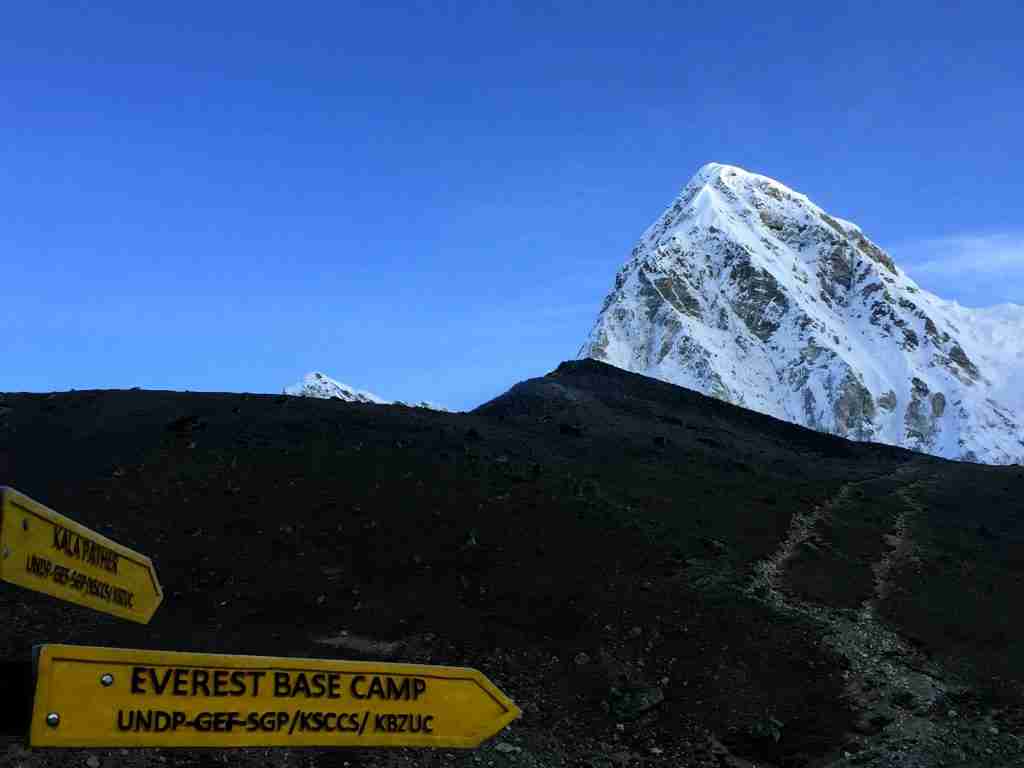
You climb Kala Patthar in the dark, for sunrise on Everest, Nuptse, Lhotse and Pumori. It is the highest point of the trek. After breakfast you walk down past Lobuche and over rocky and glacial ground to Dzongla, below the Cho La pass. It is a long day of about 8 hours, and you lose 340 m of sleeping altitude, which helps your body.
- Walking: about 8 hours
- Highest point: Kala Patthar, 5,545 m / 18,192 ft
- Sleeping altitude: Dzongla, 4,830 m / 15,846 ft
- Meals: breakfast, lunch and dinner
- Overnight: teahouse
This is the hardest day of the trek, and one of the longest. You leave early, in the dark, and climb to the Cho La pass at 5,420 m / 17,782 ft, over big rocks, with a short glacier crossing near the top. Your guide decides if it is safe, and may use ropes or crampons if there is ice or snow. You then descend a steep, loose slope toward the Ngozumpa Glacier and walk on past Thagnak (4,700 m / 15,420 ft) to Gokyo and the Gokyo Lakes. The day takes about 9 to 10 hours, which is why we start at first light and ask you to be well rested.
Please tell us when you book if you think this day will be too much. We can add a night at Thagnak, which makes the trek one day longer.
- Walking and climbing: about 9 to 10 hours
- Highest point: Cho La, 5,420 m / 17,782 ft
- Sleeping altitude: Gokyo, 4,790 m / 15,715 ft (about 40 m lower than last night)
- Meals: breakfast, lunch and dinner
- Overnight: teahouse
A day to rest and explore. You can walk along the turquoise Gokyo Lakes, or climb Gokyo Ri, a steep and rocky climb of about 3 to 4 hours up, for a view of Everest, Lhotse, Makalu, Cho Oyu and the Ngozumpa Glacier, the biggest glacier in Nepal. Gokyo Ri is optional, and you choose on the day with your guide. After two long days it is also fine to do very little.
- Optional: Gokyo Ri, about 5 to 6 hours return
- Sleeping altitude: Gokyo, 4,790 m / 15,715 ft
- Meals: breakfast, lunch and dinner
- Overnight: teahouse
The second pass. The trail climbs from Gokyo past the lakes, up long stone steps to Renjo La at 5,360 m / 17,585 ft. From the top you look back to Everest, Cho Oyu, Makalu and Lhotse, and ahead to the Tibetan ranges. Then you descend a long stone staircase to Lungden. The day takes about 6 to 7 hours. Renjo La is easier than Cho La, but it can be icy or snowy, and your guide checks the conditions first.
- Walking: about 6 to 7 hours
- Highest point: Renjo La, 5,360 m / 17,585 ft
- Sleeping altitude: Lungden, 4,380 m / 14,370 ft
- Meals: breakfast, lunch and dinner
- Overnight: teahouse
You descend to the Bhote Koshi valley, with views of Thamserku and Kusum Kanguru, and walk through meadows and juniper to Thame, a Sherpa village with an old monastery above it. The day takes about 6 to 7 hours, with a lot of downhill that is hard on the knees, so use your poles.
- Walking: about 6 to 7 hours
- Sleeping altitude: Thame, 3,820 m / 12,533 ft
- Meals: breakfast, lunch and dinner
- Overnight: teahouse
The path goes through pine forest and past traditional houses, with a few short, steep descents, and rejoins the main Everest trail at Namche. The walk takes about 5 hours. In the afternoon you can have a hot drink at a bakery and shop for souvenirs.
- Walking: about 5 hours
- Sleeping altitude: Namche Bazaar, 3,440 m / 11,286 ft
- Meals: breakfast, lunch and dinner
- Overnight: teahouse
The last day of walking. You follow the river with stone steps, steep descents and a final climb to Lukla, through thick forest with many birds. The day takes about 7 hours. In the evening you celebrate with your guide and porters, and this is the time to give tips, if you wish.
- Walking: about 7 hours
- Sleeping altitude: Lukla, 2,840 m / 9,318 ft
- Meals: breakfast, lunch and dinner
- Overnight: teahouse
You take the morning flight back, about 30 to 45 minutes. In the busy seasons the flight mostly lands at Manthali Airport in Ramechhap, and we drive you to Kathmandu, about 4 hours. At other times it lands in Kathmandu. The rest of the day is free for a hot shower, shopping in Thamel and a celebration dinner.
There is no spare day in this itinerary. If your flight is delayed by weather, you arrive late, and the extra costs are at your own cost. We suggest that you add a day in Kathmandu before or after the trek, and book your flight home for later than Day 18.
- Flight: Lukla, about 30 to 45 minutes (included), with the road transfer when the flight is to Ramechhap
- Sleeping altitude: Kathmandu, 1,345 m / 4,413 ft
- Meals: breakfast in Lukla. Lunch and dinner in Kathmandu are not included
- Overnight: 3-star hotel, Kathmandu
We take you to Tribhuvan International Airport for your flight home or onward trip. You can also extend your stay with us, for a safari in Chitwan or a tour in Kathmandu or Pokhara.
- Transfer: hotel to airport (included)
- Meals: breakfast
Physical Preparation for the Everest Two Passes Trek
This trek is hard. Read this tab before you book, and talk to your doctor. It is general information and is not medical advice.
Is the Two Passes Trek right for you?
It suits you if
- you are very fit, and have done multi-day treks before, ideally above 3,000 m / 9,843 ft
- you can walk 6 to 10 hours on a hard day, including steep and loose ground
- you are comfortable with cold, basic teahouses and few facilities
- you have 18 days, with some flexibility at the end for flight delays
Think again, or talk to us, if
- you have never trekked above 3,000 m / 9,843 ft. The Everest Base Camp trek may be a better first trek.
- you have a heart, lung or blood condition (see your doctor first)
- you are afraid of heights or of steep, loose ground
- you want a trip with hot showers and Wi-Fi every day
The fitness this trek asks for
Seven days of the trek are 6 hours or longer, and two of them are pass days: Cho La on Day 11 is about 9 to 10 hours, with a short glacier section and a long descent, and Renjo La on Day 13 is 6 to 7 hours. Days 9 and 10, Everest Base Camp and Kala Patthar, are about 8 hours each. The aim of your training is to walk for 6 to 8 hours on consecutive days with a daypack, including steep downhill, and still feel strong. Start 12 to 16 weeks before you go.
| Weeks | Focus | What to do |
|---|---|---|
| Weeks 1 to 4 | Base fitness | Cardio 3 times a week (running, cycling or swimming, 30 to 45 minutes). One hike a week of 2 to 3 hours. Strength work for legs and core twice a week. |
| Weeks 5 to 8 | Build endurance | Cardio 3 to 4 times a week. A long hike each weekend, building to 4 to 5 hours with a loaded daypack. Add stairs or hills, and step-ups. |
| Weeks 9 to 12 | Pass-day fitness | Back-to-back long hikes on a weekend, 5 to 6 hours each day, with the boots and pack you will use. Train going downhill, because the descents are long. |
| Last 2 to 4 weeks | Taper | Keep a few long walks, then reduce the load in the last week. Rest well, and check your gear and your insurance. |
If you can, spend a few days at altitude first. It helps, but it does not replace the acclimatization days in the itinerary.
How the itinerary protects you at altitude
You sleep above 4,500 m / 14,764 ft for 5 nights, and the highest night is Gorak Shep, 5,170 m / 16,962 ft. These features of the plan are there to reduce the risk:
- Three acclimatization days: Namche Bazaar (Day 4), Dingboche (Day 7) and Gokyo (Day 12, optional Gokyo Ri). On each one you walk higher and sleep low.
- Two nights go beyond the 300 to 500 m a night that we advise above 3,000 m: Namche (about 830 m) and Lobuche (about 580 m). We say so on those days.
- Both passes come after your highest night, so you cross them when you have had time to adapt.
- After Gorak Shep, the height at which you sleep goes down or stays about the same for the rest of the trek.
- Your guide checks how you feel every day, and decides if it is safe to cross a pass.
There is also a weak point: there is no spare day in this itinerary, and Day 11 is long. Tell us when you book if you want to add a night at Thagnak or a spare day in Kathmandu.
| Day | Night at | Sleeping altitude | Change from the night before |
|---|---|---|---|
| 2 | Phakding | 2,610 m / 8,563 ft | Start |
| 3 | Namche Bazaar | 3,440 m / 11,286 ft | +830 m / +2,723 ft |
| 4 | Namche Bazaar (rest) | 3,440 m / 11,286 ft | No change |
| 5 | Tengboche | 3,860 m / 12,664 ft | +420 m / +1,378 ft |
| 6 | Dingboche | 4,360 m / 14,304 ft | +500 m / +1,640 ft |
| 7 | Dingboche (rest) | 4,360 m / 14,304 ft | No change |
| 8 | Lobuche | 4,940 m / 16,207 ft | +580 m / +1,903 ft |
| 9 | Gorak Shep | 5,170 m / 16,962 ft | +230 m / +755 ft |
| 10 | Dzongla | 4,830 m / 15,846 ft | -340 m / -1,115 ft |
| 11 | Gokyo | 4,790 m / 15,715 ft | -40 m / -131 ft |
| 12 | Gokyo (rest) | 4,790 m / 15,715 ft | No change |
| 13 | Lungden | 4,380 m / 14,370 ft | -410 m / -1,345 ft |
| 14 | Thame | 3,820 m / 12,533 ft | -560 m / -1,837 ft |
| 15 | Namche Bazaar | 3,440 m / 11,286 ft | -380 m / -1,247 ft |
| 16 | Lukla | 2,840 m / 9,318 ft | -600 m / -1,969 ft |
Warning signs: when to go down
- Mild symptoms (headache, nausea, loss of appetite, dizziness, trouble sleeping): rest, drink water, do not go higher, and tell your guide.
- Emergency signs: a headache that gets worse, vomiting, confusion or loss of balance (possible cerebral edema), or a cough, breathlessness at rest or a rattling chest (possible pulmonary edema). The person must go down at once, and your guide arranges help. In a serious case we arrange evacuation, by helicopter if needed, through your insurance company.
Altitude sickness can be fatal if it is ignored, and fitness does not protect you from it. Do not hide symptoms to stay on the schedule.
Before you book
- See your doctor if you have a heart, lung or blood condition, if you are pregnant, or if you take regular medication. Ask whether altitude medication is right for you.
- Check that your insurance covers high-altitude trekking up to 5,545 m / 18,192 ft and helicopter evacuation at that altitude. Some policies stop at 4,000 m or 5,000 m.
- Tell us about any health condition when you book.
Everest Two Passes Trek: Frequently Asked Questions
Planning and booking
The trek costs USD 1,630 per person for 18 days. This includes airport transfers, a Kathmandu hotel with breakfast, Kathmandu/Ramechhap - Lukla flights, all permits, a guide and porter, tea house stays, three meals a day on the trek, a pre-trek briefing and taxes.
International flights, Kathmandu lunches and dinners, your visa, personal gear, travel insurance, tips, drinks and extra activities are not included.
March to May and September to November are the best seasons. Autumn gives the clearest skies and most stable weather. Spring brings rhododendron blooms and warmer days, but the high passes can still hold snow.
Yes, both are offered. Fixed group departures run from 10 November to 28 December 2027 and private departures can be arranged on your own dates. [Minimum 2 people; maximum group size: 12]
This trek adds two high passes, Cho La and Renjo La, plus the Gokyo Lakes. It takes 18 days instead of about 12 to 14, and it is harder. You still reach Everest Base Camp and Kala Patthar. For the shorter route without the passes, see the Everest Base Camp trek; for the lakes alone, see the Gokyo Lakes route.
Click "View dates and book" on this page, choose your date and follow the checkout. You pay a 20% deposit (USD 326 per person) to secure your place, and the balance (USD 1,304 per person) in cash when you arrive in Kathmandu. For the cancellation policy, please read our terms and conditions.
Route and passes
Cho La Pass (5,420 m) on Day 11, between Dzongla and Gokyo, and Renjo La Pass (5,345 m) on Day 13, between Gokyo and Lunghden.
You fly from Kathmandu/Ramechhap to Lukla and trek up to Namche Bazaar, Tengboche, Dingboche, Lobuche and Gorak Shep for Everest Base Camp and Kala Patthar. You then cross Cho La to Gokyo, cross Renjo La to Lunghden, and return via Thame, Namche and Lukla.
Everest Base Camp and its high-altitude acclimatization come first, so you reach the two passes already well adapted. Cho La is crossed before Renjo La, with the Gokyo Lakes in between as a recovery and viewpoint stop.
You spend Day 12 at Gokyo exploring the Gokyo Lakes, including the 5th Lake, and climbing Gokyo Ri (5,357 m) for views of Everest, Lhotse, Makalu and Cho Oyu.
Snow and ice are possible on both passes, especially in spring and early winter. Cho La can have a glacier section with loose rock and ice. Guides check conditions before each crossing.
Yes, it is the hardest day. On Day 11 you cross Cho La (5,420 m / 17,782 ft) from Dzongla and walk on to Gokyo (4,790 m / 15,715 ft), which takes about 9 to 10 hours, with big rocks, a short glacier section near the top and a steep, loose descent. You leave at first light. If you think this day will be too much, tell us when you book, and we can look at adding a night at Thagnak.
Yes. Your guide will make the decision on the day based on your health and the weather, and can adjust the plan accordingly. What actually happens depends on the condition of the trekkers at the time. Since one plan does not work for everyone, a situational plan is developed and implemented based on the circumstances.
Difficulty, fitness and altitude
It is challenging. Expect 5 to 8+ hours of walking on most days, steep climbs, two high-pass crossings, and many nights spent above 4,300 m. It can be more demanding than the standard Everest Base Camp trek, as you spend more time at high altitudes, and cumulative fatigue can make the trek comparatively more challenging.
Good cardio fitness and previous multi-day hiking experience. Train for 8 to 12 weeks with hill walking, stair climbing and cardio, and practice long days with a loaded daypack. No technical climbing skills are needed.
Kala Patthar at 5,545 m on Day 10 is the highest point. The highest overnight stay is Gorak Shep at 5,170 m. Cho La (5,420 m) and Renjo La (5,345 m) are the two highest passes.
Two rest days are built in, at Namche Bazaar (Day 4) and Dingboche (Day 7). The route also follows the climb high, sleep low rule, with the Gokyo day on Day 12 as an additional buffer before Renjo La.
Headache, nausea, dizziness, poor sleep and loss of appetite are early signs. Tell your guide straight away. Guides check your oxygen levels and symptoms daily, and the response is to rest, stop going up, or descend. Severe cases are evacuated by helicopter.
Some trekkers carry it as a preventive measure or treatment option, but you should consult your doctor before the trip. It does not replace the need for a gradual ascent and listening to your body.
It is also recommended to try Diamox before the trip, after consulting your doctor, as some people experience side effects, including blurred vision, loss of appetite, and other symptoms. Trying it in advance will help you understand how your body responds and ensure you tolerate the medication well before relying on it during the trek. The mountains are certainly not the ideal place to discover that you are experiencing adverse side effects or feeling even more unwell.
Flights, permits, food and accommodation
Yes. On Day 2 you drive from Kathmandu to Ramechhap and fly to Lukla (2,840 m), then trek to Phakding. On Day 17 you fly back from Lukla to Ramechhap and transfer to Kathmandu. The flights are included in the price.
Note: Although we mention driving to Ramechhap, during the low season, you may still fly directly from Kathmandu. Regardless of which airport you fly from, all airport transfers will be arranged by Mosaic Adventure.
Flights are weather-dependent and often depart early in the morning. Delays of a day or more are not uncommon, especially during winter and the monsoon shoulder seasons.
We recommend keeping at least one spare day in Kathmandu before your international departure, as Day 18 is scheduled as a departure day.
Alternatively, you may be able to arrange a helicopter flight. The cost typically ranges from USD 350 to 450 per person, depending on availability and conditions. Please note that helicopter flights are generally not covered by travel insurance, so make sure you budget for these potential additional expenses.
You will need two permits for this trek: the Sagarmatha National Park Entry Permit and the Khumbu Pasang Lhamu Rural Municipality Permit. Both permits are included in the trip price and will be arranged by us. You don't need to do anything; we will take care of everything for you.
Yes, and it is not included in the trip price. Many nationalities can get a tourist visa on arrival at Tribhuvan International Airport: USD 30 for 15 days, USD 50 for 30 days or USD 125 for 90 days. For this 18-day trek, take the 30-day visa. Please check the current rules and fees before you travel.
You will stay in teahouses (local mountain lodges) in twin-sharing rooms with shared bathrooms. The rooms are basic and unheated, so we recommend bringing a warm sleeping bag.
In Kathmandu, you will stay in a hotel with breakfast included on Days 1 and 17.
Follow this page to learn more about accommodation on the Everest Base Camp trek.
Breakfast, lunch and dinner are included during the trek. Menus typically offer a variety of options, including rice, noodles, soups, eggs, bread and local dishes such as dal bhat. In Kathmandu, only breakfast is included.
During the trek, you will choose your meals from the menus available at the teahouses where you stay overnight. Breakfast and dinner are usually served at your own teahouse, while lunch is enjoyed at one of the teahouses along the trail. You can choose from the available menu at each stop.
There are plenty of food options along the route, and after a long day of walking, you'll find that a warm, freshly prepared meal is especially satisfying!
Safety, insurance, gear and connectivity
Yes. Your policy must cover trekking up to 6,000 m and emergency helicopter evacuation. Insurance is not included in the price, so arrange it before you travel.
Safety comes first. Guides delay, shorten or change the day's route if snow, wind or poor visibility make the passes unsafe. Delays or changes caused by weather may cost extra, and your insurance should cover the costs.
Your guide gives first aid, arranges descent or helicopter evacuation, and contacts your insurer. Evacuation costs are covered by your insurance, not by the trek price.
General trekking gear is essential, including well-broken-in, waterproof hiking boots, layered clothing, a warm down jacket, a four-season sleeping bag, gloves, sunglasses, microspikes for crossing the high passes, trekking poles, and other basic essentials.
A detailed packing list will be provided after booking. Most trekking gear can be purchased in Kathmandu, particularly in the Thamel area, provided you allow enough time for shopping after arriving in Nepal. However, make sure your hiking boots are well broken in before the trip to avoid blisters and discomfort during the trek.
Most teahouses sell prepaid Wi-Fi data cards, and charging electronic devices usually comes at an additional cost. Mobile network coverage is weak or unavailable in higher-altitude sections, including around Cho La, Gokyo and Gorak Shep.
If you need to stay connected, we recommend purchasing a local SIM card in Kathmandu. NTC (Nepal Telecom) generally offers more reliable coverage and works in more locations along the trekking route. However, even NTC does not provide coverage throughout the entire trek.
Our suggestion is to use NTC mobile data wherever coverage is available and purchase Wi-Fi data cards at local teahouses when there is no mobile network.
Keep in mind that you will be trekking in a remote, high-altitude region where technical issues, network outages and other unexpected problems can take time to resolve. Avoid scheduling important online meetings or relying on a stable internet connection during the trek.
To learn more about electricity, Wi-Fi and charging facilities along the route, read our guide: Wi-Fi and Electricity on the Everest Base Camp Trek.
No. A porter will carry your main duffel bag, while you only need to carry a daypack with essentials such as water, a camera and extra layers.
We assign one porter for every two trekkers. Each porter carries a maximum of 20 kg in total, allowing for 10 kg per trekker.
One important detail that many trekkers overlook is the luggage allowance on flights to Lukla. The maximum combined weight for checked luggage and hand luggage is generally 15 kg per person. Airlines are quite strict about this limit because flights to Lukla operate using small aircraft with limited carrying capacity. Make sure you pack accordingly!
Tips are not included in the trip price, but they are customary and appreciated. There is no fixed amount, and tipping is entirely at your discretion. However, we recommend budgeting approximately USD 250 to 300 per trekker to tip the guide for the entire trek.
Everest Two Passes Trek Route Map

Everest Two Passes Trek: More Information
Everything below is here to help you book and plan the 18-day Everest Two Passes Trek. For fitness, altitude and safety, see the Physical Prep tab.
Booking your trek
This is a private trip, and it runs on any date you choose. A minimum of 2 people is needed, and the group can be larger. Click “View dates and book”, or contact us with your dates. You pay a 20% deposit (USD 326 per person) to secure your place, and the balance (USD 1,304 per person) in cash when you arrive in Kathmandu. For the cancellation policy, please see our terms and conditions.
Booking your international flight
Plan to arrive in Kathmandu on Day 1 and depart on Day 18. There is no spare day in this itinerary, and Lukla flights depend on the weather. We advise you to add a day in Kathmandu after the trek, and not to book a flight home earlier than Day 18, preferably later. Extra costs caused by delays, such as meals and hotels, are at your own cost.
Arrival information
After you book your flight, send us the details. We meet you at Tribhuvan International Airport and take you to your hotel. The pre-trek briefing takes place at your hotel on Day 1, and we check your gear, your documents and your insurance then.
Flights to Lukla: Kathmandu or Ramechhap
The flight to Lukla takes about 30 to 45 minutes. In the busy seasons, the flights mostly leave from Manthali Airport in Ramechhap, about 4 hours by road from Kathmandu, which means a start in the middle of the night, and we arrange the drive. At other times of the year the flights usually leave from Kathmandu. We cannot say for sure which airport you will use, because airlines and the airport authority decide, so we tell you when you arrive in Kathmandu and at the pre-trek briefing. The same applies to the flight back on Day 17.
The two passes
| Cho La, 5,420 m / 17,782 ft | Renjo La, 5,360 m / 17,585 ft | |
|---|---|---|
| Day | Day 11, from Dzongla to Gokyo | Day 13, from Gokyo to Lungden |
| Walking time | About 9 to 10 hours, including the descent to Gokyo | About 6 to 7 hours |
| Character | Big rocks, a short glacier crossing near the top, then a steep and loose descent. Crampons or ropes if there is ice or snow. | Long stone steps up, then a long stone staircase down. Can be icy or snowy. |
| Views | Cholatse, Taboche, Ama Dablam, the Ngozumpa Glacier | Everest, Cho Oyu, Makalu, Lhotse, the Gokyo Lakes, the Tibetan ranges |
| Difficulty | Difficult to strenuous | Difficult |
| Who decides | Your guide, on the day, on the conditions and on how the group feels | Your guide, on the day |
If a pass is unsafe, your guide will change the plan, and we will tell you what the options are. One traveller on a spring trip skipped Renjo La and walked back to Namche instead, and still enjoyed the trek. Skipping a pass is not a failure, and it is the kind of decision a good guide should make.
When to do the two passes
The trip runs on any date you choose. The passes are high, so we recommend spring or autumn.
| Season | Months | Weather and the passes | Our advice |
|---|---|---|---|
| Spring | March to May | Warmer, with rhododendron in the lower valleys. The passes are usually open, with snow in March. Cloud builds in the afternoons by late May. | Recommended |
| Monsoon | June to August | Rain, cloud and few views, with leeches at lower levels. Lukla flights are often delayed. | Not recommended |
| Autumn | September to November | Clear skies and the best mountain views. Early autumn can be wetter. October is the busiest month. | Recommended |
| Winter | December to February | Very cold, with snow on the passes, and some teahouses closed at the highest points. Cho La and Renjo La may be closed, and the Gokyo valley is very cold. | Only for very experienced trekkers. Ask us first. |
These are typical conditions, and every year is different. If you want to go in December or January, please talk to us first.
Which Khumbu trek: Two Passes, Three Passes, Everest Base Camp or Gokyo Lakes?
| Everest Two Passes Trek | Everest Three Passes Trek | Everest Base Camp and Gokyo Lakes Trek | |
|---|---|---|---|
| Days | 18 | 22 | Check the trip page |
| High passes crossed | 2 (Cho La, Renjo La) | 3 (Kongma La, Cho La, Renjo La) | None, or Cho La on request |
| Everest Base Camp | Yes | Yes | Yes |
| Gokyo Lakes | Yes | Yes | Yes |
| Highest point | Kala Patthar, 5,545 m / 18,192 ft | Kala Patthar, 5,545 m / 18,192 ft | Check the trip page |
| Hardest day | Cho La and Gokyo, 9 to 10 hours | Kongma La, 8 to 9 hours | Check the trip page |
| Best for | Very fit trekkers with high-altitude experience who want two passes in less time | Very fit, experienced trekkers who want the full Khumbu | Trekkers who want the lakes without a pass |
If you are not sure which trek suits you, talk to us. We can suggest the Everest Base Camp trek, the Everest Three Passes Trek or the Gokyo Lakes trek instead, if they suit your fitness and time.
Daily walking and altitude
Times are approximate and include rests. Altitudes are where you reach or sleep, unless noted.
| Day | Plan | Time | Difficulty | Altitude |
|---|---|---|---|---|
| 2 | Lukla to Phakding | Flight 30 to 45 min, walk about 3.5 hours | Easy | Lukla 2,840 m / 9,318 ft. Phakding 2,610 m / 8,563 ft |
| 3 | Phakding to Namche Bazaar | About 6 hours | Moderate | 3,440 m / 11,286 ft |
| 4 | Acclimatization: Everest View Hotel, Khumjung | About 4 hours | Easy to moderate | Khumjung 3,790 m / 12,434 ft |
| 5 | Namche to Tengboche | About 5 hours | Moderate | 3,860 m / 12,664 ft |
| 6 | Tengboche to Dingboche | About 5 hours | Moderate | 4,360 m / 14,304 ft |
| 7 | Acclimatization: ridge above Dingboche | 3 to 4 hours | Moderate | Up to 4,900 m / 16,076 ft |
| 8 | Dingboche to Lobuche | 5 to 6 hours | Moderate to difficult | 4,940 m / 16,207 ft |
| 9 | Lobuche, Gorak Shep, Everest Base Camp, Gorak Shep | About 8 hours | Difficult | EBC 5,364 m / 17,598 ft. Gorak Shep 5,170 m / 16,962 ft |
| 10 | Kala Patthar, then Dzongla | About 8 hours | Strenuous | Kala Patthar 5,545 m / 18,192 ft. Dzongla 4,830 m / 15,846 ft |
| 11 | Dzongla, Cho La, Gokyo | 9 to 10 hours | Strenuous | Pass 5,420 m / 17,782 ft. Gokyo 4,790 m / 15,715 ft |
| 12 | Gokyo, optional Gokyo Ri | Optional, 5 to 6 hours | Moderate or difficult | Gokyo Ri 5,357 m / 17,575 ft |
| 13 | Gokyo, Renjo La, Lungden | 6 to 7 hours | Difficult | Pass 5,360 m / 17,585 ft. Lungden 4,380 m / 14,370 ft |
| 14 | Lungden to Thame | 6 to 7 hours | Moderate | 3,820 m / 12,533 ft |
| 15 | Thame to Namche Bazaar | About 5 hours | Moderate | 3,440 m / 11,286 ft |
| 16 | Namche Bazaar to Lukla | About 7 hours | Moderate | 2,840 m / 9,318 ft |
Your team
- Guide: a licensed guide walks with you for the whole trek, checks how you feel every day, and decides if the passes are safe to cross.
- Porters: 1 porter for every 2 trekkers, carrying your duffel bags.
Travellers have named their guides in their reviews, for example Sonam, Purna, Manoj, Ngima and Ramesh.
A standard trekking day
Each day’s walk usually starts at about 7:00 to 7:30 am, and finishes in the afternoon, with breaks along the way. On the pass days the start is earlier, in the dark. You have breakfast and dinner at your teahouse and lunch on the trail.
Accommodation
In Kathmandu you stay in a 3-star hotel on a twin or double-sharing basis. On the trek you stay in teahouses, which are basic but clean, with shared bathrooms. They get colder and more basic as you go higher, and above 4,500 m the rooms are not heated and water can freeze in the morning.
Meals
Breakfast in Kathmandu is included. Breakfast, lunch and dinner are included on the trek, from Day 2 to Day 16, and breakfast on Day 17. Lunch and dinner in Kathmandu are not included. Teahouse menus have local and international dishes, and vegetarian options. Tell us about any dietary needs when you book.
Baggage
The baggage allowance for the Lukla flight is 15 kg (33 lb) in total, checked and carry-on together. Porters carry your duffel bag, and you carry a daypack. You can leave extra luggage at your Kathmandu hotel.
Water
Bring a reusable bottle and water purification tablets, to cut down on plastic waste. Aim to drink 3 to 4 liters of water a day.
Electricity, charging and Wi-Fi
Charging, hot showers and Wi-Fi are sometimes available at extra cost in the teahouses, but they are basic and not always working, and the price goes up with altitude. Bring a power bank and a plug adapter.
Money and tips
Carry Nepali rupees for drinks, snacks, charging and showers. Cards are not accepted on the trail. Tipping is optional. As a guide for budgeting, set aside about USD 250 to 300 per trekker, to be shared between your guide and porters.
Temperatures
It gets very cold above 4,500 m / 14,764 ft, especially at night, and on the passes it is colder, with wind. Dress in layers.
Permits and insurance
All required permits and entry fees are included. Travel insurance is required. It must cover high-altitude trekking up to 5,545 m / 18,192 ft, helicopter evacuation at that altitude, and medical costs. We check your policy at the pre-trek briefing on Day 1.
Nepal visa
The Nepal visa is not included. Many nationalities can get a visa on arrival in Kathmandu: USD 30 for 15 days, USD 50 for 30 days or USD 125 for 90 days. Check the Nepal Department of Immigration website for the latest rules.
What to pack
- Broken-in trekking boots and trekking socks
- Thermal base layers, a fleece and mid layers
- Down jacket and a warm sleeping bag rated to at least minus 15 degrees Celsius
- Waterproof jacket and trousers
- Warm hat, sun hat, gloves and a neck gaiter
- Sunglasses, sunscreen and lip balm
- Microspikes or crampons for Cho La, if your guide advises them
- Headlamp with spare batteries, water bottle and purification tablets
- Walking poles, which help on the long descents
- Daypack, power bank, camera and personal medication
Extending your stay
You can add days in Kathmandu, a trip to Chitwan National Park or Pokhara, or a longer trek. Tell us when you book.
Last updated: November 2026. Permit rules, fees, visa prices and flight arrangements can change, so please confirm the current details with us when you book.
Overall Trip Rating:
- Verified Purchase
 By Alex Visco June 19, 2025 Challenging, Rewarding and Flawlessly RunCompleting the Everest Two High Passes Trek with Mosaic Adventure was one of the most fulfilling experiences of my life. This is more than just the classic Everest Base Camp Trek, crossing Cho La Pass and Renjo La Pass, exploring the stunning Gokyo Lakes and summiting Kalapatthar made it a true high altitude adventure. If you’re looking for a challenging yet incredibly rewarding trekking route in Nepal, this is it! We were guided by Sonam and I can’t praise him enough. His deep knowledge of the Khumbu region, attention to detail and commitment to safety made a huge difference. The itinerary was thoughtfully designed with proper acclimatization days in Namche and Dingboche, which helped immensely. The trek itself was demanding, especially above Dingboche, but with Sonam by our side, we felt supported and completed it with confidence. Whether you’re a solo trekker or traveling in a group, I highly recommend Mosaic Adventure for your Everest region trek. Everything from flights to food, from guide to porter was handled with professionalism. Huge thanks to Sonam and Madhav for their dedication and for making this a once in a lifetime experience!
- Verified Purchase By Harry H June 3, 2025 Challenging and Rewarding ExperienceAs experienced hikers, we thought why stop at just Everest Base Camp? To challenge ourselves a bit more, we signed up for the Two Passes Trek with Mosaic Adventure. From our very first enquiry, Raj from the office was patient, responsive and professional. He answered all our questions and made the planning process smooth. Booking was easy too, we appreciated being able to pay a small deposit upfront and the rest in cash on arrival. The trek was well organized and fully supported by our amazing guide Purna and porter Bibu. We honestly couldn’t have completed it without their help. The trek is no joke, especially once you get above 4,500 meters, even for us so called “good hikers,” it was a serious challenge! If you're looking for a tough but incredibly rewarding adventure, we highly recommend this trek and definitely recommend going with Mosaic Adventure.
- Verified Purchase By Dale & Linda May 3, 2025 Tough but truly rewarding!This trek was very challenging, but incredibly beautiful. I’ll be honest, after reaching Everest Base Camp, I almost thought of stopping there. But our guide, Manoj, really encouraged us and gave us the confidence to keep going. The EBC section was tough but doable, with moments like watching the sunrise from Kala Patthar that made all the effort worth it. After some thinking, we decided to push on and crossed Cho La Pass to reach Gokyo. The views and experience were amazing, but after spending quite a long time at high altitude, we chose not to cross Renjo La and instead descend to Namche. Our guide Manoj quickly adjusted the plan without any issues and we really appreciated how flexible and supportive he was. Celebrating in Namche with a warm plate of dal bhat and a few beers felt like the perfect reward. Big thanks to our guide Manoj and porter Roop, who carried the heaviest load with a smile. This trek is not easy, but with a team like this, it becomes an unforgettable adventure.
- Verified Purchase By Eric Legault April 11, 2025 Wonderful Two Passes Trek ExperienceWe highly recommend the Two Passes Trek and the company, Mosaic Adventure. We had an amazing time in Nepal, it was an unforgettable journey from start to finish. If you're planning to trek to Everest Base Camp, cross Himalayan passes and explore hidden gems like Gokyo Lakes, this is the ultimate trekking experience and Mosaic Adventure is the company to do it with. Our guide, Ngima, was a true professional. Calm, experienced and always encouraging, she guided us through challenging terrain like Cho La Pass and Renjo La Pass with skill and confidence. She monitored our health daily and paced the trek perfectly to help us acclimatize to the altitude. You could tell she genuinely cared about each member of the group. If you're searching for a reliable Everest trek company with expert guides, excellent communication and a personal touch, I highly recommend Mosaic Adventure. Thank you, Ngima and Madhav, for making this dream adventure come true!
- Verified Purchase By Martin J March 22, 2025 Walking into a "Hidden World'!The two passes trek that took us to Everest Base Camp, crossing the high Cho La and Renjo La passes was truly a journey of a lifetime, made exceptional by our guide, Ramesh. His expertise and genuine care transformed this demanding trek into a series of unforgettable moments. The regular route to EBC was a bit crowded, but as we moved toward Cho La and Gokyo, it felt like stepping into a hidden world. The beautiful (though challenging) passes, stunning views and the peaceful turquoise lakes far surpassed our expectations, we had an absolutely amazing experience. If you train well, pack light, stay hydrated and trust your guide and porter, you’ll make it without any problems. It’s a soulful exploration of the Himalayas, go for it!
- Verified Purchase By Karl E March 2, 2025 Purna and team made this trek unforgettableOur 18 day Everest Base Camp, Cho La and Renjo La adventure with guide Purna and porter Laksman was nothing short of extraordinary. From the moment we landed Lukla after a thrilling flight, Punra has been really amazing. He paced our acclimatization perfectly, ensuring we adjusted to the altitude and pushing us for acclimatization which I think is critical for tackling the passes. Cho La Pass was a beast icy and steep but Purna’s encouragement and Laksman’s steady support kept us moving. Gokyo Lakes left us speechless and the sunrise from Gokyo Ri was worth every labored breath. Renjo La Pass tested our endurance, but descending into Thame village with its ancient monastery felt like a reward from the mountains. Special shoutout to Laksman, who carried our gear with a smile even in freezing conditions. If you want a trek that balances raw challenge with amazing views, this is it.
