
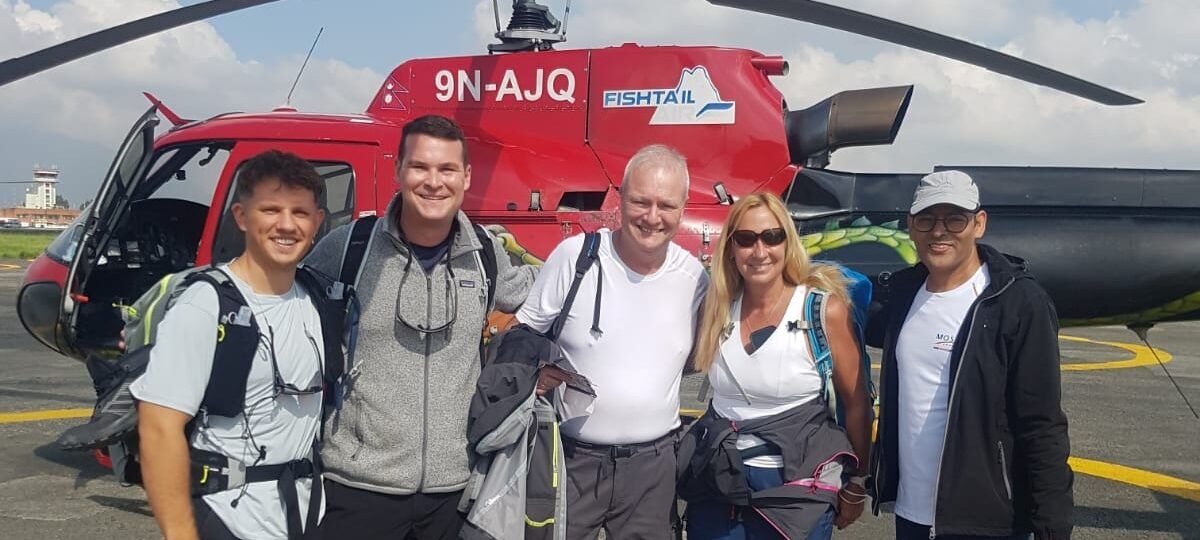
This guide explains everything you need to know about taking a helicopter tour in Nepal, from Everest Base Camp scenic flights and landing points to safety standards, weather conditions, costs, and who this experience is best suited for. Whether you are short on time, traveling with family, or unable to trek, this page helps you decide confidently if a helicopter tour is right for you.
Enjoying a Bird’s Eye View of the World’s Tallest Mountain through a Helicopter Tour in Nepal!
An unforgettable Himalayan experience
Climbing Mount Everest or trekking deep into the Himalayan ranges normally takes weeks and requires strong physical endurance. For travelers with limited time, mobility constraints, or a preference for comfort, a helicopter tour in Nepal offers a practical alternative. In just a few hours, you can experience close-up views of iconic high-altitude landmarks such as Kalapatthar (5,545 meters) and the Everest region, while enjoying a rare aerial perspective of Nepal’s dramatic mountain landscapes.
If you are visiting Nepal and not trekking, a helicopter tour can be a rewarding alternative. Below is what to expect and what to keep in mind to make the most of the experience.
Mount Everest helicopter tour
Flying above the world’s highest peaks reveals the true scale of the Himalayas, an experience that is difficult to grasp from the ground alone.
Most, if not all, helicopter tours start at Tribhuvan International Airport. If you’re taking the Mount Everest helicopter tour, your pilot will direct the aircraft east, where you’ll begin to see Nepal’s hills, river valleys, and terraced landscapes opening into the Himalayas.

Expect breathtaking views within minutes of takeoff, including villages, river valleys, and glaciated passes set against a backdrop of snow-capped mountains.
You will have a short stopover at Lukla, allowing time for sightseeing, photography, and a brief walk around this famous mountain airstrip.

You will then fly toward the Everest Base Camp area for close-range views of Mt. Everest and the surrounding peaks.
From this vantage point, you’ll also witness other towering peaks such as Lhotse, Nuptse, and Pumori.

You will then board the aircraft and fly back to Kathmandu. You might have a quick stopover at Shyangboche where you can have coffee or breakfast at the Everest View Hotel.
Everest View Hotel is famous for its panoramic mountain views. From here, you can enjoy a wide-angle look at the Himalayan skyline in a comfortable setting.
Alternatively, you could have some ground time at Lukla where you’ll have the opportunity to take some more photos and interact with the Sherpas.
You’ll also witness the awe-inspiring view of the Kathmandu Valley before you finally land back at the Tribhuvan International Airport and the helicopter tour ends.
What makes the Everest helicopter tour special?
The Everest Helicopter Tour is not just a trip; it’s an unforgettable adventure that stands out for many reasons. Here’s why it’s so special:
Breathtaking views
Flying over the Himalayas offers a perspective that few people ever experience. From above, you’ll see snow-covered peaks, deep valleys, and vast glaciers, including Mount Everest, the tallest mountain in the world.
Save time and energy
Trekking to Everest Base Camp can take weeks, but a helicopter tour lets you experience the same beauty in just a few hours. It’s perfect for those who have limited time or cannot trek for long distances.
Land at iconic spots
The tour includes stops at famous places like Lukla and the Everest View Hotel. At the hotel, you can enjoy a warm drink while taking in a 360 degree view of the Himalayas. It’s a moment you’ll never forget.
See multiple peaks
Besides Everest, you’ll view several iconic Himalayan peaks during the flight. The route often reveals dramatic ridgelines, glaciers, and sharp summit lines that are hard to appreciate from the ground.
Comfort and luxury:
Unlike trekking, a helicopter tour is comfortable and relaxing. You can enjoy the stunning scenery without worrying about physical strain. It’s a luxurious way to experience the Himalayas.
Ideal for many traveler types
This tour is popular with families, couples, photographers, and travelers who want Himalayan views without a multi-day trek.
Memories for a lifetime
The Everest Helicopter Tour is more than just a sightseeing trip. It’s a chance to create memories that will stay with you forever. From the thrill of takeoff to the peaceful moments at the Everest View Hotel, every second is special.
In short, the Everest Helicopter Tour is a once-in-a-lifetime experience that combines adventure, comfort and unmatched natural beauty. It’s the perfect way to see the Himalayas if you want something truly extraordinary.
Is the Everest helicopter tour safe?
Helicopter safety is one of the most common concerns raised by travelers on platforms like TripAdvisor, travel forums, and social media groups. In Nepal, commercial helicopter flights operate under regulations set by the Civil Aviation Authority of Nepal (CAAN).
At Mosaic Adventure, flights are operated only with licensed pilots experienced in high-altitude Himalayan flying. Weather is monitored continuously, and flights are delayed or canceled if conditions are not suitable. Modern helicopters used on this route are designed specifically for mountain terrain and thin-air performance.
Because conditions can change quickly in the mountains, reputable operators prioritize safety and may delay or cancel flights when needed.
Inclusions and Exclusions
The helicopter tour includes airport transfers, helicopter charter, pilot services, and landing permits at designated stopover points. Personal expenses such as meals, beverages, souvenirs, and optional gratuities are not included unless stated otherwise in your booking agreement.
The best people to take the helicopter tour in Nepal
The helicopter tour is suitable for travelers who want to experience the Himalayas without committing to long and physically demanding treks. It is especially popular among those with limited time, mobility concerns, or a preference for comfort while still accessing high-altitude scenery.
Who should consider, and who should avoid, a helicopter tour?
This experience is ideal for travelers with limited time, families with children, senior travelers, photographers, and those unable to trek due to physical limitations.
However, travelers seeking long immersion, gradual altitude adaptation, or multi-day cultural interaction may find trekking more rewarding. Understanding your expectations helps ensure this tour meets your travel goals.
The best time for helicopter tours
For clearer skies and more reliable flying conditions, the best months are generally September to December and January to May.
Weather conditions and flight cancellations
Mountain weather in Nepal can change quickly, especially in the Everest region. Visibility, wind, and cloud cover directly affect helicopter operations.
Flights may be delayed, rerouted, or canceled if weather conditions are unsafe. This is normal and widely discussed by experienced travelers online. Flexible travel plans and buffer days are strongly recommended to avoid disappointment.
Reputable operators will always prioritize passenger safety and offer alternative dates or solutions whenever possible.
Maximum number of people to take the tour
Helicopter tours are typically arranged for private groups such as families or friends, usually up to five passengers. Please note that these tours operate on a charter basis.
Please feel free to contact us to accommodate your needs and customize your trip according to your budget and personal preferences.
How much time will it take for the helicopter tour in Nepal?
The flight from Kathmandu to Everest Base Camp and vice versa will take approximately three (3) hours. You will have time to enjoy the scenery and, depending on the plan, stop for breakfast at Everest View Hotel.
How much does a helicopter tour in Nepal cost?
The cost of a helicopter tour to Everest Base Camp varies depending on group size, landing permissions, season, and flight duration. Most Everest helicopter tours are operated on a charter basis and typically accommodate up to five passengers.
Prices generally include aircraft charter, pilot fees, airport taxes, and landing permits, while personal expenses such as meals or beverages at stopovers are excluded. Many travelers reduce individual cost by sharing the helicopter with other passengers, which is a common practice discussed in travel forums and review platforms.
For accurate pricing and availability, it is always best to consult directly with a licensed local operator.
What to bring during the helicopter tour?
Please wear appropriate and comfortable clothing depending on the season of your tour.
If you are touring in winter, wear down jacket, wool hat, and windproof trousers. In warmer months, bring a light jacket, sun hat, sunglasses, and comfortable socks.
It’s also a good idea to put on sun lotion and bring your own bottle of water and snacks. Of course, don’t forget to bring your fully charged camera, spare batteries, and memory cards.
Other routes for helicopter tour in Nepal
Apart from the Everest region, popular helicopter routes in Nepal include Langtang Valley, Annapurna, and Chitwan.
If you like to see Kathmandu from an aerial view and witness the outstanding landscapes, temples, and city destinations from up above, the Kathmandu helicopter tour is most recommended.

Learning more about the helicopter tour
Our pilots and ground team can help explain key landmarks and local context during the tour. Feel free to ask questions to learn more about Nepal and the places you’re flying over.
Trekking to Everest and Returning via Helicopter
We also offer the option of Everest Base Camp Trek with Helicopter Return. This tour offers a more comfortable way of doing Everest Base Camp trek, you climb up but you ride helicopter back.
You get to experience the more traditional challenge of reaching the world’s highest mountain by foot and then have a bird’s eye view of the beautiful Himalayan panorama as well as structures like temples on your way back to Kathmandu.
Summary
A helicopter tour in Nepal offers a rare opportunity to experience the country’s most iconic landscapes in a short, comfortable, and memorable way. Flying alongside the Himalayan giants provides a perspective that few travelers ever forget.
With experienced pilots, responsible flight decisions, and deep local knowledge, Mosaic Adventure ensures that every helicopter tour in Nepal is operated with safety, comfort, and genuine care for your experience.
We look forward to hearing from you!
Want more information? Send us your query, and our experts will get back to you within 24 hrs.

Madhav Prasad is a seasoned trekking and tourism expert with over two decades of experience in the field. Starting his career in 2001 as a porter, Madhav quickly advanced to the role of trekking guide, gaining invaluable hands-on experience in Nepal’s diverse trekking routes. In 2009, after eight years of dedication to the industry, he co-founded Mosaic Adventure, a leading trekking and tour company known for its commitment to safety, sustainability and personalized service.
Madhav has personally trekked to nearly every major trekking destination in Nepal, including Everest Base Camp, Annapurna Base Camp, the Annapurna Circuit, Poon Hill, Jomsom Muktinath, the Indigenous Peoples Trail, Langtang Valley and Mardi Himal, among others. His experience extends beyond Nepal, as he has also successfully summited Mount Kilimanjaro, Africa’s highest peak.
In addition to his extensive trekking credentials, Madhav is well traveled globally, having explored countries such as Australia, the USA, the UK, France, Japan, China, and many others. His global exposure enhances his ability to understand and cater to the diverse needs of international trekkers.
Madhav is the primary point of contact for many clients at Mosaic Adventure, personally addressing inquiries and helping plan treks with a meticulous and personalized approach. His deep knowledge of Nepal’s trekking routes, combined with his global travel experience, ensures that every trek is well planned, safe and unforgettable.
