

Most people who reach Everest Base Camp are regular trekkers. Not especially fit, not especially experienced. They got there by going slowly and paying attention to how they felt. The ones who don’t make it? Usually rushed the ascent or ignored warning signs until it was too late. Altitude sickness is the main reason people turn back, and in almost every case it was preventable.
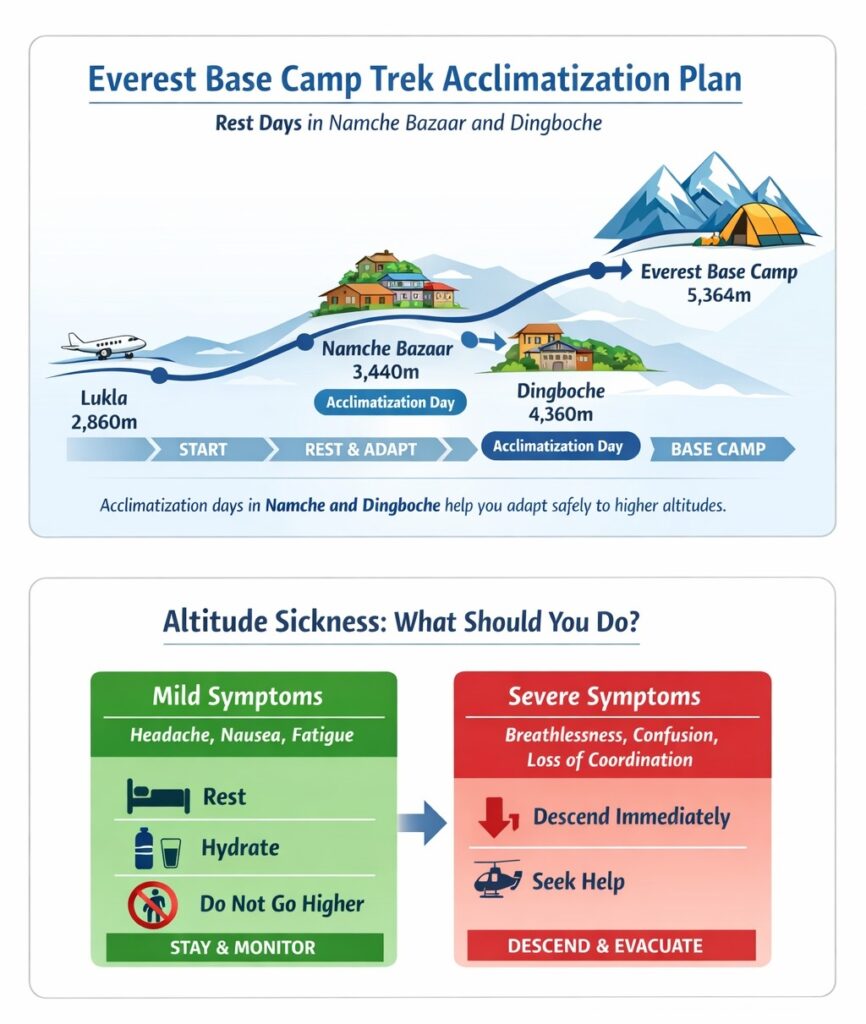
Plan for two acclimatization days, usually in Namche Bazaar (3,440m) and Dingboche (4,360m). These two days reduce risk more than almost anything else you can do.
Altitude sickness on EBC almost always comes down to one thing: going up too fast. Walk slow, take your rest days at Namche and Dingboche, drink enough, and stop climbing if you feel worse. This guide covers the warning signs, the three types of altitude illness (AMS, HAPE, HACE), and what actually works to keep you safe.
Many of our clients ask us how to prevent altitude sickness on the Everest Base Camp trek. We often hear difficult news about trekkers suffering badly. Some return mid-journey. Others do not make it back at all.
So far, we have not had fatal incidents on our treks. We want to keep it that way, and so should you.
What is Altitude Sickness?
Altitude sickness happens when your body cannot adapt fast enough to lower oxygen levels above 2,500m. It affects people of any age or fitness level, there is no reliable way to predict who will get it. The three forms are AMS (common, manageable), HAPE (lungs, serious), and HACE (brain, critical). For a full breakdown of causes, symptoms, and what each condition means, see our altitude sickness guide.
This article is for general trekking information. It is not medical advice. If you have heart or lung conditions, talk to a travel doctor before the trek.
When Will I Know if I Have Altitude Sickness?
Symptoms usually show up around 3,500m, but timing varies. Some people feel it within a few hours of gaining altitude. Others only notice it after their first night’s sleep up high, which is actually more common than people expect.
Even on a well-paced itinerary, plenty of trekkers feel some AMS above 4,000m. That is not unusual. The ones who make it to base camp usually said something early. The ones who don’t usually kept quiet and pushed on.
Early symptoms to watch for:
- Headache (especially in the morning)
- Dizziness or giddiness
- Nausea or loss of appetite
- Lethargy and poor sleep
- Swelling of hands or feet
- Shortness of breath on mild exertion
Signs the situation is getting serious:
- Breathlessness at rest
- Confusion or irrational behavior
- Loss of walking coordination
- Heart palpitations
- Coughing with frothy or bloody sputum
Any of those second symptoms means get down. Same day. Do not sleep on it hoping you will feel better in the morning.
When should you descend?
- Descend the same day if you have breathlessness at rest, confusion, trouble walking straight, blue lips, or a wet cough.
- Do not go higher if you have mild symptoms. Rest, hydrate, and monitor closely.
- Descend and get help if symptoms worsen even while resting.
Types of Altitude Sickness
There are three types. AMS is common and manageable if caught early. HAPE and HACE are medical emergencies, they can develop from untreated AMS faster than most people expect. The table below shows what to look for and what to do. For detailed descriptions of each condition, read our full altitude sickness guide.
To understand altitude gain, walking hours, and daily exertion, read our Everest Base Camp trek difficulty guide.
| Condition | Common Signs | What to Do Immediately | Can You Continue? |
|---|---|---|---|
| AMS | Headache, nausea, dizziness, fatigue, poor sleep | Rest, hydrate, do not go higher | Yes, only if symptoms improve after rest |
| HAPE | Breathlessness at rest, cough, weakness | Immediate descent, urgent medical help | No |
| HACE | Confusion, loss of balance, abnormal behavior | Immediate descent, emergency evacuation | No |
How to Prevent Altitude Sickness on Everest Base Camp Trek
Do Your Research Before You Go
We have had clients arrive thinking EBC is a long hill walk. It is not. You are going above 5,500m. That is higher than most people have ever been, and the body does not always cooperate just because you trained well.
Oxygen drops as you climb, and in the colder months we see wind and snowstorms that catch even well-prepared groups off guard.
Understanding the different Everest Base Camp trek routes matters more than people realize. Some routes allow for better gradual acclimatization than others.
If you have asthma, high blood pressure, a history of heart or lung problems, or have had altitude sickness before, see a doctor before booking. Not to get permission, but to go in informed. Some conditions make acclimatization harder. Finding that out at 4,500m is not a good time.
Useful sources: travel doctors, trekking forums, agency itineraries, and blogs from people who have done the route recently. Read the bad trip reports, not just the ones where everything went well.
Walk Slowly. Genuinely Slowly.
Most altitude sickness on EBC comes from going too fast. It really is that simple. Your body needs time to adjust, and if you push the pace you are borrowing against energy and oxygen your system has not earned yet. Slow down. Diamox, oximeters, training – none of it matters as much as just not rushing.
Don’t worry if your pace is slow or you are at the back of the group. One of our porters or assistant guides will always stay with you.
Trekking poles help more than people expect. Use them from day one, not just on steep sections. They reduce leg fatigue and help you pace yourself. A tired body acclimatizes worse. Over two weeks on the trail, tired legs cost you more than people realise.
For trekkers who want more buffer time, our 16-day Everest Base Camp itinerary builds in better recovery time at key elevations.
Climb High During the Day, Sleep Low at Night
Most altitude sickness symptoms show up at night or just after waking, not during the day’s walk. Your breathing slows during sleep. Your body is already working harder just to maintain oxygen levels, and slower breathing makes that worse.
The rule is simple: go higher during the day, sleep lower at night. Above 3,000m, try not to raise your sleeping altitude by more than 300 to 500m per day. Your body adapts during rest, not during the walk.
On your Namche rest day, go up to the Everest View Hotel (around 3,880m) and come back down to sleep. Your body gets the altitude exposure without you committing to sleeping higher. At Dingboche, hike toward Nangkartshang Hill or partway to Chukkung (4,730m), then return. We have had trekkers skip these and spend both rest days in the teahouse. More than a few of them struggled the next morning. The hikes feel optional. They are not really.
What to expect with sleep at altitude
Bad sleep is very common above 3,500m and does not always mean something is wrong. Waking up 3 or 4 times is normal. What is not normal is waking up gasping, feeling more confused than when you went to sleep, or having a headache that is worse in the morning than it was the night before. Tell your guide if you notice those patterns.
Avoid sleeping pills at altitude. They slow your breathing at a time when your body is already working to get enough oxygen. If you struggle with sleep and want pharmaceutical help, speak to a doctor before the trek, not during it.
Train Before You Go, But Know Its Limits
Training before you go is worth doing. Running and uphill walking build the cardiovascular base you will need for long days. But do not mistake fitness for protection against altitude sickness. They are different things. We have had very fit trekkers get hit hard above Dingboche while less athletic clients walked straight through to base camp.
Worth knowing too: your body burns carbohydrates more efficiently than fat at altitude. Not the time to skip the rice. Eat the dal bhat, have the bread, take the extra serving. Your body will use it.
Stay Hydrated, Starting Before You Leave Home
You will not feel thirsty up there the way you do in the heat. Cold air masks it. But you are still losing fluid through heavier breathing and hours of exertion, just without the obvious signal telling you to drink.
Start drinking more water 2 to 3 days before you even fly to Kathmandu. By the time you reach Namche, you want hydration to already be a habit, not something you are catching up on.
Watch your urine colour. Clear to light yellow means you are doing fine. Most trekkers end up drinking 3 to 5 liters of fluid daily, including water, soup, and ginger tea, depending on the weather and effort level.
Plain water is fine, but if you are sweating heavily or trekking long hours, electrolyte tablets or ORS sachets help maintain mineral balance. They are widely available in Namche. A lot of trekkers drink plenty of water but still feel flat because they are flushing out salts without replacing them. Ginger tea and soup count toward your fluid intake and are easier to get down when altitude kills your appetite.
Consider Carrying a Pulse Oximeter
A pulse oximeter is a small clip-on device that reads your blood oxygen saturation (SpO2). At sea level, a healthy reading is 95 to 100%. At altitude, your numbers drop. That part is normal.
What you are watching for is a sharp drop or a reading that keeps falling over consecutive mornings. At around 3,500 to 4,000m, readings in the high 80s are fairly common and do not always indicate a problem. If your SpO2 drops below 80% and you are also experiencing symptoms, pay attention. Below 75% with symptoms is a clear signal to descend and get help.
Our guides carry oximeters and check trekkers regularly. Personally, I think it is worth having your own so you can track your numbers morning and evening and notice trends. It is not a diagnosis on its own. A headache plus a falling SpO2 reading tells you more than either one alone.
The number is one data point. We have had trekkers reading 82% who felt fine and others at 88% who were clearly struggling. How you feel matters as much as what the device says. Use both.
No Alcohol. No Smoking. Be Careful With Sedatives.
Skip the alcohol on the trail. It dehydrates you and disrupts your breathing during sleep, which is already compromised at altitude. We have seen trekkers celebrate reaching Namche with beers and then have a rough night. Not worth it. Same goes for smoking.
Sleeping pills are another one to be careful with. They suppress breathing. If you are already struggling to get enough oxygen overnight, sedating yourself makes it worse. Talk to a doctor before the trek if sleep is a concern, not after you have already bought the pills.
Do Not Hide Your Symptoms
Trekkers hide symptoms for understandable reasons: they do not want to slow the group, they feel embarrassed, they think they can push through. Some have saved for years for this trek and cannot accept that it might end early.
Hiding it never helps. By the time it becomes obvious to everyone around you, you are usually in a worse position than if you had said something two hours earlier. Tell your guide at the first sign of a persistent headache, confusion, or breathing that feels off. They have dealt with this before. You have not.
Medications: Diamox and What Else to Carry
Some trekkers use Diamox (acetazolamide) to support acclimatization. It works by stimulating faster breathing, which helps your blood carry more oxygen. It is not for everyone. It does not work for people with sulfa allergies, and it has side effects including frequent urination and tingling in the hands and feet.
What Diamox does not do is replace slow ascent and real rest days. Trekkers who take it and still rush the itinerary still get sick. It is a support, not a solution.
Talk to your doctor before the trek about whether it is appropriate for you, the correct dose, and when to start taking it.
For a complete checklist including Diamox, other altitude medications, and first-aid essentials, read our guide on medications for the Everest Base Camp trek.
Garlic Soup, Dark Chocolate, and Other Things Worth Trying
Garlic soup is a traditional Himalayan remedy for altitude symptoms. Garlic is thought to help thin the blood and support oxygen delivery. Whether or not there is strong science behind it, it is warming, easy to find on the trail, and plenty of trekkers swear by it.
“On my recent trek, the guide from Mosaic Adventure, Purna, suggested I take garlic soup. I started having it once daily, packed with garlic, and I really feel like it helped.” – Nick B.
Dark chocolate is another one that comes up regularly. It is not clinically proven, but as an energy-dense, mood-lifting snack at altitude, it does not hurt. Several trekkers have told us it helped. Take some if you like it.
Will they prevent altitude sickness? No. But garlic soup costs next to nothing at any teahouse and takes 30 seconds to order. Worth trying either way.
Choose an Agency That Takes Acclimatization Seriously
Not every agency plans acclimatization days the same way. Some treat Namche and Dingboche rest days as fixed. Others treat them as optional depending on how the group is feeling, or quietly skip them on shorter itineraries. That difference matters more than price or group size.
Ask directly: are the rest days at Namche and Dingboche fixed, or can they be skipped? Does your guide check symptoms each morning? What happens if someone needs to be evacuated? The answers tell you more than any brochure will. Learn more in our Everest Base Camp trek safety guide.
Do your research on services, itinerary quality, and travel insurance for EBC before choosing your trekking company.
You can do EBC faster. People do. But you have already spent serious money on flights, permits, and preparation to be there. Turning back short of base camp because you rushed the ascent is a bad way for that investment to end. Go slow. Trekking “bistarai bistarai” (slowly, slowly) is not just local advice. It is the most practical strategy on the trail.
If your schedule is tight, our EBC trek with helicopter return cuts around 3 days off the itinerary while still allowing proper acclimatization on the way up. Fast-track itineraries without acclimatization days are only appropriate for experienced high-altitude trekkers who have managed rapid ascents before without problems. For most people, the risk is not worth it.
You can contact us with any questions about itinerary planning, acclimatization, or altitude safety.
Summary
Most trekkers who do not reach base camp did not fail because the trek was too hard. They turned back because of altitude sickness that could have been managed differently. The ones who get there are usually not fitter or more experienced. They just went slowly, took the rest days seriously, drank enough, and told someone when they felt off. Diamox and oximeters help, but they do not change the fundamentals.
None of it is complicated. Sleep lower than you climbed. Do the day hikes at Namche and Dingboche instead of sitting in the teahouse. Check your SpO2 morning and evening. Eat carbs, drink more than you feel like, skip the beers. And when something feels off, tell your guide. That last one matters more than all the others.
People who prepare sensibly almost always reach base camp and come home fine. The ones who don’t usually made one of two mistakes: rushed the ascent, or said nothing when they started feeling unwell. Both are avoidable.
If you are planning your EBC trek and want an itinerary built around proper acclimatization, take a look at our 14-day Everest Base Camp trek. The rest days at Namche and Dingboche are non-negotiable in our schedule, not optional add-ons.
Want more information? Send us your query, and our experts will get back to you within 24 hrs.
Madhav Prasad is a seasoned trekking and tourism expert with over two decades of experience in the field. Starting his career in 2001 as a porter, Madhav quickly advanced to the role of trekking guide, gaining invaluable hands-on experience in Nepal’s diverse trekking routes. In 2009, after eight years of dedication to the industry, he co-founded Mosaic Adventure, a leading trekking and tour company known for its commitment to safety, sustainability and personalized service.
Madhav has personally trekked to nearly every major trekking destination in Nepal, including Everest Base Camp, Annapurna Base Camp, the Annapurna Circuit, Poon Hill, Jomsom Muktinath, the Indigenous Peoples Trail, Langtang Valley and Mardi Himal, among others. His experience extends beyond Nepal, as he has also successfully summited Mount Kilimanjaro, Africa’s highest peak.
In addition to his extensive trekking credentials, Madhav is well traveled globally, having explored countries such as Australia, the USA, the UK, France, Japan, China, and many others. His global exposure enhances his ability to understand and cater to the diverse needs of international trekkers.
Madhav is the primary point of contact for many clients at Mosaic Adventure, personally addressing inquiries and helping plan treks with a meticulous and personalized approach. His deep knowledge of Nepal’s trekking routes, combined with his global travel experience, ensures that every trek is well planned, safe and unforgettable.


Good and simple to read.