
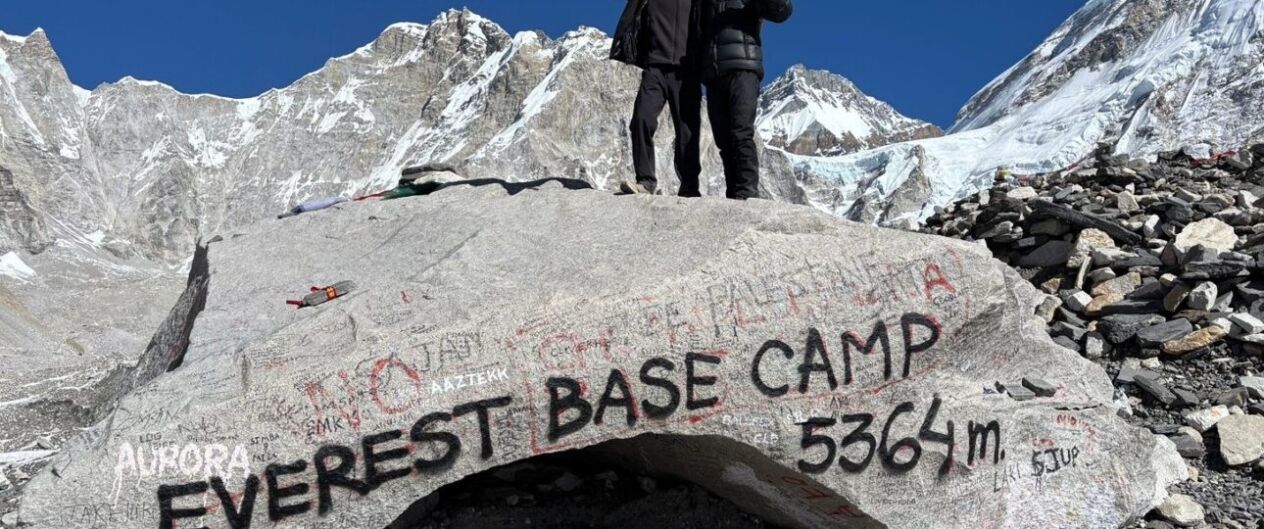
Some people spend New Year’s Eve in a loud bar. Others want to wake up on 1 January knowing they will stand at Everest Base Camp before the day is out. If that sounds like you, this trek exists for that reason.
This is not a checklist tour. Long walking days, cold teahouses, altitude that catches most people off guard on day three. Worth knowing before you book.
We run this departure every December. The goal is always the same: reach Everest Base Camp on 1 January.
What this guide covers:
- How the itinerary works and why it’s timed the way it is
- Where you sleep each night, and how cold it gets there around New Year
- What our Lukla flight records show for Christmas and early January
- What to pack (and what you can rent in Kathmandu)
- Who this trip suits and who should pick a different season
Who this trek is for
- People who want a real start to the year, not a party, not a countdown, something that actually takes effort
- Trekkers who prefer quieter trails and can handle cold mornings without making it everyone’s problem
- Couples, friends, small groups who want something to actually look back on together
- Anyone who’s prepared to put in the work before the trip, not just during it

Is a New Year Everest Base Camp trek right for you?
| You want | Good fit? |
|---|---|
| A meaningful New Year | Yes |
| Warm weather and comfort | No, wrong season for that |
| Clear mountain views | Yes |
| Festive nightlife | Not remotely |
| Your first trek at high altitude | Possible, but spring or autumn is easier |
Itinerary: 14 days to Base Camp on 1 January
Two acclimatization days are built in, Namche and Dingboche, before the push to Base Camp. The schedule doesn’t leave room to slow down later, which is why both rest days matter.
Base Camp day starts in Lobuche, goes up to Gorak Shep, out to Base Camp and back to Gorak Shep. You’ll move slowly. That’s normal above 5,000m.
| Date | Day | Plan | Walking time | Overnight altitude |
|---|---|---|---|---|
| 24 Dec 2026 | Day 1 | Arrive Kathmandu. Airport meet, hotel transfer. Pre-trek meeting in the evening. | None | 1,345m |
| 25 Dec 2026 | Day 2 | Fly to Lukla (2,840m). Trek to Phakding. | ~3.5 hrs | 2,610m |
| 26 Dec 2026 | Day 3 | Trek to Namche Bazaar. | ~6 hrs | 3,440m |
| 27 Dec 2026 | Day 4 | Acclimatization in Namche. Hike higher, return to Namche. | Easy hike | 3,440m |
| 28 Dec 2026 | Day 5 | Trek to Tengboche (Tyangboche). | ~5 hrs | 3,860m |
| 29 Dec 2026 | Day 6 | Trek to Dingboche. | ~5 hrs | 4,410m |
| 30 Dec 2026 | Day 7 | Acclimatization day. Side trip to Nagartsang Hill. | Easy hike | 4,410m |
| 31 Dec 2026 | Day 8 | Trek to Lobuche. New Year’s Eve here. | ~5 hrs | 4,940m |
| 1 Jan 2027 | Day 9 | Trek to Gorak Shep, then on to Everest Base Camp (5,364m). Return to Gorak Shep. | Full day | 5,164m |
| 2 Jan 2027 | Day 10 | Sunrise hike to Kala Patthar (5,545m). Trek to Pheriche. | ~7 hrs | 4,371m |
| 3 Jan 2027 | Day 11 | Trek back to Namche Bazaar. | ~6 hrs | 3,440m |
| 4 Jan 2027 | Day 12 | Namche to Lukla. | ~6 hrs | 2,840m |
| 5 Jan 2027 | Day 13 | Fly to Kathmandu. Transfer to hotel. | None | 1,345m |
| 6 Jan 2027 | Day 14 | Departure, or extend your Nepal trip. | None | None |
Want to join this departure?
Choose the 24 December start date on our 14-day Everest Base Camp trek page. That’s the departure that puts you at EBC on 1 January.
How cold does it actually get?
Cold enough that it matters. Once you’re above Namche, especially after dark, the temperature drops fast. Most people manage with the right gear, but underpack for warmth and you’ll have a rough time from Lobuche upward.
The trek runs across the turn of the year, so the nights get colder as you climb and as December turns into January. Here is where you sleep on each date of this departure, and the typical night there.
| Night of | Where you sleep | Typical daytime | Typical night | What it means for clothing |
|---|---|---|---|---|
| 25 Dec | Phakding, 2,610m | about 10°C | about -1°C | Base layers and fleece; light down in the evening |
| 26 and 27 Dec | Namche Bazaar, 3,440m | about 6°C | about -7°C | Warm layers; gloves and a beanie start to matter |
| 28 Dec | Tengboche, 3,860m | about 5°C | about -9°C | Down jacket from late afternoon |
| 29 and 30 Dec | Dingboche, 4,410m | about 2°C | about -13°C | Down jacket for evenings; insulated pants feel great |
| 31 Dec | Lobuche, 4,940m | about -2°C | about -17°C | Thicker gloves, warm socks and a good sleeping bag |
| 1 Jan | Gorak Shep, 5,164m | about -3°C, and -4°C at Base Camp | -18°C to -22°C | Full winter layers at night; keep your water bottle in your sleeping bag |
| 2 Jan | Pheriche, 4,371m | about 0°C | -13°C to -16°C | The Kala Patthar morning before this is the coldest of the trip |
| 3 Jan | Namche Bazaar, 3,440m | about 3 to 6°C | -7°C to -10°C | Warm layers |
| 4 Jan | Lukla, 2,840m | about 7 to 9°C | 0°C to -3°C | Base layers and fleece |
On the Kala Patthar sunrise hike (5,545m) on 2 January, it is often colder than -20°C before the sun comes up. For the full monthly averages, see our guides to the Everest Base Camp trek in December and the Everest Base Camp trek in January.
Layering: how it works in practice
- Base layer: thermal top and bottom (keeps sweat off your skin)
- Mid layer: fleece or light down (warmth while walking)
- Outer layer: windproof shell (blocks wind, holds heat)
- Stop and evening: a proper down jacket. Not optional above Dingboche.
A few things people ask before booking
- Teahouses at New Year: Usually open on the classic route, but don’t expect much beyond a bed and something hot to eat. Rooms are cold, and some lodges in Dingboche and Lobuche close from late December, so our guide confirms each night ahead. Read: accommodation on the Everest Base Camp trek.
- Lukla flight delays: Delays happen. We build buffer planning into the schedule and discuss options during the Kathmandu briefing. Read: Lukla flight guide.
- Sleeping bag and winter kit: A warm bag and layers matter more than extra clothes. Read: winter kit for Everest Base Camp.
- Ice on trail: Some mornings can be icy near higher villages; microspikes help on short sections. Read: December trail conditions.
New Year’s Eve at Lobuche: what it’s actually like
Quiet. You spend the night at a teahouse in Lobuche: dinner, warm drinks, maybe a conversation with whoever else is staying there. You go to bed early because Base Camp is tomorrow and you want to be ready for it.
No fireworks, no countdown. Most people eat, sort their gear, and sleep. Waking up on 1 January knowing you’ll be walking to Base Camp in a few hours is what most people remember. Not the night before.
If loud celebrations are what you’re after, this is not the right trip. That’s fine. Worth being upfront about it.
Lukla flights over Christmas and New Year
This departure depends on two flights: Kathmandu to Lukla on 25 December, and Lukla back to Kathmandu on 5 January. Here is what our daily flight records show for those weeks.
- The flight in (late December): from 24 to 31 December in 2023, 2024 and 2025, flights ran normally on 23 of 24 days. The only exception was a full-day closure on 28 December 2023. Flights ran normally on 25 December in all three years.
- The flight out (first week of January): from 1 to 7 January in 2023 to 2026, flights ran normally on 24 of 28 days, with delays on 3 days and one full-day closure.
Good odds, but not a guarantee. The Lukla flight is around 35 minutes, and fog or wind can stop it for a morning or a whole day. Day 14 gives you one spare day in Kathmandu. We recommend booking your flight home for 7 January or later, and 8 January if you can, so a delay doesn’t cost you your connection.
If the flight in is delayed, we will not cut an acclimatization day to keep the 1 January date. Reaching Base Camp a day later is far better than going up too fast. For flight routes, Ramechhap and seat booking, see our Lukla flight guide.

Altitude: what to know before you go
EBC is not a technical climb, but 5,364m is high enough that altitude will affect how you feel. The two acclimatization days, Namche and Dingboche, are there because the schedule has no room to slow down later.
- Walk slower than you think you need to. Seriously.
- Drink water consistently, not just when you’re thirsty. It won’t prevent altitude sickness, but dehydration causes headaches that make the real warning signs harder to read.
- If something feels off, say something early: a headache that won’t go away, nausea, unusual tiredness, or breathlessness at rest. Altitude sickness gets worse fast when you ignore the first signs. Read how to prevent altitude sickness on the Everest Base Camp trek.
Base Camp on 1 January is the plan, not a promise. If you or anyone in the group needs an extra night or needs to go down, the date moves. Your health comes first.

What to pack
Most people overpack on clothes and underpack on warmth. Those are opposite mistakes, but they happen together more than you’d think.
Once you book, we send a packing list by email tailored for winter. It covers what to bring, what you can rent in Kathmandu, and what’s not worth carrying. You can also see our full packing list for Everest Base Camp.
Things that actually make a difference
- Warm sleeping bag rated to at least -20°C comfort. A liner is worth adding if you run cold.
- Down jacket for evenings and early mornings.
- Gloves: thin liner inside a warm outer. Hands get cold faster than people expect up there.
- Hard, leak-proof water bottle you can fill with hot water at night. At Gorak Shep, bottles left out freeze overnight.
- Headlamp for early mornings (Kala Patthar sunrise).
- Microspikes for icy trail sections. Not always needed, but compact enough to carry just in case.
- Something small to celebrate with on 1 January: a flag, a photo, a note from home. People always wish they had brought one.
Permits
Two permits are required for the classic EBC route. We arrange both for you:
- Sagarmatha National Park Entry Permit
- Khumbu Pasang Lhamu Rural Municipality Entry Permit
Ready to book the 24 December departure?
Book our 14-day Everest Base Camp trek and select the 24 December departure date so you reach EBC on 1 January 2027.
Frequently Asked Questions
Can I reach Everest Base Camp on New Year’s Day?
Yes. If you arrive in Kathmandu on 24 December, fly to Lukla on 25 December and keep both acclimatization days, you reach Everest Base Camp on 1 January and return to Gorak Shep the same day. A delay on the flight in can move this by a day, because we never skip acclimatization to keep the date.
Where do you spend New Year’s Eve on this trek?
In a teahouse in Lobuche (4,940m). Dinner, a warm drink, early bed. The real moment for most people is the morning after, when you set off knowing you will stand at Base Camp that afternoon.
What happens if flights to Lukla are delayed?
Weather delays can happen, though our records show flights ran normally on 23 of 24 days between 24 and 31 December over the last three years. If your flight is delayed, our team rebooks the next flight window or discusses a helicopter option. We do not shorten acclimatization to make up the time.
How cold is it at Everest Base Camp on New Year’s Day?
Daytime at Base Camp is usually around -4°C, often feeling colder in the wind. That night at Gorak Shep typically drops to between -18°C and -22°C, and the Kala Patthar sunrise hike the next morning is often below -20°C.
When should I book my flight home?
The trek ends with your flight to Kathmandu on 5 January. We recommend booking your international flight for 7 January or later, and 8 January if you can, so a Lukla delay doesn’t cost you your connection.
Will I receive help preparing after I book?
Yes. Once you’re booked we send a packing list tailored for winter conditions, including what you can rent in Kathmandu so you’re not overpacking.
Is this trek a good “first trek”?
It can be, but we are honest about it: winter adds real difficulty to an already demanding trek. If you can walk 5 to 7 hours a day, are prepared for nights well below freezing and take acclimatization seriously, first-timers do complete it. If this is your first trek at high altitude and the date is not essential, spring or autumn is easier.
Still weighing it up? Read our guide on Everest Base Camp trek difficulty.
Extend your Nepal trip after the trek
If you want to keep traveling after the trek, we can help add a day or two in Kathmandu, a few days in Pokhara, or a wildlife trip depending on your schedule.

Madhav Prasad is a seasoned trekking and tourism expert with over two decades of experience in the field. Starting his career in 2001 as a porter, Madhav quickly advanced to the role of trekking guide, gaining invaluable hands-on experience in Nepal’s diverse trekking routes. In 2009, after eight years of dedication to the industry, he co-founded Mosaic Adventure, a leading trekking and tour company known for its commitment to safety, sustainability and personalized service.
Madhav has personally trekked to nearly every major trekking destination in Nepal, including Everest Base Camp, Annapurna Base Camp, the Annapurna Circuit, Poon Hill, Jomsom Muktinath, the Indigenous Peoples Trail, Langtang Valley and Mardi Himal, among others. His experience extends beyond Nepal, as he has also successfully summited Mount Kilimanjaro, Africa’s highest peak.
In addition to his extensive trekking credentials, Madhav is well traveled globally, having explored countries such as Australia, the USA, the UK, France, Japan, China, and many others. His global exposure enhances his ability to understand and cater to the diverse needs of international trekkers.
Madhav is the primary point of contact for many clients at Mosaic Adventure, personally addressing inquiries and helping plan treks with a meticulous and personalized approach. His deep knowledge of Nepal’s trekking routes, combined with his global travel experience, ensures that every trek is well planned, safe and unforgettable.
