
Everest Gokyo Ri is one of the most rewarding treks in Nepal, but it is important to understand the difficulty level before you commit. Learning about the Gokyo trek’s difficulty and preparing accordingly will help you enjoy the experience more.
The Everest Gokyo Ri Trek is rated difficult. Most trekking days involve around 5 to 7 hours of walking, depending on pace and conditions, with one longer summit day. You spend several trekking nights above 12,000 ft (around 3,700m), which is where altitude starts to affect sleep, appetite, and pace.
- This guide explains exactly how hard the Everest Gokyo Ri Trek is, based on real trekkers’ experiences. You will learn about altitude challenges above 5,000 meters, daily walking distances, weather risks, fitness requirements, and how this trek compares with Everest Base Camp. By the end, you will know whether this trek is right for you and how to prepare to complete it safely and confidently.
On this itinerary, you reach above 17,000 ft at Gokyo Ri (5,360m). Even with a steady ascent, the thin air above 4,000m slows most trekkers down and makes the same distance feel harder. If you choose the EBC – Cho La – Gokyo variation, the difficulty increases due to the high pass and added altitude days.
Typical Everest Gokyo Ri Trek Itinerary (Brief Overview)
Understanding the day-by-day structure of the Everest Gokyo Ri Trek helps put its difficulty into perspective. Below is a simplified outline of the standard itinerary, highlighting altitude gain, acclimatization, and daily walking hours.
| Day | Route & Elevation | Approx. Walking Time |
|---|---|---|
| 1 | Arrival in Kathmandu (1,345m / 4,412 ft), airport pickup and hotel transfer | – |
| 2 | Pre-trek briefing and sightseeing around Kathmandu Valley | – |
| 3 | Fly to Lukla (2,840m) and trek to Phakding (2,610m) | ~3.5 hrs |
| 4 | Trek to Namche Bazaar (3,440m) | ~6 hrs |
| 5 | Acclimatization day with hikes around Namche Bazaar | Light hikes |
| 6 | Trek to Phortse Ghanga (3,680m) | ~4 hrs |
| 7 | Trek to Machhermo (4,470m) | ~5 hrs |
| 8 | Trek to Gokyo (4,790m) | ~5 hrs |
| 9 | Summit Gokyo Ri (5,360m / 17,585 ft) and return to Gokyo | ~8 hrs |
| 10 | Trek to Dole (4,110m) | ~7 hrs |
| 11 | Trek back to Namche Bazaar (3,440m) | ~6 hrs |
| 12 | Final trek to Lukla (2,840m) | ~6 hrs |
| 13 | Fly back to Kathmandu, transfer to hotel | – |
| 14 | Rest / buffer day in Kathmandu | – |
| 15 | Departure or extend your stay in Nepal | – |
This gradual ascent with a dedicated acclimatization day helps reduce altitude-related risks,
but the long summit day to Gokyo Ri and multiple high-altitude nights still make this trek physically demanding. For full details, see the complete Everest Gokyo Lakes Trek itinerary.
The Everest Base Camp trek is the classic route and is familiar to many trekkers. Gokyo Ri is often chosen by people who want quieter trails and the unique Gokyo Lakes landscape.
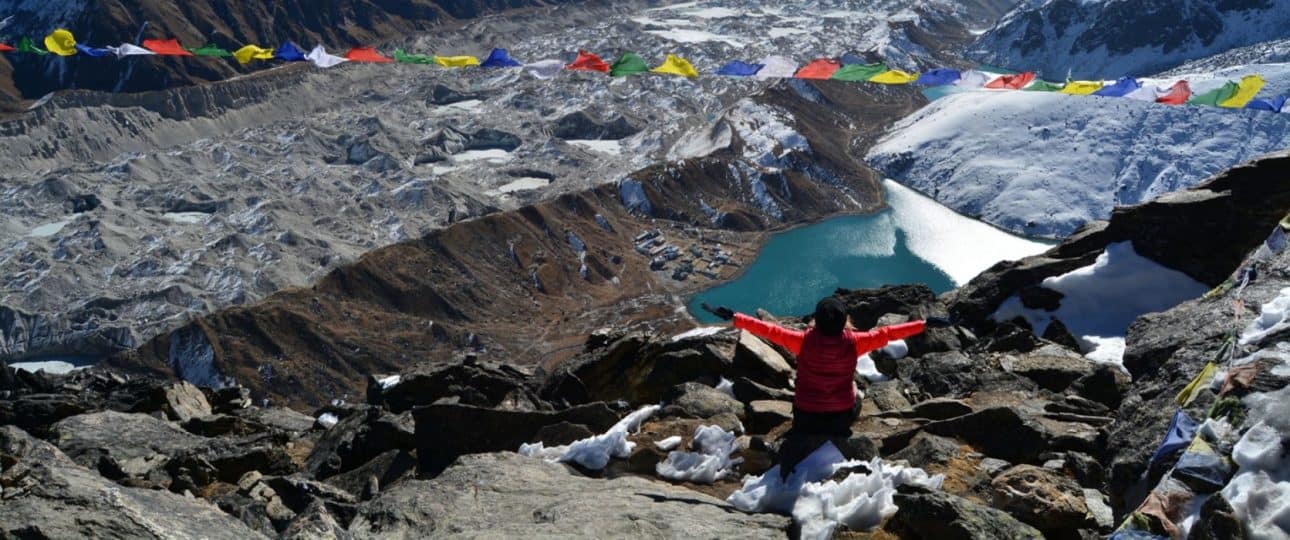
On this trek, you will walk through the five glistening alpine lakes on the way. Then the magnificent Mt Cho Oyu stands right in front of you at Gokyo. And that’s not it. At around 17,500 to 17,600 ft on top of Gokyo Ri, look up and you will witness the 8,000-meter peaks including Everest, Lhotse, and Makalu.
Look down and you will see the Ngozumpa glacier, often described as the longest glacier in the Himalayas. And this is only the Gokyo side of the journey. It’s a different side of the Everest region, with fewer crowds and a very different landscape than the main EBC trail.
A good fitness base and steady pacing matter on this route because you walk for several hours most days and spend multiple nights above 4,000m.
Mental readiness matters, especially on cold mornings and longer walking days.
5 Major Factors Affecting Everest Gokyo Ri Trek Difficulty

There are various factors that determine the difficulty level of any trek, let us discuss them below:
Duration
There are various routes that alter the duration of the Everest Gokyo Ri trek. You can increase and decrease the number of days according to your preference.
Now, if you choose a shorter package, you will be adjusting the acclimatization days and this means you will be walking for a longer period of time.
Doing so can be harsh. And could add to your Everest Base Camp Cho La pass difficulty.
However, if you choose the longer package. You have enough time for acclimatization allowing your body to adjust to various altitudes.
Various trekking packages include 15 day Gokyo Lakes Trek, Everest Gokyo Ri 18 days. Everest Gokyo Lakes trek via Cho La Pass is also possible.
The latter will take 20 days including the day of arrival and departure.
Based on feedback from trekkers, the difficulty of this trek increases sharply when itineraries are shortened. Many who attempted compressed schedules report fatigue, poor acclimatization, and higher AMS risk. Longer itineraries are consistently rated as more enjoyable and safer, even by experienced hikers.
Weather and Temperature
The weather plays a huge role in determining the Everest Gokyo Ri trek difficulty. The weather in the mountains changes significantly. In every hour you will notice the change in the climatic conditions. And the frequent weather may add difficulty to your trek.
Choosing the best time to take this trek can save you from dealing with problems related to weather such as the cold temperature. The best time to take the Everest Gokyo Ri trek is spring around April and autumn around October (see also: best season to trek in Nepal).
The average daytime temperature in April is about 15 to 12-degrees Centigrade and a few degrees lower in October. While the night temperature falls to -5 to -10 degrees.
During this time you will get clear mountain views. And the weather is pleasant and stable compared to the winter season which can be very cold with snowfalls.
Also, the trekking trail is not slippery which is most likely an issue while trekking in monsoon. Hence these are some of the reasons why thousands of trekkers prefer to trek during this time.
What often surprises trekkers is not just cold, but wind exposure around Gokyo and on the Gokyo Ri summit morning. Wind chill can make daytime temperatures feel significantly colder, especially during early morning summit pushes. Proper layering and windproof gear matter as much as fitness.
Altitude Sickness: The #1 Challenge on Gokyo Ri Trek
Trekking to the mountains means climbing to high altitude. And with the increase in altitude, increases the risk of Altitude sickness.
AMS ( Acute mountain sickness) is often a matter of concern in the mountains. As you ascend higher the oxygen level and the atmospheric pressure gets thinner. This makes breathing more difficult.
Since you reach above 5,000m on the Gokyo Ri summit day, your body has to cope with very thin air. And needless to say, everyone is at risk of altitude sickness irrespective of age, gender and fitness level. Hence it is tough to say if one is completely safe.
So for this matter, it is very important to know about the altitude sickness. Learn about the early signs and symptoms so that you can take the necessary precautions to avoid further complication.
If at any time you feel that you have the symptoms of AMS, it is best to stop proceeding further and take the necessary rest. Resting and acclimatization is a must while trekking at higher altitude.
And if resting doesn’t improve your condition, descending is the only option. It is never a good idea to push your body too hard. Doing so can even lead to the fatal condition.
Some of the things you can do to avoid the risk of altitude sickness are by walking slow, drinking plenty of water, saying no to alcohol. And most importantly acclimatizing.
If you’re planning independently, it’s smart to sort emergency coverage ahead of time (guide: travel insurance for EBC trek). Many trekkers also carry a small, practical medical kit (reference: medicines for EBC trek).
How Common Is AMS on the Gokyo Ri Route?
Some trekkers report AMS symptoms on the Gokyo route even when they felt fine on other treks, mainly because you spend several nights above 4,000m and then push above 5,000m for the summit.
This is why reputable operators build in acclimatization days and maintain conservative ascent profiles.
Training for Everest Gokyo Ri: A 6-Week Fitness Plan
If you can comfortably walk uphill for several hours and recover well overnight, this trek becomes much more manageable (use this prep guide for training + logistics: Preparing for Everest Base Camp trek).
Many trekkers completing this route successfully are not athletes. What they share instead is consistent preparation. People who trained with loaded backpacks, practiced long uphill walking, and focused on recovery reported a far easier experience than those relying on general gym fitness alone.
Brisk walking, Jogging, Skipping and climbing stairs are some of the basic exercises you can do to prepare for the trek.
Besides, working on your strength is very important. There is a lot of trekking distance that you will have to cover in high altitude carrying your backpacks. Also, you have to walk on uneven terrain. It can be taxing for your legs.
For this, strengthening your legs will be beneficial. You can do some squats to strengthen them.
Another aspect that will help you trek comfortably is flexibility. For this, you can do some stretching exercises- stretch your hamstrings, quadriceps, hip flexors, lower back muscles, and shoulders regularly.
Thus these exercises will help you to be in good shape prior to the trek.
Preparing physically is critical to tackling the Everest Gokyo Ri Trek. Here’s a sample 6-week plan:
Weeks 1-2 (Build Endurance):
- Cardio: 45 to 60 mins of brisk walking/jogging, 5 days/week.
- Strength: Squats (3 sets of 15), lunges (3 sets of 12), and planks (2 mins), 3 days/week.
- Stairs: Climb 10 to 15 floors with a 5 to 7 kg backpack, 2 days/week.
Weeks 3-4 (Increase Intensity):
- Cardio: Hike 8 to 10 km on hilly terrain (or treadmill incline) 3 days/week.
- Strength: Add step-ups (with backpack) and calf raises (3 sets of 20).
- Altitude Simulation: Spend 1 to 2 hours daily in high-elevation areas (if possible) or use stair-climbing sessions.
Weeks 5-6 (Final Prep):
- Full-Day Hike: 12 to 15 km with a 10 kg backpack, once/week.
- Yoga: 30 mins daily for flexibility (focus on hamstrings, hips, and lower back).
- Rest: Reduce intensity 3 days before departure to avoid fatigue.
Tip: Practice walking on uneven trails to mimic Himalayan terrain.
Everest Gokyo Ri vs. Everest Base Camp – Which is Harder?
Many trekkers ask the same thing: is Gokyo Ri harder than Everest Base Camp, or just different? Here’s the practical difference.
| Aspect | Gokyo Ri Trek | Everest Base Camp |
|---|---|---|
| Max Difficulty | Often feels harder due to high sleeping altitudes on some nights and the long Gokyo Ri summit day | Moderate to challenging |
| Altitude Exposure | You spend more time close to 5,000m and have a big summit day above 5,000m | Fewer high-altitude nights |
| Trail Traffic | Quieter, remote | Very busy in peak seasons |
| Best For | Fit trekkers with preparation; prior trekking helps | Fit beginners with prep |
Verdict:
- Gokyo Ri often feels tougher because of the long summit day and the way altitude affects your pace, especially after several nights above 4,000m.
- EBC is more straightforward logistically, while Gokyo offers a quieter feel and a different style of scenery with lakes and wide valley views.
- Best For: Gokyo Ri suits seasoned trekkers; EBC works for moderately experienced adventurers.
Who Should (and Should Not) Do the Everest Gokyo Ri Trek?
Good Fit If You:
- Have prior multi-day trekking experience
- Are comfortable hiking 6 to 7 hours daily
- Prefer quieter trails over crowds
- Can train consistently before arrival
Not Ideal If You:
- Are attempting your first high-altitude trek
- Have limited time and want a fast itinerary
- Are uncomfortable with basic accommodation
Tips to Reduce Everest Gokyo Ri Trek Difficulty
- If you are a novice trekker then choose the peak seasons. During these seasons you will get to walk in moderate weather with lesser difficulties.
- If you are new to trekking and opting for this Everest Gokyo Ri Trek, then hire a licensed guide for your safety. They help you overcome the trek difficulties in many ways.
- It is a good idea to spend more time on the trails and not to escape the acclimatization days. This adds a lesser burden on your legs and prevents you from altitude sickness.
- Despite some minor physical training, you must possess an optimistic thought to overcome any hurdles that may come along during the trek.
- Pack wisely keeping in mind the weather and temperature of the season you are planning to trek (packing checklist here: Everest Base Camp trek packing list). Proper packing helps you to adjust to the changing altitude and the climates.
Ready to Conquer Gokyo Ri? WhatsApp Us Today to Book Your Expert Guided Trek!

Frequently Asked Questions (FAQs)
Are teahouse accommodations available on the Everest Gokyo Ri Trek?
Will there be snow on this trek?
Is the Everest Gokyo Ri Trek suitable for beginners?
What food options are available on the Gokyo Ri trail?
(typical budget guidance: Gokyo Ri trek cost). Vegetarian options are widely available. Prices rise with altitude.
What if it rains?
What are the washroom/toilet facilities like on the trek?
How do I manage drinking water during the trek?
Is Everest Gokyo Ri Trek harder than Everest Base Camp?
What permits are needed for the Gokyo Ri Trek?
Two permits are typically required:
- Sagarmatha National Park Permit (NPR 3,000)
- Khumbu Pasang Lhamu Rural Municipality Permit (NPR 2,000)
Most agencies include these in their packages.
Can I charge my phone or camera on the trek?
Is there a mobile network on this trek?
Conclusion
The Everest Gokyo Ri Trek is an amazing journey that offers immense beauty and a once-in-a-lifetime experience.
Everest Gokyo Ri trek difficulty should not bother you if you go prepared. It is an adventurous trek, you trek deep into the Everest region and climb to very high altitude at Gokyo Ri. Along the way, you will get a visual treat, witnessing the beauty of the cobalt blue lakes.
All in all, it is a great trekking trail that will do complete justice to trekking in the Everest region. Hence with proper training prior to the trek and with strong willpower, you can complete the trek a lot easier.
Trekkers who complete this route often describe it as more rewarding than Everest Base Camp, not because it is easier, but because it demands more and gives more in return.
Further question or queries, please do not hesitate to contact us. It is our pleasure to guide and assist you with the best of our knowledge.
Have more questions? Ask us in the comments below!
Want more information? Send us your query, and our experts will get back to you within 24 hrs.

Madhav Prasad is a seasoned trekking and tourism expert with over two decades of experience in the field. Starting his career in 2001 as a porter, Madhav quickly advanced to the role of trekking guide, gaining invaluable hands-on experience in Nepal’s diverse trekking routes. In 2009, after eight years of dedication to the industry, he co-founded Mosaic Adventure, a leading trekking and tour company known for its commitment to safety, sustainability and personalized service.
Madhav has personally trekked to nearly every major trekking destination in Nepal, including Everest Base Camp, Annapurna Base Camp, the Annapurna Circuit, Poon Hill, Jomsom Muktinath, the Indigenous Peoples Trail, Langtang Valley and Mardi Himal, among others. His experience extends beyond Nepal, as he has also successfully summited Mount Kilimanjaro, Africa’s highest peak.
In addition to his extensive trekking credentials, Madhav is well traveled globally, having explored countries such as Australia, the USA, the UK, France, Japan, China, and many others. His global exposure enhances his ability to understand and cater to the diverse needs of international trekkers.
Madhav is the primary point of contact for many clients at Mosaic Adventure, personally addressing inquiries and helping plan treks with a meticulous and personalized approach. His deep knowledge of Nepal’s trekking routes, combined with his global travel experience, ensures that every trek is well planned, safe and unforgettable.
