
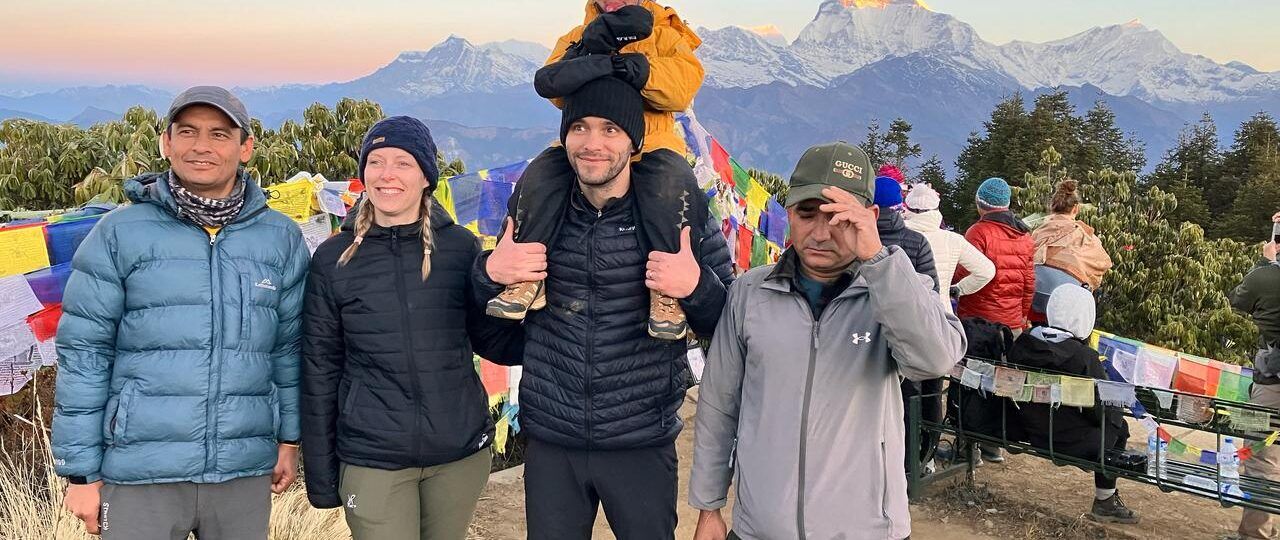
Trekking in Nepal with kids can be safe and deeply rewarding, but only when route choice, altitude and daily pace are planned conservatively.
Most problems families face are caused by rushed itineraries and rapid altitude gain, not by Nepal itself. Issues usually arise when sleeping altitude increases too quickly or when parents underestimate how differently children react to fatigue and altitude.
This guide is written specifically for parents who want clear safety boundaries, realistic walking hours and route options that work for children, not adult ambition.
Below you will find guidance by age, the sleeping altitude limits we plan around, the best season for families, three routes compared side by side and the points where families most often get into trouble. Where the right answer depends on your child’s health, we say so and point you to a doctor.
Last reviewed in October 2026 by Mosaic Adventure’s family trekking team in Nepal: Madhav Prasad and guide Sonam Lama.
Quick answers for parents:
- Best first trek with kids: Poon Hill (short, teahouses, highest overnight stop about 2,860m)
- Quiet and less crowded option: Mohare Danda / Kokhe Danda (from about age 8, one long climbing day)
- Best with older kids and teens (10+): Langtang Valley (more days, higher sleeping altitude, extra nights needed)
- Sleeping altitude guideline: under 2,500m for children under 5 where possible and under 3,000m for most children up to 9
- Best season for families: late October to November and March to April
- Everest Base Camp: not suitable for young children
- Need a porter/child carrier? often yes for ages 1 to 6 (or for tired days)
This guide is based on over a decade of organizing family treks in Nepal across Annapurna, Khumbu and Langtang regions.
Is trekking in Nepal safe for kids?
Trekking in Nepal with kids can be safe when routes are chosen carefully, altitude is kept conservative and daily walking hours are controlled.
Families typically perform best when daily walking time stays between 3 and 5 hours, elevation gains are gradual and at least one flexible buffer day is included in the itinerary.
Most problems occur when itineraries are rushed, sleeping altitude increases too quickly, or parents assume children will adapt like adults. Children often show fatigue or altitude symptoms differently from adults, including irritability, unusual tiredness, or loss of appetite.
On family treks, safety decisions must always override summit goals. Slower pacing, earlier stops and readiness to descend when needed are the foundation of safe trekking in Nepal with children.
The risks that matter most and how we handle them
Five things cause most family trek problems. None of them is a reason to stay home. They are reasons to plan slowly.
| Risk | Why it matters for children | What we do |
|---|---|---|
| Altitude illness | Young children cannot always say what they feel | Low sleeping altitude, slow gains, daily checks, early descent |
| Tired legs and falls | Steep steps, trail edges, wet stone | Short days, clear rules about running ahead |
| Stomach illness | Dehydration happens faster in small bodies | Boiled or filtered water, hand washing, rehydration salts |
| Cold | Children lose heat quickly and lodge rooms are not heated | Layers, a hot water bottle at night, early arrival at the lodge |
| Distance from help | Some valleys are days from a road | Route choice by time to a road, insurance with evacuation cover |
How to Decide if Your Child is Ready for Trekking in Nepal
Parents often ask, “Is my child ready?” The better question is not age alone, but maturity, stamina and flexibility.
| Factor | What to Look For |
|---|---|
| Attention span | Can walk 3 to 5 hours with breaks without emotional meltdown |
| Previous hiking experience | Weekend hikes of 2 to 3 hours at home |
| Adaptability | Comfortable sleeping in simple lodges |
| Altitude awareness | Parents willing to descend immediately if needed |
If your child struggles with long car rides, strict schedules, or irregular meals, choose shorter and lower routes first.
Overview of trekking in Nepal with kids
Parents considering trekking in Nepal with children usually ask the same core questions: Is it safe? How high is too high? How many hours can children realistically walk? What happens if they get sick?
This guide focuses on those practical decisions rather than romantic ideas about the Himalayas.
As experienced guides at Mosaic Adventure with over 10 years helping families, we’ve seen how these trips build lasting memories. If you need help evaluating which route fits your family, you can contact us for guidance.
Children often respond well to structured outdoor challenges when days are kept short and expectations are clear.

Family-friendly trekking in Nepal: what parents should expect
Not all treks in Nepal are high altitude expeditions. Several routes keep every overnight stop below 3,000m and are suitable for families when paced conservatively.
Expect simple teahouse accommodation, basic but hot meals and limited heating in higher villages. Preparing children for this simplicity makes the experience smoother.
Many trekking areas, such as the Annapurna region, offer family-friendly trekking routes.
Standard teahouse facilities are available along most family-friendly routes. But as a parent, you should understand that no matter how good a teahouse is, the facilities will not be comparable to a deluxe hotel or apartment. It is important to prepare children for this level of comfort before the trek. Prepare children in advance so they understand that comfort levels will be simple and basic.
Trekking in Nepal allows children to experience village life, mountain landscapes and cultural differences firsthand. Shorter, lower-elevation routes make this possible without excessive physical strain.
What a teahouse night is like for children
Most teahouse bedrooms have two or three simple beds with a thin mattress and a blanket. The walls are thin and the rooms are not heated. The dining room is the warm place and children usually eat and play there until dinner, then go to bed early.
A few small things help a lot. Bring a warm sleeping bag for each child, or rent one in Kathmandu or Pokhara. Ask the lodge for a hot water bottle before bed. Give each child their own headlamp, because night trips to the toilet can feel scary in the dark. Toilets are often shared and higher up they can be outside, so practice with your child before you go.
Younger children often sleep better with a parent in the same room. Most lodges can arrange this for family groups if you tell them in advance.
Family trekking planning checklist (so nothing goes wrong)
Most family trekking problems are preventable. The checklist below addresses the common causes of early trip failure.
- First, you should plan where you will be trekking in Nepal with kids and work out the distance. If you plan to take your family up a mountain, you need to hire or book a guide and a reliable porter.
- Carry proper equipment and gears for the kids. If the children get blistered feet from poor fitting boots, then it will cause a problem throughout the journey.
- You need to carry plenty of water and water bottles. Young children will get dehydrated very quickly in warm weather.
- Do not forget to carry a sunhat and sunscreen lotion for the kids as well. Also, do carry layers of clothing with the wind resistant top layer.
- You should carry extra snacks such as biscuits, candies, chips, chewing gum, chocolate bars. It will be a nice treat for your kids during the journey.
- Take regular breaks. Let the children enjoy the nature, surroundings and play with the people and animals in the villages.
- Always carry your kids’ favorite toys. Also, bring playing cards, colorful pens and papers for the children to play with at the lodges in the afternoons or evenings.
- Don’t forget to make regular stops since you have kids who will need a break. Remember that your progress will be a lot slower than walking without children. You can also be more flexible and customize the length of your trek to suit your child more easily.
- Altitude sickness is a risk, but it can be reduced through proper acclimatization.
Mistakes we see most often
- Choosing a route from an adult itinerary and shortening it, instead of starting from the child’s age and stamina.
- Underestimating day one. On Poon Hill, the long climb of stone steps to Ulleri comes at the start.
- Planning a 4:30am sunrise start for a young child on a cold morning.
- Leaving no spare day. One rest day often decides whether the whole trip stays enjoyable.
- Not telling the guide each child’s age, health history and past problems such as motion sickness.
Want more information? Send us your query, and our experts will get back to you within 24 hrs.
What age is best for trekking in Nepal with kids?
It is not a good idea to take very young children on a high-altitude trek. Children are fragile and as a result may not be able to acclimatize well.
Altitude rule for kids: stick to easier routes and conservative sleeping altitudes and add buffer days so you are never forced to rush. Sleeping altitude matters more than the highest point you walk to in a day, because the body adjusts while you rest.
The UIAA Medical Commission, the medical group of the international mountaineering federation, advises against sleeping higher than 3,000 to 4,000m with a preschool child and prefers under 2,500m. It also says there is little firm research on very young children, which is why its advice is cautious. You can read the full paper here: UIAA advice on children at altitude. We plan at the cautious end of that range.
| Age | Walking per day | Sleeping altitude we plan for |
|---|---|---|
| Under 3 | Short walks, mostly carried | Under 2,500m |
| 3 to 5 | 2 to 3 hours in short bursts | Under 2,500m where possible, never above 3,000m |
| 6 to 9 | 3 to 5 hours | Under 3,000m, or up to about 3,300m with slow gains and earlier trekking experience |
| 10 to 14 | 4 to 6 hours | Up to about 3,500m, or up to 3,900m with slow gains, extra nights and a doctor’s advice |
| 15 and over | 4 to 6 hours | Higher routes only with experience and medical advice |
These are planning limits, not promises. A child with a cold or a stomach bug, or one who slept badly, should rest or stay lower whatever the table says. Please also ask your child’s doctor about altitude, especially for babies, toddlers or any child with a heart, lung or other medical condition.
Children Aged 7 Years or More
Children aged 7 and above who are physically active and properly acclimatized can be strong trekking partners.
Even with children aged 7 and above, daily walking hours and altitude must still be conservative. Fitness at sea level does not equal high-altitude adaptation.
Children Aged 4-7 Years
Children aged 4 to 7 can be the most challenging age group for trekking. This age group is often too old to be carried comfortably and too young to walk long distances independently. Thus, trekking for this age will depend on the child and the parents entirely.
Very Young Children (1 Year Plus)
It is possible to go for trekking in Nepal with kids who are very young (1 year plus) on a short hiking or trekking holiday for families with kids. You can use transport services such as dokos (Nepali basket), porters, or child carriers to carry your kids to places.
Young children can also join you on low-altitude treks. Plus, short walking tours or day walks are also another option with young children in child carriers.
Best time to trek in Nepal with kids
For families, weather matters more than it does for adults. Cold mornings, wet steps and leeches affect children first. Two windows work best: late October to November and March to April.
| Months | What it is like on family routes | For kids |
|---|---|---|
| Oct to Nov | Clear skies, stable weather, cold nights above 2,500m, busier trails | Best |
| Dec to Feb | Cold, frost at lodges, below freezing at sunrise viewpoints, short days | Low routes only, with warm gear |
| Mar to Apr | Milder, rhododendron forests in flower, some haze in the views | Best |
| May | Hot at lower altitude, hazy views, some afternoon storms | Possible with early starts |
| Jun to Sep | Monsoon rain, leeches, slippery steps, landslides on roads | We avoid it |
There is one problem that catches many families. School holidays in Europe, North America and Australia often fall in July and August, which is the monsoon, or around Christmas, which is the cold season. Easter and late October breaks fit the good windows well.
If your only dates are in the monsoon, a trek is not the right plan for children. A family holiday in Nepal without a long trek is a better choice. If your dates fall in winter, a low route is possible and our notes on the Poon Hill trek in January and February show what to expect. For month by month detail across the country, see our best season to trek in Nepal guide.
Family Walking Equipment for Trekking in Nepal with Kids
- Child carrier backpacks: Suitable for babies 6 months to around 4 years who can support their head.
- Porter with doko: Helpful for children aged 1 to 6 on longer uphill sections.
- Horses or mules: Sometimes available for children aged 5 and above on selected routes.
Equipment choices depend on terrain, the child’s weight and route steepness. Discuss this clearly before finalizing your itinerary.
How to set the pace on a family trek
Before you compare routes, it helps to know what a good family day looks like. Pace decides whether a good route stays good.
Maintain a comfortable pace that matches your child’s energy level. Monitor your child’s energy and mood throughout the day. The pace of your trek depends on the age and sportiness of your kids.
The standard treks usually offer more comforts and facilities. Access to help varies by route, so check how long it takes to reach a road from each overnight stop.
Start early with your kids so that you can stop by mid-afternoon. In fact, many children are up for much longer walks than they might be willing to try at home.
| Time | What happens |
|---|---|
| 6:30 to 7:30 | Wake up, breakfast, pack bags |
| 7:30 to 8:00 | Start walking while it is cool |
| Every 60 to 75 minutes | Water, a snack and a short play break |
| 11:30 to 12:30 | Lunch at a teahouse and a longer rest |
| 12:30 to 2:30 | Easier walking, arrive at the next lodge |
| Afternoon | Rest, wash hands, games, a short village walk |
| 6:00 to 6:30 | Dinner |
| 7:30 to 8:30 | Bed |
The group walks at the speed of the slowest child, not the average of the group.
Health and safety on family treks
Health and safety must remain the top priority during the trek.
Since trekking is longer than a weekend camping trip, you need to watch out for tummy bugs. You should teach your kids to drink only boiled or purified water. Remind children to wash hands regularly and avoid putting unclean objects in their mouths.
You can pack in a few sanitary wipes for kids which can come in handy when no water is available. The children might find the sanitary arrangement i.e the bathrooms a bit uncomfortable. You need to convince them to make use of those facilities as well.
When trekking in Nepal with kids, you should establish ground rules for kids about not wandering off or running ahead on their own. You should also warn them of staying away from edges, cliffs and not getting too close to animals.
Before you leave home
Book a visit with a doctor or travel clinic at least four to six weeks before you fly. Ask about routine vaccines, vaccines for food and water related illness, animal bites and your child’s own health history. Ask directly about altitude medicine. Whether it suits a child and in what dose, is a medical decision and a guide or a website cannot make it for you.
Pack a simple kit: rehydration salts, plasters and blister dressings, a thermometer, any prescribed medicines and pain and fever medicine in the form and dose your doctor recommends for your child.
Permits, insurance and evacuation
Permits. Children under 10 are generally exempt from the Annapurna Conservation Area permit fee and children of 10 and over pay the adult rate. Rules and fees change and other regions such as Langtang have their own permits, so we confirm the current requirements when we plan your trip.
Insurance. Check that the policy covers every family member, covers trekking up to the altitude you plan to reach and includes helicopter evacuation. Some policies set an altitude limit, so read the exclusions. Our travel insurance guide for Himalayan treks was written for Everest Base Camp, but the checklist applies to family treks too.
Evacuation. Helicopters can reach many trekking areas, but weather can delay them. For a child who is mildly unwell, the first step is almost always to walk down with the guide to lower ground. This is why we look at the time to a road when choosing a family route. It is the simplest safety measure there is.
Altitude sickness prevention for children
Altitude is the #1 thing that worries parents and it’s the #1 thing we plan around.
Children often show symptoms differently than adults, including irritability, unusual fatigue, or sudden loss of appetite. Parents should treat behavioral change as a potential altitude warning sign.
Kid-safe altitude guideline
Practical planning rule: use the age table above. Above 2,500m, plan to gain about 300 to 500m of sleeping altitude per day, closer to 300m for younger children and add a rest day for every 1,000m gained. Below 2,500m, a steep day is mostly a question of tired legs, not altitude.
Some routes force a bigger gain on one day. When that happens, we treat the day as a decision point. That can mean a shorter walk, an extra night to split the climb, or a different route.
- Prefer lower, family-friendly routes and conservative sleeping altitudes.
- Add buffer days so a bad night or a sick child never forces a rushed decision.
- Ask your operator for the sleeping altitude and the gain for every night before you book.
Non-negotiable acclimatization rules
- Go slow, never “race” an itinerary.
- Drink plenty of fluids and keep kids snacking.
- Stop early (mid-afternoon) so kids rest and sleep better.
- If symptoms appear, do not ascend further.
Early warning signs parents should take seriously
- Headache, unusual tiredness, or mood changes (irritability/tears)
- Loss of appetite, nausea, or vomiting
- Poor sleep or “I don’t feel right” complaints
What to do if you suspect AMS
Young children cannot always say “I have a headache”. Watch for changes in appetite, play, sleep and mood and ask each child a simple question every evening: how is your head, your tummy and your sleep?
- Tell your guide straight away.
- Do not go higher. Rest at the same altitude and watch closely.
- Descend if symptoms do not improve with rest, or if they get worse. Even a few hundred metres lower can help.
- Do not give pain medicine just so the child can keep climbing.
Get urgent help and descend at once if a child is confused, very sleepy or hard to wake, walks unsteadily, is short of breath while resting, has a wet cough, or has blue lips. These are signs of serious altitude illness and cannot wait.
How we reduce risk on family treks
- Shorter walking days and flexible pacing
- Route choice based on your child’s age and stamina (not adult ego)
- Clear stop rules and guide monitoring
- Pre-trek briefing with parents about stop rules and immediate descent protocols
- English-speaking local guides who know each village, lodge and trail
- A written itinerary with the sleeping altitude for each night and the price, before you decide
If you want deeper adult-focused altitude reading, see: Acute Mountain Sickness guide.
Can children trek to Everest Base Camp?
Not young children. The standard trek takes around 12 days or more and sleeps as high as Gorak Shep at 5,164m. Most people fly to Lukla at 2,860m, which skips the slow gain of a road start. There are several long climbing days and there is no road along the route if you need to leave quickly.
Our advice is not to plan Everest Base Camp for children under 12. Teenagers with real hiking experience can consider it, but only with a doctor’s clearance, a slower itinerary with extra acclimatization days and a firm agreement that the family will turn back if symptoms appear. If you want to read more, see Everest Base Camp trek safety and Everest Base Camp for beginners.
For younger children who want mountain views, Poon Hill gives a similar feeling at a much lower sleeping altitude.
Food and drinks on Family Treks
Along the trekking routes, both traditional and western food is available. Some kids absolutely love the Daal Bhaat Thakali combination. In fact, some eat it using their own hands, just like the Nepalis do!
You can also feed your kids fresh fruits and local snacks that have been organically prepared. They are highly nutritious and beneficial to the health.
You should bring along a water-purifying travel cup with purifying tablets. Or, you can simply bring neutralizing powder to remove the taste of iodine from purified water.
Transport Options for Families
Road travel is often the hardest part of the trip for children. Kathmandu to Pokhara takes about 6 to 8 hours by road and about 25 minutes by flight. Kathmandu to Syabrubesi, the start of the Langtang trek, takes 7 to 8 hours on a bumpy road. These drives can cause motion sickness and nausea. If possible, consider renting a more comfortable vehicle or taking a short domestic flight. Our guide on how to reach Poon Hill from Kathmandu compares the options.
Do not start trekking on the day you land. A night in Kathmandu or Pokhara, both at low altitude, helps with jet lag and gives you time to check gear and sort out any last problem.
If you prefer to manage your trek independently but need help arranging domestic flights to Pokhara or Lukla, we can assist with flight ticket bookings only, without requiring you to book a full trek package.
Hiring a Porter for Your Kids
Consider hiring a porter if your child may need assistance during difficult sections of the trail. A porter can help carry the child for part of the trek using a child carrier or doko.
You should make sure that the porter you hire is strong, knowledgeable and experienced. Porters are experienced professionals and should be treated with respect.
For family treks we recommend going with a guide, even on easy routes. A guide watches the children for early signs of illness, sets the pace and makes the call to stop or go down. Plan at least one porter for the family and more if one or more children will need carrying.
If a porter will carry a child, agree the weight limit beforehand. A child plus a heavy bag can be too much for one person on steep steps and a fair load protects the porter too.
Clothing and Accessories for Kids
For clothing and equipment, you need to choose the same range of clothes for your child as for yourself. The clothes need to be more comfortable and relevant to the season when you will be trekking in. You can choose to bring clothing from your hometown or rent locally in Kathmandu or Pokhara.
You can also bring along a few lightweight games or toys when trekking in Nepal with kids. These toys will keep your kids occupied in the evenings at the teahouses. You can bring some crayons for drawing as well.
Exploring the Nature and Culture with Children
Children will experience village life and local culture in ways that are rarely seen on standard tourist routes. You kids will also get a chance to interact with abundant local animals and plants.
They may also gain a broader understanding of life in remote mountain communities and develop a deeper appreciation for resilience and hard work.
Best Routes for Trekking in Nepal with Kids
Listed below are a few short treks that are well suited to most families traveling with children in Nepal.
| Route | Highest sleeping altitude | Walking per day | Suggested ages |
|---|---|---|---|
| Poon Hill | About 2,860m at Ghorepani (the viewpoint is 3,210m) | 3 to 5 hours | About 6 and over on foot, younger with a carrier |
| Mohare Danda | About 3,300m | 5 to 6 hours on main days | 8 and over with some trekking experience |
| Langtang Valley | 3,870m at Kyanjin Gompa | 3 to 7 hours | 10 and over, with extra nights |
Poon Hill is the only route in this table where every overnight stop is below 3,000m. For most families trekking in Nepal with children, that lower sleeping altitude gives the best balance between mountain scenery and safety. Mohare Danda and Langtang suit older children who have already walked several days in a row. For more options at similar levels, see our guide to easy treks in Nepal.
Mohare Danda / Kokhe Danda (quiet, moderate, family-friendly)
The trek from Beni to Mohare Danda (3,300m) and Kokhe Danda (3,303m) is a peaceful alternative to crowded trails, offering wide views of Dhaulagiri and Annapurna peaks. It’s perfect for families seeking a moderate, off-the-beaten-path experience.
Why Mohare Danda Works Well for Families
- Family friendly: Moderate trails suit children with basic hiking skills.
- Porters for children: Porters use traditional dokos (baskets) that are suitable for carrying a tired child when necessary
Sample 7-Day Itinerary with Mosaic Adventure
- Day 1: Drive Pokhara to Galeshwor (near Beni), trek to Banskharka (2 to 3 hrs).
- Day 2: Banskharka to Nangi Village (5 to 6 hrs). Time for the children to explore the village.
- Day 3: Nangi to Mohare Danda (5 to 6 hrs). This is the biggest climb of the trek, so start early and take long breaks.
- Day 4: Sunrise at Mohare Danda, then a ridge walk to Kokhe Danda (5 to 6 hrs).
- Day 5: Kokhe Danda to Tikot (5 to 6 hrs), drive to Pokhara, or take a rest day.
- Day 6 to 7: Extra days to relax in Nangi or Pokhara, tailored to your family’s needs.
What to know before choosing Mohare Danda
Day 3 is the main challenge. Nangi sits at about 2,300m and Mohare Danda at about 3,300m, so your sleeping altitude rises by roughly 1,000m in one day. That is more than we plan for younger children, which is why we suggest this route from about age 8, with some earlier trekking experience. The lodges are community run and the trail is quiet. If you need to go down, the road at Tikot is about a day away on foot, so this is not a route for families who want help close by.
Poon Hill trek with kids (best first trek for most families)
Why Poon Hill with Families
- Short Duration: 4 to 5 days. Well suited to first-time family trekkers
- Teahouse Comfort: Cozy lodges along the way – great for family rest stops.
- Panoramic Mountain Views: Annapurna and Dhaulagiri panoramas from Poon Hill.
Sample 5-Day Itinerary
- Day 1: Drive Pokhara to Hile, trek to Ulleri (3 to 4 hrs, mostly stone steps).
- Day 2: Ulleri to Ghorepani (4 to 5 hrs) – steady climb.
- Day 3: Sunrise at Poon Hill, short descent to Ghorepani or continue toward Tadapani depending on children’s energy levels.
- Day 4: Tadapani to Ghandruk (4 to 5 hrs) – cultural village stop.
- In Ghandruk, children can explore the museum, try on a traditional Gurung dress for photos, etc. Ghandruk is very popular among local Nepalese and you’ll often see people posing for TikTok videos in beautiful traditional Gurung attire.
- Day 5: From Ghandruk, drive to Pokhara.
Where families struggle on Poon Hill
- The Ulleri steps. Day one includes a climb of more than 3,000 stone steps. Parent trip reports often name it as the hardest part of the trek for children under 7. Take the steps in the morning, stop at Ulleri instead of pushing on and plan carrier or porter help for the steepest sections. Jeep tracks near Ulleri and Ghorepani have changed what some families choose, so ask us for current road conditions before you decide.
- The sunrise start. Poon Hill sunrise needs a start around 4:30 to 5:00am and about 45 to 60 minutes of climbing in the dark. It can be below freezing in winter and cold in spring. For children under 7 we usually make it optional. A later walk is better than a cold, upset child.
- The highest overnight stop. Ghorepani is at about 2,860m. That is slightly above the 2,500m we prefer for children under 5. For that age group we usually suggest a shorter plan based around Ghandruk, which sits near 1,940m.
- If you need to go down. From Ghorepani, a road is roughly half a day away on foot.
For a closer look at the walking itself, see our Poon Hill trek difficulty guide. For budgeting, see Poon Hill trek cost.
Langtang Valley trek with kids: for older children and teens
Langtang suits older children who have already walked several days in a row and slept at altitude before. The valley has glaciers, yak pastures and Tamang culture and it is quieter than Annapurna. It is also the most demanding of the three routes. The sleeping altitude reaches 3,870m at Kyanjin Gompa and two days gain close to 1,000m. We suggest children of 10 and over, extra nights on the way up and a doctor’s advice before you book.
Langtang Village was destroyed in the 2015 earthquake and has been rebuilt. It is worth talking about this with older children before you go.
Why Langtang Valley with older children
- A built-in rest day: time at Kyanjin Gompa to let the body adjust.
- Cultural contact: Tamang villages, monasteries, a local cheese factory and yak herds.
- Scenery: snow-capped peaks and quiet valleys, less crowded than Annapurna.
Sample 9-Day Itinerary
- Day 1: Drive Kathmandu to Syabrubesi, about 1,550m (7 to 8 hrs).
- Day 2: Syabrubesi to Lama Hotel, about 2,470m (5 to 6 hrs).
- Day 3: Lama Hotel to Ghoda Tabela, about 3,000m (3 to 4 hrs).
- Day 4: Ghoda Tabela to Langtang Village, 3,430m (3 to 4 hrs).
- Day 5: Langtang Village to Kyanjin Gompa, 3,870m (3 to 4 hrs).
- Day 6: Rest day at Kyanjin Gompa. Short walks and the monastery only, with no climbs above the village.
- Day 7: Kyanjin Gompa to Lama Hotel (6 to 7 hrs, downhill). Split the day with a night in Langtang Village if the children are tired.
- Day 8: Lama Hotel to Syabrubesi (5 hrs).
- Day 9: Drive to Kathmandu.
Why we split the climb at Ghoda Tabela
Walking from Lama Hotel straight to Langtang Village gains close to 960m of sleeping altitude in a single day. Stopping at Ghoda Tabela splits that into two smaller steps. We do not recommend Tserko Ri or Kyanjin Ri with children. Both go far above the altitude where the family sleeps and they are not needed to enjoy the valley.
Time to a road is the main reason we keep Langtang for older children. From Kyanjin Gompa it is one very long day, or more often two days, on foot to Syabrubesi and then a 7 to 8 hour drive to Kathmandu. For route detail and prices, see our Langtang Valley trek guide and Langtang trek cost page.
You may also be interested in: Non-Trekkers Travel Guide in Nepal

Trekking with Children: How We Make It Fun & Safe
When traveling with children, the following practices improve safety and enjoyment:
Guides who engage: Guides engage children with stories and encourage steady pacing throughout the trek.
Flexible stops: Rest when your family needs it – add days if desired.
Gear tips: We recommend lightweight shoes, warm layers and small backpacks for snacks.
Safety first: Well marked trails, vetted staff and emergency support.
Questions to ask any operator before you book a family trek
Some family itineraries are adult trips with a child’s name on them. Parents have told us they were promised easy transport options on the trail that turned out not to exist. These six questions help you check any plan, ours included.
- What is the sleeping altitude each night and how much does it rise from the night before?
- How long would it take us to reach a road from each overnight stop?
- If a child cannot walk, who carries them and what does that cost?
- Is there a spare day and what happens to the price if we use it?
- Who is our guide, do they speak English well and have they worked with children before?
- What does the price include and what is left for us to pay on the trail?
We are happy to answer all six in writing before you book.
FAQs: Trekking in Nepal with Kids
Is trekking in Nepal with kids safe?
Trekking in Nepal with kids can be safe when routes stay at conservative altitude, walking days remain moderate and families are prepared to descend if symptoms appear. Safety depends more on pacing and decision-making than on the destination itself.
What is the best time of year for trekking in Nepal with kids?
Late October to November and March to April are the best windows. Weather is stable, trails are dry and days are mild. December to February is cold and suits only low routes. June to September is the monsoon, with rain, leeches and slippery steps and we do not recommend trekking with children then.
Is there a minimum age for trekking in Nepal?
There is no legal minimum age. The limits are practical. Small children must be carried, cannot always report symptoms and feel the cold quickly. Families with children under 3 usually choose day walks or low village stays below 2,500m, with a carrier or porter and talk to their doctor first.
Can children trek to Everest Base Camp?
We do not recommend it for young children. The trek sleeps as high as 5,164m and takes around 12 days or more. We suggest waiting until at least 12. For teenagers, only with hiking experience, medical clearance, extra acclimatization days and a firm plan to turn back if symptoms appear.
Do children need trekking permits in Nepal?
Children under 10 are generally exempt from the Annapurna Conservation Area permit fee and children of 10 and over pay the adult rate. Other regions have their own permits and rules change, so we confirm the current requirements when we plan your trek.
Do we need a guide when trekking with children?
We recommend one, even on easy routes. A guide watches the children for early signs of illness, sets the pace and decides when to stop or go down. For families we also suggest at least one porter and more if children will need carrying.
What should we do if my child feels unwell on the trail?
Tell your guide, stop climbing and rest. If symptoms do not improve, or get worse, go down. Get urgent help if a child is confused, hard to wake, unsteady, short of breath at rest, has a wet cough or blue lips. Do not give medicine just to keep climbing.
What age is good for trekking in Nepal with kids?
Ages 7 and up: Most kids this age can walk for several hours a day and often enjoy the challenge.
Ages 1-6: Easy, low-altitude treks are still possible, ideally with sleeping altitudes below 2,500m. You can use a child carrier or hire a porter with a doko (traditional basket) to make the journey easier.
What gear do we need for a family trek?
Pack light but smart. Essentials include:
- Child carrier for little ones
- Layered clothing and proper hiking shoes
- Snacks your kids already like
- Water purification tablets or a filter
- Sun protection (hat, sunscreen, sunglasses)
- Small games or books for downtime
How do I choose the right trek for my family?
Pick a trek that matches your family’s fitness level. Look for trails that are easy to moderate, with shorter walking days (3-5 hours) and access to teahouses for food, water and rest.
How should we prepare before the trek?
Do some practice hikes at home to build stamina. Involve your kids in planning and packing so they feel excited. Talk about what to expect, such as local food, teahouse stays and limited technology.
What snacks and food are best for kids on a trek?
Bring familiar snacks for motivation. Good options are granola bars, dried fruits, nuts, chocolate and electrolyte tablets. Teahouses serve meals, but kids often enjoy having their own treats.
How can I make trekking fun for children?
Turn it into an adventure. Try nature scavenger hunts, let your kids lead the group for short times and bring small games, drawing books, or wildlife guides.
What other activities can we do besides trekking?
Mix trekking with cultural and fun experiences. Visit local schools or monasteries, watch animals like yaks and goats and enjoy side trips to waterfalls, hot springs, or cultural museums.
Final Thoughts for Parents
Trekking in Nepal with kids is not about reaching the highest viewpoint. It is about shared effort, steady pacing and choosing routes that match your child’s limits.
When families slow down, stay conservative with altitude and build flexibility into the itinerary, children often surprise their parents with resilience and curiosity.
If you remember only three things, make them these: sleep low, walk short and keep a spare day.
If you are unsure which route fits your family best, share your children’s ages and how many days you have available. We can recommend a realistic plan or simply help arrange flights and logistics if you prefer to organize the trek yourself.
Want more information? Send us your query, and our experts will get back to you within 24 hrs.

Madhav Prasad is a seasoned trekking and tourism expert with over two decades of experience in the field. Starting his career in 2001 as a porter, Madhav quickly advanced to the role of trekking guide, gaining invaluable hands-on experience in Nepal’s diverse trekking routes. In 2009, after eight years of dedication to the industry, he co-founded Mosaic Adventure, a leading trekking and tour company known for its commitment to safety, sustainability and personalized service.
Madhav has personally trekked to nearly every major trekking destination in Nepal, including Everest Base Camp, Annapurna Base Camp, the Annapurna Circuit, Poon Hill, Jomsom Muktinath, the Indigenous Peoples Trail, Langtang Valley and Mardi Himal, among others. His experience extends beyond Nepal, as he has also successfully summited Mount Kilimanjaro, Africa’s highest peak.
In addition to his extensive trekking credentials, Madhav is well traveled globally, having explored countries such as Australia, the USA, the UK, France, Japan, China, and many others. His global exposure enhances his ability to understand and cater to the diverse needs of international trekkers.
Madhav is the primary point of contact for many clients at Mosaic Adventure, personally addressing inquiries and helping plan treks with a meticulous and personalized approach. His deep knowledge of Nepal’s trekking routes, combined with his global travel experience, ensures that every trek is well planned, safe and unforgettable.
