
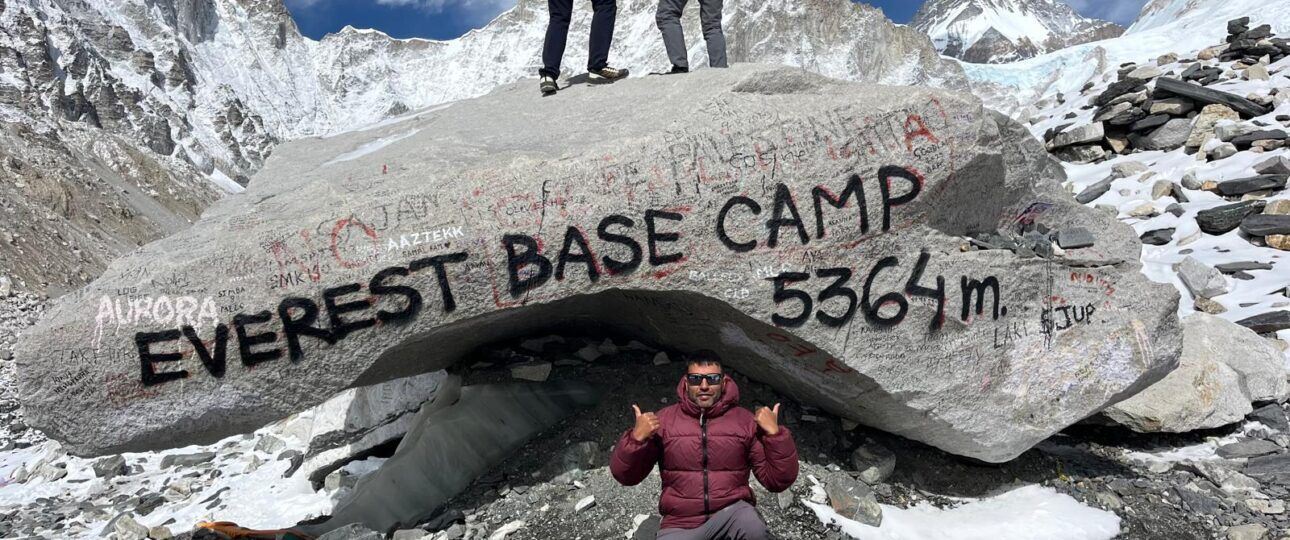
Everest Base Camp in March at a Glance
- Is March good for EBC? Yes. It is the start of the spring trekking season, with clear mornings and lodges open again after winter.
- Daytime: mild in the sun below Namche, around 0 to 8°C (32 to 46°F) in Dingboche
- Nights: -10 to -12°C (14 to 10°F) at Lobuche and Gorak Shep, colder in early March
- Daylight: about 12 hours, with sunrise around 6 to 6:30 AM and sunset around 6 PM
- Lukla flights: in our 2023 to 2026 records, flights ran at least in the morning on 102 of 124 March days. Full-day closures happened on 22 days, so plan spare days.
- Departure airport: from mid-March, most Lukla flights leave from Ramechhap (Manthali), a 4 to 5 hour drive from Kathmandu
- Crowds: quiet in early March, busy in the last week as spring treks and Everest expeditions arrive
- Flowers: first rhododendrons below about 3,500 m in late March. Full bloom comes in April
- Best window: mid-March, for a balance of warmer days, open lodges and fewer people
Your March EBC Trek in a Nutshell
Why read this: This guide helps you decide if trekking to Everest Base Camp in March matches your expectations for weather, views, crowds, and overall comfort on the trail.-
- Weather: March is the start of spring! Expect mostly clear skies, low humidity, and mild, comfortable days. Nights are still cold, especially high up, so pack warm gear.
- Crowds: You’ll see fewer trekkers in early-to-mid March compared to April and May, meaning quieter trails and easier accommodation.
- Scenery: Clear, sharp mountain views, especially in the mornings. You’ll also see the colorful rhododendron flowers beginning to bloom in the lower valleys.
- Verdict: A balanced month. Colder than April at night, but clearer and less congested.
Why trek to Everest Base Camp in March?
Besides the beautiful views, March brings some of the most stable weather for high-altitude trekking. The switch from winter to spring gives us crystal clear skies and little rain, with snow mostly limited to shaded sections higher up, which means you get the best, uninterrupted mountain views of giants like Mount Everest and Lhotse. A huge plus about trekking in early-to-mid March is you can avoid the biggest crowds. You often get to enjoy quieter trails and it’s easier to find rooms in the teahouse accommodation in famous villages like Namche Bazaar and Dingboche. This means a more personal and relaxed Khumbu trekking trip. Trekking to Everest Base Camp in March is your chance to really connect with nature. March means winter is ending and spring is starting. Many trekkers consider March one of the more balanced months for high-altitude walking. This means there will be fewer clouds and humidity and there is usually less rain and snow. Thus, you will catch the clearest mountain views. But remember, mountain weather can always change. Be ready for it to be a bit colder or wetter than you expect. Days are often mild in the sun, but mornings, evenings and nights are cold, especially above Dingboche. All you need to do is pack enough warm clothes (you can hire a porter to carry your bigger bag). Make sure you have a down jacket and a good temperature-rated sleeping bag. Get prepared with the right layers and a warm sleeping bag, and you will be set for a March trek. Contact us at Mosaic Adventure and we will customize your March trekking in Nepal as per your availability and requirements.Weather Conditions for Everest Base Camp Trek in March
The spring season in Nepal starts in March. We love this month for Everest Base Camp trekking because the daily temperatures feel mild and comfortable. It can be a little windy, but the best part is the perfect balance: it’s much warmer than winter but you skip the pre-monsoon heat and humidity. March is generally dry with low humidity, which improves mountain visibility. While the valleys start to green, the peaks of the Himalayan range, including the famous Ama Dablam, remain magnificently snow-capped, offering stunning photographic opportunities. While the valleys start growing new plants after the winter, you’ll notice the lakes and snow are melting at lower elevations too. Clear mornings help, but March is a busy month for Lukla flights. Afternoon wind, spring haze and heavy traffic mean many days have flights only in the morning, so an early flight and a spare day matter more than in winter.So, what’s the weather really like at Everest Base Camp in March?
Most days in March are clear and dry. In the daytime it can feel pleasant in the sun, but nights at high villages can drop well below freezing. At Everest Base Camp itself, the temperature can drop to around -12°C at night and reach about 5°C in the sun during the day. The Everest Base Camp Trek usually starts in Lukla at 2,860 meters (9,383 ft). From there, expect the weather to get colder and you might see snow as you climb higher. Always plan for the passes and base camps to be much colder than the villages down lower. The temperature on an average will range from 5 C inside the tea house to around -10 C outside. With the sun out during the day, it will be pretty warm. At higher elevations in places like Dingboche, Lobuche, and Gorakshep, the temperatures can go down to -10 C at nights. Because nighttime temperatures regularly fall below freezing above 4,000 meters, a proper down jacket and a sleeping bag rated to at least -15°C (ideally -20°C in early March) are not optional in March. Teahouse dining rooms are heated in the evening, but bedrooms are not. This is where most trekkers underestimate the cold. If you are new to high altitude trekking, read our guide on how to prevent altitude sickness on Everest Base Camp trek.
Everest Base Camp Trek: March Temperature Guide
| Place | Approximate Altitude (m/ft) | Average Daytime Temp (∘C) | Average Nighttime Temp (∘C) | Itinerary Days at/passing through |
| Kathmandu | 1345m/4412ft | 15 to 22 | 5 to 10 | Day 1, 13, 14 |
| Lukla / Phakding | 2860m/9383ft (Lukla), 2610m/8560ft (Phakding) | 8 to 15 | -3 to 2 | Day 2, 12 |
| Namche Bazaar | 3440m/11290ft | 5 to 12 | -5 to 0 | Day 3, 4, 11 |
| Tengboche | 3860m/12660ft | 3 to 10 | -9 to -4 | Day 5 |
| Dingboche / Pheriche | 4270m-4360m/14000ft-14300ft | 0 to 8 | -10 to -8 | Day 6, 7, 10 |
| Lobuche / Gorakshep / EBC | 4940m- 5364m/16200ft-17600ft | -4 to 5 | -12 to -10 | Day 8, 9, 10 (morning) |
How Cold Does It Actually Feel in March?
Numbers on a table and real trail experience are not always the same. In March, the sun can feel strong during the day, especially below 4,000 meters. But once it drops behind the ridgelines, temperatures fall fast. Above Dingboche, expect frozen water bottles in the morning. At Gorakshep, indoor temperatures can drop close to freezing overnight. Teahouse bedrooms are not heated. Many trekkers underestimate this in early March. Late March feels noticeably less harsh than early March, but nighttime temperatures above 4,500 meters remain below freezing throughout the month.Early March vs Late March at Everest Base Camp
Conditions shift within March. Early and late month feel noticeably different on the trail.Early March (March 1 to 15)
- Colder mornings and nights, especially above 4,000 meters
- Very clear skies and sharp mountain visibility
- Quieter trails and easier room availability
- Snow still present on shaded sections
Late March (March 16 to 31)
- Slightly warmer daytime temperatures
- Rhododendrons begin blooming below 3,500 meters
- Busier trails as April approaches
- Higher chance of Lukla flight congestion
Choosing Between Early and Late March
If you want maximum solitude and crisp visibility, choose early March. If you prefer slightly warmer days and early spring scenery, choose late March. By the final week of March, teahouses in Namche and Dingboche begin filling quickly. While it is not yet April-level congestion, independent trekkers may need to walk further for rooms if they arrive late in the afternoon.Everest Base Camp in March vs February and April
| Factor | February | March | April |
|---|---|---|---|
| Day Temperature | Cold | Mild to cool | Warmer |
| Night Temperature | Very cold | Cold | Cold but improving |
| Crowds | Very low | Moderate | High |
| Trail Conditions | Possible snow | Mostly dry | Dry |
| Scenery | Crisp winter views | Clear skies, early blooms | Full rhododendron bloom |
Is March Better Than April for Everest Base Camp?
It depends on what matters to you. Choose March if: You prefer clearer visibility, slightly fewer trekkers, and do not mind colder nights. Choose April if: You want warmer days, full rhododendron bloom, and do not mind heavier trail traffic and busier teahouses. From a guide’s perspective, March often provides sharper mountain views. April provides more color in the forests. Both are strong months, but March feels less congested.What Makes March Different on the EBC Trail?
- Sharp Visibility: Low humidity often means crisp morning views of Everest, Lhotse, and Ama Dablam.
- Transitional Energy: Villages reopen fully after winter. Supplies improve. Trails feel active but not yet overloaded.
- Early Spring Color: Rhododendron bloom begins below 3,500 meters in the second half of the month.
- Balanced Conditions: Colder than April at night, but far more comfortable than February.
What Is Happening on the EBC Trail in March?
Everest expedition season begins
Late March is when climbing teams start arriving in the Khumbu for spring Everest expeditions. You will see more yak trains and porters carrying expedition loads on the trail, especially above Namche. The tent city at Base Camp grows through April, so in March you see Base Camp at its quieter, earlier stage.The Pheriche clinic reopens
The Himalayan Rescue Association aid post in Pheriche is staffed by volunteer doctors during the spring trekking season, which starts around mid-March. In 2019, for example, it opened on March 13 (HRA). If you trek in early March, do not count on it being open.Daylight gets longer
Days are about 12 hours long in March, around 1.5 hours longer than in January. In the Khumbu, the sun rises between about 6 and 6:30 AM and sets around 6 PM. Mornings are the clearest part of the day. Cloud and wind often build up after midday, especially above Lobuche.How busy does it get?
The first half of March is quiet. The last week is busy, as spring trekking and expeditions overlap. Sagarmatha National Park recorded 12,003 visitors in the Nepali month of Chaitra in 2025 (mid-March to mid-April), its highest month of that fiscal year up to then (The Himalayan Times). If you trek in late March, book lodges and flights early.Holi in Kathmandu
Holi, the festival of colours, falls in March. In 2027 it is expected on March 22 and 23 (the hills and Kathmandu usually celebrate first, the Terai a day later). If you are in Kathmandu that day, wear clothes you do not mind ruining and keep your phone and camera in a sealed bag. Please check the official date closer to your trip, as Nepal’s festival dates follow the lunar calendar.Proposed itinerary for EBC trek in March 2027
The outline below reflects a standard 14-day March itinerary. Since there are only two nights in Kathmandu, it’s smart to book extra nights if you are flying in from a country with a big time difference. Spend two nights in Kathmandu before you fly out for the trek. Because Lukla flights can be unpredictable (they are famous for being cancelled due to bad weather), it’s really smart to add buffer days to your schedule. For the EBC trek in March, you will need the Sagarmatha National Park Entry Permit and the Khumbu Pasang Lhamu Rural Municipality Permit. These are mandatory regardless of season. Most organized treks arrange these in advance so you do not have to handle the paperwork in Kathmandu. In this itinerary, we allocate 11 days for the trail. The ascent is gradual, taking eight days to reach Everest Base Camp. However, during the descent, be prepared for a longer journey, covering the distance back to Lukla in just three days.-
- Day 1: Arrival in Kathmandu (1,345m/4,412ft); airport meet-up, transfer to the hotel. Evening pre-trek meeting.
- Day 2: Hotel pickup in Kathmandu, transfer to Kathmandu airport, or drive to Ramechhap from mid-March, for a short flight to Lukla (2,860m/9383ft). Trek to Phakding (2,610m/8,560ft) – approximately 3.5 hours.
- Day 3: Trek to Namche Bazaar (3,440m/11,290ft) – Approximately 6 hrs.
- Day 4: Acclimatization day around Namche Bazaar, with a side trip to higher altitude and return to Namche.
- Day 5: Trek to Tengboche (3,860m/12,660ft) – Approximately five hours.
- Day 6: Trek to Dingboche (4,360m/14,300ft) – Approx. 5 hrs.
- Day 7: Another acclimatization day.
- Day 8: Trek to Lobuche (4,940m/16,207ft) – Approx. 5 hrs.
- Day 9: Trek to Everest Base Camp (5,364m/17,598ft) and return to Gorakshep (5,164m/16,942ft).
- Day 10: Sunrise viewing hike up to Kalapatthar (5,545m/18,192ft) then trek to Pheriche (4,270m/14,070ft) – Approx. 7 hours.
- Day 11: Return trek to Namche Bazaar (3,440m/11,290ft) – Approx. 6 hours.
- Day 12: Namche to Lukla (2,860m/9,383ft) – Approx. 6 hrs.
- Day 13: Fly back and transfer to the hotel in Kathmandu.
- Day 14: Departure, or extend your tour for other activities in Nepal.
If you prefer an organized trek, see our Everest Base Camp trek itinerary, cost, and dates.This itinerary is the same as our standard trek, with notes for March conditions. For a full day-by-day explanation, see the 14-day Everest Base Camp trek itinerary. For trail and lodge costs, see our Everest Base Camp trek cost guide.
Fixed Departures for Everest Base Camp Trek 2027 in March
March 2027 is one of the best times to trek to Everest Base Camp, marking the start of the prime spring trekking season in Nepal. The weather is crisp and clear, rhododendrons begin to bloom, and the Himalayas stand tall under bright blue skies. Below are the scheduled March 2027 departures. This is an excellent opportunity to trek with a small group of like-minded adventurers, enjoy the company of experienced guides, and experience Nepal at its best.| Date (March 2027) | Status / Availability |
|---|---|
| March 1, 2027 | Available / Guaranteed Departure |
| March 3, 2027 | Available / Guaranteed Departure |
| March 8, 2027 | Available / Guaranteed Departure |
| March 10, 2027 | Available / Guaranteed Departure |
| March 15, 2027 | Available / Guaranteed Departure |
| March 17, 2027 | Available / Guaranteed Departure |
| March 22, 2027 | Available / Guaranteed Departure |
| March 24, 2027 | Available / Guaranteed Departure |
| March 29, 2027 | Available / Guaranteed Departure |
| March 31, 2027 | Available / Guaranteed Departure |
You can find the available dates listed above on our March 2027 EBC Trek page. All departures are guaranteed.Early March is typically quieter and colder. Late March is slightly warmer with increasing traffic.
Flight Logistics: Lukla (Tenzing-Hillary Airport) and the Ramechhap Transfer
During the peak Everest trekking season (like mid-March to mid-May), the Civil Aviation Authority of Nepal often moves all Lukla flights from Kathmandu to Ramechhap Airport (RHP) to help with air traffic. Our team has tons of experience managing this. It’s a required 4-5 hour early-morning drive from Kathmandu to Ramechhap. We will take care of all the ground transport and planning for your Lukla flight. What the Ramechhap day looks like:- Around 2 AM: pickup from your hotel in Kathmandu
- 4 to 5 hours: drive to Ramechhap (Manthali) airport
- About 20 minutes: flight to Lukla, usually in the first morning slots
Lukla Flight Operation in March (2023 to 2026 Data Overview)
Lukla flights are one of the biggest planning concerns for March trekkers, especially from mid-month onward when air traffic increases. Below is a summary of March flight operations from 2023 to 2026 based on daily operational notes recorded by our team in coordination with local staff at Tenzing-Hillary Airport. How to read: Open: Full-day operations Partial: Limited or morning-only flight window Closed: No flights operated| March (1 to 31) | 2023 | 2024 | 2025 | 2026 |
|---|---|---|---|---|
| Open (Full day) | 6 days | 10 days | 9 days | 13 days |
| Partial (Morning or limited window) | 20 days | 14 days | 15 days | 15 days |
| Closed (No flights) | 5 days | 7 days | 7 days | 3 days |
- Across March 2023 to March 2026, Lukla flights ran at least in the morning on 102 of 124 days (82%).
- Full days with no restrictions were less common: 38 days (31%). On 64 days (52%) flights ran only in the morning or with delays, usually because wind and haze build up after late morning.
- No flights operated on 22 days (18%), which is far more than in winter. In our January records over the same years, it was only 6 of 124 days.
- March 2026 was the best March in our records, with 13 full days and only 3 closed days.

What This Means for March Trekkers
March rarely sees long stretches of complete airport shutdown like peak monsoon months. However, partial morning operations are common, especially after mid-month when clouds build earlier in the afternoon. Most flight disruptions in March occur after late morning. This is why early departures are prioritized and why flexible itineraries remain important even during the spring season.How This Data Was Recorded
One of our team members keeps daily operational notes in coordination with our local team at Lukla Airport. The figures above are based on those records from 2023 to 2026. Mountain weather can change quickly, but this gives a realistic pattern of how Lukla flights typically behave in March. Each day was marked using our own guests’ flights and updates from the airlines and our staff in Lukla and Ramechhap:- Open (full day): flights ran through the normal operating window.
- Partial: flights ran only in the morning, with delays, or with fewer rotations.
- Closed: no flights to or from Lukla that day.
Are Lukla Flights Reliable in March?
Based on the data above, most March days allow at least a partial morning flight window. Full-day closures do occur, especially during unstable weather systems, but prolonged shutdowns are uncommon. We recommend at least one, ideally two, buffer days when trekking in March.Practical Considerations for March
Take Proper Gear and Equipment
Take the Right Gear and Equipment Packing properly is essential for any trek in Nepal. The weather in the Everest region can change fast, so it’s really important to research and bring the right gear and equipment for your EBC trek. In March, do not forget base layers, a water bottle, trekking poles, and a few key warm items.Book your Trip Early
March starts quietly, but the last week of March is one of the busiest times on the trail, as spring trekkers and Everest expedition teams arrive together. Accommodation fills faster toward late March, especially in Namche and Dingboche.Trek with a licensed guide
Everest Base Camp trek is a high-altitude trekking and the weather can change frequently. So, it is always a good option to hire a licensed guide for your Everest Base Camp trek. They will guide in every possible way and also take care of you if in case you get the symptoms of altitude sickness. For a deeper look at risk management and emergency planning, see our article on Everest Base Camp trek safety.Hire a Porter
Also, do not hesitate to hire a porter who will carry your load. This way you can trek freely and enjoy the March weather to the most. A porter reduces strain during long descents and colder mornings.Learn How to Hydrate Properly
While trekking to Everest Base Camp in March you will sweat a lot. So, you must not avoid carrying your own bottle, water purification tablets. And make sure you drink regularly throughout the day. A simple target is 3 to 4 liters per day, and more if it is sunny and dry. Cold temperatures reduce thirst, but hydration remains critical at altitude.Other general tips on March Trekking would be:
- Start walking early in March. Afternoon clouds build faster after mid-month.
- Layer carefully. March mornings can be below freezing, but midday sun feels strong.
- Take all the trekking equipment that you may need.
- Hire a porter to share the load. Even if you are somebody who is fit, trekking will demand a lot of mental and physical strength. Carrying a fully equipped bag will get heavy for anyone after an extended duration.
- Take a well-experienced guide and be sure to check in at every stop
- Be sure to spare a few days regardless of the season. Unpredictable weather and unexpected injuries may cause delays.
What to Wear for EBC trek in March?
March on the Everest Base Camp trail means cold mornings, strong sun during the day, and freezing temperatures above 4,000 meters at night. What you wear needs to handle all three. The key difference in March compared to winter is daytime comfort. You will often hike in a base layer or light fleece under direct sun. However, once the sun drops behind the ridges, temperatures fall quickly. Even in late March, villages like Dingboche, Lobuche, and Gorakshep remain below freezing at night. For March specifically, focus on:- A moisture-wicking base layer for daytime walking
- A mid-weight fleece or light insulated jacket
- A waterproof and windproof outer shell
- A proper down jacket for evenings and early mornings
- A sleeping bag rated to at least -15°C, or -20°C for early March
- Warm gloves and a hat for mornings above 4,000 meters
- Broken-in trekking boots with warm socks
EBC Trek March Departure Dates
| Start date | End date | Price | |
|---|---|---|---|
| Mon, Mar 1, 2027 | Sun, Mar 14, 2027 | USD 1,445 | Book now |
| Wed, Mar 3, 2027 | Tue, Mar 16, 2027 | USD 1,445 | Book now |
| Mon, Mar 8, 2027 | Sun, Mar 21, 2027 | USD 1,445 | Book now |
| Wed, Mar 10, 2027 | Tue, Mar 23, 2027 | USD 1,445 | Book now |
| Mon, Mar 15, 2027 | Sun, Mar 28, 2027 | USD 1,445 | Book now |
| Wed, Mar 17, 2027 | Tue, Mar 30, 2027 | USD 1,445 | Book now |
| Mon, Mar 22, 2027 | Sun, Apr 4, 2027 | USD 1,445 | Book now |
| Wed, Mar 24, 2027 | Tue, Apr 6, 2027 | USD 1,445 | Book now |
| Mon, Mar 29, 2027 | Sun, Apr 11, 2027 | USD 1,445 | Book now |
| Wed, Mar 31, 2027 | Tue, Apr 13, 2027 | USD 1,445 | Book now |
Other Recommended Treks in Everest Region for March
If the traditional Everest Base Camp Trek is too long or challenging, the Khumbu Region offers incredible alternatives. In early March, the high passes (Cho La, Renjo La and Kongma La) can still hold deep snow and ice. By late March they are usually crossable with care and microspikes, depending on the season’s snowfall. To compare every route side by side, with route maps, see our guide to Everest Base Camp trek routes. We recommend options based on your goals:Jiri to Everest Base Camp Trek in March: The Classic Route
This 18-day trek follows the historical and traditional path of Sir Edmund Hillary and Tenzing Norgay. It’s great for natural acclimatization because it starts at much lower altitudes than Lukla. Trekking from Jiri in March is particularly beautiful, offering lush mid-hill scenery before joining the main Khumbu Valley trail at Surke, below Lukla. Because this route starts lower than the usual Lukla-EBC trek, it’s a great option, especially if you consider trekking earlier in the year like February too. You will be able to adapt to the increasing altitude better as you have more time and there is a slow and steady climb up to higher altitudes. The trek eventually joins the more popular route from Lukla and continues on to the lively and vibrant hillside town of Namche Bazar, which offers stupendous views of Kwangde, Thamserku, Nuptse, Lhotse, and Ama Dablam. It then heads up to the beautiful site of Tyangboche where you will experience mesmerizing panoramic views, before climbing on to Everest Base Camp itself, leaving you feeling literally on top of the world!Everest View Trek (Panorama): Shorter Option
Perfect if you have less time, the Everest View Trek only goes up to 3,860 meters at Tengboche Monastery. This route is an easier, lower-risk alternative to the EBC trek. In March, you usually get clear views of Mt. Everest, Ama Dablam, and other giants from Namche Bazaar and the Tengboche viewpoint. Tyangboche, home to the ornate Tyangboche Monastery and an idyllic place that offers breathtaking, panoramic vistas of some of the world’s highest and most beautiful mountains. The trail follows the beautiful, Dudh Kosi, passing under many impressive suspension bridges, loaded with Buddhist prayer flags through thick rhododendron forests.Everest Base Camp and Gokyo Lakes Trek: The Cho La Pass Challenge
If you’re looking for a serious challenge, try the Everest Base Camp and Gokyo Lakes Trek, sometimes called the Cho La Pass Trek or Everest Circuit Trek. This is one of the most adventurous and challenging 19-day treks in the Himalayas. The trek follows the Everest Base Camp route, passing through the vibrant town of Namche Bazaar and the spectacular site of Tyangboche where a magnificent Tyangboche Monastery sits amidst a snow-capped mountain panorama. After reaching Everest Base Camp, the route continues to the summit of Kala Patthar, a spectacular viewpoint to appreciate Everest in all her glory. You will be impressed by the vistas from there, mountains as far as the eye can see, covered in a blanket of snow in March. We then head out to conquer the Cho La Pass at 5,420 meters. The Pass can still hold snow in early March and requires stable footing. If this was not enough, we then carry on further to the glistening waters of the Gokyo Lake, a system of freshwater and sacred lakes, hidden in the high Himalaya. This trip really has it all, high-altitude trekking, spectacular views insurmountable anywhere else in the world, and the beautiful Gokyo Lakes. Plus, the welcoming culture of the Sherpa people and a visit to the iconic Everest Base Camp. You also get the opportunity to climb Gokyo Ri (5,357 meters) which offer the astonishing, panoramic views of Cho Oyu, Everest, and Makalu. If you are already trekking to Everest Base Camp in March and feel strong after reaching Kala Patthar, adding the Gokyo Lakes extension via Cho La Pass is possible. However, snow conditions can still exist on the pass in early March, so flexibility in planning is important.Gokyo Lakes Trekking Holiday: High-Altitude Beauty
High up in the Himalayas is a system of beautiful freshwater lakes called the Gokyo Lakes. These are sacred and very important to both Hindus and Buddhists. This 15-day trek to Gokyo Lakes takes you to Gokyo, Gokyo Ri through the famous Namche Bazaar, the Sherpa capital and gateway to Everest. Trekking in this area rewards you with beautiful views of the mountain peaks and the Ngozumpa Glacier, one of the largest in the world. But most importantly of all, it guarantees the best views of the infamous “eight-thousanders” including Cho Oyu, Everest, Lhotse, Lhotse Shar and Makalu, which are clearly visible from Gokyo Ri (5,357m). The trek starts with a breathtaking flight between the mountains to Tenzing/Hillary airport at Lukla and then follows the Everest Base Camp route then heading out to the Gokyo Valley. Buddhist prayer flags adorn huge suspension bridges and we will pass many stone walls and Buddhist memorial sites. We aim to reach Gokyo Ri, above the Gokyo Lakes, one of the world’s highest freshwater lake systems.Everest Three Passes Challenging Trek
As the name suggests, the Everest Three Passes Trek is the most challenging trek you can opt for in the Everest region. The Three Passes of Everest Region is a challenging one but the rewards are endless! This 22 days trek ventures into the beautiful Khumbu Region, visiting Everest Base Camp and Kala Patthar before tackling not just one, not two but three high mountain passes. We enjoy time in Namche Bazaar, the Sherpa capital and gateway to the high Himalaya before increasing the altitude. Thyangboche is a magical resting place for the night enjoying panoramic vistas and is the home to a wonderful, ornate monastery. We head further up, deep into this mountainous region, conquering steep inclines and rocky trails before marveling at the views from three different passes. A steep uphill, rocky, and uneven to The first pass then steeply downhill, until we reach the Khumbu glacier then its “up and down” all the way to Lobuche via the Kongma La Pass. Some pretty spectacular Himalayan peaks from the icy wilderness of the Cho La Pass with uneven tracks, large rocky areas where you will need to climb and jump off the rocks to Thangnak via the Chola-la Pass. From Gokyo, we cross the Renjo La Pass (5,360m) and head down to Lungden. Exploring through some “Nepali flat,” steep inclines, rocky trails, we will cross the fifth lake at 4380m. Enjoy the panoramic views from the Renjola High Pass. with the magnificent views of Everest, Cho Oyu, Makalu, Lhotse, Lhotse Shar, Ama Dablam, Pumori, and many more. This trip is for energetic individuals who like a challenge, 17 days of walking, endless panoramas and an experience of a lifetime. You will get to see the Gokyo lakes and Ngozumpa glacier and 5 of the world’s “eight-thousanders” and some of the Tibetan mountain range.Everest Base Camp Trek in March: FAQs
Is March a good time to trek to Everest Base Camp?
Yes. March is the start of the spring season, with clear mornings, lodges open again and longer days than in winter. Nights are still cold above Dingboche, and the last week of March gets busy.How cold is Everest Base Camp in March?
Daytime at Lobuche, Gorak Shep and Base Camp is around -4 to 5°C (25 to 41°F). Nights drop to about -10 to -12°C (14 to 10°F), and can be colder in early March and with wind.Is there snow on the EBC trail in March?
The main trail is mostly dry, but shaded sections above Dingboche can be icy, especially in early March. Carry microspikes. Fresh snow can fall on a few days.Do Lukla flights leave from Kathmandu or Ramechhap in March?
From around mid-March, most Lukla flights leave from Ramechhap (Manthali), a 4 to 5 hour drive from Kathmandu with a very early start. In early March some flights may still leave from Kathmandu. We confirm the airport before your trek.Are Lukla flights reliable in March?
Flights ran at least in the morning on 82% of March days in our 2023 to 2026 records, but there were no flights on 18% of days. Book the earliest flight and keep one or two spare days.Is early March or late March better for EBC?
Early March is colder and quieter. Late March is warmer and busier, with the first rhododendrons. Mid-March is a good balance for most trekkers.Will I see rhododendrons in March?
The first blooms appear in the forests below about 3,500 m, between Phakding, Namche and Tengboche, usually from late March. Full bloom comes in April.Will there be climbers at Everest Base Camp in March?
Expedition teams begin arriving in late March, but the big tent city at Base Camp forms mainly in April. In March you see Base Camp at its quieter, earlier stage.Can I cross Cho La Pass in March?
Often yes in late March, with a guide and microspikes. In early March the pass can still be snowbound, so keep a backup plan to return on the Classic route.What sleeping bag do I need for EBC in March?
A bag rated to at least -15°C, and ideally -20°C for early March. Teahouse bedrooms are not heated.Is March or April better for Everest Base Camp?
March has clearer views and fewer people. April is warmer, with full rhododendron bloom and busier trails. See our guide to the Everest Base Camp trek in April.How far ahead should I book for March?
For late March, book flights and the trek at least 2 to 3 months ahead. For early March, a few weeks is often enough.Final Thoughts: Is March a Good Time for Everest Base Camp?
March is one of the most balanced months to trek to Everest Base Camp. It sits between the deep cold of winter and the heavy traffic of April. Early March feels quieter and colder. Late March feels warmer and busier. If you want strong visibility, manageable crowds, and do not mind below-freezing nights at higher elevations, March is a solid choice. Plan at least one, ideally two, buffer days for flights. Pack properly for cold mornings. Start walking early each day. With realistic expectations, March delivers a stable and rewarding Everest experience.Want more information? Send us your query, and our experts will get back to you within 24 hrs.

Madhav Prasad is a seasoned trekking and tourism expert with over two decades of experience in the field. Starting his career in 2001 as a porter, Madhav quickly advanced to the role of trekking guide, gaining invaluable hands-on experience in Nepal’s diverse trekking routes. In 2009, after eight years of dedication to the industry, he co-founded Mosaic Adventure, a leading trekking and tour company known for its commitment to safety, sustainability and personalized service.
Madhav has personally trekked to nearly every major trekking destination in Nepal, including Everest Base Camp, Annapurna Base Camp, the Annapurna Circuit, Poon Hill, Jomsom Muktinath, the Indigenous Peoples Trail, Langtang Valley and Mardi Himal, among others. His experience extends beyond Nepal, as he has also successfully summited Mount Kilimanjaro, Africa’s highest peak.
In addition to his extensive trekking credentials, Madhav is well traveled globally, having explored countries such as Australia, the USA, the UK, France, Japan, China, and many others. His global exposure enhances his ability to understand and cater to the diverse needs of international trekkers.
Madhav is the primary point of contact for many clients at Mosaic Adventure, personally addressing inquiries and helping plan treks with a meticulous and personalized approach. His deep knowledge of Nepal’s trekking routes, combined with his global travel experience, ensures that every trek is well planned, safe and unforgettable.
