
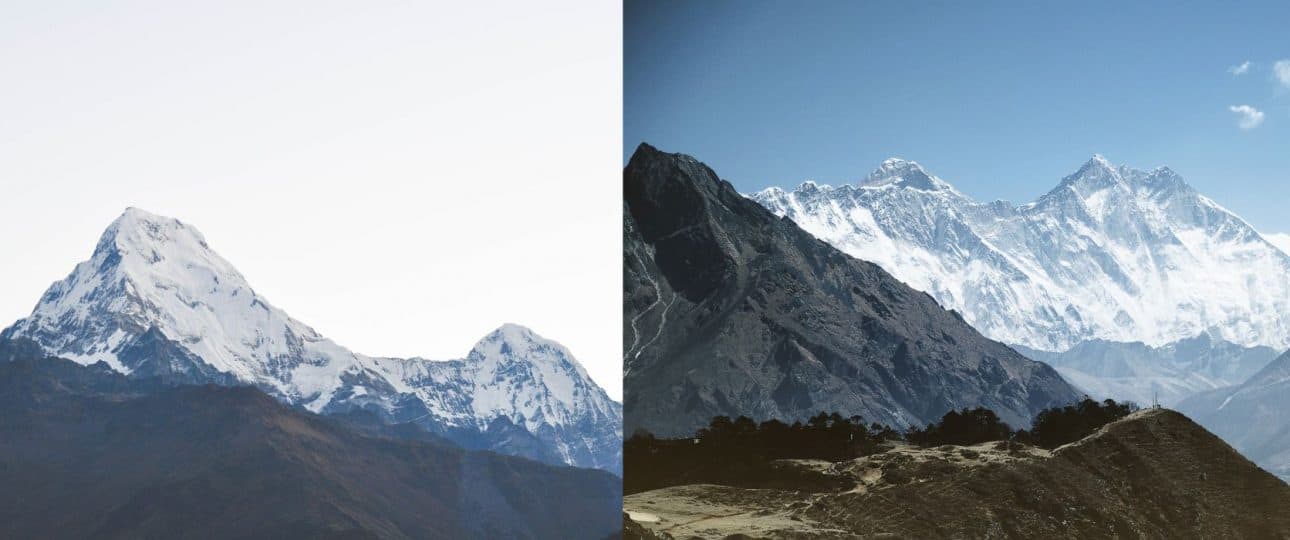
Both are great treks. That’s the honest answer. But they suit different people, and getting this choice wrong means spending two weeks doing something that doesn’t quite fit what you were looking for. Here’s where they actually differ.
Quick Comparison
| Factor | Annapurna Circuit Trek | Everest Base Camp Trek |
|---|---|---|
| Trek type | Loop (A to B) | Out-and-back |
| Duration | 12 to 21 days | 12 to 16 days |
| Distance | ~160 to 230 km | ~130 km |
| Highest point | Thorong La Pass, 5,416m | Kalapatthar, 5,555m |
| Difficulty | Moderate to strenuous | Moderate to strenuous |
| Annual trekkers | ~15,900 | 35,000 to 40,000 |
| Getting there | Road from Pokhara or Kathmandu | Domestic flight to Lukla |
| Scenery | Subtropical to high desert, very varied | High mountain, austere and dramatic |
| Culture | Multiple ethnic groups, Hindu and Buddhist | Predominantly Sherpa, Tibetan Buddhist |
| Exit flexibility | Multiple jeep and flight exit points | Very limited |
| Budget | Lower overall | Higher, mainly due to Lukla flights |
Overview
Annapurna Circuit Trek

The Annapurna Circuit loops around the entire Annapurna massif. You start near Besisahar and finish in Pokhara or Jomsom, never retracing your steps. What makes it unusual compared to most big treks is how much the terrain changes. Rice paddies and subtropical forest in the lower valleys, dry pine ridges in the middle sections, then high desert plateau that looks more Tibetan than Nepali by the time you’re above Manang.
The main highlights are Thorong La Pass (5,416m), the Kali Gandaki gorge, Manang and the upper Mustang valleys, and close views of Annapurna I, Dhaulagiri, and Machhapuchare. If you want to extend, Tilicho Lake is one of the highest lakes in the world and worth the detour if you have the days.
Everest Base Camp Trek

The EBC trek flies you into Lukla, heads north through the Khumbu to Base Camp and Kalapatthar, then brings you back out the same way. What this route does that nothing else really matches is scale. Ama Dablam hanging above the Tengboche valley, the Khumbu icefall groaning below Base Camp, Everest from Kalapatthar at first light. The landscape above Namche is less varied than the Circuit but the mountains are more immediately overwhelming.
One thing people don’t always realise before they go: Everest stays hidden behind Nuptse for most of the walk in. You won’t get a clear view until Kalapatthar. The summit isn’t visible for most of the trek, which surprises some people.
There are also extensions worth considering if you have more time, including the Everest Three Passes Trek, Gokyo Lakes, or an Island Peak climb.
Want more information? Send us your query, and our experts will get back to you within 24 hrs.
Loop vs Out-and-Back
The Annapurna Circuit is a loop. New villages, new terrain, new valley every day from start to finish. EBC is out-and-back, so the trail you walked in on is the same trail you walk out on. Some trekkers genuinely don’t mind this, and the return is usually faster. Others find repeating terrain deflating after the high of reaching Base Camp. It’s one of the more consistent things people mention when comparing the two, and worth being honest with yourself about before you book.
Getting There and Flight Risk
Annapurna Circuit
The trailhead is road-accessible. From Pokhara it’s around 2 to 3 hours to Besisahar, from Kathmandu around 7 to 8 hours. No flights involved, no cancellation risk. If your schedule shifts, you adjust the drive time and start a day later. Nothing gets grounded because of weather.
Everest Base Camp
EBC starts with a domestic flight to Lukla. Tenzing-Hillary Airport has a short runway on a hillside with a cliff at one end, operates in a narrow weather window each morning, and cancels regularly. Delays of two to three days are not unusual, and trekkers miss international connections because of it every season. If you’re flying home on a fixed ticket, build in at least two buffer days on each end of your trek, not one.

See our Lukla flight guide for what to expect and how to plan around it.
Best Time to Go
Both treks peak in the same two windows: spring (March to May) and autumn (October to November). Spring is warmer, rhododendrons are out in the lower sections, and visibility is good. Autumn after the monsoon is sharper and clearer, which is why most guides rate it first.
The Annapurna Circuit has a practical advantage outside peak season. Above Manang the route sits in a rain shadow, so the upper sections stay walkable during shoulder months when EBC is getting hammered by weather. If your travel dates are locked into an awkward window, that matters.
For a full breakdown of both routes by season, see our guide on the best season to trek in Nepal.
Altitude and Acclimatization
Most comparisons lead with peak altitude numbers. Those are less useful than they look. The Annapurna Circuit tops out at 5,416m on Thorong La, and EBC at 5,555m on Kalapatthar. On paper EBC goes higher. In practice, what determines altitude sickness risk is how many nights you spend above 3,500m, not just the single highest point you reach.
EBC keeps you above 3,500m for most of the upper portion of the trek, with multiple nights at Dingboche (4,410m), Lobuche (4,940m), and Gorakshep (5,140m). The Annapurna Circuit crosses a higher pass but descends quickly into Muktinath and the lower Mustang valleys afterwards. The sustained altitude exposure on EBC is meaningfully greater.
On the Annapurna Circuit, almost everyone takes a rest day in Manang (3,500m) before attempting Thorong La. Skipping it to save a day is probably the single most common mistake on this route. On EBC, rest days at Namche Bazaar and Dingboche are built into every sensible itinerary and are not negotiable if you want to get through safely.
See our guide on altitude sickness and high altitude trekking for more on managing this on either route.
Crowd Levels
EBC gets around 35,000 to 40,000 trekkers a year. The Annapurna Circuit sees roughly 15,900. In peak season on EBC, several hundred people can set off in the same direction on the same morning. Lodges at Gorakshep and Lobuche book out fast and overflow is common in October.
The Circuit has its own crowded moment, which is Thorong La Pass day when everyone leaves their guesthouse before dawn at the same time. But outside that single stretch, the trail is noticeably quieter. The Mustang side after the pass, in particular, can feel genuinely remote.
Road Construction on the Annapurna Circuit
This is something a lot of comparison articles skip over, probably because it complicates the pitch. A jeep road now runs as far as Manang on the eastern side and Muktinath on the western side, which means sections of the lower Circuit have you walking alongside a dusty road rather than a mountain trail. It has changed the character of those parts of the trek.
The practical fix is the NATT (Naya Annapurna Trekking Trail), a series of alternative paths that branch away from the road and go through traditional villages instead. A good guide will route you onto these sections automatically. The upper portion from Manang to Thorong La and down to Muktinath is largely unaffected and still as good as it’s always been.
Scenery

If you want raw mountain drama, EBC is the stronger choice. The Khumbu peaks are enormous and close, and standing at Base Camp with the icefall in front of you is unlike anything else in trekking. The Annapurna Circuit has spectacular mountain views too, but they don’t carry the same immediate weight as looking up at the Lhotse face or watching Ama Dablam from Tengboche.
What the Circuit does better is variety. Subtropical forest, river gorges, alpine meadows, high desert plateau. The landscape changes enough that each section of the trek feels like a different trip. On EBC above Namche, the terrain is consistently rocky and high. It’s dramatic, but it doesn’t change much for the last several days.
Culture
The Annapurna Circuit passes through a wider range of communities than any other major trek in Nepal. Lower villages are predominantly Brahmin, Chhetri, Magar, and Gurung, a mix of Hinduism and Buddhism. As you gain altitude the villages shift, and by the time you’re above Manang the culture is distinctly Tibetan.
EBC is Sherpa country from start to finish. The cultural experience is deep rather than varied. You’ll visit monasteries at Tengboche, see how Buddhist practice is woven into daily life in the Khumbu, and meet families with direct ties to Himalayan climbing history going back generations. It’s not the broad cultural range of the Circuit, but the Khumbu has a depth that takes most people by surprise.
See our cultural highlights guide for the EBC route for more detail on what to expect.
Accommodation and Food
Both routes are tea house treks. You sleep in lodges each night, no camping gear needed. At lower elevations on both routes you’ll find reasonably comfortable rooms, hot showers in some guesthouses, and decent food. Higher up the rooms get more basic, heating disappears, and the menu narrows down to dal bhat, noodle soup, fried rice, and eggs in most combinations.
One practical difference: food and lodge prices on EBC rise steeply as you gain altitude because everything above Namche is carried in by porter or flown in by helicopter. On the Annapurna Circuit the road access means supply costs stay lower for more of the route. See our EBC accommodation guide for what to expect at each stage.
Difficulty and Evacuation
Both treks sit in the moderate to strenuous range. No technical climbing, no ropes, no crampons. What they do require is solid aerobic fitness and the discipline to slow down when your body tells you to.
The hardest day on the Annapurna Circuit is Thorong La Pass, 8 to 10 hours with a sustained climb to 5,416m followed by a long descent to Muktinath on the other side. It’s exhausting but manageable with a proper rest day in Manang beforehand. The training that helps most here is back-to-back long days with a loaded pack and some hill work at pace, because the pass is less about overall fitness and more about having legs that can still function after several hours of climbing.
EBC doesn’t have a day that hard, but the accumulated effect of sleeping at altitude for days on end catches up differently. By Gorakshep most people are running on fumes in a way that’s hard to explain after individual days that didn’t feel that brutal. The training that transfers best is sustained aerobic work over months, long hikes with a pack, stair climbing, building time on your feet consistently rather than peaking for one hard day.
Getting out in an emergency is easier on the Annapurna Circuit. Road access at multiple points means jeep evacuation is possible without helicopter costs. On EBC above Namche, helicopter rescue is essentially the only option if something goes wrong. It’s used regularly, but it costs thousands of dollars. Travel insurance covering high-altitude evacuation is important on both routes and non-negotiable on EBC.
See our guide on trek grades and what to expect physically for more on both routes.
Cost
The Annapurna Circuit is cheaper overall. Road access to the trailhead, lower permit fees compared to the Sagarmatha National Park, and more affordable food along more of the route all contribute. EBC costs more primarily because of the Lukla flights, which run roughly USD 200 to 250 per person each way, and because lodge and food prices in the Khumbu are higher the further in you go.
For a full breakdown of what to budget for each trek, see our guide on trekking in Nepal costs.
Packing
The gear list for both is almost the same. Warm layers, a sleeping bag rated for cold temperatures, waterproofs, solid trekking boots, and sun protection. The main difference is that EBC keeps you at high altitude for longer, so your warmest kit gets used more consistently. On the Annapurna Circuit the wider elevation range means you’ll be adding and removing layers throughout the day more than on EBC.
See our Nepal trekking packing list for the full breakdown.
Which Trek is Right for You?
If available days are the main constraint, that usually settles it:
| Days available | Better fit |
|---|---|
| 10 to 12 days | Everest Base Camp |
| 13 to 17 days | Either, depending on preference |
| 18 days or more | Annapurna Circuit |
The Annapurna Circuit tends to suit people who:
- Want variety in scenery and culture rather than a single destination
- Have a tight travel schedule or fixed international flights
- Are conscious of budget
- Prefer not to retrace their steps on the way out
- Want quieter trails
EBC makes more sense if you:
- Have standing at Everest Base Camp as a specific goal
- Are drawn to Sherpa culture and Himalayan climbing history
- Want the dramatic high-mountain environment above everything else
- Have buffer days built into your travel schedule
The Circuit is a poor fit if you have fewer than 12 days, if close-up views of enormous peaks all day every day is the main draw, or if a long pre-dawn pass crossing sounds more miserable than it does hard. EBC is a poor fit if your flights home are fixed with less than two buffer days on either end, if you want varied terrain and a range of cultural experiences, or if sustained days at high altitude worries you more than one hard single day.
If this is your first Nepal trek and you’re still sitting on the fence, most guides lean toward the Annapurna Circuit as the better introduction. The logistics are simpler, the cultural range is broader, and the variety gives you a more complete picture of what trekking in Nepal actually is. Everest isn’t going anywhere. If you haven’t done a multi-day trek before at all, have a look at our guide to treks for beginners in Nepal before committing to either of these.
If you want to see what else Nepal has to offer before committing to either route, our guide to the best treks in Nepal covers the full range. And if you have specific questions about either trek, get in touch directly.
Want more information? Send us your query, and our experts will get back to you within 24 hrs.

Madhav Prasad is a seasoned trekking and tourism expert with over two decades of experience in the field. Starting his career in 2001 as a porter, Madhav quickly advanced to the role of trekking guide, gaining invaluable hands-on experience in Nepal’s diverse trekking routes. In 2009, after eight years of dedication to the industry, he co-founded Mosaic Adventure, a leading trekking and tour company known for its commitment to safety, sustainability and personalized service.
Madhav has personally trekked to nearly every major trekking destination in Nepal, including Everest Base Camp, Annapurna Base Camp, the Annapurna Circuit, Poon Hill, Jomsom Muktinath, the Indigenous Peoples Trail, Langtang Valley and Mardi Himal, among others. His experience extends beyond Nepal, as he has also successfully summited Mount Kilimanjaro, Africa’s highest peak.
In addition to his extensive trekking credentials, Madhav is well traveled globally, having explored countries such as Australia, the USA, the UK, France, Japan, China, and many others. His global exposure enhances his ability to understand and cater to the diverse needs of international trekkers.
Madhav is the primary point of contact for many clients at Mosaic Adventure, personally addressing inquiries and helping plan treks with a meticulous and personalized approach. His deep knowledge of Nepal’s trekking routes, combined with his global travel experience, ensures that every trek is well planned, safe and unforgettable.
