
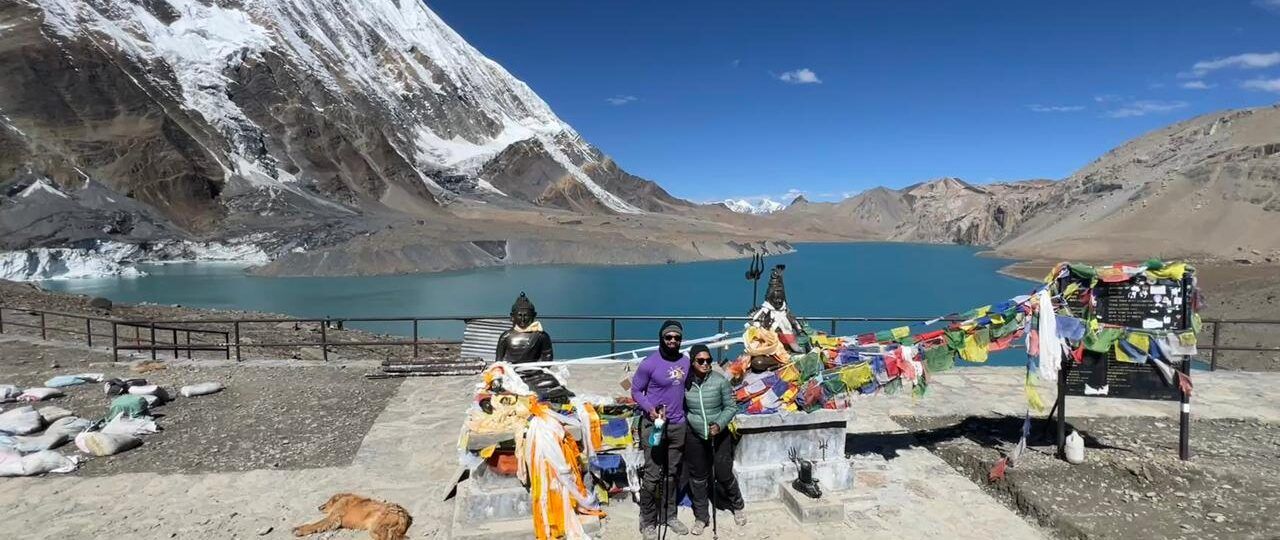
This 15-day Annapurna Circuit with Tilicho Lake follows the classic circuit route but adds a high-altitude detour to Tilicho Lake (4919m) before crossing Thorong La Pass (5416m). The trail moves gradually from forested lower valleys to the dry, high-alpine terrain of Manang, then into exposed mountain landscapes above 4000 meters.
The route passes through Tibetan-influenced villages, crosses the Kali Gandaki Gorge, and continues to the pilgrimage site of Muktinath after Thorong La. Adding Tilicho Lake changes the rhythm of the circuit. It brings you to a high altitude lake at 4919m before the 5416m pass and makes the journey feel more remote than the standard route.
What Is the Tilicho Lake Side Trip on the Annapurna Circuit?
The Tilicho Lake side trip is a high altitude detour from Manang that leaves the main Annapurna Circuit trail and climbs toward Tilicho Base Camp at 4150m before reaching Tilicho Lake at 4919m. After returning from the lake, the route reconnects with the standard circuit near Yak Kharka before continuing toward Thorong La Pass.
This extension adds 2 to 3 extra days to the Annapurna Circuit. It is not a separate trek. It is a connected route variation within the circuit.
Trekkers choose this detour to experience one of the highest lakes in Nepal, set in the dry high-alpine deserts of Manang. The lake is often described as turquoise and is surrounded by steep glacial walls and exposed mountain slopes.
Unlike the main Annapurna Circuit route, the Tilicho section is more remote and less trafficked. The terrain is more exposed, and the altitude gain is faster. This is why proper acclimatization in Manang is essential before attempting the lake.
Is Tilicho Lake Worth the Detour on the Annapurna Circuit?
Many trekkers ask us this in Manang: should I take the side trip to Tilicho Lake or continue directly toward Thorong La?
Whether Tilicho Lake is worth the detour depends on your goals. If your aim is simply to complete the Annapurna Circuit and cross Thorong La, you can skip it. But if you want to experience a true high altitude lake at 4919m in a raw alpine setting, then the extension changes the character of the entire trek.
Many trekkers who skip Tilicho later tell us they regret it. The lake feels remote and dramatic in a way the main circuit does not. However, it comes with extra altitude exposure and a longer walking day. This decision should be based on energy levels in Manang, not on ego.
Tilicho Lake sits at 4919m, higher than most points on the standard Annapurna Circuit before Thorong La. It is considered one of the highest lakes in Nepal and carries spiritual meaning in Hindu mythology. What stands out is not only the color of the water but the silence. There are no villages nearby, no trees, just rock, ice, and wind.
Reaching it requires steady effort.
The detour adds 2 to 3 extra days from Manang. The trail between Shree Kharka and Tilicho Base Camp crosses a short landslide-prone section. It is safe with proper timing and experienced guides, but it demands attention.
If your priority is completing the circuit quickly, you may skip it. If you have the time and are comfortable with additional altitude exposure, the extension adds a distinct high altitude lake experience to the circuit.
Why the Annapurna Circuit with Tilicho Lake Stands Out as a Top Nepal Trek
Tilicho Lake Extension: Unlike standard Annapurna treks, this journey includes the dramatic side trip to Tilicho Lake, a high altitude lake at 4919m linked to Hindu legends from the Ramayana.

Thorong La Pass Challenge: Crossing this 5,416m pass rewards trekkers with wide views of Annapurna, Dhaulagiri, and Manaslu.
Cultural Encounters: Visit Tibetan-style villages, stay in locally operated teahouses, and join in seasonal festivals along the way.
Diverse Landscapes: From lush rhododendron forests to the windswept Kali Gandaki Gorge, the trek covers over 160 km of varied scenery.
Your Step-by-Step 15-Day Itinerary: From Kathmandu to the High Passes
This 15-day Annapurna Circuit with Tilicho Lake itinerary is structured for gradual altitude gain and realistic walking hours. Distances and elevations are planned to support acclimatization before reaching Tilicho Lake at 4919m and Thorong La Pass at 5416m. Teahouse accommodation is used throughout the trek, and porters carry the main duffel bags.
Day 1: Arrival in Kathmandu (1345 meters)
Arrival at Tribhuvan International Airport. Our team transfers you to your hotel in Thamel. The rest of the day is free to rest, exchange currency, or check equipment. No scheduled activities.
Day 2: Exploring Kathmandu’s Treasures
After breakfast, a guided full day of sights in Kathmandu Valley. Visits typically include Pashupatinath Temple, Boudhanath Stupa, Swayambhunath, and Patan Durbar Square. A detailed trek briefing and gear check are conducted in the afternoon.
Day 3: Drive to Dharapani (1960 meters), 10-11 hours
Drive by private jeep from Kathmandu to Dharapani. The road follows the Marsyangdi River through Besisahar and Jagat. Conditions vary depending on the season. Overnight in a teahouse.
Day 4: Trek to Chame (2710 meters), 5 hours
The trail follows the river valley through pine forest and small settlements. Gradual ascent with permit checks along the way. Chame is the administrative center of Manang district.
Day 5: Trek to Pisang (3300 meters), 5 hours
Steady climb through forest and open sections. Upper Pisang is preferred for better altitude progression and wider mountain views. Walking pace remains controlled to support acclimatization.
Day 6: Trek to Manang (3540 meters), 6 hours
The landscape becomes drier as the trail enters the rain shadow area of Manang. The route passes Braga village and monasteries before reaching Manang, the main acclimatization stop on the Annapurna Circuit.
Day 7: Acclimatization in Manang (3540 meters)
Second night in Manang for altitude adjustment. Optional acclimatization hikes above the village, including Gangapurna viewpoint or Praken Gompa. Our guides monitor hydration and altitude symptoms.
Day 8: Trek to Tilicho Base Camp (4150 meters), 5-6 hours
From Manang, the trail branches toward Khangsar and Shree Kharka. A narrow section crosses a landslide-prone slope before reaching Tilicho Base Camp. Walking speed is slow and steady due to altitude.
Day 9: Hike to Tilicho Lake (4919 meters) and Back, 6-7 hours
Early start due to wind conditions at higher elevations. The ascent from base camp is steep and exposed in sections. Tilicho Lake sits at 4919m, surrounded by glaciated slopes. After a short stay, return to base camp for overnight.
Manang to Tilicho Lake Trek Duration and Route Details
From Manang (3540m), the Tilicho Lake side trip typically requires 2 to 3 days.
- Manang to Shree Kharka: 3 to 4 hours
- Shree Kharka to Tilicho Base Camp: 4 to 5 hours
- Tilicho Base Camp to Tilicho Lake (4919m): 3 to 4 hours one way
The section between Shree Kharka and base camp includes a short unstable slope that requires careful timing and spacing between trekkers. After returning from Tilicho Lake, the route reconnects near Yak Kharka before continuing toward Thorong Phedi.
Day 10: Trek to Letdar (4230 meters), 6 hours
Return to Shree Kharka and continue toward Letdar. Terrain is open and dry. Altitude gain remains gradual in preparation for Thorong La.
Day 11: Trek to Thorong Phedi (4600 meters), 4 hours
Short ascent to Thorong Phedi. The remainder of the day is used for rest, hydration, and preparation for the pass crossing.
Day 12: Cross Thorong La Pass (5416 meters) to Muktinath (3800 meters), 8 hours; Then to Jomsom
Early departure, usually before sunrise. The climb to Thorong La is steady and gradual. After reaching 5416m, descend to Muktinath. Continue by jeep to Jomsom for overnight.

Day 13: Fly to Pokhara (850 meters)
Morning flight from Jomsom to Pokhara, weather permitting. Free afternoon in Pokhara.
Day 14: Fly Back to Kathmandu
Flight to Kathmandu. Free time for rest or shopping.
Day 15: Departure
Airport transfer according to flight schedule.
The schedule builds altitude gradually and keeps walking hours manageable before Tilicho Lake and Thorong La.
Total walking: Approximately 100 kilometers on foot, excluding drives and flights.
Trekking Experience: Accommodation, Food & Daily Life
Accommodation: Family-run teahouses with twin beds, simple bedding, and shared bathrooms.
Meals: Dal bhat, soups, noodles, pancakes, and apple pies in Manang. Vegetarian and vegan options available.
Daily routine: 5 to 8 hours of walking, evenings in teahouse dining rooms with simple meals and early rest.
Safety, Acclimatization & Trek Difficulty
Difficulty: Moderate to strenuous; 5-8 hrs trekking daily.
Altitude: Tilicho Lake at 4919m, Thorong La Pass at 5416m.
Acclimatization: We spend two nights in Manang (3540m) before heading toward Tilicho. This allows gradual altitude adaptation before reaching 4150m at Tilicho Base Camp and 4919m at the lake. After Tilicho, the body is better prepared for Thorong La Pass at 5416m. We follow the principle of climbing high and sleeping lower whenever possible.
A safe altitude profile for Tilicho Lake should follow this progression:
- Sleep at Manang 3540m for two nights
- Optional acclimatization hike to 4000m to 4200m before moving higher
- Sleep at Tilicho Base Camp 4150m
- Reach Tilicho Lake 4919m and descend the same day
- Do not sleep above 4200m before visiting the lake
We avoid rapid ascents from Manang directly to Tilicho Base Camp in one push if trekkers show symptoms such as headache or poor appetite. A flexible schedule is more important than speed on this route.
Guides & Support: Experienced local guides monitor symptoms daily and manage spacing and timing on exposed sections of the trail.
Route Logic: Thorong La Direct vs Thorong La via Tilicho Lake
On the standard Annapurna Circuit, trekkers move from Manang to Yak Kharka, then to Thorong Phedi, and cross Thorong La Pass at 5416m without first reaching 4900m.
When taking the Tilicho Lake extension, the body is exposed to 4919m before Thorong La. This has two effects. First, it adds physical fatigue. Second, it can help partial acclimatization because the body experiences higher altitude before attempting the 5416m pass.
However, this benefit only works if the ascent is gradual and hydration is maintained. Rushing from Manang to Tilicho Base Camp without proper pacing increases risk.
For trekkers with stable energy and good adaptation in Manang, crossing Thorong La after Tilicho Lake often feels psychologically easier because they have already stood near 5000m.
Annapurna Circuit vs Annapurna Circuit with Tilicho Lake Extension
| Standard Circuit | With Tilicho Lake Extension |
|---|---|
| Shorter by 2 to 3 days | Adds 2 to 3 extra days |
| Highest point: Thorong La 5416m | Includes Tilicho Lake 4919m before Thorong La |
| Moderate to strenuous | More physically demanding |
| Less exposure to landslide sections | Includes short landslide-prone stretch near Base Camp |
Cost & Inclusions
Price: USD 1290 per person (minimum 2 trekkers, customizable on request).
Included:
- Airport transfers
- Kathmandu hotel with breakfast
- Drive to Dharapani
- All meals during trek
- Teahouse accommodation
- Licensed English-speaking guide & porters
- Trekking permits
- Jeep transfer Muktinath-Jomsom
- Domestic flights Jomsom-Pokhara-Kathmandu
- Duffel bag, sleeping bag, down jacket (on request)
- Taxes & service charges
Not included
- Personal expenses,
- Drinks
- Insurance
- Gear
- Meals in cities
- Tips to guide/porters.
Why the Tilicho Extension Costs More Than the Standard Circuit
The Tilicho Lake detour adds extra accommodation nights, additional porter days, and longer guide support. It also involves higher food transport costs because Tilicho Base Camp is more remote than the main Annapurna Circuit villages.
Flights from Jomsom are weather dependent. In case of cancellation, alternative jeep transfers may be required, which can affect overall cost and schedule. We always discuss contingency planning before departure.
Common Questions About the Annapurna Circuit with Tilicho Lake Trek
How difficult is the Annapurna Circuit with Tilicho Lake?
This route is physically demanding due to altitude rather than technical terrain. Daily walking time ranges from 5 to 8 hours. The Tilicho Lake side trip and Thorong La Pass at 5416m are the most demanding sections. The trail is non-technical, but stamina and steady pacing are important.
Is previous trekking experience required?
Previous multi-day trekking experience helps but is not mandatory. Trekkers should be comfortable walking uphill for several hours at a steady pace. Consistent cardio training for at least four weeks before arrival is recommended.
How many extra days are needed for Tilicho Lake?
The Tilicho Lake extension adds 2 to 3 days to the standard Annapurna Circuit itinerary. This includes the walk from Manang to Tilicho Base Camp and the return to rejoin the main route toward Yak Kharka.
What is the best time for Annapurna Circuit with Tilicho Lake?
Spring (March to May) and autumn (September to November) offer stable weather and clearer mountain views. Winter crossings are possible but snow can close Thorong La. During monsoon, the lower sections receive rain and the landslide area near Tilicho requires extra caution.
Is Tilicho Lake safe to visit?
Tilicho Lake sits at 4919m. The main risk is altitude gain and a short unstable slope between Shree Kharka and base camp. With proper acclimatization in Manang and careful timing across the slope, the route is considered safe under normal conditions.
How does acclimatization work on this itinerary?
Two nights are spent in Manang before ascending toward Tilicho. After visiting the lake and descending, the body is better prepared for Thorong La. Guides monitor symptoms daily and adjust pacing if needed.
What permits are required?
The trek requires an Annapurna Conservation Area Permit (ACAP) and a TIMS card. These are arranged before departure from Kathmandu.
What kind of accommodation is available?
Accommodation is in family-run teahouses with basic twin rooms and shared bathrooms. Facilities become simpler above 4000m. Heating is generally available only in the dining area.
What meals are provided during the trek?
Meals are ordered from teahouse menus and typically include rice, lentils, vegetables, noodles, potatoes, eggs, and soups. Meat is available in lower villages but becomes limited at higher elevations. Boiled drinking water is available for purchase.
Do I need travel insurance?
Insurance must cover trekking above 5000 meters and emergency helicopter evacuation. This is mandatory due to the altitude of Tilicho Lake and Thorong La Pass.
Can the itinerary be customized?
Yes. Extra acclimatization days can be added if needed. Extensions toward Nar Phu Valley or Annapurna Base Camp are possible, depending on time and permits.
What are the main risks on this trek?
The primary risks on this route are altitude sickness above 4000m, sudden weather shifts at Thorong La, and the unstable slope between Shree Kharka and Tilicho Base Camp.
The landslide section is crossed early in the morning when rockfall risk is lower. Trekkers move with spacing between each other and do not stop in the exposed zone.
Thorong La crossings begin before sunrise to avoid strong winds that build late morning. If weather deteriorates, we delay the crossing. If weather or health conditions are not right, we turn back. Reaching the pass matters less than returning safely.
Why Trek with Mosaic Adventure?
Our guides have worked on this route for many seasons. They understand the timing across the Tilicho slope, the wind patterns near Thorong La, and when trekkers need an extra acclimatization day. Decisions on the trail are based on conditions, not fixed schedules.
Planning Your Annapurna Circuit with Tilicho Lake
If you are considering the Annapurna Circuit with Tilicho Lake, take time to evaluate your pacing, acclimatization strategy, and seasonal timing. This route rewards patience and preparation.
For route planning questions or customization, contact our team directly. We are happy to review your schedule and suggest realistic adjustments based on current trail conditions.
Want more information? Send us your query, and our experts will get back to you within 24 hrs.

Rajendra Sapkota is the co-founder of Mosaic Adventure and a veteran in the trekking industry with over three decades of experience guiding adventurers through Nepal’s stunning landscapes. . His unparalleled knowledge of every trail, from the popular Everest Base Camp to the remote Upper Mustang, has earned him a reputation as a trusted authority on Nepal’s geography and culture. Raj’s passion for the Himalayas is matched only by his dedication to ensuring a safe and memorable journey for every traveler.
If you have any questions or need personalized advice to plan your trip to Nepal, you can reach out to him directly at [email protected].
