
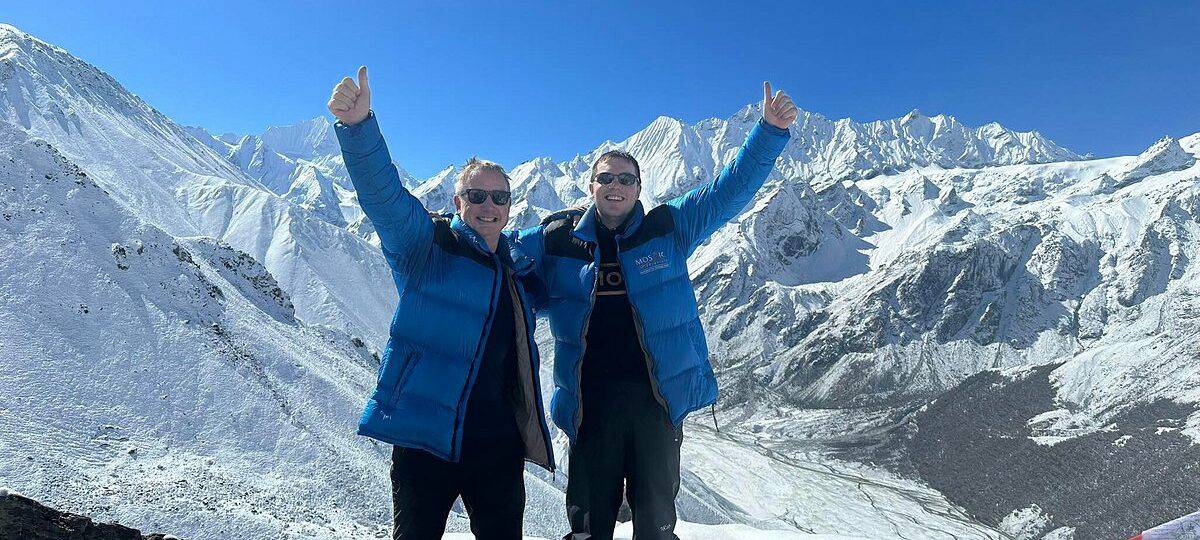
The choice between Langtang and Everest Base Camp isn’t really about “which is better.” It’s about what kind of trek you want day after day: quieter trails and faster logistics, or higher altitude, bigger scenery and a busier route with more moving parts.
We’ll compare them using the things that actually change your experience on the trail: altitude exposure, pacing, logistics, cost, crowds and what each route feels like culturally.
Both routes sit among Nepal’s best-known treks, but they deliver different tradeoffs. It’s worth deciding based on the experience you want, not just the headline.
If you’re comparing these two routes, you’re likely choosing between a quieter Himalayan valley and the classic Everest experience. They differ in pace, altitude, atmosphere and overall intensity.
Key Differences at a Glance (or Must-Know Trek Facts)
- Langtang is shorter and lower: 7 days, with a highest night of 3,830m. There is no flight, but there is a long jeep ride to Thulo Syabru (6 to 7 hours). Since the August 2026 flood, the trek starts there and not at Syabrubesi.
- Everest Base Camp is longer and higher: 14 days on our guided trek, with nine nights above 3,000m and five above 4,000m. It needs a flight to Lukla and more acclimatization days.
- If crowds matter, the difference is noticeable in peak seasons. Everest feels social and busy and Langtang feels calmer.
- Langtang is not automatically the safer choice. On a 7-day plan it gains height faster, so the speed of ascent matters as much as the top altitude.
| Langtang Valley Trek | Everest Base Camp Trek | |
|---|---|---|
| Duration (our guided trek) | 7 days | 14 days |
| Highest sleeping altitude | 3,830 m (Kyanjin Gompa) | 5,170 m (Gorak Shep) |
| Highest point reached | 4,984 m (Tsergo Ri, optional day trip) | 5,545 m (Kala Patthar, day trip) |
| Nights above 3,000 m | 3 | 9 |
| Nights above 4,000 m | 0 | 5 |
| Location | Langtang National Park (Nepal) | Sagarmatha National Park (Nepal) |
| Getting there | Private jeep from Kathmandu to Thulo Syabru, about 6 to 7 hours | Flight to Lukla (about 25 minutes), from Ramechhap in peak season |
| Hardest travel day | The jeep ride and the long first walking day | The early start for the Lukla flight (1 to 2 am in peak season) |
| Difficulty | Moderate to demanding | Demanding |
| Altitude sickness risk | Lower top altitude, but the 7-day plan gains about 1,090 m of sleeping altitude on night 3 | Higher top altitude, with two rest days built in |
| Nearest road | About two days’ walk from Kyanjin Gompa to Thulo Syabru | No road. About three days’ walk from Gorak Shep to Lukla |
| Crowd | Less crowded | Crowded during peak seasons |
| Cost | From USD 595 | From USD 1,445 |
| Accommodation | Teahouses | Teahouses (upgrade options available at some stops) |
Counts of nights are from our guided itineraries: the 7-day Langtang trek from Thulo Syabru and the 14-day Everest Base Camp trek. Altitudes are rounded and vary by source.
If you’re stuck, decide based on three things: how many days you have, how you handle altitude and how you feel about busy trails. Cost, logistics and season tend to follow from those.

Want more information? Send us your query, and our experts will get back to you within 24 hrs.
Langtang vs EBC: An Overview of the Trekking Routes
The Langtang Valley Trek runs through the Langtang region north of Kathmandu, combining Tamang villages, forest sections and high valley scenery. It is quieter than the Everest corridor, which changes the feel of the trek day to day. Since the August 2026 flood damaged Syabrubesi, we start at Thulo Syabru and walk down to Pairo, where the route joins the classic trail up the valley. For the full route and current status, see our Langtang Valley trek guide.
The Everest Base Camp route takes you through the Khumbu region toward the base of Mount Everest (8,848.86m). This classic Khumbu Valley trek gives wide views of Everest, Lhotse, Nuptse and Ama Dablam.
The trek also passes through Sherpa villages, where daily life has adapted to high altitude over generations.

Scenery and Landscape: Langtang VS Everest
The Langtang Valley moves from forest to open alpine terrain in a gradual, contained way. Lower sections pass through rhododendron and bamboo forests and traditional Tamang villages, while higher up the valley opens toward pasture and glacier views beneath peaks such as Langtang Lirung and Ganesh Himal.
Above Namche, the Everest route becomes more exposed and expansive. Views widen toward Everest, Lhotse and Nuptse and the terrain shifts to rock, moraine and glacier. By the time you approach base camp, most of the walking is through a high-altitude, glacial landscape with little vegetation.
Cultural Experience
The Langtang Valley Trek gives you a close look at the Tamang and Tibetan cultures. As you walk the trail, you’ll see ancient Buddhist monasteries, mani walls (stone carvings) and prayer wheels and you notice the spiritual life of the Langtang people.
You’ll notice more Tibetan-influenced elements as you gain altitude, not as a performance for visitors, but as part of everyday practice.
On the EBC route, you see Sherpa culture up close, visiting places like Tengboche Monastery and the busy village of Namche Bazaar (often called the Sherpa capital). Even with more tourism, the Everest region combines Sherpa village life with high mountain scenery, especially around Namche and Tengboche.
In peak season, Namche and the main trail can feel almost like a moving village, which some trekkers love and others avoid.

Difficulty and Altitude
The Langtang Valley Trek is a moderate to demanding trek. Its highest night is 3,830 meters at Kyanjin Gompa and the optional Tsergo Ri day trip reaches 4,984 meters. The top altitude is lower than Everest, but a 7-day plan climbs quickly. On our itinerary, night 3 (Rimche to Mundu) gains about 1,090 meters of sleeping altitude, which is more than the 500 meters a night we use as a guide above 3,000 meters. That is why we suggest it for fit trekkers who have been at altitude before.
The Everest Base Camp trek is more demanding. Base Camp is at 5,364 meters and the highest night is at Gorak Shep (5,170 meters). The trail has many steep climbs and drops and you spend five nights above 4,000 meters. Our 14-day plan includes two rest days, at Namche Bazaar and Dingboche and keeps most nightly gains near or below 500 meters. You need good fitness and careful acclimatization to keep the risk of altitude sickness low. For more, see our Everest Base Camp trek difficulty guide.
A simple rule that works on both routes: if your pace falls apart or your sleep gets worse as you go higher, slow down early and tell your guide instead of pushing through. For the basics of prevention, see our guide to altitude sickness.
Duration
The Langtang Valley Trek takes 7 days on our guided itinerary, including a long drive on the first and last days. That leaves about five days on the trail, which makes it a good fit if your time is limited.
Everest Base Camp takes 14 days on our guided trek, including two acclimatization days. Shorter versions of around 12 days exist, but they leave less room for rest days. While it asks for a longer commitment, the trek covers a fuller stretch of the Khumbu region and Sagarmatha National Park.
Accessibility and Crowds
Langtang starts with a road journey. We ride a private jeep from your hotel in Kathmandu to Thulo Syabru, about 6 to 7 hours through Trishuli, Betrawati and Dhunche. Before August 2026 the trek started at Syabrubesi, which the flood severely damaged. The road can still be affected by heavy rain, so we confirm conditions before each departure. On the trail, Langtang is noticeably quieter.
Everest starts with a flight to Lukla, followed by a walk through the busy trails of the Khumbu region. As one of the most popular treks in the world, expect larger crowds along the route. In peak seasons, Lukla flights usually leave from Ramechhap, which means a drive of about 4 hours starting around 1:00 to 2:00 am. See our Lukla flight guide.
Distance from Help
Langtang is a road trek, but the road starts at Thulo Syabru, about two days’ walk from Kyanjin Gompa on our plan, followed by a 6 to 7 hour drive to Kathmandu. Everest has no road. From Gorak Shep it is about three days’ walk to the Lukla airstrip, so helicopter evacuation is the main way out in an emergency and it depends on the weather. On both treks the first step is the same: tell your guide early and go down. Insurance that covers helicopter evacuation matters on both. See our travel insurance guide, written for Everest Base Camp but useful for Langtang too.
Physical Fitness
For Langtang, the best preparation is simple: consistent walking uphill with a loaded daypack, plus enough cardio that you can hold a steady pace for several hours. The trek has long days and steady climbs and it suits trekkers with good fitness.
For Everest, the same training matters, but you’ll benefit from extra endurance, more days on your feet, more time at altitude and less room to rush the itinerary.
For a training plan, see our guide to training for trekking in Nepal.
Cost
In terms of cost, the Langtang Valley Trek is more budget friendly than the Everest Base Camp Trek. Our guided Langtang trek starts from USD 595 and our 14-day Everest Base Camp trek from USD 1,445. The gap comes from the shorter trek, lower permit costs and no flight. Langtang has one new cost: since the flood we use a private jeep to reach Thulo Syabru. For a budget breakdown, see our Langtang trek cost and Everest Base Camp trek cost guides.
On Everest, daily prices for food and lodging increase as you gain altitude. The extra costs come from the required flight to Lukla, the higher permit fees for the region and higher prices for food and accommodation on the trail. If you’re budgeting tightly, the flight plus higher trail prices are usually what surprises people most on Everest.
Highlights
The Langtang route is known for its open alpine views, cultural landmarks such as Kyanjin Gompa, high view point like Tsergo Ri, diverse flora and fauna and famous cheese from Langtang.
The upper valley around Kyanjin is also a good place for viewpoint hikes and an extra night here gives your body more time.
In contrast, the Everest Base Camp Trek offers highlights including close-range views of Everest from Kala Patthar, Tengboche Monastery, Khumbu Glacier and the milestone of reaching Everest Base Camp itself.
Most people remember Kala Patthar more than base camp itself. It’s where the classic sunrise and Everest-facing views come together.
Packing Requirements
For the Langtang Valley Trek, pack lightweight, breathable clothing for lower elevations, along with warm layers for higher altitudes. Essentials include a fleece or high-quality down jacket, a waterproof outer shell, quick-drying trekking pants and moisture-wicking base layers. Don’t forget sturdy trekking boots, trekking poles and sun protection gear.
For the EBC, pack similar clothing with additional warm layers, thermal underwear and insulated pants for extreme cold. Prioritize high quality, insulated trekking boots and gaiters for icy terrain if trekking around winter season. On Everest, bring a simple way to track how you’re doing (resting pulse, sleep quality, appetite) and keep your layering system dialed, cold and fatigue compound quickly at altitude.

Best season
Both the Langtang Valley Trek and the Everest Base Camp Trek are viable in the main trekking seasons, but knowing the best time to trek is key. The ideal seasons differ a little between the two.
For Langtang, the best times are spring (March to May) and autumn (September to November). In spring, expect mild weather, clear skies and a burst of color from the rhododendron blooms.
The stable weather conditions make this season ideal for enjoying panoramic views of the Langtang region and its surrounding peaks. Additionally, autumn offers similar benefits, with crisp air, golden foliage and fewer crowds compared to the peak season. These months usually mean stable visibility and fewer weather disruptions, which makes planning simpler.
On the other hand, for the Everest, spring and autumn are the best seasons for exploration. In spring, trekkers can enjoy mild temperatures, clear skies and the clearer views that come with stable spring weather. Spring often has clear mornings and more manageable trail traffic compared to autumn.
Autumn presents favorable weather conditions, making it an excellent time to trek to Everest Base Camp. Autumn has crisp air and consistent visibility, but it’s also the busiest time on the Everest trail.
While both treks can be undertaken during the winter months, it’s important to note that they present additional challenges. In winter, colder temperatures and occasional snowfall can make trekking more demanding, especially at higher elevations.
Proper preparation, including adequate cold-weather gear and experience with winter trekking, is essential for those embarking on these adventures during this season.
Comparing the two, the Langtang Valley trek is more feasible in winter because the highest night is at 3,830 meters in Kyanjin Gompa. On the Everest Base Camp trek, the highest teahouse is at 5,170 meters in Gorak Shep, which is much colder. Winter still brings snow and short days on both routes and the Langtang road can be affected by snow or rain, so leave buffer days. For month by month detail on Everest, see our guide to the best time to trek Everest Base Camp.
Safety
The Langtang Trek is a well-established route, but it goes through remote areas where medical help is limited. Your guide carries a first aid kit and you should know the basics of altitude illness. The 7-day plan gains height quickly on night 3, so pace yourself and tell your guide how you feel.
Also, Langtang weather can change fast, especially in the monsoon season (June to August), when the risk of landslides is higher. The August 2026 flood on the Bhote Koshi river showed how quickly the road corridor can change. Check conditions with your operator and leave buffer days at both ends of the trek.
Wildlife encounters are rare, but store food properly and avoid feeding or approaching wild animals.
Similarly, the Everest Trek is safe for those who are prepared and follow good safety rules. However, altitude sickness (or AMS) is a major concern because of the extremely high elevations. You must acclimatize properly by hiking slowly and taking rest days to let your body adjust to the thin air. It is very important to stay hydrated, keep a slow, steady pace and know the symptoms of AMS, which can get serious if ignored. The main prevention is simple: build in acclimatization days and keep a conservative pace.
In addition to altitude related risks, trekkers on the Everest Base Camp Trek should be prepared for variable weather conditions, including cold temperatures, strong winds and the possibility of snowfall, especially at higher elevations. Proper gear, including warm clothing, sturdy footwear and waterproof layers, is essential for staying safe and comfortable throughout the trek.

Frequently Asked Questions (FAQs)
Here are answers to the most common questions about choosing between the Langtang Valley and Everest Base Camp treks.
Q: Which trek is better for first-time trekkers: Langtang Valley or EBC?
A: Both are possible for first-time trekkers in Nepal, but neither is a casual first trek. Langtang is shorter (7 days) and its highest night is lower (3,830m), but our 7-day plan gains height quickly, so it suits fit trekkers who have been at altitude before. Everest is higher and longer, with two rest days built in. If this is your first high altitude trek, ask us about extra nights on Langtang, or see our guides to the best treks in Nepal for beginners and Everest Base Camp for beginners.
Q: What is the highest altitude reached on each trek?
A: The highest point on the Langtang trek is the viewpoint of Tsergo Ri at 4,984 meters, an optional day trip. You sleep no higher than Kyanjin Gompa at 3,830 meters. The highest point on the Everest Base Camp trek is Kala Patthar at 5,545 meters (with Base Camp at 5,364m) and you sleep at Gorak Shep at 5,170 meters. This is considerably higher and requires more cautious acclimatization.
Q: Why is the Everest Base Camp Trek significantly more expensive than Langtang?
A: The higher cost of the EBC Trek is mainly due to the required flight to Lukla (the trailhead), which is a significant expense. Additionally, the EBC region (Khumbu) has higher government permit fees and generally increased costs for food and accommodation along the trail due to the high volume of international tourism.
Q: Which trek offers a more authentic cultural experience?
A: The Langtang Valley route offers a deeper and more intimate cultural experience with the Tamang people and Tibetan-influenced Buddhist life, as the trails and villages are less crowded. While EBC is rich in Sherpa culture (like at Tengboche Monastery), the heavy tourism volume often makes the experience feel less solitary.
Q: Are the permit requirements different for the two regions?
A: Yes, they are different. The Langtang Trek requires the Langtang National Park Entry Permit and a TIMS Card. The EBC Trek requires the Sagarmatha National Park Permit and the Khumbu Pasang Lhamu Rural Municipality Entry Permit (the local authority permit, which replaced the TIMS card for this region).
Q: Which trek has a higher risk of delays and itinerary disruption?
A: Everest has the more visible risk. Weather can delay or cancel Lukla flights and add days to your trip. Langtang has no flight, but the road to Thulo Syabru can be slowed by rain and landslides and the road corridor was damaged in the August 2026 flood. Both treks need a buffer day. See our Lukla flight guide.
Q: When is the absolute best time to go for either of the treks?
A: The peak seasons are identical for both: Spring (March to May) and Autumn (September to November). These seasons offer the most stable weather, clearest mountain views and moderate temperatures. However, autumn sees heavier crowds on the EBC route compared to Langtang.
Q: Is the Langtang Valley trek open after the August 2026 flood?
A: Yes. Our guides walk the trail from Pairo up to Kyanjin Gompa and it is intact. The trek now starts and ends at Thulo Syabru instead of Syabrubesi. Road conditions can change, so confirm with your operator before you travel. Details are in our Langtang Valley trek guide.
Q: How many nights do you sleep above 3,000 meters on each trek?
A: On our itineraries, Langtang has three nights above 3,000 meters and none above 4,000. Everest has nine nights above 3,000 meters, five above 4,000 and one above 5,000 (at Gorak Shep).
Q: Which trek should I choose if I only have 8 to 10 days?
A: Langtang. Our guided Everest Base Camp trek takes 14 days, including two rest days. If you are short of time, a helicopter return can shorten Everest to about 11 days, but it does not remove the altitude on the way up. See our Everest Base Camp helicopter trek.
Q: Is 7 days enough for the Langtang Valley trek?
A: Yes, if you are fit and have been at altitude before. Seven days is the standard schedule we run. Night 3 gains about 1,090 meters, so if this is your first high altitude trek, ask us about a longer plan with extra nights.
Conclusion
The choice between Langtang and Everest Base Camp comes down to your time, how you handle altitude and what you want to see.
Choose the Langtang Valley Trek if you have 7 to 9 days, want quieter trails and a lower highest night, are fit and have been at altitude before (or are willing to add nights) and are happy with a long jeep ride at the start and end.
Choose the Everest Base Camp Trek if you have around 14 days, want to stand at the foot of Mt. Everest and watch the sunrise from Kala Patthar, are comfortable with a flight and an early start and accept colder, higher nights and busier trails in peak season.
Whichever route you choose, the trek goes better when the itinerary matches your pace and your altitude comfort. That is usually what decides whether you enjoy the walk or simply endure it.
If you’re unsure, send us your available dates, any previous high-altitude experience and the kind of trail you like. We are a locally owned team in Nepal, our guides speak English and we usually reply within 24 hours. We will suggest the route and pacing plan that fits, put the itinerary and price in writing and tell you honestly if neither fits.
Check the detailed pages here: Langtang Valley Trek and Everest Base Camp Trek. If you are weighing Everest against other treks, see Annapurna Base Camp vs Everest Base Camp and Three Passes vs Everest Base Camp.
Want more information? Send us your query, and our experts will get back to you within 24 hrs.

Madhav Prasad is a seasoned trekking and tourism expert with over two decades of experience in the field. Starting his career in 2001 as a porter, Madhav quickly advanced to the role of trekking guide, gaining invaluable hands-on experience in Nepal’s diverse trekking routes. In 2009, after eight years of dedication to the industry, he co-founded Mosaic Adventure, a leading trekking and tour company known for its commitment to safety, sustainability and personalized service.
Madhav has personally trekked to nearly every major trekking destination in Nepal, including Everest Base Camp, Annapurna Base Camp, the Annapurna Circuit, Poon Hill, Jomsom Muktinath, the Indigenous Peoples Trail, Langtang Valley and Mardi Himal, among others. His experience extends beyond Nepal, as he has also successfully summited Mount Kilimanjaro, Africa’s highest peak.
In addition to his extensive trekking credentials, Madhav is well traveled globally, having explored countries such as Australia, the USA, the UK, France, Japan, China, and many others. His global exposure enhances his ability to understand and cater to the diverse needs of international trekkers.
Madhav is the primary point of contact for many clients at Mosaic Adventure, personally addressing inquiries and helping plan treks with a meticulous and personalized approach. His deep knowledge of Nepal’s trekking routes, combined with his global travel experience, ensures that every trek is well planned, safe and unforgettable.
