
I get asked this a lot. And it’s not a simple answer because these two treks feel completely different on the ground, even if they look similar on paper. Both are multi-day Himalayan treks, both are popular with first-timers, and both will leave you wrecked in the best possible way. But if you only have time for one, the choice matters.
Here’s what I actually think, having stood at both.
Quick Decision Guide
- Choose Annapurna Base Camp if you want varied landscapes, lower altitude, a shorter trip, and simpler logistics.
- Choose Everest Base Camp if seeing Everest is specifically what brought you to Nepal and you’re comfortable at high altitude.
- Both are doable for fit beginners who prepare properly.
- Altitude tolerance, available time, and budget are the biggest deciding factors.
ABC vs EBC at a Glance
| Annapurna Base Camp | Everest Base Camp | |
|---|---|---|
| Duration | 5 to 10 days | 11 to 14 days |
| Max Elevation | 4,130 m | 5,643 m (Kalapatthar) |
| Difficulty | Moderate | Moderate to challenging |
| Scenery | Forests, rivers, glaciers, mountain amphitheater | High alpine terrain, glaciers, big Himalayan views |
| Cost | Lower | Higher (Lukla flight adds up) |
| Crowds | Moderate | Busy on the main valley trail |
| Best for | First-timers, shorter trips, varied landscapes | Bucket list Everest experience, high-altitude trekkers |
Planning the Trek
Getting There
Annapurna Base Camp starts from Pokhara, reachable by a quick domestic flight or a 6 to 7 hour bus ride from Kathmandu. No mountain flight needed. From Pokhara, most itineraries drive to Nayapul or Jhinu Danda to begin walking. Simple logistics, no weather delays at high altitude airstrips to worry about.
Everest Base Camp requires a flight from Kathmandu to Lukla, a small airstrip at 2,860 m that has a well-known reputation for cancellations when weather turns bad. The flight in is something else, you’re skimming ridgelines and the views hit you before you’ve even laced your boots. Build buffer days into your schedule though. Miss that Lukla flight and your whole schedule comes apart fast.

How Long Does Each Trek Take?
ABC can be done in as few as 5 days if you move fast and conditions cooperate, though 7 to 10 days is more realistic and more enjoyable. You can shorten the approach with a jeep, add a Poon Hill detour, or loop into the Annapurna Circuit. That flexibility is real and worth using.
The route also affects total distance more than most guides let on. A direct route via Nayapul, Sinuwa and Chhomrong and back covers significantly less ground than the longer loop through Ghorepani, Poon Hill and Tadapani before reaching the base camp. That’s why you’ll get wildly different answers when you ask how long ABC takes.
EBC is less flexible. Rushing acclimatization is how people get sick. Most realistic itineraries run 12 to 14 days. EBC follows the same trail up and back, so the total distance is predictable at around 130 km. There are shorter EBC options but they cut corners on acclimatization and are best avoided unless you have prior high-altitude experience.

Training
Neither trek will get you fit. You need to arrive fit. That’s the most important thing to understand before booking either of these trips.
For ABC, the focus should be on cardio endurance and leg strength. Long day hikes with a loaded pack are the best preparation. If you can comfortably manage back-to-back 6 to 7 hour hikes over uneven terrain without your knees giving out on the descents, you’re in reasonable shape. Start at least 8 weeks out.
EBC demands more because the altitude demands more. Your cardiovascular system is under stress for a longer period at greater elevation. Stair climbing, long hikes, and time on an incline with weight on your back will serve you better than flat running. If you have access to any high altitude before the trek, use it. Even a weekend at moderate elevation is worth doing before you go.
Full training guides for both: Annapurna Base Camp trek training and preparing for Everest Base Camp.
On the Trail
Altitude and Altitude Sickness
This is the one people get wrong most often.
ABC tops out at 4,130 m. High enough to feel the effects. You’ll likely get a headache, feel slow, tire faster than usual. But the ascent is gradual enough that most trekkers acclimatize without serious issues. The trail moves through different climate zones from subtropical to alpine, your body gets time to adjust before the altitude really bites.
EBC tops out at Kalapatthar at 5,545 m, with the base camp itself sitting around 5,364 m. The itinerary includes two dedicated acclimatization days, at Namche Bazaar around day 3 and at Dingboche around day 7, and you still need to pay close attention to how you’re feeling at places like Gorakshep. Altitude sickness is more common on EBC.
If you’ve never trekked above 3,500 m and you’re unsure how your body handles altitude, ABC is the smarter first choice. Our guide on altitude sickness and high altitude trekking covers what to watch for and how to prepare.
Difficulty
Both are graded moderate, which doesn’t mean much without context. Moderate in the Himalayas is not moderate anywhere else.
ABC involves daily walks of roughly 7 to 10 km with elevation gains of 200 to 400 m per day. No technical sections, no equipment beyond good boots and trekking poles. Hard, but doable if you’ve put the time in beforehand. The ABC difficulty breakdown gives a day-by-day picture of what to expect.
EBC is harder, mostly because of altitude and the cumulative fatigue of two weeks on the trail. The terrain is not technically difficult and you won’t need crampons or ropes. The altitude does something to you that’s hard to explain before you’ve felt it. You’re working harder just to breathe up there. The EBC difficulty guide goes into more detail.
The Base Camps Themselves
Most comparison posts skip this, which is strange because it’s one of the most concrete differences.
Annapurna Base Camp has teahouses. You sleep there. You wake up surrounded by the Annapurna massif with Machapuchare right in front of you. The overnight experience at ABC is one of the highlights of the whole trip, not just a checkpoint at the end of a long day.
EBC is a different story. There are no teahouses at EBC. During climbing season in April and May you’ll find expedition tents pitched across the glacier moraine, but outside of that it’s largely empty. Trekkers stay overnight at Gorakshep, the last teahouse settlement on the trail, and do a round trip to base camp from there. Most people spend a couple of hours at EBC and head back. The base camp itself is rocky, flat, and honestly not that photogenic. Kalapatthar, the ridge above Gorakshep, is where the real views are.
If the overnight experience matters to you, ABC wins that comparison without much contest.
Scenery
This is where they actually feel like two different trips.
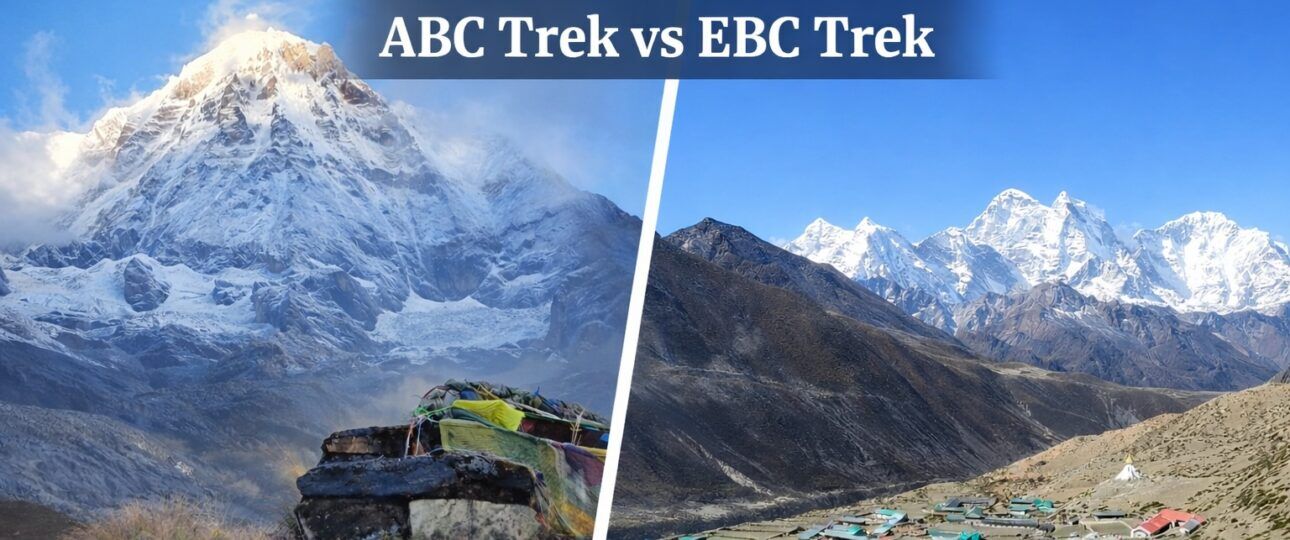
ABC has the more varied scenery. You start in warm, green lowland Nepal, walk through dense rhododendron forest that is genuinely spectacular in spring, follow the Modi Khola river gorge, pass through terraced farming villages, and then emerge into the high mountain amphitheater surrounding the base camp. Standing at ABC with Annapurna I, Annapurna South, Hiunchuli, and Machapuchare rising all around you is one of those moments. You’re not looking at the mountains from a distance. You’re inside them.
EBC scenery is dramatic and stark rather than varied. Above Namche Bazaar the landscape becomes increasingly alpine, rocky and sparse, with massive peaks appearing around every bend. The views of Ama Dablam on the way up are genuinely jaw-dropping. Kalapatthar gives you probably the best ground-level view of Everest’s upper slopes without a climbing permit. It’s epic. But it is also more of the same for long stretches, which wears on some people more than they expect.
Neither is better. It just depends what you’re there for.
Highlights
Annapurna Base Camp

- Annapurna Conservation Area is the largest protected region in Nepal, covering everything from subtropical lowlands to high glacial terrain. The biodiversity is genuinely surprising; rhododendron forests, subtropical birds, and alpine terrain within the same walk. The Kali Gandaki gorge, one of the deepest gorges in the world, cuts through the western edge of this region.
- Ghandruk village is a Gurung settlement with strong mountain views and a cultural life that hasn’t been reshaped by tourism the way some trail villages have. Don’t just pass through. Spend a night and actually look around.
- Poon Hill is an optional viewpoint many trekkers add on for the sunrise over the Annapurna range. Views of Dhaulagiri, Annapurna I, Nilgiri, and Machapuchare from the top. Poon Hill trek details here.

Everest Base Camp
- Namche Bazaar is the main hub of the Khumbu region and the heart of Sherpa culture. More facilities than you’d expect at 3,440 m. Bakeries, gear shops, restaurants, even a decent espresso if that matters to you. First views of Everest appear from the hill above the village.
- Tengboche Monastery is one of the highest monasteries in the world, with a backdrop of Everest and Ama Dablam that makes every photo look edited. Get there early before day visitors arrive.
- Kalapatthar sits at 5,545 m above Gorakshep and takes around 2 to 3 hours to climb from the teahouses. Most people start before dawn to catch the sunrise. That’s when Everest’s southwest face catches the light and the views are at their clearest before afternoon cloud builds.
People, Cost and Logistics
Weather and Best Times to Go
For both treks the best seasons are spring (March to May) and autumn (September to November). Stable skies, manageable temperatures, good visibility on the peaks.
ABC in winter is doable and some people prefer the quieter trails. Snow above 3,000 m can make certain sections genuinely difficult though. ABC during monsoon (June to August) brings heavy rain alongside lush green landscapes and very few other trekkers. Some people love it for exactly that reason. Full details in our best time for ABC guide.
EBC in winter is harsh. Temperatures at Gorakshep can reach -20 C at night. Doable if you’re serious about gear and cold, but not for the unprepared. Monsoon at EBC is generally not worth it since cloud cover kills the views and the trail gets slippery. Full EBC weather breakdown here.
Cost
ABC is the more affordable trek. Teahouse accommodation runs around $5 to $6 per night at the lower end, meals around $8 to $10 each. No expensive domestic flight required, just transport to Pokhara. Full ABC cost breakdown here.
EBC costs more, partly because accommodation prices rise with altitude (expect $8 to $10 per night for the basics) and partly because the Lukla flight is a real expense. Charging electronics and hot showers cost extra at higher elevations on both treks, though it adds up faster on EBC. Some trekkers cut costs by trekking to EBC without the Lukla flight, starting from Jiri instead. Full EBC cost breakdown here.

Permits
Both treks require permits but the requirements differ.
For ABC you need the Annapurna Conservation Area Project (ACAP) entry permit. For EBC the required permit is the Sagarmatha National Park entry permit. Both are straightforward to arrange in Kathmandu or Pokhara, and any reputable agency handles this for you.
On TIMS: the government has announced the TIMS card requirement but it is not being actively enforced on either trail at the moment. If properly implemented, both regions would likely require it. This kind of regulation can change without much notice, so check the current rules before you go rather than relying on what was true six months ago.
Guides and Porters
On ABC, some experienced trekkers go independently. The trail is well-marked and teahouses are easy to find. A guide helps during peak season when accommodation gets tight. More on hiring a guide and porter for ABC here.
On EBC, the altitude changes the calculation. A guide who can recognize AMS symptoms, adjust the pace, and arrange helicopter evacuation if things go wrong is genuinely worth having. Not a luxury, a practical decision. Carrying a heavy pack at high altitude is also harder than most people expect going in. EBC guide hire details here.
Culture and Communities
On the ABC trail you’ll pass through farming villages in the lower sections, with Gurung communities being the most prominent cultural group. Ghandruk is the best example. Traditional stone houses, family-run guesthouses, and a village life that feels real rather than performed for tourists.
EBC passes through Sherpa territory from start to finish. Namche Bazaar is the cultural center, but monasteries, mani walls carved with Buddhist prayers, and prayer flags strung across the trail appear throughout the whole route. The Khumbu region has a deep Buddhist identity and you feel it at every stage rather than only at designated stops.
Side Trips
From ABC, the obvious addition is Poon Hill, a 3 to 4 day extension that adds the famous sunrise viewpoint over the Annapurna range. Very popular and worth it.
From EBC, the main side trip is Gokyo Lakes, a route through a chain of high-altitude glacial lakes with views across to Cho Oyu. Combining EBC and Gokyo into a single itinerary is one of the better ways to do the Khumbu region justice if you have 18 or more days.
Which Trek Is Right for You?
Go with Annapurna Base Camp if:
- You’re trekking in Nepal for the first time and want varied, accessible terrain
- You have 10 days or less
- Altitude concerns you or you’ve never been above 4,000 m before
- You want lower costs and simpler logistics
- Forests, villages, and changing scenery matter as much as the mountain views
Go with Everest Base Camp if:
- Seeing Everest is specifically what brought you to Nepal
- You have 14 or more days and the budget for flights
- You’re comfortable at altitude or have previous high-altitude experience
- The cultural draw of Sherpa communities and Buddhist history interests you
- You want the biggest name in trekking and the sense of achievement that comes with it
If someone tells you one is objectively better than the other, they’ve probably only done one of them.
Frequently Asked Questions
Which trek is better for beginners?
ABC. Lower altitude, simpler logistics, and you’re not committed to a 12-day schedule. EBC is doable for beginners but it doesn’t forgive poor prep.
Is altitude sickness more likely on EBC?
Yes. EBC reaches significantly higher altitude and keeps you above 4,000 m for more days. With proper pacing most people get through it fine, but the risk is genuinely higher than on ABC.
Which trek is less crowded?
ABC is quieter, especially outside peak season. EBC funnels everyone through the same valley and in October it shows.
Which has better food and teahouses?
EBC teahouses are generally more developed, especially around Namche Bazaar. ABC teahouses are simpler but comfortable, and the food is good throughout.
Can I do both treks in one trip?
Yes, with enough time. They’re in different regions so you’d need at least 3 to 4 weeks and reasonable fitness. Some trekkers do ABC first as a warm-up before heading to the higher altitude of EBC.
Which trek feels more rewarding?
It depends on the person. ABC tends to reward trekkers who value the journey itself, the changing scenery, the villages, the gradual climb. EBC rewards the goal-oriented trekker who came to stand somewhere specific and significant. Both are valid reasons to trek.
If I can only do one trek in Nepal, which should I choose?
If Everest is the reason you booked the flight, EBC is the obvious choice. If you want the more complete trekking experience with varied terrain, cultural depth, and easier logistics, many people who’ve done both actually prefer ABC. You see more of what Nepal actually is, beyond the name on the summit.
Ready to plan? Browse the full Annapurna Base Camp Trek itinerary or the Everest Base Camp Trek itinerary to see what each trip looks like day by day.
Want more information? Send us your query, and our experts will get back to you within 24 hrs.

Madhav Prasad is a seasoned trekking and tourism expert with over two decades of experience in the field. Starting his career in 2001 as a porter, Madhav quickly advanced to the role of trekking guide, gaining invaluable hands-on experience in Nepal’s diverse trekking routes. In 2009, after eight years of dedication to the industry, he co-founded Mosaic Adventure, a leading trekking and tour company known for its commitment to safety, sustainability and personalized service.
Madhav has personally trekked to nearly every major trekking destination in Nepal, including Everest Base Camp, Annapurna Base Camp, the Annapurna Circuit, Poon Hill, Jomsom Muktinath, the Indigenous Peoples Trail, Langtang Valley and Mardi Himal, among others. His experience extends beyond Nepal, as he has also successfully summited Mount Kilimanjaro, Africa’s highest peak.
In addition to his extensive trekking credentials, Madhav is well traveled globally, having explored countries such as Australia, the USA, the UK, France, Japan, China, and many others. His global exposure enhances his ability to understand and cater to the diverse needs of international trekkers.
Madhav is the primary point of contact for many clients at Mosaic Adventure, personally addressing inquiries and helping plan treks with a meticulous and personalized approach. His deep knowledge of Nepal’s trekking routes, combined with his global travel experience, ensures that every trek is well planned, safe and unforgettable.
