
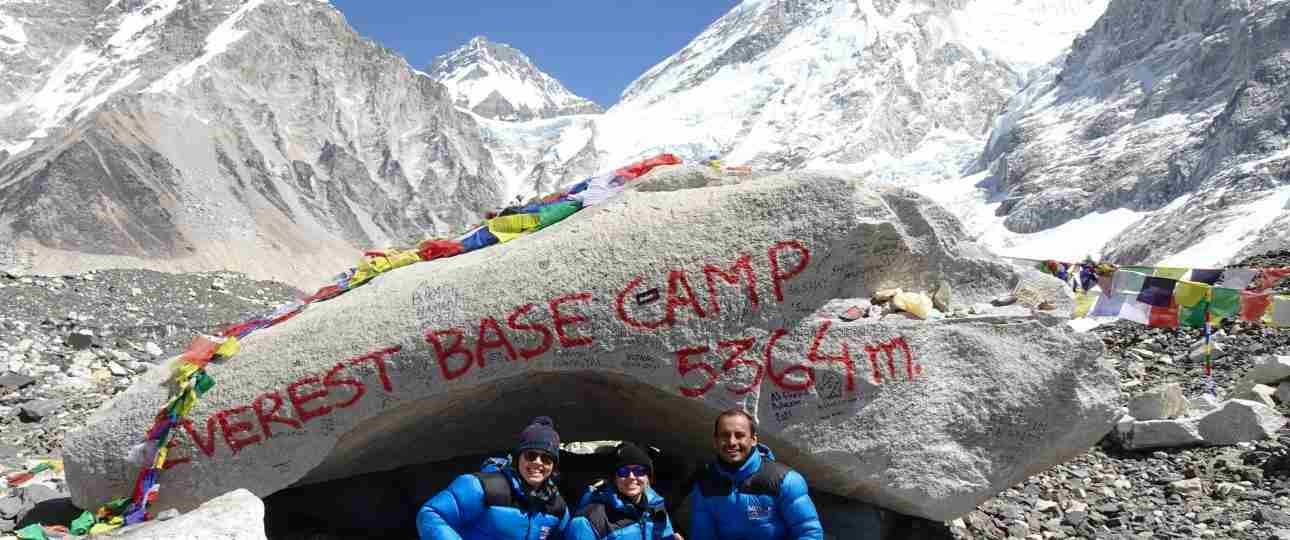
By Natascha, a junior doctor from Denmark, who trekked to Everest Base Camp (5,364m) with her friend Signe and our guide Ramesh in late February and early March 2022. Natascha wrote this diary every evening on the trail, and we share it here, with her permission, exactly as she lived it.
The Trek at a Glance
- When: late February to early March 2022, the end of winter
- Who: Natascha and Signe, with Mosaic Adventure guide Ramesh
- Length: 12 days from Kathmandu: 8 days up and 4 days down, about 130 km
- Route up: Lukla, Phakding, Namche Bazaar, then the quieter Phortse route to Dingboche, Lobuche and Gorak Shep
- Route down: Gorak Shep to Pangboche, Namche Bazaar and Lukla
- Conditions: clear skies, quiet trails, around -15°C at night high up, frozen water bottles at Gorak Shep
- Gear tip from the trail: -20°C down sleeping bags, rented from us, made the cold nights bearable
Part 1 of my journey to Everest Base Camp:
The worldwide pandemic has changed the way we travel. Due to Covid-19, many of us have only had the opportunity to travel around our own continent in the past few years. December 2019, while on Christmas vacation in Oman, was the last time I was in an airport outside of Europe.
My studies are finished, and my first year as a junior doctor is done, so I took this opportunity during a break before my next job to finally be able to travel out of Europe again. Travelling to airports with unknown signs, cultures, and an unknown assortment of snacks!
The best thing about airports is what they symbolize. An airport is a place filled with new beginnings and long-awaited endings, arrivals, and departures, hellos, and goodbyes. We begin in one city to end up in another, hundreds of kilometers away. You depart from a desert and arrive in a blizzard. Begin in winter and end in summer. Travelling from an environment of security into something completely foreign or the other way around.
For many, stepping out of a plane into Nepal’s vibrant and often bustling capital, Kathmandu city, is a pupil-dilating experience. A clamor of sights, sounds, and smells quickly leads to sensory overload. Kathmandu can be both an overwhelming and amazing city as well as an exhausting place.

Kathmandu is also known as the “City of Temples” or the gateway to the Himalayan Mountains. 180 kilometers east of Kathmandu, on the border with Tibet, the world’s highest mountain, Mount Everest, rises with an insane altitude of 8,848 meters. Fortunately, the summit of Everest is not something that appealed to us, but instead, we decided to reach the base camp, located at an altitude of 5,364 meters. Seeing this has been a dream of my friend Signe’s for many years.
If you know a little about the two of us or have read our blog over the years, then you know that Signe is the sweet young woman who has traveled with me through a lot of different places all over the world. Many destinations and experiences we’ve had were primarily my choices, so this time it was my turn to follow her to one of her dream places! However, I was hit with instant regret after saying, “you decide where to go,” because with the prompt response of Everest Base Camp Trek, I knew full well that there was no going back.
We have been to a number of different mountain peaks in recent years, and all four of them are equally clear in my memory because after each and every one of those climbs, I have told myself that I would never do it again…
Adam’s peak in Sri Lanka (2243m) was the first time I climbed to the top of a relatively high mountain. The trip was not particularly physically challenging, but without a doubt, I can easily say that I was the most unprepared person on that mountain. It was not well planned at all, and the fact that I was at the summit in jeans, trainers, and a sweatshirt was almost a miracle in itself.
Mt. Kinabalu at Borneo (4095m) was our second mountain. If one would have thought I was unprepared the first time, then I don’t have words for what we were this time. What can I say! The pictures speak for themselves here. Note to self: Buy waterproof shoes and jackets! Signe and I both learned a lot on this trip.
Quilotoa loop in Ecuador (3914m) was the third time we climbed a tall mountain range. On this occasion, I would give us credit for at least getting slightly warmer clothes in our bags, although still walking in sneakers, but who is perfect?
Pulpit Rock in Norway (604m) was the fourth and latest time I was lured into the mountains. A trip that was a failure in far too many ways, but we look back and laugh about it now. Would it have helped if we had some proper equipment? Probably!
I’ve spent a lot of years traveling in the most inefficient ways possible,
and it has taken me to exactly where I wanted to go!
So, in late February 2022, we flew to Kathmandu. From home, we had bought a lot of equipment because this time we weren’t going to just wing it. After all, this was not a one-, two-, or three-day trip, but a 12-day hike: eight days up and four days down. It was an insanely epic trip that I had already started regretting before it even began.
We had brought our Scandinavian wool underwear, gloves, hats, and the warmest garments from our wardrobes, along with a first aid bag that I am almost proud of. In Kathmandu, we had to buy everything else we would need – trekking poles, toilet paper, and especially snacks! Our 12 snacks were worth the hassle. There were days, especially towards the end, where the highlight of the day was our little chocolate bar. Our bodies may not have needed the sugar, but our souls certainly did.
We did not have internet on the mountain, so I decided to write a diary every day, which I ended up posting here. It is raw, honest, and the best way I can represent the reality of the trip. So if you’re curious about our trek to Everest Base Camp or just want to know my thoughts while hiking, then sit down with a cup of coffee and come on a trip to the majestic Himalayan Mountains in Nepal.
Day 0: Kathmandu
19:00, Rest Up Kathmandu – We have been in Kathmandu for 2 days and met with our trekking company Mosaic Adventure (best company for Everest Base Camp), who have arranged all our hiking permits. We have bought the latest necessary equipment, tried to fix our jet lag, and re-packed our bags to weigh half of what we had when we arrived here. The summer clothes have been left in the hotel’s storage room, and the winter clothes are in our backpacks, which we will carry from tomorrow. We have had a hot shower and are on our way to bed early so we can be ready first thing tomorrow when our guide Ramesh will pick us up at 05:15 to drive towards the domestic airport.
We are both excited about what the next 12 days will bring, in terms of challenges, good views, and adventure. I hope we get a good night’s sleep and most importantly, that the weather tomorrow is good for the flight to Lukla.
Day 1: Kathmandu to Lukla (2,840m) and Phakding (2,610m)
08:35 – Lukla Cafe – Early this morning, our guide picked us up at our hostel in Kathmandu, marking the start of the hike and the start of an unforgettable adventure.
Ramesh was 10 minutes late compared to the agreed-upon time. He quickly jumped out of the taxi and ran towards us while laughing and saying, “Haha, were you worried that your guide is not coming?” Ramesh seems funny, and I’m sure he has a lot of good stories for us along the way. He seems like a perfect guide match for us.
In the taxi, Ramesh told us a little about how he expected the flight to turn out and that we should expect 2-3 hours of waiting time before we took off. However, everything went easier than expected at the airport, and after 30 minutes, we were called to the gate and were ready for departure. The benefit of traveling during COVID!
We all entered the little 18-person plane, were handed some chewing gum, and took off shortly after. How do I best describe it? Slightly nauseating and with a pulse that one does not need to be a doctor to say is elevated. We first hovered over the blue-roofed buildings of the city, only to later have a view of the Himalayan mountains to our right. Did I mention that Lukla is the world’s most dangerous airport?
The runway in Lukla is only 525 meters long. It is built up along a mountain, and therefore has a very steep climb, which is necessary to stop the planes before they quickly reach the mountain at the end of the runway. Needless to say, we held our breaths during landing. Surprised at how easy both the flight and the landing went, we had the best start on the trip towards Everest Base Camp, and we are very grateful for today!

20:00 – Phakding Tea House
Today we actually lost altitude as we went from 2840m to 2610m. It took us three and a half hours to traverse the gravel path with occasional white and black painted Buddhist stones, Hindu temples, and donkeys clinking with their bells on their way along the mountain.
We arrived at the tea house at 13:30, and a delicious dal bhat was ready for us for lunch. After filling up with another dal bhat for dinner, we are now in our beds. Tomorrow will be much, much harder, so I better get to sleep because we must wake up early to get there before the afternoon rain begins.
Day 2: Phakding to Namche Bazaar (3,440m)
20: 30- Namche Bazaar tea house
Today was a challenging day, as we gained 830 meters in altitude. We walked for six hours, from Phakding to Namche Bazaar, and halfway, we officially passed the entrance of Sagarmatha National Park, home of Mount Everest. My expectations for today’s challenge with an almost constant upward elevation were high, and now I can say that I was right. My lungs and knees felt reliable, and I’m proud that my body passed part 2 of this insane challenge, but I don’t have words for the feeling of exhaustion I feel.
It helps that we are surrounded by the wildly beautiful nature of the Himalayas. Today we got the first glimpse of Mt. Everest between some treetops, saw several waterfalls in the distance, and crossed four long suspension bridges. Have you even lived if you have not crossed a Nepalese suspension bridge? Probably not, and your life expectancy is much higher! They are made of slatted metal and are hurled across the great deep gorges with huge glacial rivers below. The kind that sways and swings in the wind, so you can just about feel that you are alive.
At 14:30, we arrived at Namche Bazaar, a small village with numerous tea houses, cafes, stalls, and small shops, most of which are closed as there are not many tourists. We must be here for two days to acclimatize.
I’m very pleased that we’ve made it here. We spent the afternoon drinking a 3-liter teapot with ginger-lemon tea, and dinner was Sherpa T-MoMo and fried rice with vegetables (we are vegetarians on the trip as meat is carried up here and therefore is 2-3 days old before it arrives). After a couple of rounds of backgammon with Signe, we are soon on our way into our -20 C down sleeping bags (rented from Mosaic), which we are grateful for because it is already super cold here!
Day 3: Acclimatization Day in Namche Bazaar
21:10 – Namche Bazaar tea house
We woke up this morning feeling amazing after sleeping for no less than 10 hours. Today is an acclimatization day, but not a day of relaxation. We woke up at 06:45 and after a little breakfast (omelet and oatmeal with apple most days), we went on a short 2.5-hour hike without our backpacks. It was a steep climb to high altitude, where we stopped for a little while to take pictures and eat snacks before hiking down to lower altitude to sleep. The hike felt good on our legs and we both feel great. Today, we saw Mt. Everest much closer than yesterday.
After our hike, Signe tried the Nepalese form of a hot shower, but she got cold afterwards. We spent the afternoon exploring the city and searching for a place where the sun could warm us. We succeeded and spent a few hours at the local bakery with chocolate cake, hot cocoa, and free internet before returning to our tea house.
Hours later, after dinner (surprise! dal bhat), Ramesh taught us a new card game and we spent a few hours in the heated restaurant with good stories. Now we are once again lying in our warm sleeping bags.
The acclimatization day was clearly needed. Tomorrow we are heading higher up the mountains, and I just hope it does not rain.

Day 4: Namche Bazaar to Phortse (3,840m)
19:30 – Phortse village tea house
We woke up to clear skies and sunshine. We hiked from Namche to Phortse on the route that the locals call “the scenic route” (opposite to the standard way to reach Everest Base Camp via Tyangboche).
The day started well, and the views were indescribable! Our lunch break was on top of a mountain at 4000 meters altitude, where we both ate dal bhat. After hiking for 4 hours in the morning, I was totally exhausted. The last 2 hours were uphill, and with not enough oxygen in the air, it got difficult to breathe. After lunch, we walked 1 hour down the mountain to cross the river, and then walked another hour up the mountain on the other side to reach our accommodation in Phortse. A few tears and 7 hours later, we arrived at the small village of Phortse at 15:00. Luckily, we stayed in a nice place with a Sherpa family where the father told us he had summited Everest 12 times! We got a little star-struck. Also, Signe has promised me a foot massage tonight, so I am grateful for that.
Editor’s note: Natascha and Signe went up via Phortse, a quieter alternative to the main trail through Tengboche, with wide views of the valley. It is the route we use on our 16-day Everest Base Camp itinerary.
I did not think anything could be harder than day 2, but day 4 has without a doubt been extreme, and to be honest, I fear a little for tomorrow. I sincerely hope that hitting the 4000m mark today will give us an advantage. We will find out soon enough.
Day 5: Phortse to Dingboche (4,410m)
21:00 – Dingboche tea house
Today was the day we crossed the 4000m mark, and the terrain has definitely changed. We crossed the tree line, and the lush pine forest, along with growing rhododendrons, has been replaced by a rocky, dusty landscape, scattered with bushes, sharp winds, and blowing sand.
Halfway on our 6-hour hike, we stopped in the sun for lunch and got a big bowl of dal baht (guess what?). The rest of the afternoon was spent in what Nepalese call “flat landscape,” which we back in Denmark would describe as rather hilly. Even the flat places have an uphill elevation!
It is icy cold in the large tea house, but warm and cozy in the dining room. The room is heated by a wood stove, where yak dung is used as firewood…
In many of the tea houses we have been to, we have almost been the only tourists. However, this evening the tea house was busier, and we chatted amongst the tables about everyone’s experiences until now. It was nice to meet others who have also accepted the challenge of getting to Everest Base Camp.
We are at an altitude of 4,410m, which is also the altitude at which you feel out of breath just by turning around in bed, so I guess I won’t move much tonight.
I have gotten a blister on my foot, and I find the hikes to be very long. Signe enjoys the days more than I do; she is happy and seems to enjoy the thought of the many hours in nature. So, I will put a blister patch on my sore heel and pull on my hiking boots again tomorrow. Luckily, it will be another acclimatization day with a supposedly smaller hike, so I’m grateful for that!
Day 6: Acclimatization Day in Dingboche
20:32 – Dingboche Tea House
Today was our second and last acclimatization day on our way to Everest Base Camp. We had a steep hike in front of us, which we spent nearly two and a half hours completing this morning. When we first hit a rhythm, it was nice to get out without our backpacks. It is hard not to enjoy a walk when the sky is clear, and the snow-capped mountains of the Himalayas surround us. After lunch, we had the day to ourselves. We mainly sat in the sun, sheltered from the icy wind. Eventually, we went to the town’s bakery, where we tasted goodies and watched a film with our new Dutch and English friends. The film is put on every day at 14:00.
The evening was spent in the semi-warm dining room (the only heated area in the tea house – by a small stove). We taught our new friends the card game ‘Goofy,’ and we all played around the table while trying not to fall asleep too early. Tomorrow we are headed to Lobuche, which I am excited about. Ramesh says it will take approximately 5 hours, which usually means anything between 4 and 7 hours.
Day 7: Dingboche to Lobuche (4,940m)
19:30 – Lobuche tea house
We started the morning by packing all our things once again into our backpacks. It has gradually become a ritual that we perform in half an hour while jumping and dancing to get warm! Getting out of the warm sleeping bags in the morning is challenging. The even more challenging bit is having to change clothes. It gets significantly colder the higher up we get, so whether we succeed in changing underwear every day will forever remain a Himalayan mystery.
After breakfast, we started the day’s hike at 8 am as usual. After two quick hours, we had already reached our lunch break – it went by fast today – maybe the idea of base camp tomorrow gives us energy?
After lunch and a steep hour uphill, we crossed the ‘Thukla Pass’ and came to a memorial site for people who have died in the Himalayas while attempting to reach the top of one of the many summits. There was a large field with prayer flags and structures of stones scattered all around. We took a short break, and Ramesh showed us some of the many memorial stones. Seeing Scott Fischer’s memorial stone was almost like a testimony to me of how privileged I am to be able to move in this wonderful yet dangerous landscape.
We arrived in Lobuche at 1 pm, to a cozy tea house where Ramesh got us a “deluxe” room. There is not much deluxe about it, but up here, we really appreciate a double-glass window and a coat rack in the room. There is a small glass-covered shack next to our tea house, almost a greenhouse, where we sat alongside our Dutch friends in the sun almost all afternoon. We read our books for a little bit, took a nap, all the while our guides played Goofy with each other. It was nice to see that they enjoyed the newly learned card game. The evening went along with playing card games around the little wood stove.
We are both tired but fortunately have no symptoms of altitude sickness. Tomorrow is Base Camp, and the alarm clock is set for 05:20. We are looking forward to it but are nervous about the cold which is approaching -15 degrees C at night.

~ The beauty of simplicity ~
Part 2 of my journey to Everest Base Camp
If you are reading this, it means that I survived – there was never any doubt about Signe’s survival. Signe has proven to be a real mountain goat; it’s fascinating how nature gives her energy when I feel it is slowly draining mine. Not that I was doubting it, but I should stick to the depths and diving instead of the heights and hiking. At least as long as this experience is fresh in memory, and if hiking trips include -15 degrees C at night.
Part 2 of our crazy adventure to Mount Everest Base Camp was frankly brutal in many ways. No doubt it was insanely beautiful, unique, and mind-blowing, but it was also incredibly hard, cold, difficult, and challenging.
Continuation of part 1.
Day 8: Lobuche to Gorak Shep (5,164m) and Everest Base Camp (5,364m)
18:30 – Gorak Shep Tea House
It’s Everest Base Camp day! We have been eagerly awaiting, dreading, and feeling very excited for this day. I didn’t sleep much last night as I really felt the lack of oxygen. As the altitude increases, atmospheric pressure decreases, and the amount of oxygen in the air drops. Around Base Camp, there is 30% less oxygen than at sea level. I discovered the disadvantage of knowing the symptoms of altitude sickness because last night I had them all, according to myself. Fortunately, Signe is feeling well.
Editor’s note: around Everest Base Camp, each breath holds roughly half the oxygen it would at sea level, not 30% less, which is why everything feels so hard up there. Mild symptoms like Natascha’s headache and nausea are common above 4,000 m. The rule our guides follow is simple: you can continue if symptoms are mild and improving, but you never go higher while they are getting worse. Our guides check every trekker’s oxygen level each evening. Read more about preventing altitude sickness on the Everest Base Camp trek.
The day started early and the ground was completely frozen when we left Lobuche. Honestly, it remained frozen all day. The morning was tough for me as I did not feel much better, but after three hours, we finally reached Gorak Shep. Here, we had a quick lunch, left our big backpacks, and shortly after made our way towards Everest Base Camp.
After two very hard hours, where I had almost given up, we finally arrived at Mount Everest Base Camp! The headache and nausea were replaced with feelings of extreme relief and joy. It was so unreal. What an achievement, what a success, what a win!
After spending some time at Everest Base Camp, we went back to Gorak Shep where we would spend the night. However, Signe the mountain goat hadn’t had enough, so she and Ramesh went on a sunset trek to Kala Patthar. In the meantime, I wrote in my diary and kept the sleeping bags warm. Thankfully, tomorrow we start going down, back towards civilization, and I can almost taste the oxygen.
Day 9: Gorak Shep (5,164m) to Pangboche (3,985m)
20:30, Pangboche tea house
Today was the first day going downhill, from Gorak Shep to Pangboche, with an elevation drop of around 1,180m. The night in Gorak Shep was not the best; it was honestly freezing cold. We woke up to frozen water in our water bottles, frozen sunscreen, frozen toothpaste, EVERYTHING was frozen, and the water to flush the toilet was also frozen. Besides, I do not remember the last time I washed my hands using anything other than frozen wet wipes and alcohol gel. The water in the sink has been frozen for almost as many days as I can remember.
All in all, it was a tough night for everyone, even the guides. The morning started early and we returned surprisingly fast over the glacier, back through Lobuche, past Dingboche, and after 6 hours, 33,000 steps, and 23 km, we arrived in Pangboche. The first day going downhill went well, and we are both happy not to get too breathless just from putting on socks and being able to eat and breathe at the same time. On the hike today, we also befriended a dog who followed us for almost the entire hike. It was quite cozy with four-legged company.
Day 10: Pangboche to Namche Bazaar (3,440m)
20:45, Namche Bazaar tea house
We woke up this morning after having slept reasonably well. The nights above 4000m have not been great, so it was nice to finally get a good night’s sleep.
Although the overall goal today was to descend in altitude, our hike today also went a lot uphill. Down, up, down, up, down. The dog lay in front of our tea house this morning and followed us for a few more hours, but I think it got tired of going up and down without getting offered anything but a week-old protein bar. We also saw a large herd of wild mountain goats a little later in the day. After another long day with an additional 21 kilometers and two suspension bridges behind us, we arrived in the early afternoon at Namche Bazaar. The superhero Ramesh surprised us with an almost luxurious room with two (!) coat racks, a private bathroom and, wait for it, a shower with hot water! We both had a much-needed shower. However, we did not bring shampoo on the trip, so our hair must wait. Once again, we spent the afternoon at the warm, local bakery. Never have I felt like I deserved a piece of chocolate cake so much.
There are a lot more people on the route now than a week ago. Most shops in Namche have opened up, and our tea house is filled with people on their way up. We feel very grateful for having had the trail to ourselves for most of our trip up. We have really had the opportunity to appreciate this unique landscape with a minimal number of tourists. Early March has proven to be a perfect time to come here.
Our evening in the tea house went as follows – dal bhat for dinner, movies about Everest, popcorn, and lemon-ginger tea.
Day 11: Namche Bazaar to Lukla (2,840m)
21:10, Lukla tea house
Our last day on the hike, and what a day it was. We walked another 7 hours and 20 km down from Namche to Lukla, which brought our total distance to a total of 130 km. We crossed six suspension bridges and had lunch in Phakding. After Phakding, I remembered that our first day was mostly downhill, which then meant that the last few hours from Phakding to Lukla would be uphill … My feet are full of blisters, my toenails feel ready to fall off, and you can barely see my skin between blisters, sports tape, and plaster. Oh yes, and dirt.
When we arrived at Lukla, our guide Ramesh had again provided us with a nice room with a bathroom and hot water in the shower.
Later in the afternoon, we found by coincidence that it was Ramesh’s birthday, so we decided to celebrate both his birthday and our survival with a feast in our tea house in Lukla.
Now we are once again in our sleeping bags and are both tired and sore. The mountain has also finally won again the mountain goat Signe, who for the next few days probably will be going backwards down stairs.
Day 12: Lukla to Kathmandu
06:14, Lukla tea house
We woke up to the last sunrise over the Himalayas. What a trip it has been! I have no words for how beaten my body is and how excited I am to not be wearing hiking boots, to get my hair washed, and not having to set an alarm. We dreamed of having Indian food for dinner at a restaurant we came across in Kathmandu before we left, and we have decided to book a couple of nights in a hotel. Our current standard of accommodation is clearly easy to surpass.
The flight back to Kathmandu departs “between 6 and 8”. We are booked on today’s first flight out of Lukla, but departure times are not fixed because everything depends on the weather. The short runway ends at the mountain cliff, so I think I will close my eyes and hold my breath when we take off.
17:40, Kathmandu hotel
I am grateful for getting safely through the world’s most dangerous airport. I am grateful for running tap water, power in the sockets, clean clothes, a well-insulated house, and, not least, a sufficient amount of oxygen in the air!
For almost two weeks, every morning, I have been putting blister tape on my feet, blowing blood out of my nose, and struggling to get my sleeping bag into my backpack. I cannot describe the joy that fills me, knowing that this morning routine is finally over. We do not need to set an alarm clock for 6 a.m. tomorrow, and we look forward to waking up without ice in our water bottles.
Editor’s note: nosebleeds like Natascha’s are common in the very dry, cold air at altitude. A small saline nasal spray or a little balm inside the nose each evening helps a lot.
We had amazing Indian food for lunch and look forward to seeing a little more of Kathmandu than what we saw before heading off towards the mountains.
~ What comes up, must come down ~
Editor’s notes and trek facts added by the Mosaic Adventure team. Last reviewed November 2026.
Our Notes on Natascha’s Trek
Natascha’s diary shows the Everest Base Camp trek as it really is: beautiful, quiet and deeply rewarding, but also cold, tiring and hard on the feet. A few things stand out for anyone planning their own trek:
- Late winter can be wonderful. Clear skies and almost empty trails, but very cold nights. See our guides to the Everest Base Camp trek in February and in winter.
- Look after your feet. Break in your boots well before the trip and carry blister care. Our packing list covers what to bring.
- Everyone experiences altitude differently. Signe felt strong throughout, while Natascha had headaches and nausea at the highest points. Walk at your own pace and tell your guide how you feel. Our guide to Everest Base Camp trek difficulty explains why.
- The rest days matter. Both acclimatization days, in Namche and Dingboche, were “clearly needed”, as Natascha put it.
For another personal story from the same trail, read Jamuna’s journey to Everest Base Camp in spring. To walk it yourself, see our 14-day Everest Base Camp trek and the trek distance from Lukla to Everest Base Camp.
Questions About Natascha’s Trek
What is the Everest Base Camp trek like in late February and early March?
Very quiet and usually clear, but cold. Natascha and Signe had many teahouses almost to themselves, sunny days and clear views, but nights of around -15°C high up, frozen water bottles and frozen taps at Gorak Shep. By early March the trail was getting busier as the spring season began.
How long did the Everest Base Camp trek take?
Natascha’s trek took 12 days from Kathmandu: 8 days up to Everest Base Camp, including rest days in Namche Bazaar and Dingboche, and 4 days down to Lukla, about 130 km of walking in total.
What is the Phortse route to Everest Base Camp?
It is a quieter alternative to the main trail between Namche Bazaar and Dingboche. Instead of going via Tengboche, it climbs high above the valley to Phortse with wide views, then rejoins the main route. It is the route on our 16-day Everest Base Camp itinerary.
Did Natascha get altitude sickness on the Everest Base Camp trek?
She had mild symptoms, a headache, nausea and poor sleep, on the night at Lobuche and on Base Camp day, while her friend Signe felt fine. She reached Base Camp, and her symptoms eased as soon as they started going down.
Want more information? Send us your query, and our experts will get back to you within 24 hrs.

My name is Natascha, and I live in the fairytale town of Odense, Denmark, and I love adventure!
I am happy to provide advice and help with travel planning for countries I have visited or answer general questions about solo, first, or multiple trips.
Please send me an email at [email protected], and I will see how I can be of assistance.
I confirm the subscription of this blog to the Paperblog service under the username mosaicadventure
