
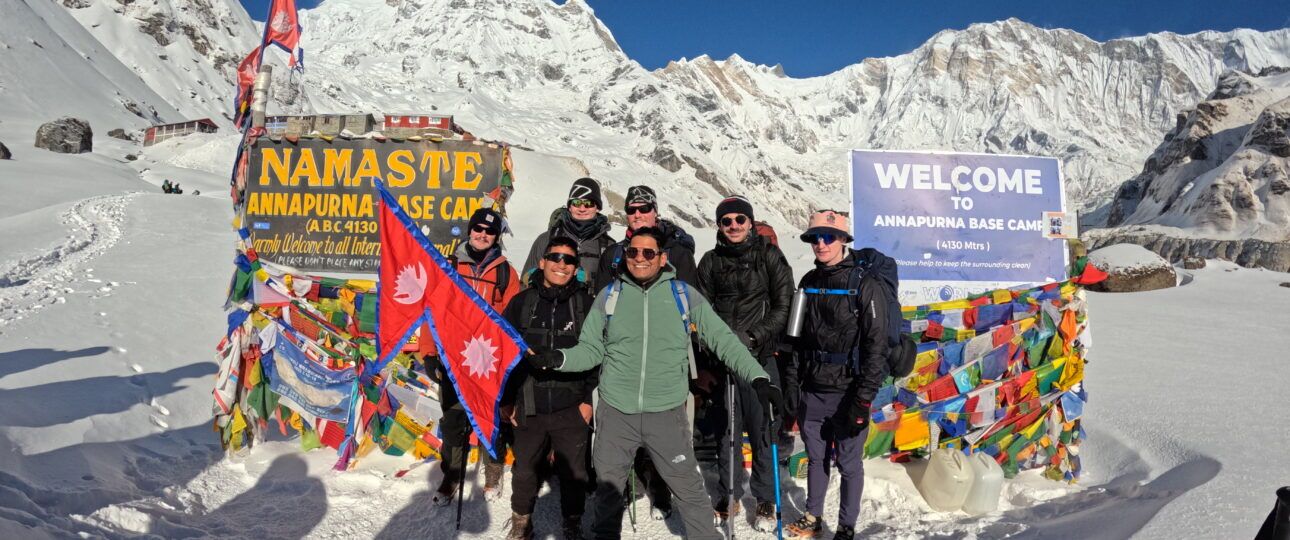
If you are asking yourself “Is the Annapurna Base Camp trek right for me?” you are already thinking the right way.
The ABC trek reaches 4,110 meters inside the Annapurna Sanctuary. It involves 5 to 7 hours of walking per day, many stone staircases, and steady altitude gain. It does not require technical climbing, but it does require preparation, mental resilience, and realistic expectations.
The sections below break this down in practical terms: fitness, safety, who should reconsider, and what type of traveler this route actually suits.
ABC Trek at a Glance
| Maximum altitude | 4,110 m at Annapurna Base Camp (one night) |
| Walking days | 5 to 8 days from Pokhara, depending on route |
| Walking per day | Mostly 5 to 7 hours, with a few shorter days |
| Terrain | Stone staircases, forest trails and a glacial valley. No technical climbing. |
| Accommodation | Simple teahouses, mostly twin rooms with shared bathrooms |
| Best seasons | Autumn (October to November) and spring (March to May) |
| Suits | Prepared beginners, trekkers short on time, active older trekkers and fit teenagers |
| Less suited to | People with significant knee problems, those seeking solitude in peak season, and anyone expecting hotel comfort |
Before thinking about views and villages, here is the honest picture. The Annapurna Base Camp trek reaches 4,110 meters. You will walk 5 to 7 hours most days. There are long stone staircases. Weather can change quickly. Lodges are simple. There is no luxury comfort at higher elevations.
If that description feels realistic rather than overwhelming, you are approaching this trek with the right expectations.
Annapurna Base Camp Trek Overview
The Annapurna Base Camp trek combines cultural villages, forested valleys, and high alpine terrain within a relatively compact route.
Along the way you will find rhododendron forests, terraced Gurung villages, natural hot springs at Jhinu Danda, and close-up views of Annapurna South (7,219 m), Annapurna I (8,091 m) and the sacred Machapuchare (6,993 m) from inside the Annapurna Sanctuary.

If you are deciding between this route and Everest, our Annapurna Base Camp vs Everest Base Camp comparison looks at the two treks side by side.
What Fitness Level Do You Need for the ABC Trek?
The majority of our guests are not athletes. They are regular travelers who trained consistently before arriving in Nepal.
You should be able to:
- Walk 10 to 15 kilometers in a day
- Climb 1,000 meters of elevation in a day without collapsing
- Hike uphill for 2 to 3 hours continuously at a steady pace
- Recover overnight and repeat the effort the next day
If you currently live a sedentary lifestyle and struggle with long stair climbs, you will need 8 to 12 weeks of focused training before attempting this trek.
The ABC trek is often suitable for beginners, but only beginners who respect the preparation process.
Test Yourself at Home: 4 Simple Benchmarks
“Moderately fit” means different things to different people. These four tests reflect what the ABC trail actually asks of your body. If you can pass all four, you are likely ready. If not, they show you exactly what to work on.
- The uphill test: Hike 2 to 3 hours on a hill or trail with around 500 to 600 meters of climbing, carrying a 5 to 6 kg daypack, without needing long stops.
- The back-to-back test: Repeat a similar hike the next day. ABC is about recovering overnight and going again, day after day.
- The stair test: Climb 50 to 60 flights of stairs in about an hour with your daypack. Much of the ABC trail is stone staircase.
- The downhill test: Walk down 20 to 30 flights of stairs at a steady pace without knee pain. Long descents are where many trekkers struggle most.
If one or more of these feels out of reach today, that is normal. Most people close the gap with consistent preparation. If you are starting from a mostly sedentary routine, allow 8 to 12 weeks. Our Annapurna Base Camp training guide explains how to build up.
Quick Readiness Check: 5 Questions
Answer honestly. Each answer points you towards the trek that fits you best.
- Do you have a heart, lung or other chronic medical condition? If yes, speak to a doctor familiar with high-altitude travel before booking any trek. If no, go to question 2.
- Can you pass at least three of the four home benchmarks above? If no, start training now, or consider the Poon Hill trek (maximum 3,210 m) as your first Himalayan trek. If yes, go to question 3.
- Do you have at least 5 walking days, plus travel days to and from Pokhara? If no, the Poon Hill trek fits a shorter window. If yes, go to question 4.
- Are you comfortable with shared bathrooms, simple food and cold bedrooms for a week? If no, ABC may frustrate you regardless of fitness, and a shorter trek with fewer teahouse nights is a better start. If yes, go to question 5.
- Do you want higher altitude, a high mountain pass or more remote trails? If yes, the Annapurna Circuit or Everest Base Camp may suit you better (see the alternatives further down). If no, ABC is very likely the right trek for you.
Who is the Annapurna Base Camp Trek best suited for?
This trek suits people who want a true Himalayan experience without extreme altitude, long expedition-style trekking, or technical climbing.
The ABC trek is a great choice for most trekkers. It’s a good balance of challenge and reward, especially if:
You need a shorter trekking route but want a real Himalayan adventure
The ABC trek can be completed in 5 to 8 days of walking from Pokhara, making it ideal for travelers with limited time who still want a complete Himalayan trekking experience without compromising on the mountain views. This is one of the more popular short trekking routes in the Himalayas. In that short span, you’ll move from tropical lowlands up to high alpine terrain, reaching the Base Camp at 4,110 meters.
You want to stay in traditional villages with local teahouses
Throughout the trek, you’ll spend nights in local teahouses in villages like Ghorepani, Tadapani, Chhomrong, Bamboo, and Deurali. This gives you a taste of the unique Gurung and Magar culture. These are not luxury hotels, but they are clean, comfortable, and serve warm meals with an amazing mountain backdrop.
You enjoy both forest trails and high mountain views
The Annapurna region offers a mix of landscapes, from terraced rice fields and rhododendron forests to glacial valleys and the stunning central space of the Annapurna Sanctuary.
You’re moderately fit and ready for daily hikes
The daily hikes range from 4 to 7 hours. There are lots of ups and downs (literally!), but it’s doable with steady preparation and a positive mindset. No technical climbing is involved.
You want a trek without the risks of the Lukla flight
Unlike the EBC trek, which requires a flight to Lukla, the ABC trek starts with a scenic drive from Pokhara. This means you avoid the risk of weather-related flight delays or cancellations that often affect the Everest region, making your trip logistics much more reliable.
Is the ABC Trek Right for You If You Are…
A first-time trekker
For most prepared beginners, yes. The ascent is gradual, you sleep above 4,000 meters for only one night, there are lodges every couple of hours on most of the route, and there is road access near both ends of the trek. Train beforehand and choose an itinerary that does not rush the climb.
A young or student trekker
Fitness is rarely the problem for young trekkers. Pacing is. Going too fast in the first days raises the risk of altitude sickness, even for strong walkers. Walk slower than you think you need to, especially above Deurali, and make sure your travel insurance covers high-altitude trekking and helicopter evacuation.
Over 60
Age alone does not rule you out. Health and preparation do. Get a medical check-up before booking, consider adding an extra day so the daily walking is shorter, and use trekking poles on every descent. Our guide to the best treks in Nepal for beginners and seniors compares ABC with gentler options.
A family with children
Age guidance for children on ABC varies, and the right answer depends on the child. Teenagers with multi-day walking experience usually manage well. Younger children often struggle with the daily distances and may not clearly describe how they feel at altitude, which matters for spotting altitude sickness. For a first family trek with younger children, Poon Hill is usually the better choice. Read more in our guide to trekking in Nepal with kids.
A solo or female traveler
ABC is one of Nepal’s busiest and most established trekking routes, with teahouses throughout and many solo and female trekkers on the trail each season. See our guides to solo trekking in Nepal and trekking in Nepal for female travelers.
Someone with knee problems
Be honest with yourself here. ABC has thousands of stone steps and long descents, especially the walk down from Base Camp to Bamboo. Mild knee issues are usually manageable with trekking poles, knee support, a slower pace and leg-strengthening work before the trek. If you have a recent injury or recurring knee pain, get advice from a physiotherapist before you book.
Afraid of heights
This is good news. The ABC trail runs mostly through forest and along valley floors, with wide paths and very few exposed drops. Suspension bridges are the main thing you will need to cross, and you can walk them at your own pace with your guide beside you.
Vegetarian or on a special diet
Teahouse menus are largely vegetarian: dal bhat, noodles, pasta, potatoes and eggs. Meat is generally not served beyond Chhomrong, as the Annapurna Sanctuary is considered sacred. If you are vegan, note that dairy and eggs are common in teahouse cooking, so tell your guide in advance.

Who Should Avoid the Annapurna Base Camp Trek?
The Annapurna Base Camp trek is achievable for many people, but it is not for everyone. Being honest about this is part of responsible trekking. Consider these factors before committing:
- Individuals with serious health issues: Anyone with pre-existing heart, lung, or chronic medical conditions must consult a doctor who understands high-altitude travel before booking. The physical exertion and altitude can be dangerous.
- Pregnant women: Strenuous trekking at altitude is generally not advised during pregnancy. Speak to your doctor before considering any high-altitude trek.
- People with mobility limitations: The trail’s steep ascents, descents and uneven terrain can be challenging for those with mobility issues.
- Unfit individuals: Without regular physical activity, ABC trek’s demands may be overwhelming. A proper fitness program is recommended before attempting it.
- Altitude sensitive individuals: Those prone to altitude sickness should take extra precautions, such as acclimatization and medication like Diamox.
- Young children: Annapurna Base Camp trek’s physical demands and altitude risks are unsuitable for young children, who may struggle to communicate discomfort.
- Elderly trekkers: While fit seniors can complete the trek, those with health concerns should assess their capabilities carefully.
- People with severe allergies: Ensure access to medications and inform guides of any allergies, as medical facilities are limited on the trail.
- Inexperienced solo trekkers: Nepal introduced a licensed-guide requirement for foreign trekkers in 2023, and how it applies in the Annapurna region has been reported differently since. Check the current rule when you book. Either way, first-time trekkers are safer with a licensed guide. See our guide to hiring a guide and porter for ABC.
- Those uncomfortable with basic amenities: Teahouses offer simple accommodations, which may not suit those who dislike rustic conditions.
A medical check-up and honest assessment of your physical and mental readiness are important before starting the ABC trek. Safety first!
You may also prefer a different trek if…
- You want solitude in October or November. This is peak season. Lodges fill early and trails are busy.
- You really dislike stair climbing. There is no way around the stone staircases on this route.
- You only have 3 or 4 days. The Poon Hill trek fits a short window better.
- You want higher altitude or to cross a mountain pass. The Annapurna Circuit offers both.
- You can only travel from June to September and dislike rain. Monsoon brings cloud, wet trails and leeches in the lower forests.
How to Know If ABC Trek Matches Your Travel Style
The Annapurna Base Camp trek is not only about fitness. It is about how you like to travel.
In practical terms, this route tends to work well if:
- You are comfortable with simple teahouse accommodation
- You value mountain scenery over luxury comfort
- You enjoy gradual immersion into Gurung and Magar culture
- You are patient with changing mountain weather
- You prefer walking through forests and valleys instead of barren high passes
This trek may frustrate you if you expect luxury rooms, private bathrooms at every stop, or instant helicopter exits when tired.
What teahouse life actually looks like
- Rooms: Mostly basic twin rooms with shared bathrooms. Lodges become simpler the higher you go.
- Toilets: Squat toilets are common, especially at higher lodges. Some lodges also have western-style toilets.
- Showers: Hot showers are often available for an extra charge at lower villages, but limited or unavailable higher up.
- Charging and Wi-Fi: Usually paid. Wi-Fi gets slower and less reliable with altitude.
- Food: Dal bhat, noodles, pasta, potatoes and eggs. Menus get simpler and prices rise with altitude, because supplies are carried up on foot.
- Warmth: The dining room is the social and warmest space. Bedrooms are unheated and cold at night, so a good sleeping bag matters.
For more detail, see our guide to teahouse trekking in Nepal.
What the Daily Pacing Actually Looks Like
Understanding the day-by-day rhythm helps you decide if this trek matches your stamina and recovery ability.
This sample itinerary begins and ends in Pokhara. For international trekkers, you should plan additional time in Nepal before and after the trek.
If you are flying in from abroad, this is how the timing usually works in real life:
- Arrive in Kathmandu at least one day before traveling to Pokhara
- Travel from Kathmandu to Pokhara by a 25-minute flight or a 6 to 8 hour drive
- Return to Kathmandu after the trek for departure flights
In total, international trekkers should usually plan 11 to 14 days in Nepal to complete the trek comfortably, including arrival, travel to Pokhara, and buffer time.
We strongly recommend adding at least one buffer day in Kathmandu before your international departure. Mountain weather, road conditions, or personal fatigue can occasionally affect schedules.
Many trekkers also choose to spend extra time in Kathmandu or Pokhara before or after the trek to recover and explore.
This trekking schedule below focuses only on the walking portion from Pokhara to Pokhara.
For full route details and pricing, refer to our main Annapurna Base Camp trek page.
Day 1: Pokhara to Ulleri (2,070 meters, 2.5 hours trek)
Drive approximately one hour to the trailhead, then trek uphill to Ulleri. The first day introduces sustained stone stair climbing and sets the tone for the days ahead.
Day 2: Ulleri to Ghorepani (2,810 meters, 5 hours trek)
A steady forest ascent through rhododendron and oak. This day builds endurance and gains significant elevation.
Day 3: Ghorepani – Poon Hill – Tadapani (2,700 meters, 6 hours total walking)
Early morning hike to Poon Hill at 3,210 meters, followed by rolling forest trails to Tadapani. Expect both ascent and descent.
Day 4: Tadapani to Sinuwa (2,310 meters, 6 hours trek)
Long descent followed by a climb to Sinuwa. This day tests knee strength and downhill stamina.
Day 5: Sinuwa to Deurali (3,230 meters, 5 hours trek)
Gradual climb along the Modi Khola valley. Air becomes cooler as you approach higher elevations.
Day 6: Deurali to Annapurna Base Camp (4,110 meters, 4 hours trek)
Steady ascent into the Annapurna Sanctuary. This is the highest sleeping altitude of the trek.
Day 7: Annapurna Base Camp to Bamboo (2,340 meters, 6 to 7 hours trek)
Long descent back through the sanctuary. Downhill walking can feel harder than ascent for many trekkers.
Day 8: Bamboo to Jhinu Danda and drive to Pokhara (1,780 meters, 4 to 5 hours walking)
Final descent followed by a return drive to Pokhara.
This gradual ascent profile helps reduce altitude stress and allows most trekkers to acclimatize naturally.
Shorter and longer versions
The 8-day itinerary above includes the Poon Hill sunrise. If you have less time, a direct route by jeep towards Jhinu Danda skips Poon Hill and reaches the Sanctuary sooner. Our 5-day Annapurna Base Camp trek suits fit trekkers who are short on time, though a faster ascent leaves less room for slow days. If you are older, new to trekking or simply want more margin, adding an extra day to any version makes the daily walking easier.
The sections that will tell you if this trek suits you
- The Ulleri stairs (Day 1): More than 3,000 stone steps. This is your first real test.
- Chhomrong and the river crossing (Day 4): A steep staircase down to the Chhomrong Khola, then a climb back up towards Sinuwa.
- Deurali to Base Camp (Day 6): The altitude section. The air is thinner and your pace will naturally slow.
- Base Camp to Bamboo (Day 7): A long descent that tests your knees more than any climb.
For a full breakdown of the challenges, read our guide to Annapurna Base Camp trek difficulty.
Common Worries, Answered
“What if I get altitude sickness?”
You sleep above 4,000 meters for only one night on this trek, and the ascent is gradual. Watch for headache, nausea, dizziness and unusual tiredness, and tell your guide early. The most effective treatment is going down, and on ABC you can lose altitude quickly by walking back down the valley. Learn the warning signs in our guide to acute mountain sickness.
“What if I’m the slowest person?”
Slow is how you acclimatize. On a private trek, the pace is entirely yours. In a group, a good guide sets a pace everyone can hold and builds in rest stops.
“What if I can’t finish?”
You can rest at a lodge, wait for others, or walk back down. Turning back is a sensible decision, not a failure. In a genuine emergency, helicopter evacuation is possible, weather permitting. That is why your travel insurance should cover high-altitude trekking and helicopter evacuation.
“Are there leeches?”
Leeches appear in the lower forests during the monsoon and just after it. In the main dry seasons they are rarely a problem.
“Will I cope with basic toilets and cold rooms?”
Most trekkers adjust within a day or two. A warm sleeping bag, a headlamp, toilet paper and hand sanitizer make a big difference.
The Mental Side of the Trek
The hard days on ABC are rarely dangerous. They are repetitive. Staircase after staircase, cloud that hides the view, and heavy legs by the fourth day. The trekkers who enjoy it most are not always the fittest. They are the ones who expect these moments and keep going steadily.
A few things help:
- Break each day into short stages between villages instead of thinking about the whole distance.
- Start early, so you are not rushing to beat the afternoon cloud.
- Take short, steady steps on stairs rather than fast bursts with long stops.
- Trust your guide’s pace, even when it feels too slow.
Does the Season Suit You?
- Autumn (October to November): Usually the clearest views and most stable weather. Also the busiest time on the trail.
- Spring (March to May): Rhododendrons in bloom and warmer days, with more haze and afternoon cloud. Late May brings the first pre-monsoon rain.
- Monsoon (June to September): Frequent rain, cloud, slippery trails and leeches. Quieter, but views are often hidden.
- Winter (December to February): Cold nights and possible snow on the upper section. After heavy snowfall, the stretch between Deurali and Machapuchare Base Camp can face avalanche risk.
For month-by-month detail, see our guide to the best time to trek Annapurna Base Camp.
Essential Tips for a Successful Trek to Annapurna Base Camp
To increase your chances of completing the Annapurna Base Camp trek successfully, follow these practical guidelines used by experienced guides:
- Choose a reputable operator: Select a trusted tour company with experienced guides familiar with the Annapurna region.
- Acclimatize properly: The itinerary includes gradual ascents, but listen to your body and ascend slowly to avoid altitude sickness.
- Stay hydrated: Drink 3-4 liters of water daily to combat dehydration and support acclimatization.
- Pack smart: Bring layers for varying temperatures, sturdy trekking boots, a good sleeping bag (especially for high-altitude nights), trekking poles for stability, and Diamox after consulting your doctor.
- Follow your guide: Trust your guide’s advice on pacing, rest and safety, especially in challenging sections.
- Train in advance: Build endurance with cardio, hiking, and strength training 2-3 months before the trek.
- Respect the environment: Follow Leave No Trace principles to preserve the Annapurna region’s pristine beauty.
- Monitor your health: Be aware of altitude sickness symptoms (headache, nausea, dizziness) and communicate with your guide if you feel unwell.
How you prepare before arriving in Nepal usually determines how smooth the trek feels once you are on the trail.
How Many People Fail the Annapurna Base Camp Trek?
In our experience guiding trekkers in the Annapurna region, most healthy and prepared individuals complete the trek successfully. The trek is generally considered safe when approached responsibly, with proper acclimatization and experienced guidance.
The people who turn back usually do so because of poor preparation, unrealistic pacing, or early symptoms of altitude sickness. Turning back is not failure. It is part of responsible mountain travel. A good guide will always prioritize health over summit success.
True medical evacuations are rare on this route compared to higher Himalayan treks, but they do happen. This is why itinerary design and guide experience matter.
If ABC Isn’t Right for You, Consider These Instead
| If you want… | Consider | Why |
|---|---|---|
| Something shorter and lower | Poon Hill Trek | Maximum 3,210 m, 4 to 5 days, and a classic Himalayan sunrise |
| A quieter route with fewer trekkers | Mardi Himal Trek | A ridge trail close to Machapuchare, though steeper and higher at its base camp (around 4,500 m) |
| More altitude and a high pass | Annapurna Circuit Trek | Crosses Thorong La at 5,416 m over a longer itinerary |
| Everest views and higher altitude | Everest Base Camp Trek | Reaches 5,364 m, takes longer and usually involves the Lukla flight |
| A trek closer to Kathmandu | Langtang Valley Trek | Starts by road from Kathmandu, so no travel to Pokhara is needed |
Still deciding between two Annapurna options? Our Poon Hill vs Mardi Himal comparison may help.
Final Verdict: Should You Do the Annapurna Base Camp Trek?
If you are moderately fit, willing to train, comfortable with basic mountain lodges, and excited by the idea of standing at 4,110 meters inside the Annapurna Sanctuary, then yes, the Annapurna Base Camp trek is likely right for you.
If you are unsure about your health, resistant to physical discomfort, or expecting comfort-focused travel, you may want to reconsider or prepare longer.
Choosing this trek is less about proving something and more about making sure your expectations match the reality of daily mountain walking.
Still unsure? Talk to our team. Tell us your age, fitness, trekking experience and travel dates, and we will tell you honestly whether ABC suits you or whether another trek would be a better fit.
We’ve guided thousands of trekkers along the trails of the Annapurna region over the years, adapting routes and pacing based on real trail conditions and guest feedback. Whether you’re going solo or with a group, we’d be happy to help plan your trek.
Frequently Asked Questions
Can a complete beginner do the Annapurna Base Camp trek?
Yes, if you prepare. ABC requires no technical climbing, and the gradual ascent suits first-time trekkers. You should be able to hike 5 to 7 hours a day on stairs and repeat it the next day, so allow 8 to 12 weeks of training if you are starting from a sedentary routine.
Can I do the ABC trek if I am over 60?
Yes, many fit older trekkers complete it. Get a medical check-up before booking, consider an extra day to shorten daily walking, and use trekking poles on descents.
What age can children do the ABC trek?
It depends on the child more than a fixed age. Teenagers with multi-day walking experience usually manage well, while younger children often find the distances hard. For a first family trek with younger children, Poon Hill is usually a better choice.
Can I do the ABC trek with bad knees?
Mild knee issues are usually manageable with trekking poles, knee support, a slower pace and strengthening exercises before the trek. The route has thousands of stone steps and long descents, so if you have a recent injury or recurring pain, get advice from a physiotherapist first.
Is the ABC trek scary if I am afraid of heights?
Usually not. The trail runs mostly through forest and along valley floors, with wide paths and very few exposed drops. Suspension bridges are the main thing you will need to cross.
Do I need a guide for Annapurna Base Camp?
Nepal introduced a licensed-guide requirement for foreign trekkers in 2023, and how it applies in the Annapurna region has been reported differently since, so check the current rule when you book. For first-time trekkers, a licensed guide is strongly recommended for safety and support.
Can I do the ABC trek in 5 days?
Yes. A shorter route by jeep towards Jhinu Danda makes a 5-day trek from Pokhara possible for fit trekkers. The faster ascent leaves less room for slow days, so it suits people who already hike regularly.
Is the Annapurna Base Camp trek worth it?
For most trekkers, yes. In a relatively short trek you move from terraced villages and rhododendron forests to standing inside the Annapurna Sanctuary at 4,110 meters, surrounded by some of the highest peaks in the world, without technical climbing.
What happens if I can’t finish the trek?
You can rest at a lodge, wait for your group or walk back down. Turning back is a sensible decision, not a failure. In an emergency, helicopter evacuation is possible weather permitting, so make sure your travel insurance covers high-altitude trekking and helicopter evacuation.

Jamuna Sharma is a partner and investor at Mosaic Adventure, bringing her extensive experience in finance and business to help us grow in adventure tourism. With over ten years in financial management and strategic planning, Jamuna’s skills are essential in shaping our operations and offerings.
Her love for travel is evident in her diverse experiences. Jamuna has trekked across various routes in Nepal, including the Everest Base Camp, Annapurna Base Camp and Annapurna Circuit. Internationally, she has explored the USA, UK, Thailand, UAE, and India, gaining a broad perspective on different cultures and landscapes.
Jamuna’s deep connection to both local and global travel enriches her writing, offering readers valuable insights into trekking in Nepal and beyond. Her dedication to supporting local businesses and promoting eco friendly tourism practices aligns with our mission at Mosaic Adventure.
