Everest Base Camp (EBC) trek routes offer several ways to reach the base of Mount Everest, the world’s highest peak. This high-altitude trek combines mountain landscapes, Sherpa culture, and progressive elevation gain across the Khumbu region. With multiple options, including the Classic route, the Gokyo Lakes variation, and the Three Passes trek, choosing the right itinerary depends on your time, experience level, fitness, and trekking goals. This guide compares the main EBC trek routes to help you evaluate which option aligns with your experience and timeline.
Which Everest Base Camp Route Should You Choose? Quick Answer
Most first-time trekkers should take the Classic Lukla route: 12 trekking days, or 14 days from Kathmandu, with two acclimatization days. It has the gentlest climb profile and no high passes. Choose a different route only if you have a clear reason:
- First trek at high altitude: Classic EBC route, 14 days
- Best scenery: EBC with Gokyo Lakes via Cho La Pass, 19 days
- Fewer crowds: Two Passes route via Cho La and Renjo La, 18 days
- Biggest challenge: Everest Three Passes Trek, 22 days
- Short on time: EBC with helicopter return, 11 days
- Want to avoid the Lukla flight: EBC trek by road via Salleri, 14 days
- Can’t trek at high altitude: see other ways to see Everest below
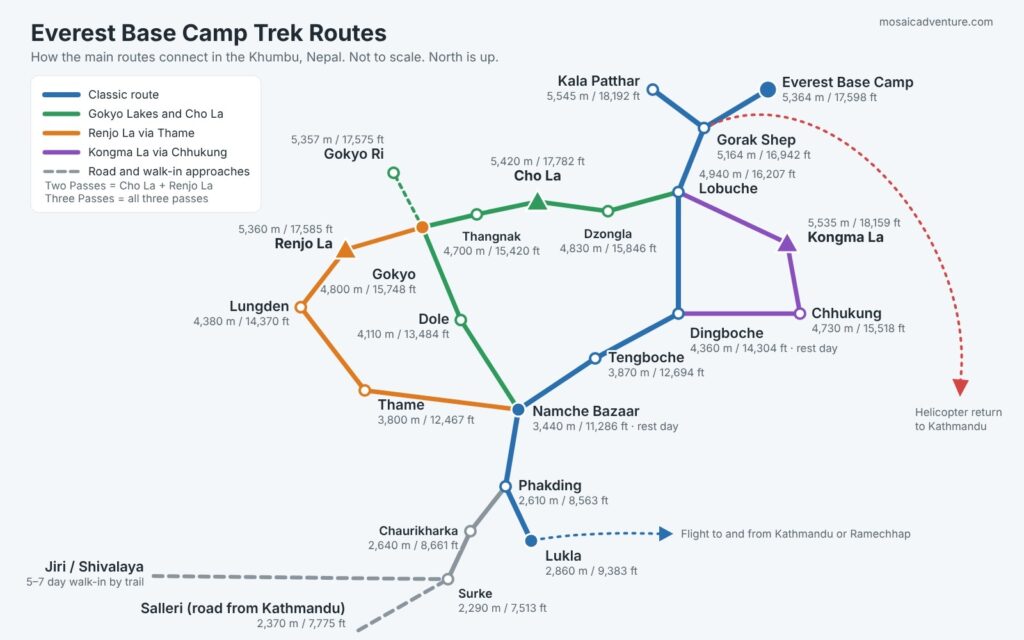
How the Everest Base Camp routes connect. Not to scale. For a printable map with altitudes, download our free EBC route map and altitude guide (PDF) or see the Everest Base Camp trek map.
History: The Everest Base Camp trek gained international attention after Sir Edmund Hillary and Tenzing Norgay completed the first successful ascent of Mount Everest in 1953. Since then, trekking to Everest Base Camp has become one of the most recognized high-altitude walking routes in the world.
Length: Most routes take approximately 12 to 18 days in total, typically starting and ending in Lukla. The standard round-trip distance is about 130 to 150 kilometers (80 to 93 miles) from Lukla to Everest Base Camp and back.
Why Are There Different Everest Base Camp Trek Routes?
Before jumping into the routes, it helps to know how they are all connected. All EBC treks start or end in the Khumbu Valley and visit the main villages like Namche Bazaar, Tengboche, and Dingboche.
The main difference between the routes comes down to high passes and scenic side trips.
The Classic Route: The most established and direct path to Everest Base Camp. It prioritizes gradual acclimatization and follows the traditional trail through the main Khumbu villages.
The Gokyo Route: A variation that detours northwest to the Gokyo Lakes and Gokyo Ri, offering additional alpine lake and glacier landscapes.
The Passes Routes (Cho La, Renjo La, Kongma La): These routes involve crossing one, two, or all three major high passes. They are more physically demanding and are typically chosen by experienced trekkers.
Choosing the right route means thinking about how much time you have, your experience, and whether you prefer a busier main trail or a more physically demanding, less crowded alternative.
Quick Comparison of Everest Base Camp Trek Routes
If you are trying to decide which route to choose to reach Everest Base Camp, this comparison table makes it simple. Each EBC trek route differs in length, difficulty, scenery, crowd levels, and acclimatization profile.
All routes reach the same Everest Base Camp (5,364 m) and Kala Patthar viewpoint (5,545 m), except the Tibet route. They differ in how you get there, which high passes you cross, and how many days you spend. “Trekking days” counts from the day you fly or drive in to Lukla (or Surke) to the day you fly or drive back out. “Full trip” counts from arrival in Kathmandu to departure.
| Route | Trekking days | Full trip from Kathmandu | High passes | Difficulty | Crowds | Best for |
|---|---|---|---|---|---|---|
| 1. Classic Lukla route | 12 | 14 days | None | Moderate to challenging | High | First-timers, safest acclimatization |
| 2. Gokyo Lakes and Cho La Pass | 15 | 19 days | Cho La (5,420 m) | Challenging | Medium | Scenery: lakes, glacier, Gokyo Ri |
| 3. Renjo La, Gokyo and Cho La (Two Passes) | 16 | 18 days | Cho La, Renjo La (5,360 m) | Very challenging | Low | Fit trekkers who want quiet trails |
| 4. Kongma La Pass | 13 | Custom trip | Kongma La (5,535 m) | Challenging | Medium | One pass plus the Chhukung valley |
| 5. Three Passes | 18 | 22 days | Kongma La, Cho La, Renjo La | Very challenging | Low | Experienced high-altitude trekkers |
| 6a. Helicopter return | 9 | 11 days | None | Moderate to challenging | High | Limited time, same safe ascent as Classic |
| 6b. Fastest 7-day trek | 7 | Custom trip | None | High altitude risk | High | Only trekkers already acclimatized |
| 7. Without Lukla flight (Salleri road) | 12 | 14 days | None | Moderate to challenging | Low at the start | Avoiding flight delays |
| 8. Jiri, the original Hillary route | 18 (19 from Jiri) | About 20 to 21 days | None | Challenging (long) | Low at the start | Culture, history, gradual acclimatization |
| 9. Tibet north side | Not a trek | 15 days (vehicle tour) | None | Easy walking, high altitude | Medium | Seeing Everest’s north face by road |
Need daily distances? See our Everest Base Camp trek distance guide, which breaks the Classic route into daily stages.
In summary, the Classic route generally has the highest completion rate, the Gokyo variation offers greater landscape diversity, the Three Passes trek is the longest and most demanding, and shorter itineraries involve higher altitude risk.
All Everest Base Camp Trek Routes Explained
Choosing the right route to EBC can make your trek more enjoyable and tailored to your preferences. Here are nine ways to reach Everest Base Camp:
#1. Classic Trek to Everest Base Camp

The Classic Everest Base Camp Trek follows the original and most established route to EBC. It is the most widely chosen option and is structured to balance acclimatization with steady daily progress.
Itinerary:
- Day 1: Fly to Lukla (2,840m/9,318ft), trek to Phakding (2,610m/8,563ft) – 3-4 hours
- Day 2: Phakding to Namche Bazaar (3,440m/11,286ft) – 5-6 hours
- Day 3: Acclimatization day in Namche Bazaar
- Day 4: Namche Bazaar to Tengboche (3,860m/12,664ft) – 5-6 hours
- Day 5: Tengboche to Dingboche (4,410m/14,469ft) – 5-6 hours
- Day 6: Acclimatization day in Dingboche
- Day 7: Dingboche to Lobuche (4,940m/16,207ft) – 5-6 hours
- Day 8: Lobuche to Gorakshep (5,164m/16,942ft), trek to EBC (5,364m/17,598ft) – 6-7 hours
- Day 9: Hike to Kala Patthar (5,545m/18,192ft), trek to Pheriche (4,371m/14,341ft) – 7-8 hours
- Day 10: Pheriche to Namche Bazaar – 6-7 hours
- Day 11: Namche Bazaar to Lukla – 6-7 hours
- Day 12: Fly back to Kathmandu
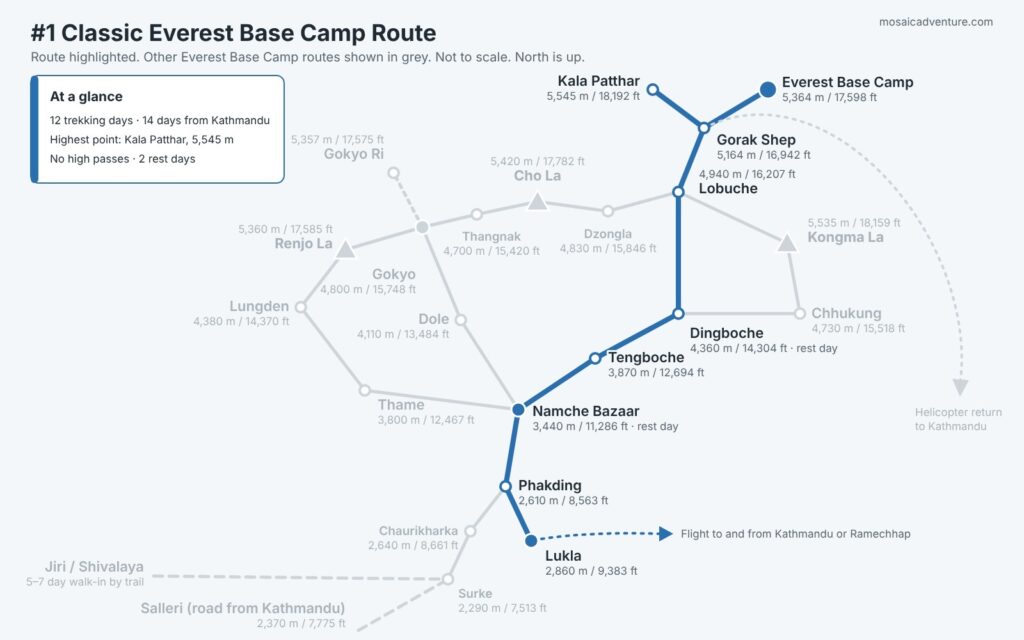
Difficulty Level: Moderate to challenging due to altitude and sustained daily walking hours.
Views: Panoramic views of Everest, Lhotse, Nuptse, and Ama Dablam.
Crowd: The classic route is the most popular and can be crowded, especially during peak seasons.
Classic route at a glance
- Start and finish: Lukla (2,840 m), by flight from Kathmandu or Ramechhap
- Trekking days: 12 (14 days from Kathmandu)
- Highest point: Kala Patthar, 5,545 m
- Acclimatization days: 2 (Namche Bazaar and Dingboche)
- Chance of completing: Highest of all routes, because the climb is gradual
- Good for: first-timers, older trekkers, anyone unsure about passes
- Not ideal for: people who want quiet trails in October and November
See the 14-day EBC itinerary explained day by day or book the 14-day Everest Base Camp trek.
#2. Everest Base Camp via Gokyo Lakes and Cho La Pass

The Everest Base Camp with Gokyo Lakes Trek via Cho La Pass is a more adventurous and challenging option that takes you off the main classic trail. This 15-day itinerary suits trekkers who want to explore the Gokyo Valley, the Gokyo Lakes (including the Third Lake), and Cho La Pass.
Itinerary:
- Day 1: Fly to Lukla (2,840m/9,318ft), trek to Phakding (2,610m/8,563ft) – 3-4 hours
- Day 2: Phakding to Namche Bazaar (3,440m/11,286ft) – 5-6 hours
- Day 3: Acclimatization day in Namche Bazaar
- Day 4: Namche Bazaar to Tengboche (3,860m/12,664ft) – 5-6 hours
- Day 5: Tengboche to Dingboche (4,410m/14,469ft) – 5-6 hours
- Day 6: Acclimatization day in Dingboche
- Day 7: Dingboche to Lobuche (4,940m/16,207ft) – 5-6 hours
- Day 8: Lobuche to Gorakshep (5,164m/16,942ft), trek to EBC (5,364m/17,598ft) – 6-7 hours
- Day 9: Hike to Kala Patthar (5,545m/18,192ft), trek to Dzongla (4,830m/15,846ft) – 7-8 hours
- Day 10: Dzongla to Gokyo (4,790m/15,715ft) via Cho La Pass (5,420m/17,782ft) – 8-9 hours
- Day 11: Hike to Gokyo Ri (5,357m/17,575ft), rest in Gokyo
- Day 12: Gokyo to Dole (4,110m/13,484ft) – 5-6 hours
- Day 13: Dole to Namche Bazaar – 5-6 hours
- Day 14: Namche Bazaar to Lukla – 6-7 hours
- Day 15: Fly back to Kathmandu
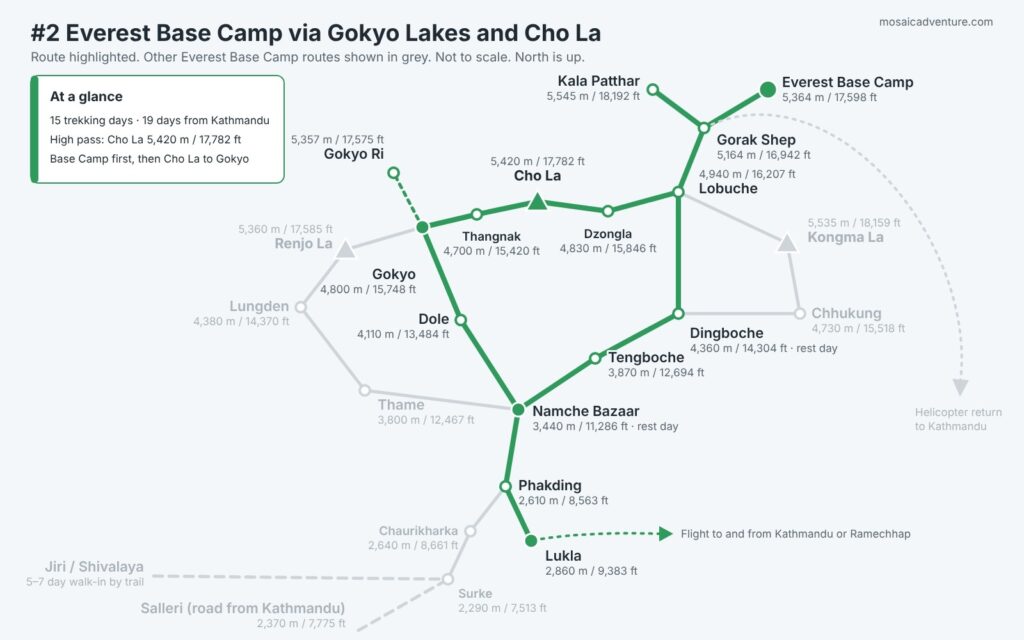
Difficulty Level: Challenging due to the high passes and long trekking days.
Views: Impressive views of the Gokyo Lakes, Cho Oyu, and Everest.
Crowd: Less crowded compared to the classic route.
Gokyo Lakes and Cho La route at a glance
- Start and finish: Lukla, as a loop through Everest Base Camp and Gokyo
- Trekking days: 15 (19 days from Kathmandu)
- High pass: Cho La, 5,420 m, with a short glacier section
- Highest point: Kala Patthar, 5,545 m. Gokyo Ri (5,357 m) is a bonus viewpoint
- Chance of completing: High, because our itinerary reaches Base Camp first and crosses Cho La once you are well acclimatized
- Good for: trekkers who want lakes, glacier views and fewer people
- Not ideal for: first-timers with no hiking experience on steep, rocky ground
How hard is the pass? Read Everest Base Camp via Cho La Pass difficulty, or see the 19-day EBC and Gokyo Lakes trek.
#3. Everest Base Camp via Renjo La Pass, Gokyo Lakes and Cho La Pass

This third option, Everest Base Camp via Renjo La Pass, Gokyo Lakes and Cho La Pass, is a demanding itinerary for trekkers looking for solitude and diverse landscapes.
This 16-day trek is designed for those wanting to experience multiple high passes, the Gokyo Lakes, and Everest Base Camp.
Itinerary:
- Day 1: Fly to Lukla (2,840m/9,318ft), trek to Phakding (2,610m/8,563ft) – 3-4 hours
- Day 2: Phakding to Namche Bazaar (3,440m/11,286ft) – 5-6 hours
- Day 3: Acclimatization day in Namche Bazaar
- Day 4: Namche Bazaar to Tengboche (3,860m/12,664ft) – 5-6 hours
- Day 5: Tengboche to Dingboche (4,410m/14,469ft) – 5-6 hours
- Day 6: Acclimatization day in Dingboche
- Day 7: Dingboche to Lobuche (4,940m/16,207ft) – 5-6 hours
- Day 8: Lobuche to Gorakshep (5,164m/16,942ft), trek to EBC (5,364m/17,598ft) – 6-7 hours
- Day 9: Hike to Kala Patthar (5,545m/18,192ft), trek to Dzongla (4,830m/15,846ft) – 7-8 hours
- Day 10: Dzongla to Gokyo (4,790m/15,715ft) via Cho La Pass (5,420m/17,782ft) – 8-9 hours
- Day 11: Exploration day in Gokyo, hike to Gokyo Ri (5,357m/17,575ft)
- Day 12: Gokyo to Lungden (4,380m/14,370ft) via Renjo La Pass (5,360m/17,585ft) – 7-8 hours
- Day 13: Lungden to Thame (3,820m/12,533ft) – 5-6 hours
- Day 14: Thame to Namche Bazaar – 4-5 hours
- Day 15: Namche Bazaar to Lukla – 6-7 hours
- Day 16: Fly back to Kathmandu
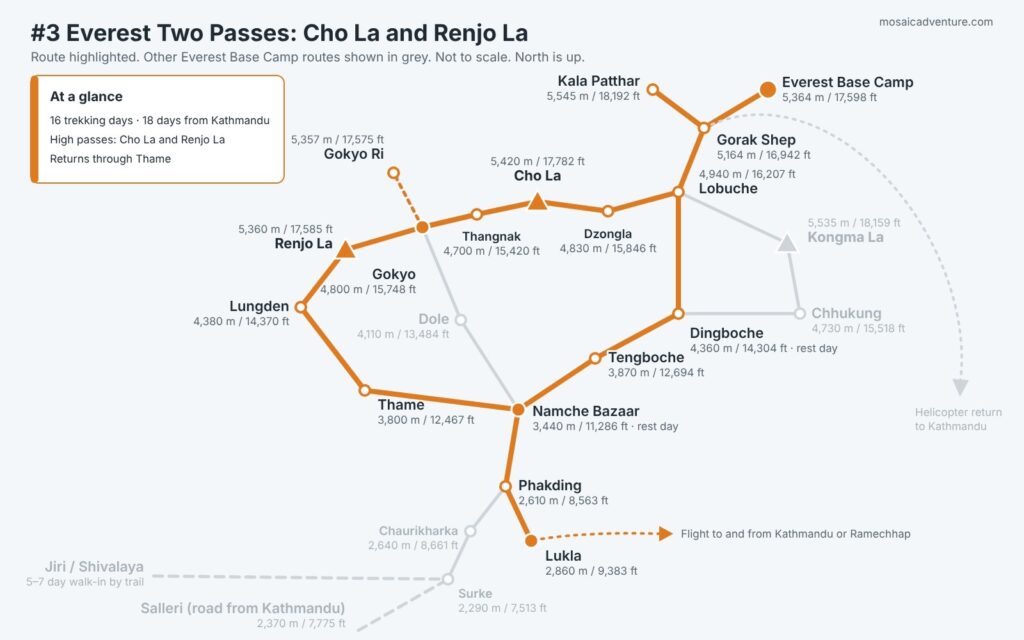
Difficulty Level: Very challenging due to multiple high passes.
Views: Wide mountain panoramas including Everest, the Gokyo Lakes, and surrounding peaks.
Crowd: Least crowded of the main route variations.
Two Passes route at a glance
- Start and finish: Lukla, returning through Thame, a quiet Sherpa village
- Trekking days: 16 (18 days from Kathmandu)
- High passes: Cho La (5,420 m) and Renjo La (5,360 m)
- Highest point: Kala Patthar, 5,545 m
- Chance of completing: Medium. Two long pass days need good weather and strong legs
- Good for: fit trekkers who want the Gokyo views and the quietest return trail
- Not ideal for: trekkers with no buffer days, since weather can close a pass
#4. Everest Base Camp via Kongma La Pass

This variation crosses Kongma La Pass and adds additional elevation gain compared to the Classic route.
This 13-day trek is ideal for trekkers looking to take on the challenge of crossing Kongma La Pass while gaining additional elevation across the Everest range.
Itinerary:
- Day 1: Fly to Lukla, trek to Phakding – 3-4 hours
- Day 2: Phakding to Namche Bazaar – 5-6 hours
- Day 3: Acclimatization day in Namche Bazaar
- Day 4: Namche Bazaar to Tengboche – 5-6 hours
- Day 5: Tengboche to Dingboche – 5-6 hours
- Day 6: Acclimatization day in Dingboche
- Day 7: Dingboche to Chhukung (4,730m/15,518ft) – 3-4 hours
- Day 8: Chhukung to Lobuche via Kongma La Pass (5,535m/18,159ft) – 7-8 hours
- Day 9: Lobuche to Gorakshep, trek to EBC – 6-7 hours
- Day 10: Hike to Kala Patthar, trek to Pheriche – 7-8 hours
- Day 11: Pheriche to Namche Bazaar – 6-7 hours
- Day 12: Namche Bazaar to Lukla – 6-7 hours
- Day 13: Fly back to the capital Kathmandu
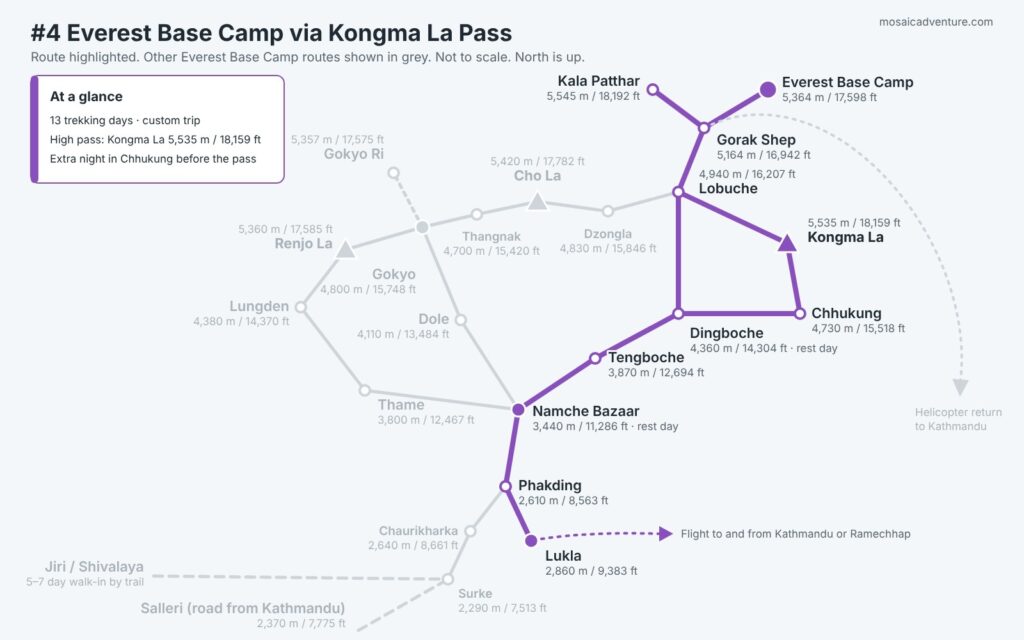
Difficulty Level: Challenging due to the Kongma La Pass.
Views: Panoramic views of the Everest range and surrounding peaks.
Crowd: Moderately crowded, less so than the classic route but more than the other alternatives.
Kongma La route at a glance
- Start and finish: Lukla, with a side trip to the Chhukung valley
- Trekking days: 13
- High pass: Kongma La, 5,535 m, the highest of the three Everest passes
- Highest point: Kala Patthar, 5,545 m
- Chance of completing: Medium. You cross the pass before reaching Base Camp, so the extra night in Chhukung matters
- Good for: strong trekkers who want one pass without adding a week
- Not ideal for: first-timers
Ask us about running this route as a private trip. Kongma La is also the first pass of the Everest Three Passes Trek. For a climb from the same valley, see Island Peak via Everest Base Camp.
#5. Everest Three Passes Trek

The Everest Three Passes Trek is the longest and most demanding route. This very challenging route is for serious, experienced trekkers. It takes you across all three major high passes, Kongma La (5,535m), Cho La (5,420m), and Renjo La (5,360m), providing extended exposure to high mountain terrain.
It is typically chosen by experienced trekkers looking for a longer and more demanding itinerary.
Itinerary:
- Day 1: Fly to Lukla (2,840m / 9,317ft) and trek to Phakding (2,610m / 8,562ft) – 3.5 hours
- Day 2-3: Trek to Namche Bazaar (3,440m / 11,286ft) – 6 hours; acclimatization day
- Day 4: Trek to Tyangboche (3,860m / 12,665ft) – 5 hours
- Day 5-6: Trek to Dingboche (4,410m / 14,469ft) – 5 hours; acclimatization day
- Day 7: Trek to Chhukung and Chhukung Ri (4,730m / 15,518ft) – 4.5 hours
- Day 8: Cross Kongma La Pass (5,535m / 18,160ft) and trek to Lobuche (4,940m / 16,207ft) – 6.5 hours
- Day 9: Trek to Everest Base Camp (5,364m / 17,598ft) and return to Gorakshep (5,164m / 16,942ft) – 8 hours
- Day 10: Ascend Kala Patthar (5,545m / 18,192ft) and trek to Dzongla (4,830m / 15,842ft) – 8 hours
- Day 11: Cross Cho La Pass (5,420m / 17,782ft) and trek to Thagnak (4,700m / 15,416ft) – 5 hours
- Day 12: Trek to Gokyo (4,790m / 15,711ft) – 2 hours
- Day 13: Exploration day in Gokyo; hike to the Fifth Lake and Gokyo Ri (5,360m / 17,585ft)
- Day 14: Cross Renjo La Pass (5,360m / 17,585ft) and trek to Lungden (4,560m / 14,956ft) – 6 hours
- Day 15: Trek to Thame (3,820m / 12,592ft) – 6 hours
- Day 16: Trek to Namche Bazaar – 5 hours
- Day 17: Trek to Lukla – 7 hours
- Day 18: Fly back to Kathmandu
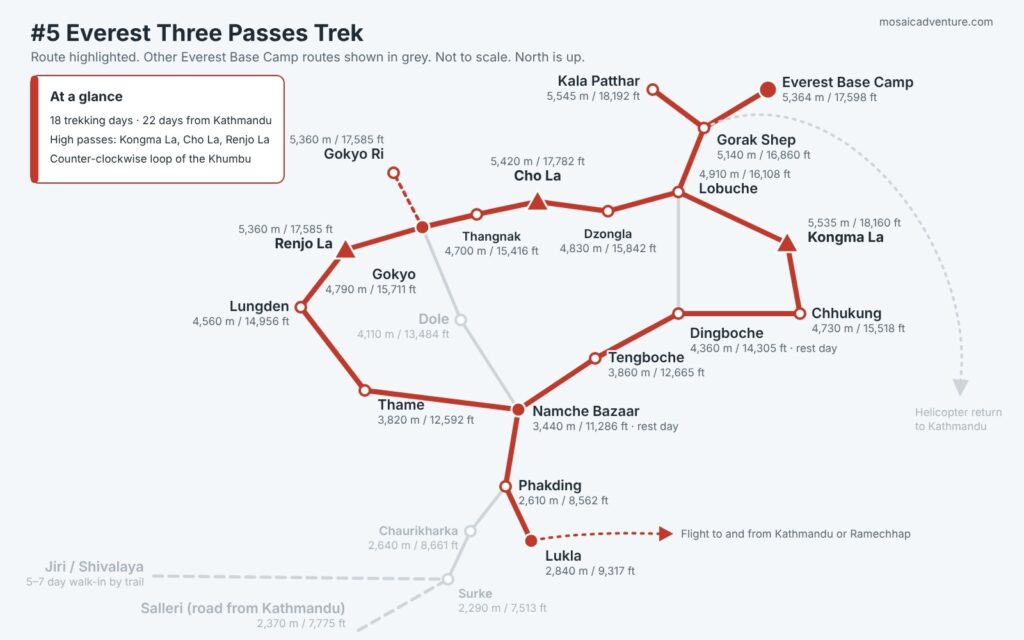
Difficulty Level: Very challenging due to high passes, long trekking days, and significant altitude gains.
Views: Extensive mountain views including Everest, Lhotse, Nuptse, Makalu, Cho Oyu, and the Gokyo Lakes.
Crowd: Less crowded than the Classic Everest Base Camp route.
Three Passes route at a glance
- Start and finish: Lukla, as a full loop of the Khumbu
- Trekking days: 18 (22 days from Kathmandu)
- High passes: Kongma La (5,535 m), Cho La (5,420 m), Renjo La (5,360 m)
- Highest point: Kala Patthar, 5,545 m
- Chance of completing: Lower than other routes. It is the longest and hardest, with three pass days
- Good for: trekkers who have already been above 5,000 m
- Not ideal for: a first Himalayan trek
Compare it side by side in Three Passes Trek vs Everest Base Camp, or see the 22-day Everest Three Passes Trek.
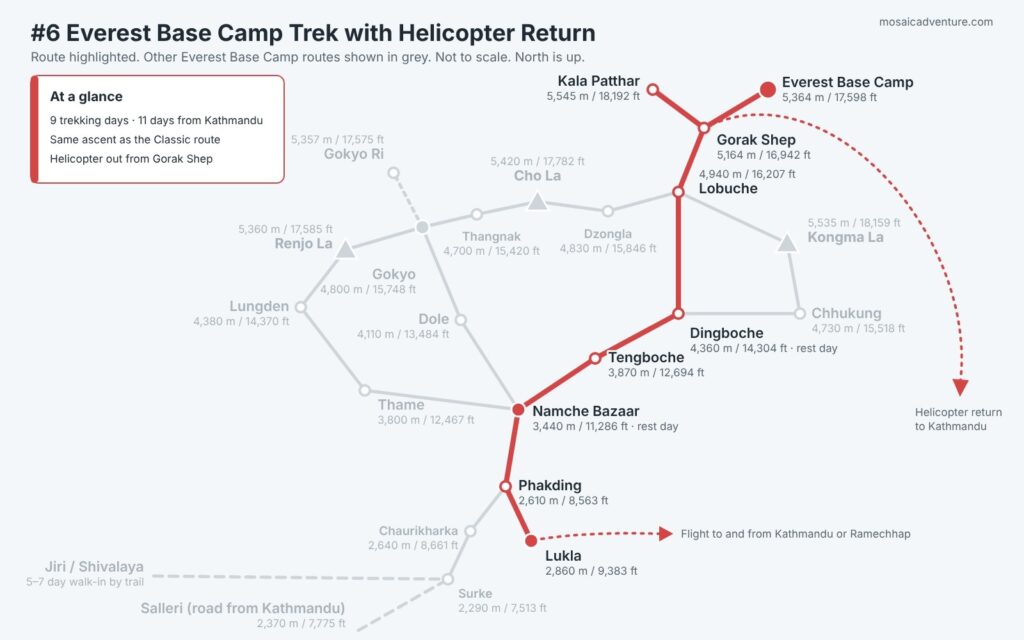
#6. Shorter Everest Base Camp Trek

The shortest Everest Base Camp Trek (7 Days with Helicopter Return) is for people who are short on time but still want to see EBC. This condensed itinerary combines trekking up to EBC with a helicopter return flight to Kathmandu. Kala Patthar is not included, because there is no time for it.
- Note: This itinerary involves increased altitude risk due to rapid ascent. It is only recommended for those with previous high-altitude experience.
Itinerary:
- Day 1: Fly to Lukla (2,840m/9,318ft), trek to Phakding (2,610m/8,563ft) – about 3.5 hours
- Day 2: Phakding to Namche Bazaar (3,440m/11,286ft) – about 6 hours
- Day 3: Acclimatization day in Namche, hike to Syangboche (3,790m/12,434ft)
- Day 4: Namche Bazaar to Tengboche (3,860m/12,664ft) – 4 to 6 hours
- Day 5: Tengboche to Dingboche (4,410m/14,469ft) – 5 to 6 hours
- Day 6: Dingboche to Lobuche (4,940m/16,207ft) – 5 to 6 hours
- Day 7: Lobuche to Gorakshep (5,164m/16,942ft) and Everest Base Camp (5,364m/17,598ft), helicopter from Gorakshep to Kathmandu
Difficulty Level: Challenging due to rapid altitude gain and limited acclimatization time. This itinerary should only be considered by trekkers with prior high-altitude experience.
Views: Spectacular views of Everest, Lhotse, Nuptse, Ama Dablam, Makalu, Cho Oyu, and other Himalayan peaks from both the trek and the helicopter ride.
Crowd: This route is popular, similar to the classic EBC trek.
Read the full 7-day EBC trek details, and how it compares with the other short options, in our short trek guide.
Short route at a glance: two very different options
- Helicopter return, 11 days: you walk up exactly like the Classic route, with both acclimatization days, then fly from Gorak Shep to Kathmandu after Kala Patthar. You save 3 days of walking down, not days of acclimatization.
- Fastest 7-day trek: you reach Lobuche (4,940 m) by day 6. This is much faster than medical guidance allows, so we only suggest it for trekkers already acclimatized, for example after another high trek.
- Chance of completing: High for the 11-day helicopter return. Lower for the 7-day trek
- Good for: travelers short on time who still want to walk to Base Camp
Read the 11-day EBC helicopter trek guide or see the EBC trek with helicopter return.
#7. Everest Base Camp Trek Without Lukla Flight
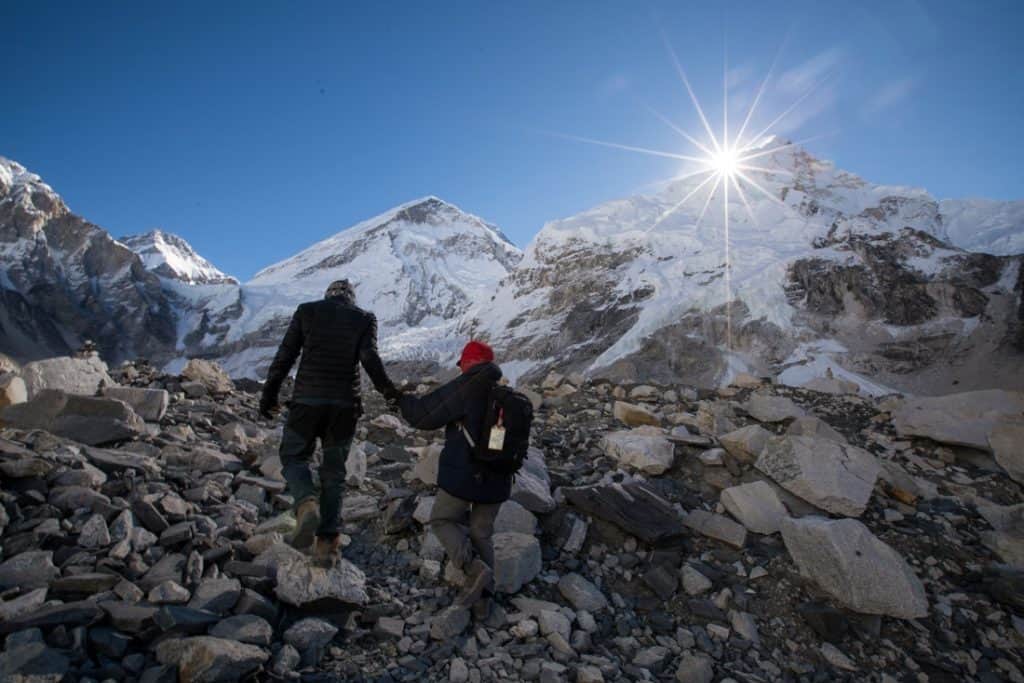
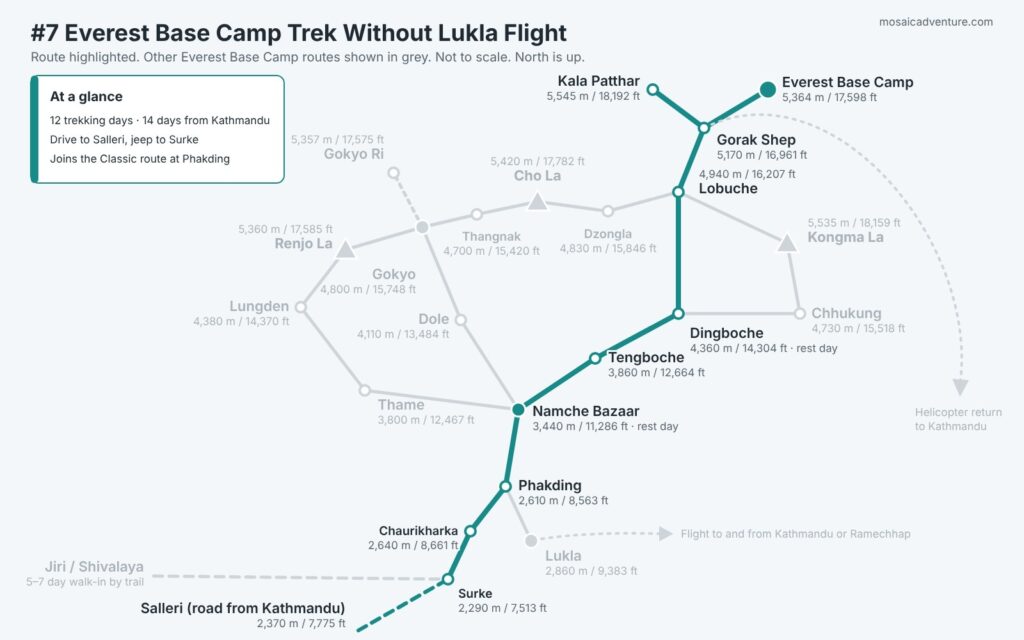
Everest Base Camp Trek Without the Lukla Flight (Salleri Start) is a suitable option for trekkers who prefer a road approach and want to avoid the Lukla flight.
Itinerary
- Day 1: Drive from Kathmandu (1,345 m / 4,413 ft) to Salleri (2,370 m / 7,775 ft)
- Day 2: Drive toward Surke (2,290 m / 7,513 ft) and trek to Phakding (2,610 m / 8,563 ft)
- Day 3: Trek to Namche Bazaar (3,440 m / 11,286 ft)
- Day 4: Acclimatization in Namche Bazaar (3,440 m / 11,286 ft)
- Day 5: Trek to Tyangboche (3,860 m / 12,664 ft)
- Day 6: Trek to Dingboche (4,410 m / 14,469 ft)
- Day 7: Acclimatization in Dingboche (4,410 m / 14,469 ft)
- Day 8: Trek to Lobuche (4,940 m / 16,207 ft)
- Day 9: Trek to Everest Base Camp (5,364 m / 17,598 ft) and return to Gorak Shep (5,164 m / 16,942 ft)
- Day 10: Hike to Kala Patthar (5,545 m / 18,192 ft) and descend to Pheriche (4,371 m / 14,341 ft)
- Day 11: Trek to Namche Bazaar (3,440 m / 11,286 ft)
- Day 12: Trek to Chaurikharka (2,640 m / 8,661 ft)
- Day 13: Trek to Surke (2,290 m / 7,513 ft), drive to Salleri (2,362 m / 7,749 ft)
- Day 14: Drive back to Kathmandu (1,345 m / 4,413 ft)
Difficulty level: Moderate to challenging, especially due to the longer trekking days and the lack of a flight to Lukla.
Views: The route passes through lower forested valleys before joining the high alpine terrain of the main EBC trail.
Crowd: This route is quieter before you join the classic EBC trek, meaning the early and final sections of the trek typically see fewer trekkers.
Road route via Salleri at a glance
- Start and finish: drive from Kathmandu to Salleri, then by jeep to Surke, below Lukla
- Trekking days: 12 (14 days from Kathmandu, including two long drive days)
- Highest point: Kala Patthar, 5,545 m
- Chance of completing: High. It follows the Classic route above Phakding
- Good for: trekkers who want to avoid Lukla flight delays, including in the monsoon
- Not ideal for: anyone who gets car sick on long mountain roads
#8. Everest Base Camp via Jiri: The Original Hillary Route
Before Lukla airport was built, every expedition walked in from the road head. In 1953, Edmund Hillary and Tenzing Norgay’s expedition set out from the Kathmandu valley and walked for weeks to reach the Khumbu. Today most trekkers drive to Bhandar, past Jiri, and walk for five days through Sherpa, Rai and Tamang villages to join the Classic route at Surke, below Lukla. You can still start from Jiri itself by adding one more walking day.
Itinerary:
- Day 1: Drive from Kathmandu to Bhandar (2,190m/7,185ft) – 8-10 hours
- Day 2: Bhandar to Sete (2,575m/8,448ft) – 6-7 hours
- Day 3: Sete to Junbesi (2,700m/8,858ft) via Lamjura La (3,530m/11,581ft) – 6-7 hours
- Day 4: Junbesi to Nunthala (2,220m/7,283ft) via Taksindu La (3,071m/10,075ft) – 6-7 hours
- Day 5: Nunthala to Khari Khola (2,020m/6,627ft) – 6-7 hours
- Day 6: Khari Khola to Surke (2,290m/7,513ft) – 6-7 hours
- Day 7: Surke to Phakding (2,610m/8,563ft) – 5-6 hours
- Day 8: Phakding to Namche Bazaar (3,440m/11,286ft) – 6 hours
- Day 9: Acclimatization day in Namche Bazaar, optional hike to the Everest View Hotel (3,880m/12,730ft)
- Day 10: Namche Bazaar to Tengboche (3,860m/12,664ft) – 5 hours
- Day 11: Tengboche to Dingboche (4,410m/14,469ft) – 5 hours
- Day 12: Acclimatization day in Dingboche, optional hike to Nagartsang Hill (5,100m/16,732ft)
- Day 13: Dingboche to Lobuche (4,940m/16,207ft) – 5 hours
- Day 14: Lobuche to Everest Base Camp (5,364m/17,598ft), back to Gorak Shep (5,164m/16,942ft) – 7-8 hours
- Day 15: Hike to Kala Patthar (5,545m/18,192ft), descend to Pheriche (4,371m/14,341ft) – 7 hours
- Day 16: Pheriche to Namche Bazaar – 6-7 hours
- Day 17: Namche Bazaar to Lukla – 6 hours
- Day 18: Fly from Lukla to Kathmandu – 30-40 minutes
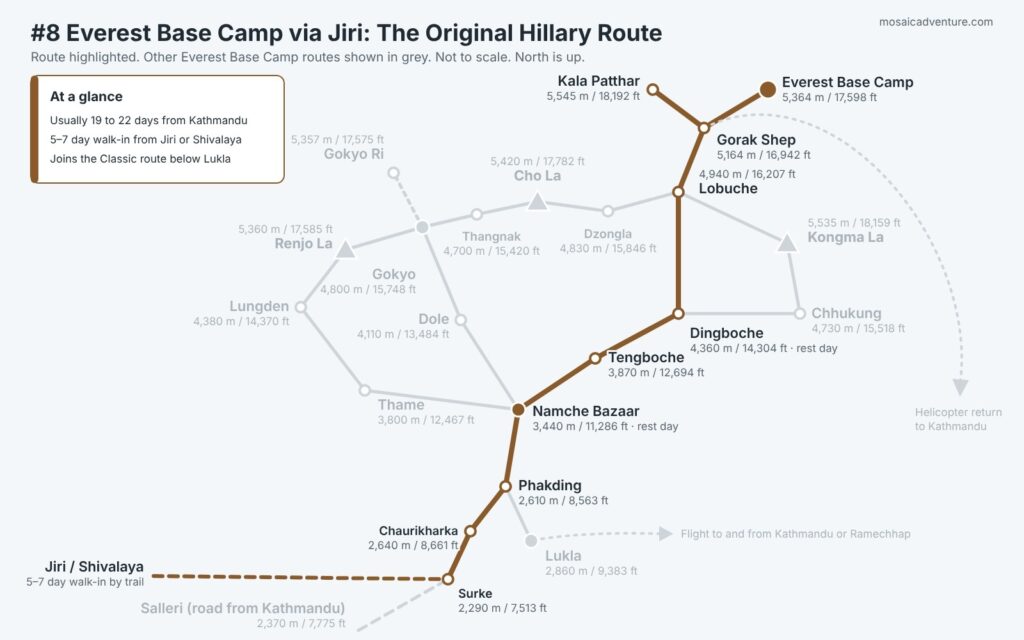
Difficulty Level: Challenging because of its length. The first five days cross two passes, Lamjura La and Taksindu La, with long climbs and descents through forest.
Views: Rhododendron forests, terraced farmland and Sherpa villages, then the full Everest panorama once you join the Classic route.
Crowd: Very quiet until Surke. After that, as busy as the Classic route.
Jiri route at a glance
- Start: drive from Kathmandu to Bhandar (2,190 m / 7,185 ft), or start walking from Jiri with one extra day
- Finish: flight from Lukla to Kathmandu
- Trek: 18 days from Kathmandu back to Kathmandu (19 days from Jiri), plus your arrival and departure days
- Walk-in: 5 days from Bhandar to Surke, crossing Lamjura La (3,530 m / 11,581 ft)
- Highest point: Kala Patthar, 5,545 m / 18,192 ft
- Chance of completing: High. The long, low start gives your body more time to adjust
- Good for: trekkers with time who want history, villages and quiet trails
- Not ideal for: short holidays
See the full Jiri to Everest Base Camp trek itinerary.
#9. Everest Base Camp from the Tibet Side (North)
Everest has a second base camp on its north side in Tibet. It is reached by road, not on foot. You drive across the Tibetan Plateau to Rongbuk (about 4,980 m) and then walk or take a short ride to the Base Camp area, with direct views of Everest’s north face. It is a very different trip from trekking in Nepal and needs Tibet travel permits, arranged through an agency.
Tibet north side at a glance
- Type: vehicle tour with short walks
- Full trip: 15 days, combining Nepal and Tibet
- Highest overnight: Rongbuk, about 4,980 m
- Good for: travelers who want to see Everest up close without a multi-day trek
- Not ideal for: anyone who wants the Khumbu trekking experience
Read about Tibet permits or see the 15-day Nepal and Tibet Everest Base Camp tour.
Ways In and Ways Out of the Everest Region
Every Nepal-side route is built from a way in and a way out. Mixing them is how most custom EBC itineraries are made.
| Option | How it works | Good to know |
|---|---|---|
| In: fly to Lukla | A short flight to Lukla (2,840 m), from Kathmandu or from Ramechhap (Manthali) | Fastest way in. In busy seasons many flights leave from Ramechhap, an early-morning drive from Kathmandu. Weather delays are common. See our Lukla flight guide |
| In: drive to Salleri | Drive to Salleri, then by jeep to Surke below Lukla | No flight risk. Adds about two long drive days to the trip |
| In: drive to Jiri | Drive to Jiri or Shivalaya and walk about 5 to 7 days to join the main trail | The historic route, with the best natural acclimatization |
| Out: walk back to Lukla | Return the same way through Pheriche and Namche, then fly | Most common. Plan a spare day in case flights are delayed |
| Out: loop through Gokyo or Thame | Cross Cho La or Renjo La and return on a different trail | New scenery on every day of the return |
| Out: helicopter from Gorak Shep | Fly straight to Kathmandu after Kala Patthar | Saves about 3 days of walking. Shared seats can lower the cost |
For a full guide to flights, drives and helicopter options, read how to get to Everest Base Camp.
Which Direction Should You Cross the Passes?
On the pass routes, direction matters as much as the route itself. The safest plan is to reach Everest Base Camp first and cross the high passes afterwards, when your body is already used to the altitude.
- Base Camp first, then Cho La to Gokyo: this is how our EBC and Gokyo Lakes trek runs. You cross the pass after nine nights on the trail.
- Gokyo first, then Cho La to Base Camp: possible, but you cross a 5,420 m pass earlier in the trip. It suits trekkers with recent high-altitude experience.
- Three Passes: we go counter-clockwise, Kongma La, then Cho La, then Renjo La, with an acclimatization day in Chhukung before the first pass.
Conditions on the passes change with snow and ice, so your guide may suggest the direction that suits the group and the weather that season.
Which Everest Base Camp Trek Route Has the Highest Completion Rate?
The main reason trekkers turn back before Base Camp is altitude sickness, and the biggest factor is how fast the route gains height. Medical guidance from the Wilderness Medical Society advises that above 3,000 m you avoid sleeping more than about 500 m higher than the night before, and take a rest day for every 1,000 m of sleeping altitude gained (summary in American Family Physician).
Here is how the routes compare against that guidance:
- Classic, helicopter return, Salleri road and Jiri routes: close to the guidance, with rest days at Namche Bazaar and Dingboche.
- Gokyo, Two Passes and Three Passes: follow the guidance on the way up, but pass days are long and depend on the weather.
- Fastest 7-day trek: gains height much faster than the guidance. Only suitable if you are already acclimatized.
Learn the early signs in our guide to preventing altitude sickness on the Everest Base Camp trek.
For most first-time trekkers, choosing a route with proper acclimatization is more important than choosing the shortest schedule.
How to Choose the Best Everest Base Camp Trek Route
Choosing the right Everest Base Camp trek route depends on four practical factors: time, experience, fitness, and risk tolerance.
1. If You Have Limited Time
Our 11-day trek with helicopter return is the safest short option: you walk up with both acclimatization days and fly back from Gorak Shep. The 7-day version is faster but has the highest risk of altitude sickness, so it is not recommended for beginners.
2. If You Want the Safest Route
The Classic 14-day EBC route generally provides the most structured acclimatization profile.
3. If You Want the Most Beautiful Route
The Gokyo Lakes and Cho La Pass route provides more varied landscapes, glacier crossings, and lake views.
4. If You Want Fewer Crowds
The Renjo La variation and the full Three Passes route attract fewer trekkers compared to the Classic trail.
5. If You Are Experienced and Want a Challenge
The Three Passes trek is the longest and most demanding EBC route. It requires previous high-altitude trekking experience.
Best Everest Base Camp Route for Each Season
All routes are open in the main trekking seasons. Outside them, some routes become much harder or less reliable.
| Season | Best routes | Why |
|---|---|---|
| Spring (March to May) | All routes, including the passes | Stable weather and longer days. Passes are usually crossable, with some early-season snow |
| Monsoon (June to August) | Salleri road route, Classic with spare days | Lukla flights are often cancelled. Mud and leeches on the lower trail |
| Autumn (September to November) | All routes. Gokyo and Two Passes for fewer people | Clearest views of the year and the busiest trails on the Classic route |
| Winter (December to February) | Classic or helicopter return | Snow and ice can close Cho La and Renjo La, and some higher lodges close |
For month-by-month weather, see the best time to trek Everest Base Camp. Trekking in the cold season? Read Everest Base Camp trek in winter or, for the rainy months, Everest Base Camp trek in monsoon.
Which EBC Trek Route Is the Most Beautiful?
Beauty along the Everest Base Camp trek is subjective, but routes that include alpine lakes, glaciers, and high passes are often described as more visually diverse.
Many trekkers report that the Gokyo route offers more landscape variety compared to the Classic route. This variation combines alpine lakes, glacier crossings, and high passes while still including the main Everest Base Camp landmarks.
Why Many Trekkers Consider Gokyo Lakes and Cho La Pass the Most Scenic Route
1. The Turquoise Gokyo Lakes
A chain of six Gokyo lakes located between 4,700 and 5,000 meters, the Gokyo Lakes reflect the snowy slopes of Cho Oyu, the sixth-highest mountain in the world. Their deep blue and turquoise colors make this one of Nepal’s notable alpine regions.
2. The Ngozumpa Glacier
Trekkers cross the Ngozumpa Glacier, the largest glacier in the Everest region, filled with ice formations, frozen rivers, and dramatic ridges. The terrain differs significantly from the classic EBC trail.
3. Cho La Pass (5,420 m)
The Cho La Pass offers one of the notable high-altitude crossings in the Everest region. Covered with colorful prayer flags, it opens to a 360-degree panorama of Everest, Lhotse, and Makalu, three of the world’s highest peaks.
4. Gokyo Ri Summit
Gokyo Ri provides one of the highest panoramic viewpoints in the region, offering wide views of Everest, Lhotse, Makalu, and Cho Oyu.
5. Peaceful and Less Crowded
Compared to the classic EBC route, the Gokyo and Cho La Pass trail is quieter, offering fewer trekkers on the trail compared to the Classic route.
Many trekkers consider this one of the most scenic EBC route variations due to its lake views, glacier crossings, and high mountain panoramas.
Includes All the Classic EBC Highlights
The Gokyo Lakes and Cho La Pass route not only delivers diverse alpine landscapes but also includes all the iconic EBC landmarks.
Tengboche Monastery: an important monastery in the Khumbu with golden rooftops framed by Ama Dablam and Everest.
Kala Patthar Sunrise (5,545 m): the classic sunrise viewpoint for close-up views of Everest.
Everest Base Camp (5,364 m): stand at the base of the world’s highest mountain at 5,364 meters.
Namche Bazaar and Dingboche: lively Sherpa villages that showcase culture, trade, and warm hospitality.
This route combines the Gokyo section with the main Everest Base Camp highlights in a single itinerary.
Which Is the Most Scenic Everest Base Camp Trek Route?
For trekkers prioritizing landscape diversity and fewer crowds, the Gokyo Lakes and Cho La Pass variation is often considered the most scenic way to reach Everest Base Camp.
Important Practical Notes for All Everest Base Camp Trek Routes
No matter which Everest Base Camp trek route you choose, a few practical details remain the same.
Permits
All routes require two permits:
- Sagarmatha National Park Permit
- Khumbu Pasang Lhamu Rural Municipality Permit
The permits are the same whichever Nepal-side route you choose, including the pass routes and the Salleri and Jiri approaches. The Tibet north side is different and needs Tibet travel permits instead. Current permit fees are listed in our Everest Base Camp trek cost guide. If you are trekking a pass route, a guide who knows the pass is strongly recommended. Read why to hire a guide for Everest Base Camp.
Acclimatization
Proper acclimatization is critical on all EBC trek routes. Even the shorter route requires careful altitude management. Routes with extra rest days generally have higher completion rates and lower altitude risk.
Planning and Budget
If you would like a broader overview of preparation, training, and general planning, you can review our complete guide here: Everest Base Camp trek guide
For a full breakdown of budgeting factors across different route options, see: Detailed Everest trek cost guide
Packing Essentials
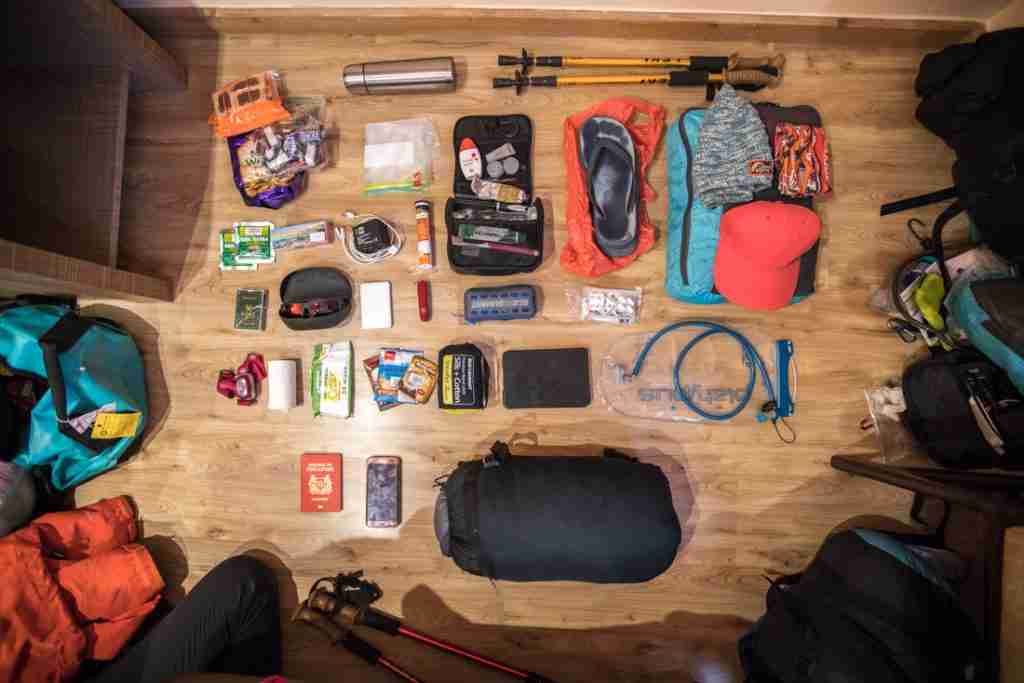
Proper preparation is important on all Everest Base Camp trek routes. Packing appropriately helps manage changing weather conditions, cold nights, and high-altitude exposure.
Key essentials include layered clothing (for fluctuating temperatures), sturdy waterproof trekking boots (well broken in), a four-season sleeping bag rated for sub-zero temperatures, trekking poles, a basic first aid kit, water purification tablets, and high-energy snacks.
For a complete equipment breakdown, refer to our detailed Everest Base Camp packing list guide. If you are still in the early planning phase, you may also review our broader Everest Base Camp preparation guide for training and readiness advice.
Health and Safety Considerations
Regardless of which EBC route you choose, altitude management is the primary safety concern.
- Hydration: Drink approximately 3 to 4 liters of water daily and limit alcohol intake at altitude.
- Gradual Ascent: Follow acclimatization guidelines and the “climb high, sleep low” principle.
- Recognize AMS Symptoms: Persistent headache, dizziness, nausea, or unusual fatigue may indicate Acute Mountain Sickness (AMS).
- Medication: Consult a medical professional before using preventative medication such as acetazolamide (Diamox). Clinical information about AMS can be found via the National Center for Biotechnology Information.
Local Culture: The Khumbu region is home to the Sherpa community. Respect local customs, monasteries, and trekking etiquette throughout your journey.
Is the Classic Route the Best Choice for Most Trekkers?
For most first-time visitors to the Khumbu, yes. The Classic route avoids high passes, includes two acclimatization days, and still takes in all the landmarks that define the trek, from Namche Bazaar and Tengboche Monastery to Everest Base Camp and Kala Patthar.
The Classic route is often suitable for:
- First-time high altitude trekkers
- Trekkers who prefer a structured acclimatization plan
- Those who want the traditional Everest Base Camp experience
- Travelers who are unsure about crossing high passes
It may not be the best choice for trekkers seeking solitude or extended high-pass crossings. In those cases, the Gokyo or Three Passes routes may offer more variation and challenge. If you are unsure how demanding the Classic route will feel, read how hard the Everest Base Camp trek is.
Not Sure Everest Base Camp Is Right for You? Other Ways to See Everest
Everest Base Camp is not the only way to see the world’s highest mountain. If you have less time, want to stay lower, or are traveling with family, these options still show you Everest:
- Everest Panorama Trek: a short, lower-altitude trek around Namche Bazaar and Tengboche, with Everest views. There is also a luxury version with better lodges.
- Gokyo Lakes Trek: skip Base Camp and climb Gokyo Ri for one of the best views of Everest in the region.
- Pikey Peak Trek: a lower, quieter trek outside the main Everest trekking area with a wide view of Everest and its neighbors.
- Everest scenic flight: a 1-hour flight from Kathmandu with a window seat for every passenger.
- Everest helicopter tour: fly to the Everest region and land at a viewpoint in one morning.
Older trekkers or first-timers may also find our guides to Everest Base Camp for seniors and how hard the Everest Base Camp trek is useful.
Everest Base Camp Trek Routes: FAQs
What is the easiest route to Everest Base Camp?
The Classic Lukla route is the easiest. It has no high passes and includes two acclimatization days. The Salleri road route and the helicopter return option follow the same trail on the way up, so they are similar in difficulty.
Can you trek to Everest Base Camp without flying to Lukla?
Yes. You can drive from Kathmandu to Salleri and Surke and start walking below Lukla, which takes 14 days in total. Or you can start from Jiri, the original route, which takes 18 days from Bhandar, or 19 from Jiri, plus your Kathmandu days.
Is the Gokyo route harder than the Classic route?
Yes. It adds Cho La Pass (5,420 m), which has steep, rocky sections and a short glacier crossing, and it takes about 5 more days. In return you get the Gokyo Lakes, the Ngozumpa Glacier and fewer people.
Which Everest Base Camp route is the least crowded?
The Two Passes and Three Passes routes are the quietest, especially the return through Renjo La and Thame. The Classic route between Namche and Gorak Shep is the busiest, particularly in October and November.
Can I walk up to Everest Base Camp and take a helicopter back?
Yes. On our 11-day helicopter return trip you walk up like the Classic route and fly from Gorak Shep to Kathmandu after Kala Patthar. It saves time without skipping acclimatization.
Can I change routes during the trek?
Sometimes. A guide can switch from a pass route to the Classic return if the weather turns or someone feels the altitude. Plan for this in advance, because it changes the number of days.
Do all routes reach the same Everest Base Camp?
All Nepal-side routes reach the same South Base Camp at 5,364 m. The Tibet route goes to the North Base Camp, on the other side of the mountain.
How far is the Everest Base Camp trek?
The Classic route is about 130 km from Lukla and back. Pass routes are longer. See the full Everest Base Camp trek distance breakdown.
Final Thoughts on Choosing Your Everest Base Camp Trek Route
There is no single Everest Base Camp route that fits every trekker. The right choice depends on your time, experience, and what kind of journey you want.
For first-time high-altitude trekkers, the Classic itinerary typically offers the most structured acclimatization profile. If scenery is a priority, the Gokyo variation adds alpine lakes and high mountain passes. If you want a serious physical challenge, the Three Passes route delivers the most demanding experience.
Take your time to compare the routes and select the itinerary that aligns with your experience, timeline, and goals.
Plan Your Everest Base Camp Trek: Next Steps
- How hard is the Everest Base Camp trek?
- How much does the Everest Base Camp trek cost?
- When is the best time to go?
- What travel insurance do I need?
- What can I add beyond Everest Base Camp?
Want more information? Send us your query, and our experts will get back to you within 24 hrs.
Madhav Prasad is a seasoned trekking and tourism expert with over two decades of experience in the field. Starting his career in 2001 as a porter, Madhav quickly advanced to the role of trekking guide, gaining invaluable hands-on experience in Nepal’s diverse trekking routes. In 2009, after eight years of dedication to the industry, he co-founded Mosaic Adventure, a leading trekking and tour company known for its commitment to safety, sustainability and personalized service.
Madhav has personally trekked to nearly every major trekking destination in Nepal, including Everest Base Camp, Annapurna Base Camp, the Annapurna Circuit, Poon Hill, Jomsom Muktinath, the Indigenous Peoples Trail, Langtang Valley and Mardi Himal, among others. His experience extends beyond Nepal, as he has also successfully summited Mount Kilimanjaro, Africa’s highest peak.
In addition to his extensive trekking credentials, Madhav is well traveled globally, having explored countries such as Australia, the USA, the UK, France, Japan, China, and many others. His global exposure enhances his ability to understand and cater to the diverse needs of international trekkers.
Madhav is the primary point of contact for many clients at Mosaic Adventure, personally addressing inquiries and helping plan treks with a meticulous and personalized approach. His deep knowledge of Nepal’s trekking routes, combined with his global travel experience, ensures that every trek is well planned, safe and unforgettable.