
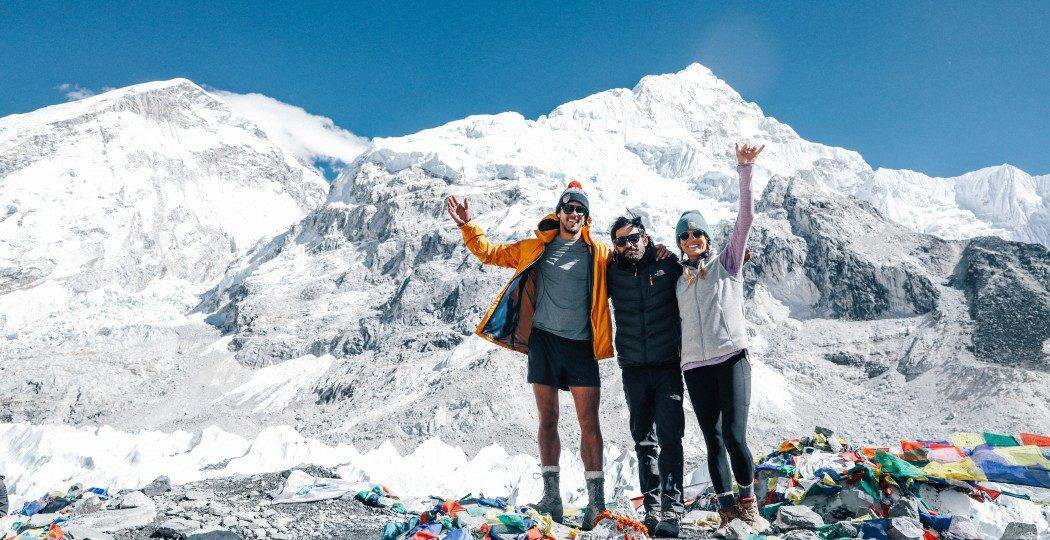
The Everest Base Camp trek costs USD 1,445 per person with our 14-day package, which covers Lukla flights, permits, guide, porter, teahouses, all meals on the trek and two hotel nights in Kathmandu. Trekking independently with a hired guide and porter usually comes to about USD 1,750 to 2,300. Once you add international flights, insurance, gear, tips and spending money, most trekkers budget USD 3,000 to 5,000 for the whole trip.
We have run Everest treks since 2009, and the questions we hear most are not about the package price. They are about everything around it: how much cash to carry, what a hot shower costs at Gorak Shep, how much to tip, and what happens to the budget if Lukla flights stop for two days. This guide answers all of it, in the order you will spend the money.
Everest Base Camp Trek Cost at a Glance (2027)
- Our 14-day package: USD 1,445 per person, fixed price
- 11-day trek with helicopter return: USD 2,695 per person
- Independent trek with guide and porter: about USD 1,750 to 2,300, excluding international flights
- Whole trip including international flights: about USD 3,000 to 5,000
- Spending money on the trail (package trekkers): about USD 10 to 25 a day
- Daily trail budget (independent trekkers): about USD 35 to 60 a day, more above Lobuche
- Tips for guide and porter: about USD 250 to 300 in total
- Keep in reserve: USD 300 to 500 for flight delays and surprises
Prices checked November 2026. Lukla airfares, permit fees and trail prices change, so check them again before you plan.

What Our 14-Day Package Includes, and What You Pay Yourself
Most of the cost of the trek is fixed in the package price. The table below shows exactly where the line sits, so you can see what is left for you to budget.
| Included in the USD 1,445 package | You pay yourself |
|---|---|
| Kathmandu to Lukla return flights | International flights to and from Nepal |
| Transfer to your Lukla flight, from Kathmandu or Ramechhap | Nepal visa (USD 50 for 30 days) |
| Sagarmatha National Park and Khumbu Pasang Lhamu permits | Travel insurance with helicopter evacuation cover |
| Licensed guide and porter, including their wages, food and insurance | Tips for your guide and porter |
| Teahouse accommodation on the trek | Hot showers, charging, Wi-Fi, snacks and extra drinks on the trail |
| Breakfast, lunch and dinner on the trek | Lunch and dinner in Kathmandu |
| 2 nights hotel in Kathmandu with breakfast | Extra hotel nights, for example if flights are delayed |
| Airport transfers in Kathmandu | Gear you buy, vaccinations and personal medicines |
| Duffel bag, plus sleeping bag and down jacket on loan if you ask in advance | Souvenirs and optional add-ons |
Travelling solo? A private room costs an extra USD 80 for the two Kathmandu hotel nights and USD 220 for the 11 teahouse nights on the trek, USD 300 in total.
See the full itinerary and departure dates on our 14-day Everest Base Camp trek page.
Costs Before You Leave Home
International flights to Kathmandu: about USD 700 to 1,500
Return economy flights from Europe and the Middle East are usually at the lower end. Flights from North America and Australia are usually higher, and peak trekking months (October, November, March and April) cost more than quieter months. Book early for autumn and spring.
Travel insurance: about USD 120 to 250
Insurance is the one cost you must not cut. Your policy needs to cover trekking up to at least 5,500 m, medical treatment and helicopter evacuation.
A helicopter evacuation from Gorak Shep or nearby costs about USD 4,500 to 5,000. Some insurers pay the helicopter company directly, but others ask you to pay first and claim the money back later. Ask your insurer which way they work before you go, and if they want you to pay first, make sure you can cover that amount on a credit card.
Price depends on your age, your country and the length of cover. A policy for about a month with high-altitude cover usually falls within this range.
Gear and clothing: about USD 150 to 500
Good boots you have already broken in, warm layers, a rain shell, gloves, a hat and trekking poles are the basics. If you already hike, you may only need a few items. Our package includes a duffel bag, and a sleeping bag and down jacket on loan if you ask in advance, which saves a large part of this cost.
You can also buy or rent gear in Thamel, Kathmandu. Rental is cheap, but check the quality, especially sleeping bags. Do not cut corners on boots. Our packing list for the Everest Base Camp trek covers what to bring.
Vaccinations, medicines and first aid: about USD 50 to 200
Visit a travel clinic a few weeks before you leave. Many trekkers pay for routine travel vaccines, a basic first aid kit and personal medicines. If your doctor prescribes acetazolamide (Diamox) for altitude, bring it from home. This cost depends heavily on your country and what your doctor recommends. For more on staying well at altitude, see our guide to preventing altitude sickness on the Everest Base Camp trek.
Training: optional
You do not need a gym membership, but regular hill walks with a loaded pack in the months before the trek make a real difference. Our guide to Everest Base Camp trek difficulty explains how fit you need to be.
Costs When You Arrive in Nepal
Nepal visa: USD 30, 50 or 125
Most nationalities can buy a tourist visa on arrival at Kathmandu airport, or apply online before travel:
- 15 days, multiple entry: USD 30
- 30 days, multiple entry: USD 50
- 90 days, multiple entry: USD 125
The 30-day visa is the right choice for the 14-day trek, because it leaves room for flight delays or a few extra days in Nepal. Indian citizens do not need a visa. Bring US dollars in cash for the fee. See our guide to the Nepal visa on arrival and the official Department of Immigration page.
Airport transfers: included
We meet you at Kathmandu airport and take you back for your flight home. We also take care of the transfer to your Lukla flight, whether it leaves from Kathmandu or from Ramechhap. In the busy spring and autumn seasons, many Lukla flights move to Ramechhap, an early drive of about 4 to 5 hours, and this is included.
Kathmandu hotels and meals
Two nights with breakfast are included. You pay for lunch and dinner in Kathmandu, usually about USD 15 to 35 a day depending on where you eat. If you arrive early, stay longer after the trek, or need extra nights because of flight delays, a mid-range hotel in Kathmandu is usually about USD 30 to 100 a night.
SIM card and mobile data: about USD 5 to 15
A Nepali SIM card with data is cheap and useful in Kathmandu and in the lower villages. You need your passport and a photo to buy one. Signal on the trail is patchy above Namche.
What the Trek Itself Costs: Package or Independent
If you trek independently, you pay each part of the trek separately. Here is how that compares with our package for the same 14-day trek.
| Trek cost | Independent (approx.) | Our package |
|---|---|---|
| Lukla return flights | USD 452 | Included |
| Permits (2 x NPR 3,000) | about USD 45 | Included |
| Guide (12 days at USD 35 to 40) | USD 420 to 480 | Included |
| Porter (12 days at USD 25 to 30) | USD 300 to 360 | Included |
| Teahouse rooms, meals, water and extras (12 days at USD 35 to 60) | USD 420 to 720 | Rooms and meals included; extras about USD 110 to 275 |
| Kathmandu hotel (2 nights) and transfers | USD 100 to 250 | Included |
| Total | about USD 1,740 to 2,310 | USD 1,445, plus about USD 110 to 275 in trail extras |
Mobile tip: Swipe left or right to view the full table.
Tips, international flights, insurance and gear are the same either way, so they are not in this table. The guide wage usually includes the guide’s own food, room and insurance. If you hire a guide in Kathmandu, you normally also pay their Lukla flights, so agree on this before you start.
Lukla flights: USD 452 return
The return flight to Lukla costs USD 452 per person (about USD 226 each way), whether it leaves from Kathmandu or Ramechhap. Fares are subject to change, so check the current price before you plan. Flights allow about 10 kg of checked baggage and 5 kg of hand luggage, and you can leave extra luggage at your Kathmandu hotel. For routes, delays and booking, see our Lukla flight guide.
Skipping the flight is possible by driving to Salleri or Surke and walking in, which saves money but adds several days. See our guide to the Everest Base Camp trek without a Lukla flight.
Permits: NPR 3,000 each
You need two permits for the Everest Base Camp trek, and both are included in our package:
- Sagarmatha National Park Entry Permit: NPR 3,000 per person
- Khumbu Pasang Lhamu Rural Municipality Permit: NPR 3,000 per person
The TIMS card is not required in the Everest region. Permit fees can change, so check the current rate before you plan.
Guide and porter: USD 35 to 40 and USD 25 to 30 a day
A licensed, experienced guide usually costs USD 35 to 40 a day, and a porter USD 25 to 30 a day for up to about 20 kg. A good guide does much more than show the way. They pace the group, find rooms when lodges are full or closed, and make the call when weather or health changes. Rules on mandatory guides have changed in recent years, so check the current rule for the Khumbu before you go. For more on hiring, see our guide to hiring a guide for the Everest Base Camp trek.

Daily Budget on the Everest Base Camp Trail
This is the money you spend each day between Lukla and Base Camp. Everything above Lukla is carried up by porters, yaks or small aircraft, so prices climb with the altitude. A meal that costs about USD 5 in Phakding costs more than twice that at Gorak Shep.
Typical trail prices by village
These are typical prices for a standard teahouse in the 2026 season, averaged from several published trail price reports. Prices are usually charged in Nepali rupees and rise a little every season, so expect slightly higher figures in 2027.
| Item | Lukla to Namche (2,610 to 3,440 m) | Tengboche to Dingboche (3,860 to 4,410 m) | Lobuche and Gorak Shep (4,940 to 5,164 m) |
|---|---|---|---|
| Dal bhat (with refills) | USD 5 to 8 | USD 7 to 10 | USD 10 to 12 |
| Room, if you eat at the lodge | USD 3 to 8 | USD 7 to 12 | USD 10 to 20 |
| Bottled water (1 litre) | USD 1 to 2 | USD 2 to 3 | USD 3 to 5 |
| Tea, coffee or hot lemon | USD 1 to 3 | USD 2 to 4 | USD 3 to 5 |
| Hot shower | USD 2 to 4 | USD 4 to 6 | USD 6 to 9, often not available |
| Charging, per device | Free to USD 2 | USD 2 to 4 | USD 3 to 5 |
| Wi-Fi | Often free in lodges, or USD 2 to 5 a day | Data cards, about USD 5 to 8 a day | Data cards, about USD 8 to 10 a day, slow |
Many lodges charge very little for the room, or nothing at all in the quieter months, as long as you eat dinner and breakfast there. A room without meals costs much more. Upgraded lodges with attached bathrooms exist mainly up to Namche, at a much higher price. For room types and facilities, see our Everest Base Camp accommodation guide, and for menus, our Everest Base Camp food guide.
How much to budget per day
If you trek with our package, your rooms and three meals a day are already paid. Budget about USD 10 to 25 a day for extras such as showers, charging, Wi-Fi, snacks and drinks, which is about USD 110 to 275 for the 11 nights on the trail.
If you trek independently, you pay for everything yourself:
- Budget style, USD 35 to 45 a day: dal bhat, boiled or treated water, few extras
- Standard style, USD 45 to 60 a day: a mix of meals, hot drinks, some showers and charging
- Comfort style, USD 60 to 80 a day: bottled drinks, daily Wi-Fi, showers, more snacks
Expect the lower end of your range in Phakding and Namche, and the upper end in Lobuche and Gorak Shep.
How much cash to carry
Teahouses and small shops on the trail take cash only, in Nepali rupees. Lukla and Namche have ATMs, but they often run out of cash or decline foreign cards, so withdraw what you need in Kathmandu. Smaller notes are easier to use.
- Package trekkers: about USD 500 to 800 in rupees covers trail extras, tips and a small reserve.
- Independent trekkers: your daily spend for 12 days (about USD 420 to 720), plus tips, plus a reserve. Guide and porter wages are on top if you pay them in cash.
Save on water without risking your health
Bottled water is one of the biggest daily costs, and it adds plastic waste to the Khumbu. Refill a bottle with boiled water from the lodge, or treat tap water with purification tablets, drops, a filter or a UV pen. Never drink untreated stream water. This can save USD 50 to 80 over the trek.

Costs After the Trek
Tipping your guide and porter: about USD 250 to 300
Tips are not part of the package price, but they are expected. For many guides and porters, tips are a regular part of their income, not a bonus. Plan around USD 250 to 300 in total for your guide and porter on the 14-day trek, given at the end of the trek. For how to split it and hand it over, see our guide to tipping on the Everest Base Camp trek.
Souvenirs: your choice
Thamel in Kathmandu is the easiest place to shop: prayer flags, singing bowls, pashmina, tea, thangka paintings and trekking T-shirts. Namche has shops too, but prices are higher and anything you buy has to be carried down. Many trekkers set aside about USD 50 to 200.
Optional add-ons
- Helicopter return instead of walking down: our 11-day Everest Base Camp trek with helicopter return costs USD 2,695 per person.
- A day of sightseeing in Kathmandu: heritage sites charge entry fees, and a guided tour costs extra.
- A few days in Pokhara or Chitwan: popular after the trek. Ask us for a price.
Your Contingency Fund
Keep USD 300 to 500 in reserve on top of your planned budget. Lukla flights depend on the weather, and a delay of one or two days means extra nights and meals in Lukla or Kathmandu, and sometimes a changed international flight. A two-day delay can easily add USD 150 to 300.
The other reason for a reserve is insurance. If your insurer asks you to pay for a helicopter evacuation first, that is USD 4,500 to 5,000 on your card, so know your card limit before you go. See our Lukla flight guide for how delays work and how we plan around them.
Total Budget for an Everest Base Camp Trip
Here is a realistic total for one person joining our 14-day package, from leaving home to getting back. The middle column is what most of our trekkers spend.
| Expense | Lower | Typical | Higher |
|---|---|---|---|
| 14-day trek package | 1,445 | 1,445 | 1,445 |
| International flights | 700 | 1,100 | 1,500 |
| Nepal visa (30 days) | 50 | 50 | 50 |
| Travel insurance | 120 | 180 | 250 |
| Gear and clothing | 150 | 300 | 500 |
| Vaccinations and medicines | 50 | 100 | 200 |
| Kathmandu lunches and dinners | 60 | 100 | 140 |
| Two spare hotel nights in Kathmandu | 60 | 120 | 200 |
| SIM card and data | 5 | 10 | 15 |
| Trail extras (11 days) | 110 | 190 | 275 |
| Tips for guide and porter | 250 | 275 | 300 |
| Souvenirs | 0 | 100 | 200 |
| Total (USD) | 3,000 | 3,970 | 5,075 |
Add USD 300 if you want a private room as a solo traveller, and keep the USD 300 to 500 contingency fund on top. International flights, insurance, gear and medicines are typical market ranges and depend on where you live. Everything else comes from our package price and current prices in Nepal.
What Makes the Cost Go Up or Down
- Season: spring (March to May) and autumn (late September to November) are the busiest months, with the highest demand for flights and rooms. Winter (December to February) is quieter and lodges sometimes charge less, but it is cold. The monsoon (June to August) is quiet too, but brings more flight delays. See the best time to trek Everest Base Camp.
- Itinerary length: every extra day adds food, lodging and staff costs. Never save money by cutting acclimatization days.
- Transport: flying to Lukla is faster but costs more than driving to Salleri or Surke and walking in.
- Support level: guide only, guide and porter, or a full package.
- Comfort: standard teahouses or upgraded lodges in the lower villages.
- Helicopter return: saves days but adds significantly to the cost.
- Delays: extra nights in Lukla or Kathmandu.
Ways to Save Money Without Cutting Safety
- Treat your own water instead of buying bottles.
- Eat dal bhat. It is filling, comes with free refills and is the best value on every menu.
- Bring a power bank and charge it in Kathmandu or Namche, where charging is cheap or free.
- Rent a sleeping bag and down jacket instead of buying, or ask us to lend you one.
- Bring snacks, tissues and basic medicines from Kathmandu or home. They cost more on the trail.
- Skip alcohol at altitude. It is expensive and does not help your body adjust.
- Trek in a quieter season if your dates are flexible.
The one thing we never recommend cutting is insurance. A helicopter evacuation without cover costs more than the whole trek.
Everest Base Camp Trek Cost FAQs
How much does the Everest Base Camp trek cost in 2027?
Our 14-day package costs USD 1,445 per person. Trekking independently with a guide and porter costs about USD 1,750 to 2,300. Including international flights, insurance, gear, tips and spending money, most trekkers spend USD 3,000 to 5,000 on the whole trip.
What is included in the USD 1,445 package?
Lukla return flights, transfers to your Lukla flight from Kathmandu or Ramechhap, both permits, a licensed guide and porter with their wages, food and insurance, teahouse rooms, three meals a day on the trek, two hotel nights in Kathmandu with breakfast, airport transfers, and a duffel bag. A sleeping bag and down jacket can be loaned if you ask in advance.
Is it cheaper to trek Everest Base Camp independently?
Usually not, if you hire a guide and porter. Paying for flights, permits, staff, rooms, food and a Kathmandu hotel separately comes to about USD 1,750 to 2,300, compared with USD 1,445 plus about USD 110 to 275 in trail extras for our package.
How much should I budget per day on the Everest Base Camp trail?
With our package, about USD 10 to 25 a day for extras such as showers, charging, Wi-Fi and snacks. Independent trekkers should budget about USD 35 to 60 a day for rooms, meals, water and extras, rising toward USD 80 a day in comfort style and at Lobuche and Gorak Shep.
How much cash should I carry on the Everest Base Camp trek?
Package trekkers usually carry about USD 500 to 800 in Nepali rupees for trail extras, tips and a small reserve. Teahouses take cash only, and the ATMs in Lukla and Namche are unreliable, so withdraw what you need in Kathmandu.
How much does the Lukla flight cost?
The return flight costs USD 452 per person, from Kathmandu or Ramechhap. It is included in our package. Fares are subject to change, so check the current price before you plan.
How much are the Everest Base Camp permits?
The Sagarmatha National Park permit and the Khumbu Pasang Lhamu Rural Municipality permit cost NPR 3,000 each per person. Both are included in our package. The TIMS card is not required in the Everest region.
How much should I tip my guide and porter?
Plan about USD 250 to 300 in total for your guide and porter on a 14-day trek, given at the end of the trek. Tips are not included in the package price.
Does my travel insurance need to cover helicopter evacuation?
Yes. A helicopter evacuation from Gorak Shep or nearby costs about USD 4,500 to 5,000. Some insurers ask you to pay first and claim later, so check how your insurer works and make sure you can cover that amount if needed.
How much is the single supplement?
A private room costs USD 300 extra: USD 80 for the two Kathmandu hotel nights and USD 220 for the 11 teahouse nights on the trek.
Final Budget Notes
The Everest Base Camp trek cost comes down to four things: how you get to Lukla, how much support you want, how comfortable you want to be on the trail, and how much room you leave for delays. Our package fixes most of it in one price, so the only numbers left to plan are your flights, insurance, gear, tips and spending money.
If you would like a cost estimate for your own dates, group size or route, contact us with your plans.
Want more information? Send us your query, and our experts will get back to you within 24 hrs.

Madhav Prasad is a seasoned trekking and tourism expert with over two decades of experience in the field. Starting his career in 2001 as a porter, Madhav quickly advanced to the role of trekking guide, gaining invaluable hands-on experience in Nepal’s diverse trekking routes. In 2009, after eight years of dedication to the industry, he co-founded Mosaic Adventure, a leading trekking and tour company known for its commitment to safety, sustainability and personalized service.
Madhav has personally trekked to nearly every major trekking destination in Nepal, including Everest Base Camp, Annapurna Base Camp, the Annapurna Circuit, Poon Hill, Jomsom Muktinath, the Indigenous Peoples Trail, Langtang Valley and Mardi Himal, among others. His experience extends beyond Nepal, as he has also successfully summited Mount Kilimanjaro, Africa’s highest peak.
In addition to his extensive trekking credentials, Madhav is well traveled globally, having explored countries such as Australia, the USA, the UK, France, Japan, China, and many others. His global exposure enhances his ability to understand and cater to the diverse needs of international trekkers.
Madhav is the primary point of contact for many clients at Mosaic Adventure, personally addressing inquiries and helping plan treks with a meticulous and personalized approach. His deep knowledge of Nepal’s trekking routes, combined with his global travel experience, ensures that every trek is well planned, safe and unforgettable.
