
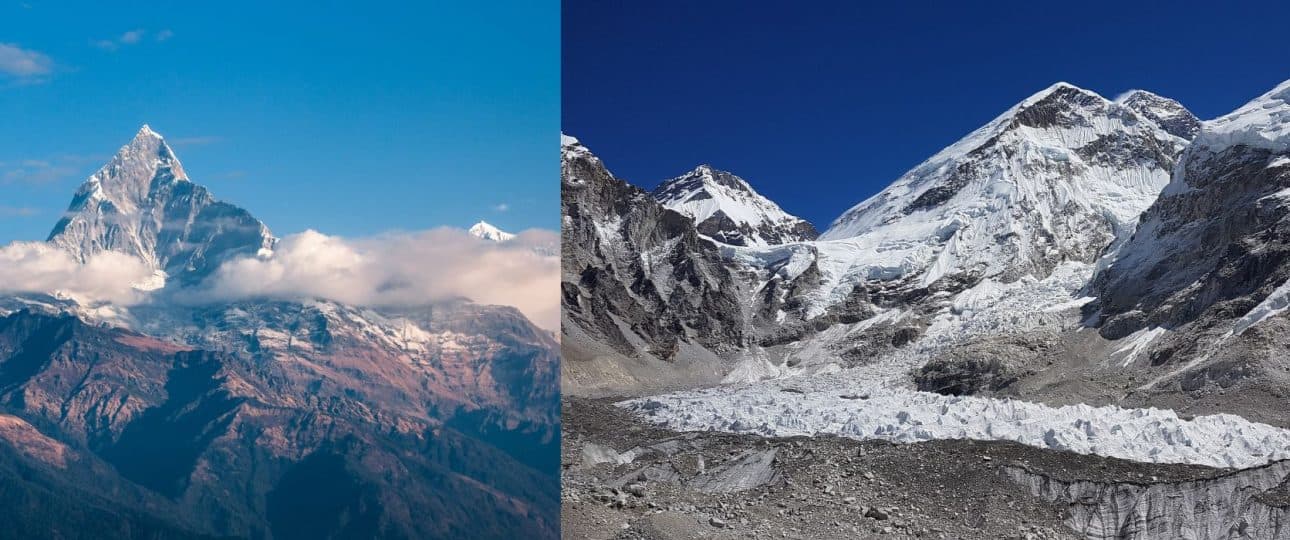
Both the Manaslu Circuit Trek and the Everest Base Camp Trek are worth doing. The problem is they are not interchangeable, and picking the wrong one for your fitness, timeline, or expectations is a real risk.
We guide both routes every season. What follows is based on what we actually see on the trail, not what sounds good in a brochure.
Last updated: November 2026. Prices, altitudes and itinerary details below come from our own Manaslu Circuit and Everest Base Camp treks.
Manaslu vs Everest Base Camp at a Glance
- Highest point: Manaslu, Larkya La Pass 5,106 m / 16,752 ft. EBC, Kalapatthar 5,545 m / 18,192 ft.
- Highest night: Manaslu, Larkya Phedi 4,460 m / 14,633 ft. EBC, Gorak Shep 5,164 m / 16,942 ft.
- Nights above 4,000 m on our itineraries: Manaslu 1. EBC 5.
- Length of our trips: Manaslu Circuit 11 days. Everest Base Camp 14 days.
- Our price: Manaslu Circuit from USD 1,180. Everest Base Camp from USD 1,445, including Lukla flights.
- Getting there: Manaslu, an 8 to 10 hour drive from Kathmandu. EBC, a flight to Lukla (from Ramechhap in busy seasons).
- Crowds: 17,710 foreign trekkers visited the Manaslu region in all of 2025. The Everest region saw 608 foreign visitors arrive in a single day in April 2025.
- Guide: mandatory on Manaslu. Not mandatory in the Everest region under the local rule, but recommended.
- Choose Manaslu for quiet trails, a full circuit and traditional villages. Choose EBC for Everest itself, better lodges and easier logistics.
About the author: This comparison is written by Madhav Prasad, Co-Founder at Mosaic Adventure, who has guided treks in Nepal since 2001 and co-founded Mosaic Adventure in 2009.
Quick comparison: The Manaslu Circuit Trek is generally harder than the Everest Base Camp Trek because it is more remote, has longer walking days, and includes a high pass crossing at Larkya La (5,106m). Everest Base Camp is still challenging due to altitude and cold, but it offers better facilities, easier logistics, and more comfortable teahouses. The best trek depends on whether you value solitude and raw culture (Manaslu) or iconic views and comfort (EBC).
The simplest way to frame it: Manaslu is wilder and cheaper but harder to organize. EBC is more famous, more comfortable, and busier. Neither is better outright.
- Choose Manaslu if you want fewer crowds, a more remote trail, and a raw trekking feel.
- Choose EBC if Everest is your dream, and you want better lodges, more food choices, and easier logistics.
Here is the short version before we go into detail on each factor:
| Topic | Manaslu Circuit | Everest Base Camp |
|---|---|---|
| Harder trek? | Usually harder (remote, long days, high pass) | Hard too (altitude, cold) but easier support |
| Crowds | Fewer | More |
| Facilities | Basic | More options |
| Best for | Quiet trails, culture, wilderness feel | Everest dream, comfort, famous views |

Manaslu vs Everest: Which One Should You Choose?
Most people research these two treks and still end up deciding based on which name they recognise. That is not a great way to choose. Here is what actually separates them.
Cost and Logistics
Both trips cost a similar amount at first glance. The difference is in where the money goes.
- Manaslu Circuit: usually slightly cheaper overall, but it requires restricted-area permits and a licensed guide. The route is remote, so logistics are normally arranged through a trekking agency.
- Everest Base Camp: tends to cost more mainly because of flights to Lukla, which can vary depending on season and demand. Food and accommodation prices also increase as you go higher on the trail.
In simple terms, Manaslu costs less but requires more planning, while Everest is easier to organize but can cost more.
For comparison, our current group prices are USD 1,180 for the 11-day Manaslu Circuit Trek and USD 1,445 for the 14-day Everest Base Camp Trek, which includes return Lukla flights. Most of the difference is the Lukla flights and the three extra days on the Everest trip.
See the full cost breakdown:
Permits: How Complex Is Each Trek to Organize?
Permits are not just a formality, on Manaslu, they shape the entire logistics of the trek. Here is the practical difference:
| Permit Type | Manaslu Circuit Trek | Everest Base Camp Trek |
|---|---|---|
| Restricted Area Permit | Required, must be arranged through a registered agency | Not required |
| National Park / Conservation Permit | Manaslu Conservation Area Permit (MCAP) and Annapurna Conservation Area Permit (ACAP), because the circuit ends in the Annapurna region | Sagarmatha National Park Entry Permit and Khumbu Pasang Lhamu Rural Municipality permit |
| TIMS Card | Arranged by your agency with the other permits if required | Not required. The local Khumbu municipality permit is used instead |
| Can you trek independently? | No. A licensed guide is mandatory | Allowed in practice. The local municipality says a guide is not mandatory, but national rules have changed before, so check before you go |
| Permit complexity | Higher, multiple permits, agency involvement required | Lower, straightforward to arrange on arrival |
The restricted area permit is a large part of why Manaslu stays quiet. It is not just geography keeping people away, it is the paperwork. Whether that is a selling point or an inconvenience depends on the kind of trekker you are.
Permit fees: the Manaslu restricted area permit costs USD 100 per person for the first week from September to November, then USD 15 per extra day. From December to August it is USD 75 for the first week, then USD 10 per extra day (Follow Alice, 2026). Rules and fees in Nepal change often, so we confirm them for every booking. For full details, see our Manaslu trek permit guide and Nepal restricted area permit fees.
Location and Getting There
The Manaslu Circuit is in west-central Nepal, in Gorkha district, between the Ganesh Himal and the Annapurna range. To get there, you drive from Kathmandu to Machha Khola or Jagat, which takes about 8 to 10 hours depending on road conditions. At the end, you drive back from Dharapani to Kathmandu via Besisahar. Most agencies include the drive as part of the trek package. There are no flights involved, so there are no flight delays before you start walking, although landslides can slow the road in the monsoon.
The Everest Base Camp Trek is in the eastern part of Nepal and is among the most trekked trails in the country. Most trekkers fly from Kathmandu to Lukla on a short mountain flight of roughly 35 minutes. In the busy spring and autumn seasons, most Lukla flights leave from Ramechhap instead, a 4 to 5 hour drive from Kathmandu. See our Lukla flight guide. It is a convenient start, but Lukla flights get delayed or cancelled regularly due to weather, and that can ripple through your entire itinerary. Some trekkers avoid the uncertainty by trekking to EBC without the Lukla flight, though that adds several days to the route.
Trek Overview: How the Two Routes Compare at a Glance
The duration is similar. The daily experience is not. A quick look at the structure of each route:
| Factor | Manaslu Circuit Trek | Everest Base Camp Trek |
|---|---|---|
| Typical duration | 11 to 14 days (our trip: 11 days) | 12 to 16 days (our trip: 14 days) |
| Start and end point | Jagat or Machha Khola to Dharapani, both reached by road (circuit) | Lukla to Lukla (out and back) |
| Highest point | Larkya La Pass: 5,106 m / 16,752 ft | Kalapatthar: 5,545 m / 18,192 ft |
| Highest place you sleep | Larkya Phedi: 4,460 m / 14,633 ft | Gorak Shep: 5,164 m / 16,942 ft |
| Nights above 4,000 m (our itineraries) | 1 | 5 |
| Daily walking hours | 6 to 8 hours on most days | 5 to 7 hours on most days |
| Trek shape | Loop, you do not retrace your steps | Out and back, same trail both ways |
| Acclimatization days | 1 to 2 built into most itineraries | 2 to 3 built into most itineraries |
| Key highlights on route | Samagaon, Samdo, Larkya La, Birendra Tal | Namche Bazaar, Tengboche, Lobuche, Gorak Shep |
Want the full day-by-day breakdown?
Crowds and Trail Conditions:
Manaslu is much quieter, and not just because it is remote. The permit system and mandatory guide requirement mean the route self-selects for a certain kind of trekker. You cannot just show up and go.
On EBC in October, you will eat dinner with 30 or 40 strangers most nights. On Manaslu, four or five fellow trekkers at a lodge is a busy evening. I have spoken to people who chose Manaslu purely for this reason, and none of them regretted it.
The official numbers show the gap clearly. The Manaslu region received 17,710 foreign trekkers in all of 2025, according to Department of Immigration data (The Rising Nepal). The Everest region recorded 608 foreign visitors in a single day in April 2025, and more than 12,000 visitors in the month from mid-March to mid-April 2025 (The Himalayan Times). Manaslu is getting busier every year, but it is still a fraction of Everest.
Accommodation: What to Actually Expect Each Night
Accommodation is where the two treks feel most different day to day. After seven hours of walking, where you sleep matters more than people expect.
On the Manaslu Circuit, teahouses at lower villages like Jagat and Philim are simple but manageable. As you gain altitude toward Samagaon and Samdo, rooms get colder, walls get thinner, and menus get shorter. Hot showers are not guaranteed. Charging your phone often means paying extra and hoping the generator is running. That said, the teahouses feel genuinely local, family-run, quiet, and nothing like a tourist lodge.
On the Everest Base Camp trail, teahouses in Namche Bazaar are a different world, some have heated dining rooms, reliable Wi-Fi, and menus with pasta, pizza, and apple pie. Higher up at Dingboche and Lobuche things strip back considerably, but you are still in a far more developed system than anything on the Manaslu trail. Most lodges have attached bathrooms at lower elevations and communal hot showers further up.
| Accommodation Factor | Manaslu Circuit | Everest Base Camp |
|---|---|---|
| Room quality | Basic, twin beds, thin walls, shared bathrooms | Varies, basic to reasonably comfortable |
| Hot shower availability | Limited, often extra cost, not always reliable | More widely available, especially lower on trail |
| Heating in dining rooms | Wood stove at some lodges, not guaranteed | More consistent, especially in Namche and Tengboche |
| Phone and device charging | Available but often pay-per-charge | More widely available, solar-powered at higher points |
| Food menu variety | Dal bhat, noodles, basic items, limited higher up | Wider variety throughout, including Western options |
If you have spent nights in basic teahouses before, Manaslu is manageable. If this is your first time at altitude and you are already anxious about the physical side of things, the EBC infrastructure removes one layer of stress. That is worth something.
Which trek feels harder?
Manaslu is harder for most people. The days are longer, the lodges offer less recovery, and the Larkya La crossing demands a full day of effort at over 5,000m. It accumulates.
The hardest single day is the Larkya La crossing. On our itinerary, you climb about 650 m from Larkya Phedi (4,460 m) to the pass (5,106 m), then descend about 1,500 m to Bimthang (3,610 m). Most groups leave before dawn and walk 8 to 10 hours. EBC has no day quite like it. Its challenge is spending five nights above 4,000 m, including one at Gorak Shep (5,164 m).
EBC is not easy, but the difficulty is more contained. Altitude and cold are the main issues, not the length of the days or the quality of where you sleep. Most trekkers find it more manageable than they expected.
Want the detailed difficulty breakdown?
Altitude and Safety: How the Risk Profile Differs
Both routes cross above 5,000m. Altitude sickness is a genuine risk on either one, but the two treks handle that risk very differently.
On EBC, the altitude gain is gradual and the itinerary is built around it. Acclimatisation days at Namche and Dingboche are standard. If something goes wrong, helicopter evacuation from the Khumbu is well practised and usually straightforward to arrange.
On Manaslu, the route stays low for a while and then climbs sharply toward the pass. That compression makes acclimatization trickier to manage. More importantly, if someone needs to get out near Larkya La, you are far from help. Evacuation takes longer and requires more coordination. The mandatory guide is not just a bureaucratic requirement here, having someone experienced watching your group’s pace and condition is genuinely useful in that terrain.
One practical difference helps Manaslu here: on our itinerary you sleep above 4,000 m for only one night, at Larkya Phedi, before crossing the pass and descending. On EBC, you spend five nights above 4,000 m. Read more about preventing altitude sickness.
| Safety Factor | Manaslu Circuit | Everest Base Camp |
|---|---|---|
| Maximum altitude | 5,106m (Larkya La Pass) | 5,545m (Kalapatthar) |
| Altitude gain pace | Gradual then sharp near the pass | Gradual with structured acclimatization stops |
| Evacuation accessibility | More remote, evacuation requires more planning | More accessible, helicopter evacuations common |
| Medical facilities on trail | Very limited, with no dedicated high-altitude clinic on the route | Himalayan Rescue Association aid post in Pheriche (staffed in spring and autumn) and clinics around Namche |
| Guide requirement | Mandatory, and practically important | Optional, though recommended |
Get helicopter evacuation cover before either trek. On Manaslu, it is not optional in any practical sense given how remote the upper section is.
It is also worth knowing your exit options before you leave Kathmandu. A bad day at altitude feels different when you know what your options are.
On EBC, the route back is the same trail you came in on. If someone in your group needs to descend quickly, you retrace to Lukla and fly out. There are exit points at most major stops, Namche, Dingboche, Lobuche, and the trail is well-travelled enough that help is rarely far away.
On Manaslu, the situation past Samagaon gets more complicated. Once you are approaching Larkya La, turning back means a long walk out on a remote trail with limited infrastructure. It is not impossible, but it requires more planning and coordination through your guide and agency. This is one more reason the mandatory guide requirement on Manaslu is a practical asset rather than just a bureaucratic hurdle.
Manaslu vs Everest views: what will you actually see?
Manaslu’s scenery builds gradually. Lower sections have forests, rivers and terraced villages. Higher up around Samagaon and the pass, you get open ridgelines with views of Manaslu, Himalchuli and Ganesh Himal. It never has one defining viewpoint, the route is the experience.
On EBC, the peaks are bigger and more famous, Everest, Amadablam, and Nuptse dominate the skyline. The trail also passes through Tengboche Monastery and the UNESCO-listed Sagarmatha National Park.
Standing on Kalapatthar with Everest in front of you is genuinely hard to describe. That single moment is what most EBC trekkers remember years later. Manaslu does not have an equivalent moment, but the scenery across the whole route is more varied and, in my opinion, less predictable in the best way.
For photography the two routes suit different instincts. EBC is where you get the iconic frame, Everest above the icefall, prayer flags against the ridge. Manaslu is better for quieter work, monasteries with no queue outside them, villages that are not used to cameras. Neither is wrong, they just require different intentions.
Cultural Experience
Manaslu passes through communities of Gurung and Tibetan origin. The Everest region is Sherpa country. Both have real cultural depth, but they have had very different relationships with outside visitors.
On Manaslu, villages like Samagaon and Samdo still function largely as they have for generations. The monasteries along the route see a fraction of the visitors that Tengboche does. You are passing through communities where trekking tourism is not yet the dominant economic force, and that shows in how people interact with you on the trail. On EBC, the Sherpa culture is genuinely fascinating but it has also been shaped by decades of high-volume trekking and climbing expeditions. The cultural experience is still real, just less raw.
If culture is the main reason you are going to Nepal rather than, say, the altitude or the challenge, Manaslu is the more honest choice.

Which Trek Is Actually Right for You?
Difficulty and cost are easy to compare. What is harder to articulate is whether a trek will suit you as a person. Here is how I tend to think about it when someone asks me directly:
You should probably choose Manaslu if:
- You have done a multi-day trek before and want something that feels less packaged
- Solitude matters more to you than comfort, you genuinely enjoy quiet trails and basic teahouses
- You have 11 to 14 days available and are not rushing
- You want to see Himalayan culture that has not been shaped much by trekking tourism
- You have already done Everest Base Camp and want a contrast
- You are traveling solo and prefer a guide-led, structured experience without the social noise of a busy trail
You should probably choose Everest Base Camp if:
- This is your first big Himalayan trek, the infrastructure on EBC genuinely makes a difference when you are managing altitude for the first time
- Standing at the foot of Everest is the actual goal, not just a Himalayan trek in general
- You are traveling with someone less experienced or older, and trail support matters
- You have around 12 to 14 days and want a well-defined, well-marked route
- You want the option of hot showers, charging points, and a wider food menu at the end of hard days
- You are the kind of person who draws energy from other trekkers on the trail
If you are still undecided:
Most people who ask me this question end up on EBC for their first Nepal trek. Not because it is better, but because the goal is concrete. You know what you are walking toward, and the route does not ask much of you logistically. Manaslu suits people who are comfortable with a bit of uncertainty, basic nights, and longer days. If reading that makes you lean toward Manaslu rather than away from it, that is probably your answer.
If I am being direct: for a fit trekker who wants something real rather than something famous, I recommend Manaslu. I have done both. The Everest trail is extraordinary but it has also been walked by hundreds of thousands of people. Manaslu still feels like it belongs to whoever is on it that day.
Weather by Season: Manaslu Circuit Trek vs Everest Base Camp Trek
EBC runs colder overall, particularly at the higher elevations. Use this as a general guide rather than a precise forecast, conditions at altitude vary considerably year to year.
| Season | Manaslu Circuit | Everest Base Camp |
|---|---|---|
| Autumn (late September to November) | Best season. Clear skies, and Larkya La is usually open. Nights at Samdo and Larkya Phedi drop below freezing. | Best season and the busiest. Nights at Gorak Shep are around -10°C or colder. |
| Winter (December to February) | Larkya La is often blocked by snow, and some lodges above Samagaon close. Not recommended for most trekkers. | Possible on the Classic route. Very cold, with nights around -25°C at Gorak Shep in January. See EBC in January. |
| Spring (March to May) | Good season. Rhododendrons in the lower valley; the pass can still hold snow in early March. | Good season, busy from late March as expeditions arrive. See EBC in March. |
| Monsoon (June to August) | Heavy rain, landslides and leeches on the lower trail, and road delays. | Frequent cloud and Lukla flight cancellations. |
Notes:
- Manaslu: The range within a single day can be dramatic. Mornings near Larkya La in October feel nothing like afternoons in the lower valleys.
- EBC: Colder than Manaslu at night, because you sleep higher. Gorak Shep in particular gets bitterly cold at night even in October.
Best time to trek: do both routes share the same seasons?
Broadly yes, but with some differences worth knowing if your travel dates are fixed.
Both treks are at their best in October and November, stable weather, clear skies, and good visibility on the high passes and viewpoints. Spring, particularly March to May, is the second best window for both. March can still be cold at altitude but the trails are quieter. April and May bring warmer conditions and rhododendrons in bloom lower down.
Where the two treks differ is in how they handle the edges of those windows. The upper Manaslu valley, around Samdo, is drier than the lower valley, but the lower Budhi Gandaki valley gets heavy monsoon rain and landslides. Neither trek is a good choice from June to August. In late September, both can work if your plans are flexible.
Both routes are doable in winter for experienced trekkers, but Larkya La on Manaslu is a serious undertaking in December and January, snow on the pass can make it genuinely difficult. EBC in winter is cold but more predictable since the Khumbu is drier. If you are set on a winter trek, EBC is the safer choice.
Full seasonal guides:
Can You Do Both Treks in One Trip?
We get asked this fairly often. The answer is almost always no, not in a single trip.
Manaslu takes 11 to 14 days. EBC takes 12 to 16. Put them back to back and you are looking at close to a month at altitude, before you factor in travel between the two regions. Most people do not have the time, and those who do usually find their bodies need a longer break in between.
What works better for some trekkers is pairing Manaslu with the Annapurna Circuit, since the trails connect at Dharapani. That combination makes geographic sense and is genuinely achievable for fit trekkers with 3 to 4 weeks. We have a dedicated page on the Manaslu, Nar Phu and Annapurna 3 Passes Trek if that is of interest.
If you want more time in the Manaslu region instead, you can add the quiet Tsum Valley to the circuit. See our Manaslu and Tsum Valley Trek.
For most people though, the practical approach is one trip, one trek, come back for the other. Quite a few of our returning trekkers have done exactly that.
Manaslu vs Everest Base Camp: FAQs
Is Manaslu harder than Everest Base Camp?
For most people, yes. Manaslu has longer walking days, simpler lodges and the Larkya La crossing, an 8 to 10 hour day over a 5,106 m pass. EBC goes higher, to 5,545 m at Kalapatthar, but its days are shorter and its lodges are better.
Which trek has the higher altitude?
Everest Base Camp. You reach 5,545 m at Kalapatthar and sleep at 5,164 m in Gorak Shep. On Manaslu, the highest point is Larkya La at 5,106 m, and the highest night on our itinerary is Larkya Phedi at 4,460 m.
Is altitude sickness more likely on Manaslu or EBC?
EBC keeps you higher for longer, with five nights above 4,000 m on our itinerary, compared with one on Manaslu. Manaslu’s risk is the big pass day and its remoteness, which makes evacuation slower. Both need proper acclimatization.
Which trek is cheaper?
Manaslu, usually. Our Manaslu Circuit Trek is USD 1,180 for 11 days, and our Everest Base Camp Trek is USD 1,445 for 14 days, including Lukla flights. See the Manaslu cost guide and EBC cost guide.
Do I need a guide for both treks?
On Manaslu, yes. It is a restricted area, so a licensed guide and an agency are required. In the Everest region, the local municipality says a guide is not mandatory, but we recommend one, especially for a first trek at altitude.
Can I trek Manaslu solo?
Since 23 March 2026, solo trekkers can get the Manaslu restricted area permit, as long as they trek with a licensed guide. Before that, at least two trekkers were needed.
Which trek is less crowded?
Manaslu, by far. The Manaslu region had 17,710 foreign trekkers in all of 2025, while the Everest region saw 608 foreign visitors arrive in a single day in April 2025.
Which is better for a first trek in Nepal?
Everest Base Camp, for most people. The lodges, food and evacuation options take a lot of stress out of a first trek at altitude. Manaslu suits trekkers who have done a multi-day trek before.
Which has better views?
EBC has the famous close-up of Everest from Kalapatthar. Manaslu has more varied scenery along the whole circuit, from river gorges to the Manaslu massif and the Larkya La pass.
Is there internet and phone signal on both treks?
On EBC, most villages have Wi-Fi for a fee and mobile signal in many places. On Manaslu, signal is patchy and Wi-Fi is limited, especially above Samagaon, so plan to be offline for a few days.
So, Which Trek Should You Choose?
By this point you probably have a sense of which direction you are leaning. Trust that.
EBC is the right first trek for most people. The route is clear, the infrastructure handles a lot of the difficulty, and standing near the base of Everest is worth the journey. It is commercial in places, but that commercialism also means it is well set up for people doing this for the first time.
Manaslu asks more of you and gives you something harder to explain when you get home. The trail is quieter, the culture is less performed, and the pass crossing is a proper challenge. If that sounds like the kind of trip you want, it probably is.
We run both routes every season. If you are still working it out, get in touch. A short conversation usually settles it.
Ready to plan? Visit our Manaslu Circuit Trek and Everest Base Camp Trek pages to see full itineraries, costs, and departure dates.
Want more information? Send us your query, and our experts will get back to you within 24 hrs.

Madhav Prasad is a seasoned trekking and tourism expert with over two decades of experience in the field. Starting his career in 2001 as a porter, Madhav quickly advanced to the role of trekking guide, gaining invaluable hands-on experience in Nepal’s diverse trekking routes. In 2009, after eight years of dedication to the industry, he co-founded Mosaic Adventure, a leading trekking and tour company known for its commitment to safety, sustainability and personalized service.
Madhav has personally trekked to nearly every major trekking destination in Nepal, including Everest Base Camp, Annapurna Base Camp, the Annapurna Circuit, Poon Hill, Jomsom Muktinath, the Indigenous Peoples Trail, Langtang Valley and Mardi Himal, among others. His experience extends beyond Nepal, as he has also successfully summited Mount Kilimanjaro, Africa’s highest peak.
In addition to his extensive trekking credentials, Madhav is well traveled globally, having explored countries such as Australia, the USA, the UK, France, Japan, China, and many others. His global exposure enhances his ability to understand and cater to the diverse needs of international trekkers.
Madhav is the primary point of contact for many clients at Mosaic Adventure, personally addressing inquiries and helping plan treks with a meticulous and personalized approach. His deep knowledge of Nepal’s trekking routes, combined with his global travel experience, ensures that every trek is well planned, safe and unforgettable.
